
"I'd rather come home with a sore shoulder from having to move all that data around than with Diabetes [from sitting too much]"

Decision Intelligence News
35.3K views |
+0 today
Filter by date
Tags

|
Decision Intelligence News
Decision Intelligence (DI) is the discipline concerned with how organizations and individuals design, support, and improve decision making at scale. It connects actions to outcomes in context by integrating human judgment, data, models, text, and AI into coherent decision systems. Decision Intelligence News curates developments across DI and related fields, including AI, machine learning, governance, enterprise architecture, orchestration, measurement, and decision modeling. Learn more at www.opendi.org and www.learn-di.com. Curated by Decision Intelligence |
 Your new post is loading...


|
Scooped by
Decision Intelligence
August 14, 2015 9:35 PM
|
 Scoop.it!

'The decision is only as good as the data that supports it'. It was bound to be said"
Decision Intelligence's insight:
Why data matters less than you think. Me on one of my soapboxes :-)
|
|
Scooped by
Decision Intelligence
August 14, 2015 5:26 PM
|
Scoop.it!

As soon as the situation becomes dynamic, when something unexpected happens and basic assumptions change, the machine-only approach fails mightily
Decision Intelligence's insight:
What a terrific argument for the importance of human-in-the-loop machine learning! Great job Forbes, Dan, and Arnab!
|
|
Scooped by
Decision Intelligence
August 10, 2015 3:34 AM
|
Scoop.it!
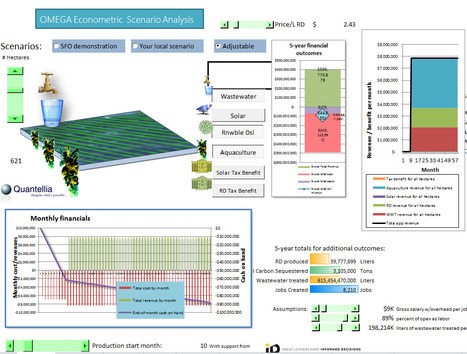
Since thinking so much about levers in the last two posts, I've also been pondering the variety of levers I've built and seen, and the different purposes they serve in a decision model. In particular, given that our goal is for models to be as easy to understand as possible to facilitate collaborative team…
Decision Intelligence's insight:
Enjoy this tour of decision lever animations.
|
|
Scooped by
Decision Intelligence
August 10, 2015 1:31 AM
|
Scoop.it!

"Physical gestures ...constitute a kind of back-channel way of expressing and even working out our thoughts. Research demonstrates that the movements we make with our hands when we talk constitute a kind of second language, adding information that’s absent from our words."
Decision Intelligence's insight:
This is why decision models live in visual, motor, even 3D navigation space: to get at all of the smart brains within us.

Kashif Zia's curator insight,
August 10, 2015 5:09 AM
This is why decision models live in visual, motor, even 3D navigation space: to get at all of the smart brains within us.
|
|
Scooped by
Decision Intelligence
August 9, 2015 8:19 PM
|
Scoop.it!

Now Bayesian statistics are rippling through everything from physics to cancer research, ecology to psychology. Enthusiasts say they are allowing scientists to solve problems that would have been considered impossible just 20 years ago.
Decision Intelligence's insight:
Bayesian statistics are increasingly important, and this article is an accessible introduction. The basic idea: calculate statistics as conditional on something else: the probability of cancer *given that* you're a woman over 50; the likelihood of revenue growing more than 50% *given that* your competitors don't launch a new marketing campaign.
Relevant to DI because there's a close relationship between propagating causation in the world and propagating probability (indeed, we might think of the observed probability as the epiphenomenon of the underlying causative link, modulo causation/correlation). So a Bayesian model can be implemented in a decision model, in those circumstances when probability analysis is the right formalism to solve a particular problem.
|
|
Scooped by
Decision Intelligence
August 5, 2015 4:02 PM
|
Scoop.it!

"We need to win more work," says the CEO. "Can you think through how we could lower our prices to become more attractive to our customers?" A good decision engineer can't help but ask "the lever question" at this point: "Ma'am, are we only to consider pricing, or would you be open to other approaches…
Decision Intelligence's insight:
A deeper dive for decision models about how to get your levers right.
|
|
Scooped by
Decision Intelligence
August 2, 2015 5:24 PM
|
Scoop.it!
"Our people believe that every human being, male or female has two minds: the mother mind, and the warrior mind. The warrior mind looks at things logically. The warrior mind says "two plus two is four". But the mother mind says nothing like that. The mother mind…does not think in a line way as warriors do. The mother mind things sideways, sideways, and upwards and downwards. We must awaken the mother mind within us. We must feel what is going on in the world, we mustn't just listen. "
Decision Intelligence's insight:
So the Zulu have an innate understanding of decision intelligence / nonlinear systems thinking / auditory/sequential versus motor/spatial/visual thinking. Who'd have guessed!
|
|
Scooped by
Decision Intelligence
July 13, 2015 5:17 AM
|
Scoop.it!

In the course of my decision analysis, analytics, and intelligence work for businesses and industry, I have identified a set of common points of failure in a typical decision engineering initiative. These characterize the "hidden traps", where decision makers often struggle to preserve the integrity of the Decision Engineering life cycle. Below is the chain…
Decision Intelligence's insight:
A great article by @TANGENT Arc about how to avoid decision making pitfalls.
|
|
Scooped by
Decision Intelligence
July 11, 2015 1:18 PM
|
Scoop.it!

We use the word "decision" to mean two very different things. If I say "I've decided that the moon is made of green cheese", or "I've decided that the economy will deteriorate next year", these statements aren't necessarily about actions I'm going to take. If, instead, I say, "I've decided to go to go to…
Decision Intelligence's insight:
Distinguishing "deciding that..." from "deciding what to do". There's an important difference!
|
|
Scooped by
Decision Intelligence
July 10, 2015 5:17 PM
|
Scoop.it!

It's been an incredible last few weeks in the Decision Intelligence world, as we're seeing an ecosystem emerging with new vendors, articles in IEEE, the New York Times, at HBR, and much more. I've taken a first shot, in the graphic below, of mapping the ecosystem. It's not at all complete, so please send me…
Decision Intelligence's insight:
The ecosystem is really taking off. Thanks to you for being a part of this exciting new discipline!
|
|
Scooped by
Decision Intelligence
July 2, 2015 3:22 AM
|
Scoop.it!

I just learned that there is a very interesting analytics company in Alameda, California. Alameda is just across San Francisco Bay from Baker Street Publishing. The company is AbsolutData. I can almost see their office from my rooftop.The AbsolutData website reads, "Introducing Decision Engineering -- Turning the traditional delivery model on its head, start with decisions and not data and tools." What a refreshing idea! Start with decisions and not with data.I have been promoting dec
Decision Intelligence's insight:
A nice post from my friend Steve Barrager about my friends at AbsolutData. And if you scooched this map down a bit, you'd see me there too, here in Mountain View. Small world :-)

luc taesch's curator insight,
July 3, 2015 4:06 AM
(Big) Data is focused on the past, not the future. Decision making is about the future.
|
|
Scooped by
Decision Intelligence
June 4, 2015 4:14 PM
|
Scoop.it!

Founded last year, Experfy Inc. has built a marketplace for data scientists who, like designers using 99Designs Inc. or business consultants using HourlyNerd Inc., respond to requests from individuals and businesses for help with specific projects.
Decision Intelligence's insight:
Experfy provides world-class, expert resources for data science. Including decision intelligence / decision engineering, I'm delighted to say :-) (see https://www.experfy.com/practice-areas/visualizations ). Yup, this is the week.
|
|
Scooped by
Decision Intelligence
June 4, 2015 2:06 PM
|
Scoop.it!

Decision engineering (which also goes by the name decision intelligence) is a field that designs decisions themselves as if they were tangible projects, such as building robots or computer systems, using the same engineering methodologies and techniques.
Decision Intelligence's insight:
Delighted that the DE/DI field was covered today on IEEE Roundup! Congrats to @timvangelder, @SteveBarrager for mentions in this important article.
This is the week, guys, the inflection point in the hockey stick. Hold on tight.
|
|
Scooped by
Decision Intelligence
June 4, 2015 1:16 AM
|
Scoop.it!

Draw your guess for every income level, then compare it with the actual data on college enrollment and the drawings of other readers.
Decision Intelligence's insight:
I really can't express in words how important this is. In a world where "interactive data visualization" is *only* about drill-down into static data, the NYT earlier this week showed the roots of an interactive, collaborative cause-and-effect link.
This is the CORE BUILDING BLOCK of forward models, and is the most important element for the future models we're starting to see more and more, where human expertise, machine learning, complex systems, collaboration, and causal visualization combine to bring us to an ENTIRELY NEW LEVEL in how computers support cognition. Whether you call it Intelligence Augmentation, Cybernetics, Causal Flow Modeling, or Decision Intelligence, the NYT has nailed it.
Congratulations to Gregor Aisch, Amanda Cox, and Kevin Quealy. I don't know you guys, but you've nailed it.
|
|
Scooped by
Decision Intelligence
June 2, 2015 2:22 PM
|
Scoop.it!

From
gongos
Gongos is a decision intelligence company. We partner with outcome-driven, visionary organizations exposing them to the future as seen through consumers' eyes.
Decision Intelligence's insight:
It's tremendously exciting to see decision intelligence taking off. Here's yet another company in this space! Based in Michigan, Gongos offers solutions to multiple verticals. Clients include Whole Foods, Chase, Fiat Chrysler, and more. Beyond dashboards, the company offers "infographical journeys, video documentaries, insight portals, animated vignettes, and insight integration initiatives". Looking forward to getting to know you, @_Gongos!
|
|
Scooped by
Decision Intelligence
May 31, 2015 3:13 PM
|
Scoop.it!

It's not easy selling into an emerging market, no matter how important it is. We won two projects in the last week or so. In both cases, the customer hadn't heard of decision intelligence before talking with us. In one, they were looking for data analysis to guide a marketing investment; in the other, the question was to determine the…
|
|
Scooped by
Decision Intelligence
May 30, 2015 8:08 PM
|
Scoop.it!

I'm going to write a series of posts about the core elements of a decision model. This one's about Levers: simulations of things you can change as you make the decision. We might also have called levers choices. It can be confusing: you'd think that a decision model would produce the choices as output, not as input. Because…
Decision Intelligence's insight:
Every complex decision is made of just a few kinds of building blocks. Levers represent the choices you can make,
|
|
Scooped by
Decision Intelligence
May 30, 2015 6:36 PM
|
Scoop.it!

The real value lies in being able to capture and analyze the data that comes from the sensors at the endpoints of IoT — and that needs to be the few nuggets of data that are of material value to the business
Decision Intelligence's insight:
More data from IOT devices doesn't necessarily translate into more business value; some data is more useful than others
|
|
Scooped by
Decision Intelligence
May 27, 2015 8:19 PM
|
Scoop.it!

This is an article about invisible things that matter. Because these things are invisible, it's going to be harder going than usual. Because they matter, it's worth it. There's a story a friend told me last week about a plumber. A women calls him in an emergency; there's water everywhere. ..."
Decision Intelligence's insight:
There are a lot of invisible things that need to be made visible. The "but for" reality is one of them.
|
|
Scooped by
Decision Intelligence
May 21, 2015 4:15 PM
|
Scoop.it!

Decision Intelligence's insight:
A must-read grand tour of tools & techniques for decision leadership, from two Harvard professors / consultants. My summary:
Leaders can architect decisions through a five-step process:
- Understand biases
- Kahneman, thinking fast and slow, system 1 and system 2
- Understand behavioral issues at the heart of poor decisions
- Burnout?
- Technology / knowledge issues?
- Narrow down the problem
- Determine causes
- Insufficient motivation?
- e.g. an onboarding process that failed to create an emotional connection
- Cognitive bias?
- Action-oriented
- Bias from perception and judgment of alternatives
- Biases from framing of alternatives
- Stability bias: prefer the status quo
- Seek to shift from System 1 to System 2
- Redesign the decision-making context
- Use choice architectures and nudges e.g. Thaler
- e.g. sign near big plates at google about portion size
- e.g. opt-in vs. opt-out retirement planning
- Trigger system 1: tap into emotions
- Harness biases, e.g. loss aversion: "pay your tax or lose your car"
- Simplify processes
- Engage system 2
- Reflection, broaden thinking, increase accountability, use reminders, and more
- Skirt systems 1 and 2 altogether using default and automatic systems
- Rigorously test
- Identify outcome
- Focus on one solution at a time
- Think in terms of treatment and control groups
|
|
Scooped by
Decision Intelligence
May 19, 2015 12:00 PM
|
Scoop.it!

Once upon a time there were programmers, but not software engineers. As businesses and other organizations learned the value of this new technology, software engineering emerged as a discipline to derive maximum business value from it. There is a similar need emerging in data science today. This means that machine learning is underutilized compared to…
Decision Intelligence's insight:
Great talk by Quantellia CEO Mark Zangari in Seattle a couple of weeks ago.
|
|
Scooped by
Decision Intelligence
May 18, 2015 7:42 PM
|
Scoop.it!

Scientists working in a little-known branch of psychology called perceptual learning have shown that it is possible to fast-forward a person’s gut instincts both in physical fields, like flying an airplane, and more academic ones, like deciphering advanced chemical notation. The idea is to train specific visual skills, usually with computer-game-like modules that require split-second decisions. Over time, a person develops a “good eye” for the material, and with it an ability to extract meaningful patterns instantaneously.
Decision Intelligence's insight:
This is probably the most important Decision Intelligence-related article I've read in a while; apparently there is a new field called Perceptual Learning that studies how we can train specific visual skills, much like my co-founder Mark's STATPLAY research.
Summary:
- A Brooklyn-based painter and conceptual artist is helping genetic scientists to visualize data
- The goal: reduce big data overload
- "perceptual learning" is the little-known field that fast-forwards gut instincts by training specific visual skills, often with computer game modules
- Eleanor J. Gibson founded this field in 1969
- UCLA medical school has adopted perceptual learning modules as part of its standard curriculum, to train on skills like reading electrocardiograms, identifying rashes, and interpreting biopsy samples
|
|
Scooped by
Decision Intelligence
May 17, 2015 2:24 PM
|
Scoop.it!

Decision Engineering 3.0:The guru industry seems ripe for disruptive innovation.
Decision Intelligence's insight:
An excellent perspective on the past and future of Decision Engineering from one of *my* favorite Gurus, Steve Barrager at Baker Street Publishing.
|
|
Scooped by
Decision Intelligence
May 16, 2015 7:20 PM
|
Scoop.it!

Earlier this year, the newly appointed White House CTO told Wired Magazine that the tech industry needs to "show up" in DC. So this week, award-winning teams from around the nation flew to Washington to attend the #hack4congress finalist presentation, which you can watch below. http://www.youtube.com/watch?v=Xf3ZBkipVsM Commented Abby Alger, from the Office of the House Republican Conference Chair,…
Decision Intelligence's insight:
It's great to see data and analytics being taken seriously in DC, in creative and innovative ways. Also a little plug for causal modeling on the hill this week :-)
Loading





I love this prescient talk from my friend Anselm about whole-body gestural interfaces to computers. We'll be smarter if we do this, too (http://bit.ly/1LevmNg).