

TEDxLivermore team has chosen empathy as the theme for its 2016 meeting.


|
Decision Intelligence News
Decision Intelligence (DI) is the discipline concerned with how organizations and individuals design, support, and improve decision making at scale. It connects actions to outcomes in context by integrating human judgment, data, models, text, and AI into coherent decision systems. Decision Intelligence News curates developments across DI and related fields, including AI, machine learning, governance, enterprise architecture, orchestration, measurement, and decision modeling. Learn more at www.opendi.org and www.learn-di.com. Curated by Decision Intelligence |
 Your new post is loading...

|
Scooped by
Decision Intelligence
June 24, 2016 8:20 PM
|
 Scoop.it!
TEDxLivermore team has chosen empathy as the theme for its 2016 meeting.
|
|
Scooped by
Decision Intelligence
June 14, 2016 12:48 AM
|
Scoop.it!
"Because if your enemy is a policy, no matter how complicated...that we can work with."
Believe it or not, this compelling video of a former covert CIA agent is about decision intelligence.
Our adversaries are humans too, with children they care about, and people they love.
By moving from "us vs. them" and seeking a shared vision and working towards shared synergistic outcomes through getting complex situations under control, we have a chance. It's about policies being too complicated, and working together to fix them.
|
|
Scooped by
Decision Intelligence
June 6, 2016 5:30 PM
|
Scoop.it!

The standard, equilibrium approach has been highly successful. It sees the economy as perfect, rational, and machine-like, and many economists – I’m certainly one – admire its power and elegance. But these qualities come at a price. By its very definition, equilibrium filters out exploration, creation, transitory phenomena: anything in the economy that takes adjustment – adaptation, innovation, structural change, history itself. These must be bypassed or dropped from the theory.
By the mid 1980s, many economists were ready for a change.
Core DI reading: W. Brian Arthur's overview of the history of complexity economics. Complexity economics is very closely related to DI: the difference is DI's tighter connection to machine learning, and our emphasis on visual models that make complex models accessible to the masses. Also, DI has a tighter focus: on the decision - than economics, which seeks to model larger systems. We share identical roots however: the core themes of emergence, systems, and complexity are essential for solving complex problems, and complexity economics is way ahead of the pack in terms of fields that understand this.
|
|
Scooped by
Decision Intelligence
June 4, 2016 1:37 PM
|
Scoop.it!

There is a “growing gulf” between companies’ desire to embrace big data and their ability to operationalize it..."
The explosion of big data has created an adjacent "desert": knowledge and best practices about how to translate that data into value. This is especially true in large organizations, in areas like telecom (as shown here), health care, and government. This article is one of many showing that this resource is vastly underutilized.
Indeed, there isn't even a widely-followed practice of how to write a specification/requirement/objectives document for a project that uses big data. Indeed, most companies begin with the data, and only later get to the use case / machine learning spec / decision modeling that will translate that data into their business objectives.
This is what we do for our clients (http://bit.ly/1Ukqi98).
|
|
Scooped by
Decision Intelligence
June 3, 2016 3:31 PM
|
Scoop.it!


Simplicity, simplicity, simplicity!” Henry David Thoreau exhorted in his 1854 memoir Walden, in which he extolled the virtues of…
A great illustration of antifragile principles. And a hope for the future: the complexity we face everywhere will make us stronger.
|
|
Scooped by
Decision Intelligence
May 30, 2016 4:05 PM
|
Scoop.it!
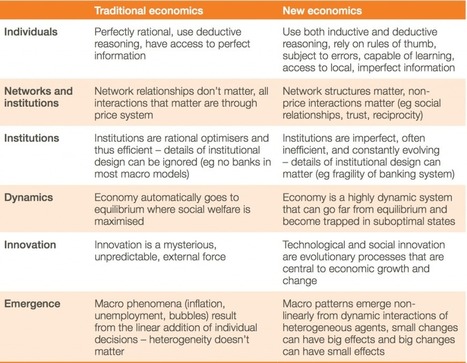
...new economic thinking provides something altogether different: a new way of seeing and understanding the economic world. When viewed through the eyeglasses of new economics, the old right–left debates don’t just look wrong, they look irrelevant. New economic thinking will not end economic or political debates; there will always be issues to argue over. But it has the promise to reframe those debates in new and hopefully more productive directions....
New economics seeks explanations of how the economy works that have empirical validity. Thus behavioural economists run painstakingly crafted experiments to explain actual human economic behaviour. Institutional economists conduct detailed field investigations into the functions and dysfunctions of real institutions. Complexity theorists seek to understand the dynamic behaviour of the economy with computer models validated against data."
In multiple arenas, including economics and more, an older approach - which we might call "linear" for lack of a better term - is giving way to a way of thinking that better reflects the world.
This article gives a good summary of what's going on from the point of view of economics.
For instance, the Federal Reserve did an analysis in 2006 that predicted "not much" of an impact on the economy if housing prices dropped by 20%. This was, of course, wildly wrong. As have been many other predictions that don't take networks, virtuous and vicious cycles, and emergence into account.
This is, in essence, the core of what we do in Decision Intelligence: bringing the same next level of nonlinear systems thinking to organizational decision making that this article says is starting to creep into economics.
There is every reason to believe that both approaches have tremendous promise.
|
|
Scooped by
Decision Intelligence
May 29, 2016 5:34 PM
|
Scoop.it!

CMOs, take note: From omnichannel challenges to IoT developments, digital marketing's future looks bright ... and a little scary.
Different verticals are adopting data, analytics, and machine learning at different rates. Digital marketing is near the start of the pack, so other industries like healthcare and telecom can learn a lot by watching its progression. Here's a great article from my friend Karsten on the state of the art.
|
|
Scooped by
Decision Intelligence
May 28, 2016 5:49 PM
|
Scoop.it!

Numerai is a global artificial intelligence tournament to predict the stock market. You download our data, build a model, and upload your predictions.
Exciting! Take expensive-to-obtain stock market data, encrypt it, then allow anyone to download it and make predictions. Run a tournament, create a hedge fund, and share earnings with the winners.
One question: if the data is encrypted, it's going to preclude one of the most powerful techniques for maximizing performance: feature engineering.
otoh, unlike Kaggle, you don't have to disclose your intellectual property when done. That's a very good thing.
See more discussion here: https://www.reddit.com/r/MachineLearning/comments/3wdr9e/numerai_a_global_ai_tournament_to_predict_the/
|
|
Rescooped by
Decision Intelligence
from Mindful Decision Making
May 27, 2016 11:09 PM
|
Scoop.it!
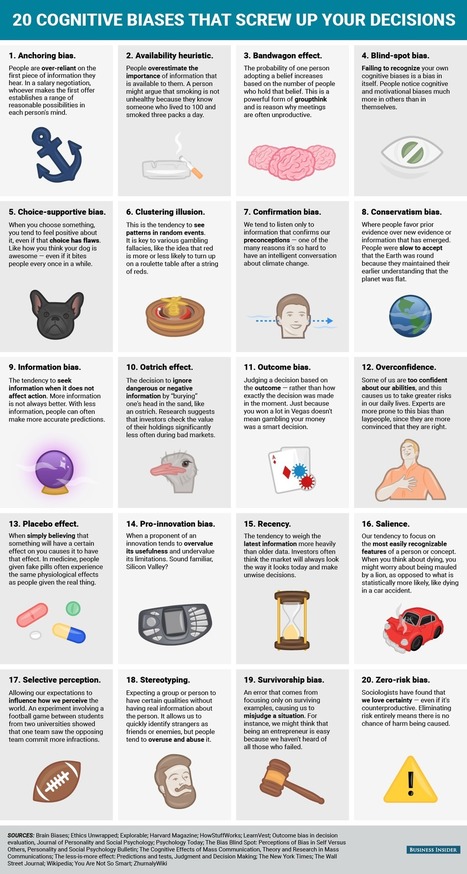
From cognitive bias to groupthink - this chart shows what could be clouding your thinking
A nice chart with the classic biases

|
|
Scooped by
Decision Intelligence
May 27, 2016 11:06 PM
|
Scoop.it!

I have never visualized anything in my entire life. I can't "see" my father's face or a bouncing blue ball, my childhood bedroom or the run I went on 10 minutes ago. I'm 30 years old, and I never knew a human could do any of this.
Written by Firefox founder Blake Ross, this is a fascinating story about a condition I'd never heard of before: "aphantasia". It means the lack of an ability to form pictures in your head.
For me, it's a cautionary tale of decision making diversity: just because decision mental models are *often* visual, they are not so for everyone. So this is reinforcement to a number of conversations I've been having (one just today with Ruth Fisher and John Kelly) that emphasize the importance of story (text) as an adjunct to a good decision visualization.
|
|
Scooped by
Decision Intelligence
May 26, 2016 10:41 PM
|
Scoop.it!

"The results showed that when the participants were shown the positive subliminal images, they did better on the task: They were more accurate in determining which way the dots were moving. But they also responded more quickly and reported feeling more confident in their choice.
The experiments also suggested that the participants became better at using their intuition over time, Pearson said. "It's all about learning to use unconscious information in your brain," he said. Just as people can become more comfortable making decisions when they apply logic and reasoning, they may also become more adept at trusting their intuition when they use it more frequently over time, the study revealed. "
Unlike previous studies, which relied primarily on questionnaires, this study used a clever subliminal design to present information to only the subconscious - and not the conscious - mind.
|
|
Scooped by
Decision Intelligence
May 25, 2016 4:54 PM
|
Scoop.it!

What is big data? Where did big data come from? Big Data analytics 1.0. Big Data analytics 2.0.
Slides from a great talk from H2o's Erin LeDell at Oscon last week. Good view of how machine learning and AI help organizations to extract value from big data investments.
|
|
Scooped by
Decision Intelligence
May 21, 2016 1:38 AM
|
Scoop.it!

"In Howard Gardner's catalog of Multiple Intelligences, the Ninth Intelligence is the rarest of them all...."
A great insight from Barry Kort. And a beautiful little gem of a video trailer about Gregory Bateson here. A couple of my favorite quotes:
"...He was interested in larger patterns, he was interested in how things are connected"
and
"The major problems of the world are the result of the difference between how nature works and how people think."
|
|
Scooped by
Decision Intelligence
May 19, 2016 12:33 PM
|
Scoop.it!
Conference theme is "The economics of empathy". See main web site here: http://www.tedxlivermore.com/tedxlivermore-2016/ , and buy tickets here: https://www.eventbrite.com/e/tedxlivermore-2016-tickets-24303286785
I hope to see you in Livermore in June.
|
|
Scooped by
Decision Intelligence
May 18, 2016 2:17 PM
|
Scoop.it!

"To explain why this is such a groundbreaking discovery, I should first tell you that Life spaceships can be loosely divided into two categories. Engineered ships are the ones that consist of various small components. They often have adjustable speed. However, the population of tens of thousands to millions of cells causes these spaceships to have no practical value. There is much more incentive in hunting for elementary spaceships, which can be used for complex constructions."
Imagine you have a spreadsheet. Some cells are black ("live"), others white. Now you have software that updates that spreadsheet, using these simple rules:
As it turns out, there are emergent patterns from these simple rules: blinkers, "spaceships", and more. And as shown in this article, an entire discipline has grown up around finding patterns that move, eat others, blink, and much much more. I had no idea.
Why does this matter? Because emergent patterns underlie everything. From individual decisions made by people, individual strategies made by flocking birds, individual marketing decisions made by companies, and individual legislation introduced into governments, emerge *completely non-intuitive* patterns.
Understanding emergence is critical to solving the world's hardest problems, which happen as individual elements interact over time. Much like the black and white cells on your spreadsheet.
|
|
Scooped by
Decision Intelligence
May 17, 2016 8:30 PM
|
Scoop.it!

The ideomotor effect says that people can move or move something without their conscious mind realizing it. In the case of the Ouija board, if you really want the answer to a question to be yes and your partner knows it, you could both push the planchette to “YES” without either of you consciously applying any force. (And if you think you can ever keep your hands completely still, try keeping a laser pointer’s dot perfectly motionless.)"
More evidence for unconscious rationality: this time it's the "ideomotor effect": you can move things - and even do so in cooperation with others - without the conscious mind realizing it.
When I throw a ball at an audience during a DI talk, and when I say that decision intelligence is meant to train our intuitions to align more effectively in complex situations, this is what I'm talking about.
There's a myth that "conscious == rational" and "unconscious == irrational". I think that Kahneman and behavioral economics have debunked the former. And now there's an increasing understanding of the validity of may aspects of the rational unconscious.
Of course, this is what Malcolm Gladwell covered in "Blink". DI takes the cognitive science insights there and transitions them into practical applications that solve "wicked" problems.
In DI we do this using a combination of methods, from systems thinking, to AI, to big data, and the interconnectedness insights of Buckminster Fuller, all on a basis of improved understanding of neuroscience and cognition.
|
|
Scooped by
Decision Intelligence
May 17, 2016 2:01 AM
|
Scoop.it!
"What is the future of Silicon Valley technology? Will it always be about consumer applications, advertising, and media, or will we extend this technology to the wicked problems of the world? And what role does art and media play?"
A grand tour of decision intelligence, with a focus on art and visual reasoning, also including what's happening in the Silicon Valley SimCenter and the Reality Stack vision
Thanks to Don Kimber of FXPAL for making it happen
|
|
Scooped by
Decision Intelligence
May 17, 2016 12:09 AM
|
Scoop.it!

A new study finds government surveillance of telephone metadata can easily lead to invasions of privacy.
This is a cautionary tale for machine learning: by detecting weak signals we can discover way more than what is apparent in a raw data source. And in this article the researchers found that it didn't even require that level of sophistication to deduce a heart condition, a gun buyer, and a woman planning an abortion: not from the content of a phone call, but from the identity of who was called as well as the timing of those calls (aka metadata / CDRs for my telecom friends).
|
|
Scooped by
Decision Intelligence
May 13, 2016 5:33 PM
|
Scoop.it!
Old-fashioned symbolic AI was based on the notion that reasoning happened consciously (and could be captured by logic and language). Subsymbolic AI - of which today's (primarily neural network-based) machine learning is a subfield, recognizes that to emulate human thought, we must go beyond the consciously introspectable.
So what are the implications of subconscious rationality on decision intelligence? If decisions are made "below the water line", then how can a consciously accessed thing - like a dashboard or visualization - help? By training our subconscious reasoning.
That's the core premise of DI: that we "train the brain" through rich, interactive, whole-body visualizations. This article is good recent evidence that this is on the right track.
|
|
Scooped by
Decision Intelligence
May 12, 2016 7:18 PM
|
Scoop.it!

Ross, the world's first artificially intelligent attorney, has its first official law firm. Baker & Hostetler announced that they will be employing Ross for its bankruptcy practice, currently comprised of almost 50 lawyers.
Congrats to my friend Bob, quoted here. Thing are getting interesting :-)

|
|
Scooped by
Decision Intelligence
May 11, 2016 6:44 PM
|
Scoop.it!

Are we getting dumber? Or is stuff just harder? Both are true. Between-silo problems are the new bottleneck. We're inundated with information, so we take cognitive short cuts. And "wicked" problems keep getting wickeder. Take this "invisible art" artist. She sold a few.* Real decisions are made in the heart, the gut, based on…
|
|
Scooped by
Decision Intelligence
May 9, 2016 9:35 PM
|
Scoop.it!
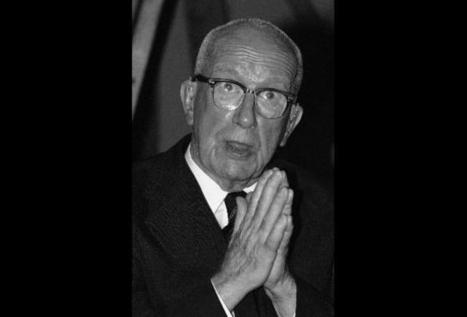
Late one evening in the winter of 1927, Buckminster Fuller set out to kill himself in frigid Lake Michigan. At thirty-two years old, he was a failure. He had neither job prospects nor savings, and his wife had just given birth to a daughter. A life insurance policy, bought while he was in the Navy, was all that he had to support his family. So Fuller walked down to a deserted stretch of shoreline on the North Side of Chicago. He looked out over the churning water and calculated how long he'd need to swim before succumbing to hypothermia. But as he prepared to jump, he felt a strange resistance, as if he were being lifted, and he heard a stern voice inside his head: "You do not have the right to eliminate yourself. You do not belong to you. You belong to the universe." Then the voice confided that his life had a purpose, which could be fulfilled only by sharing his mind with the world, and that his family would always be provided for, as long as he submitted to his calling.... Book excerpt from "You Belong to the Universe," by Jonathon Keats.
Yeah, Bucky's back for sure
|
|
Scooped by
Decision Intelligence
May 9, 2016 7:10 PM
|
Scoop.it!

Vinay Gupta is the smartest human you've never heard of. He's a technologist, inventor, futurist, systems theorist, and global resilience guru whose life's work focuses on how to ensure the long-term survival and flourishing of the human race.
Another bucky follower / systems thinker working on wicked problems
|
|
Scooped by
Decision Intelligence
May 2, 2016 3:31 AM
|
Scoop.it!

http://www.tedxlivermore.com/news/: "This year’s theme, the economics of empathy, is a highly nuanced theme. It is about how we can use empathy to shape our community when our empathies are in conflict. Literally, we can see all sides of an issue and know that there is no solution that leaves everyone with everything they want. But, because we start with empathy as currency, we try to at least get our community as a whole, and individuals, what they need. "
Mark your calendar: I'll be speaking June 25 at TEDx Livermore. More soon.
|
|
Scooped by
Decision Intelligence
May 2, 2016 2:58 AM
|
Scoop.it!

Conferences are for meeting and learning. Project teams are for solving problems and building deliverables. Data analysis is done by senior researchers, trained by their mentors. Online communities are for socializing. Right? Maybe there's a new mix. Can we solve difficult problems in a short-term conference setting? Is there a new way ...
Watch out, Bucky’s back
The latest on the Silicon Valley Sim Center








Join us tomorrow in Livermore