“ Flipboard is a tool I've had running on my iPhone for a number of years. It's great because I can tell it what I'm interested in reading about and it finds content for me to read and subsequently ...”
Via Deborah Welsh, catspyjamasnz

 Your new post is loading...
 Scoop.it! “ Flipboard is a tool I've had running on my iPhone for a number of years. It's great because I can tell it what I'm interested in reading about and it finds content for me to read and subsequently ...” Via Deborah Welsh, catspyjamasnz 
No comment yet.
Sign up to comment
Scoop.it!

Mashable sat down with Greg Marra, who is Facebook's product manager for News Feed, to discuss how Facebook users can best curate the content that they see on their News Feed.
Scoop.it!

Alfredo Corell's curator insight,
January 23, 2014 3:25 PM
A very useful guide from one of the Pioneers in Content Curation 
Anne-Laure Conté's curator insight,
December 14, 2015 3:04 AM
What about a test on this matter at the baccalaureat ?
Scoop.it!

In this post I want to argue that learning to code is part of a larger landscape that we at Mozilla call 'web literacy'. I see that landscape as being increasingly relevant in 2014 as we come to realise that "learn to code!" is too simplistic and de-contextualised to be a useful exhortation. Web Literacy, on the other hand, is reasonably well-defined as the skills and competencies required to read, write and participate effectively online. We’ve included ‘coding/scripting’ as just one part of a wider strand identified as 'Building' (i.e. writing) the web. Other competencies in this strand include 'remixing' and 'composing for the web'.
Scoop.it!

Content curation is the art of finding, selecting, contextualizing, personalizing and illustrating relevant information items on a specific topic and for a specific audience Via catspyjamasnz

Andrea Walker's curator insight,
January 7, 2014 8:08 AM
Great collection of web 2.0 tools to capture and curate content.
Scoop.it!

How about you? What’s your routine like? What do you make of my wrangling setup? Via Howard Rheingold

Louise Robinson-Lay's curator insight,
December 31, 2013 9:43 PM
This blog goes through how to manage the huge amounts of information coming in each moment through our digital channels. The author shares her personal knowledge management routine. 
CIE San Diego's curator insight,
January 1, 2014 7:28 PM
Helpful way to structure what we each do more informally 
Patricia Baker's curator insight,
February 15, 2014 6:33 PM
Could be a quick research tip for students: seek, sense, share.
Scoop.it!
This article is the second part of the excellent guide written by Robin Good and published on MasterNewMedia in these recent days.
Via Giuseppe Mauriello

Jeff Domansky's curator insight,
February 18, 2014 1:45 PM
Valuable tips from Robin Good and thanks Giuseppe Mauriello for sharing them. 
Alessandro Mosca's curator insight,
July 16, 2017 12:55 PM
Valuable tips from Robin Good and thanks Giuseppe Mauriello for sharing them.
Scoop.it!

That’s part of the argument made by Wheaton College Professor Alan Jacobs in The Atlantic, who says the ease of search and user interface of fee-based databases have failed to keep up with those of free search engines. In combination with the well-documented gaps in students’ search skills, he suggests that this creates a perfect storm for the abandonment of scholarly databases in favor of search engines. He concludes: “Maybe our greater emphasis shouldn’t be on training users to work with bad search tools, but to improve the search tools.”
Scoop.it!
National Louis University's Gail Bush, Ph.D., professor in the National College of Education, describes how teachers need to adjust their skill sets to a concept of 21st century information transliteracy, where the validity of sources is more important than the message of sources. In this short video, Dr. Gail Bush from National Louis University talks about information and literacy. She states we’ve moved beyond information literacy toward information transliteracy, where the format becomes “literally irrelevant.” Dr. Bush says that in the 20th Century we were taught to “answer the question” but now we must “question the answer” She speaks of the great challenge teachers face when trying to move the model from cognitive authority toward a more open model where the student model the learning habits of instructors and it makes me think about how that happens – or doesn’t – in a public library."
http://librariesandtransliteracy.wordpress.com/2012/02/27/questioning-the-answer/
Scoop.it!

Whether Conducting Academic Research or Purely Scientific Research, These Sites can be an Invaluable Aid. Researching is the most crucial step of writing a scientific paper. It is always a well-researched scientific paper that inspires the assessor. At the same time, it must have genuine and authentic information for credibility. With the development in Internet industry, i.e., web resources, researching for scientific materials has now become a matter of a few clicks. Now students can get information on any topic pertaining to science through academic search engines. They provide a centralized platform and allow the students to acquire literature on any topic within seconds.
Kim Flintoff's insight:
When working with students to develp information fluency it is very useful to get them to explore alternatives to the two major search engines taht most people rely on. This broadening of search strategy also helps limit the effect of "filter bubbles"
If you're not sure what a filter bubble might be then you will be shocked when you read and watch this: http://www.brainpickings.org/index.php/2011/05/12/the-filter-bubble/
Scoop.it!
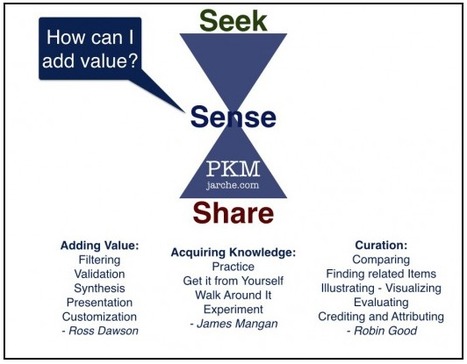
Thinking of adding value should be the first stage in curation, PKM, or any professional online sharing. Via Robin Good
Kim Flintoff's insight:
While the focus is on SEO clever educators can make sense of this in educational terms.

SyReach's curator insight,
July 7, 2014 4:53 AM
SyReach Notes now offers a full coverage of personal KM needs: Seek with integrated watch module and search engines, Sense with note and article edition, linking and knowledge building. Share by email or publish to Scoop.it selected resources linked to your articles!
Scoop.it!

Using curated content for populating your website or blog for the purpose of digital marketing is a great idea. It is a professional and respected way of providing your browsers with valuable and insightful information.
Via catspyjamasnz
Scoop.it!

"The search engine only indexes content with either a public domain and / or Creative Commons license, and as such everything within it is available for reuse without any major need for copyright clearance or checking.
Lots more to discuss and we've set up a community site as well to help handle this http://solvonauts.org/community/ Via Jim Lerman

Ava Chen's curator insight,
November 26, 2013 9:21 AM
A new open search engine tool. It also offers sevearl plugin options to users in different platform. Give it a try to see what are the results come out ;-) 
Becky Mowat's curator insight,
December 5, 2013 7:47 AM
What a timesaver for e-educators, content writers and curators! |
Scoop.it!

The Best Predictor of Digital Book Usage? Physical Book Sales Via catspyjamasnz
Scoop.it!

The Internet Curator’s role is to seek on the web information related to a specic domain,fillter them, select them,organise,share,present them in a unique mode.Curation-Art of :searching,selecting, sharing/bookmarking...
Scoop.it!
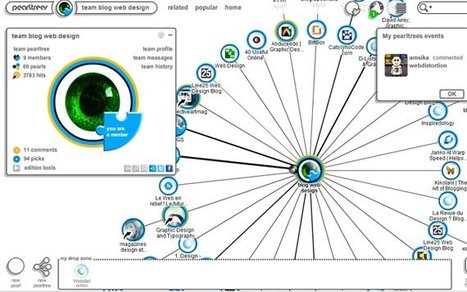
Numerous content curation platforms, tools and websites are emerging at a rate of knots in 2011, making sense of the social web, and the mountain of content to be consumed. Here's a collection of some of the standout startups. Via witszen, Dean J. Fusto

Tricia Simons's curator insight,
January 10, 2014 7:38 AM
So many tools, so little time - that is why articles like this are great! I know and use Scoop.it, but most of these are new to me and going to have to try some out.
Scoop.it!
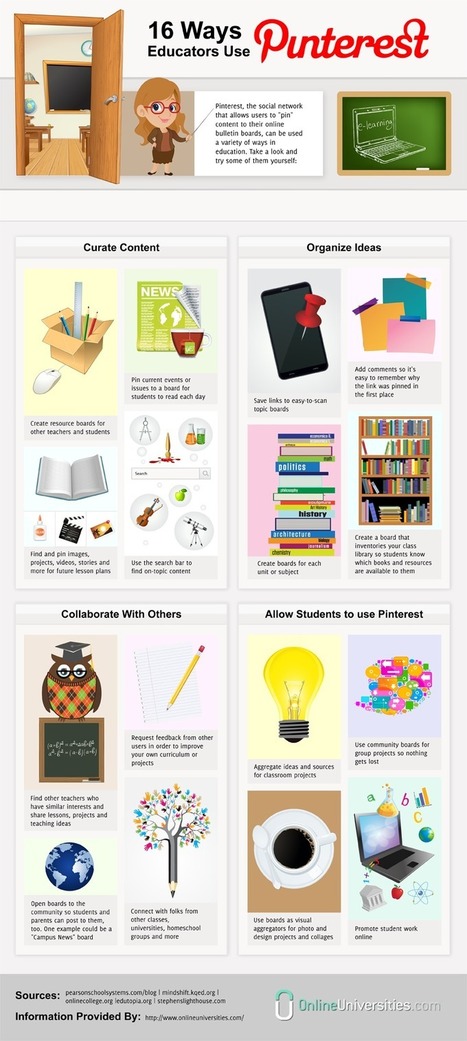
Good curation tools like Scoop.it and Pinterest are useful for teachers and educators across the globe. Here is an infographic showing how can a educators use Pinterest for educational tasks.
Scoop.it!

The power of iPads and other tablets can help students learn concepts of enormous scale, like the size of the solar system, that traditional methods struggle to teach.

Com.En.Zar's curator insight,
January 14, 2014 3:43 PM
Parece que la implantación de los iPad en las aulas escoleras está siendo una buena idea.
Scoop.it!

Carlos Bisbal's curator insight,
November 16, 2013 10:11 AM
Buena herramienta para recopilar y organizar todo el material que puedes necesitar para tus proyectos e intereses. A diferencia de otras herramientas similares, esta ofrece un completo editor de textos y un editor de contenido para enriquecer, complementar y hacer anotaciones con material original. También deja abierto el camino de su uso para el aprendizaje y los fines educativos . 
Anne Méner's curator insight,
November 17, 2013 5:34 AM
Paraît simple à utiliser pour un premier travail de collecte d'information. 
Georges Millet's curator insight,
November 18, 2013 5:58 AM
If you look for new ways of curating all information you processed, an other alternative to Evernote ...
Scoop.it!

"Blair identifies four “S’s of text management” from the past that we still use today: storing,sorting, selecting, and summarizing. She also notes the history of alternative solutions to information overload that are the equivalent of deleting one’s Twitter account: Descartes and other philosophers, for instance, simply deciding to forget the library so they could start anew. Other to-hell-with-it daydreams proliferated too:" Via Howard Rheingold

Howard Rheingold's curator insight,
December 23, 2013 12:31 PM
I've scooped before about Ann Blair's book of pre-modern info-overload -- and what was done about (http://yalepress.yale.edu/book.asp?isbn=9780300112511). This is a nice short musing about today's information overload discourse.
Scoop.it!

Learn How To Make Students Better Online Researchers. Getting learners to really focus on what exactly they are searching for, and then be able to further distill idea into a few key specific search terms is a skill that we must teach students.
Scoop.it!

"School librarians can use curation as a tool to position themselves as information and communication authorities and information professionals." Via Robin Good

Kathy Schrock's curator insight,
January 23, 2014 7:00 PM
Librarians have been doing this for years, but now have many tools to pick from! 
Angel Somers's curator insight,
February 2, 2014 1:31 PM
LIbrarians are natural curators! It's what we do, so it makes sense that we should take the initiative to promot curation as a valuable skill for both our colleagues and our students.
Scoop.it!

Before today, imitation was the greatest form of flattery. If your idea was good enough to be copied, then you were golden. But now, with the state of the web in our lives, this balance is shifting.
Scoop.it!


Kimberley Vico's curator insight,
December 8, 2013 2:41 AM
Incredible documentaries... something for everyone...!
Scoop.it!

Curation is nothing new, but online content curation is still in its early stages. Many content marketers are still unsure about what constitutes ethical content curation. If you're in this group, ... Via catspyjamasnz
|