cross pond high tech
167.9K views | +16 today
Follow
cross pond high tech
light views on high tech in both Europe and US
Your new post is loading...
Scooped by Philippe J DEWOST
November 14, 2012 10:30 AM
Scoop.it!

New Chip Is Next Step in 3D Gesture Control Phones

New Chip Is Next Step in 3D Gesture Control Phones | cross pond high tech | Scoop.it
The clickwheel of the first iPod worked by measuring electric field disturbances in one dimension. The first iPhone touch screen functioned similarly, but in two dimensions.

This week, Microchip Technology, a large U.S. semiconductor manufacturer, says it is releasing the first controller that uses electrical fields to make 3D measurements.

The low-power chip makes it possible to interact with mobile devices and a host of other consumer electronics using hand gesture recognition, which today is usually accomplished with camera-based sensors. A key limitation is that it only recognizes motions, such as a hand flick or circular movement, within a six-inch range.
No comment yet.
Scooped by Philippe J DEWOST
November 1, 2012 6:17 PM
Scoop.it!

We're on the verge of having smartphones that use half the power

We're on the verge of having smartphones that use half the power | cross pond high tech | Scoop.it
Powering cellular base stations around the world will cost $36 billion this year—chewing through nearly 1 percent of all global electricity production. Much of this is wasted by a grossly inefficient piece of hardware: the power amplifier, a gadget that turns electricity into radio signals.

The versions of amplifiers within smartphones suffer similar problems. If you’ve noticed your phone getting warm and rapidly draining the battery when streaming video or sending large files, blame the power amplifiers. As with the versions in base stations, these chips waste more than 65 percent of their energy—and that’s why you sometimes need to charge your phone twice a day.

Now an MIT spinout company called Eta Devices, based in Cambridge, Massachusetts, cofounded by two MIT electrical engineering professors, Joel Dawson and David Perreault, say they have cracked the efficiency problem with a new amplifier design.

It’s currently a lab-bench technology, but if it proves itself in commercialization, which is expected to start in 2013—first targeting LTE base stations—the technology could slash base station energy use by half. Likewise, a chip-scale version of the technology, still in development, could double the battery life of smartphones.

“There really has been no significant advance in this area for years,” says Vanu Bose, founder of Vanu, a wireless technology startup. “If you get 30 to 35 percent efficiency with today’s amplifiers, you are doing really well. But they can more than double that.”
No comment yet.
Rescooped by Philippe J DEWOST from Pierre Paperon
August 28, 2012 3:37 AM
Scoop.it!

NASA to launch smartphone-powered nanosatellites

NASA to launch smartphone-powered nanosatellites | cross pond high tech | Scoop.it
NASA is relying on a small team of engineers at its Ames Research Center in the Bay Area’s Moffett Field to develop three nanosatellites powered by Android smartphones.

Via Pierre Paperon
No comment yet.
Scooped by Philippe J DEWOST
April 26, 2012 4:08 PM
Scoop.it!

Smartphones Just Don’t Shut Up: some apps ping the network as often as 2400 times an hour

Smartphones Just Don’t Shut Up: some apps ping the network as often as 2400 times an hour | cross pond high tech | Scoop.it
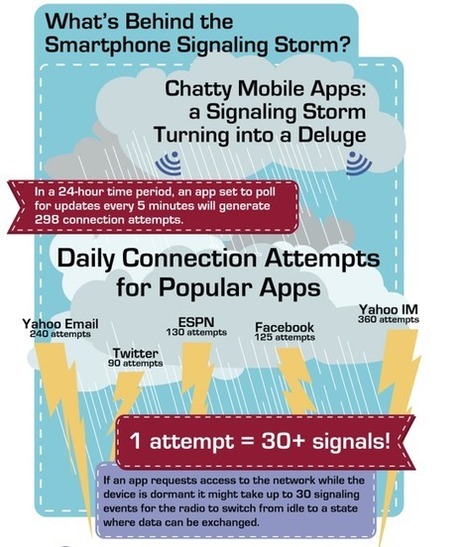
It's not just that modern smartphones are gobbling up tons of data. Another part of their challenge to wireless networks is that they are constantly pinging the network.

A less talked-about issue is the fact that many smartphone apps are constantly pinging the network, like a kid asking his or her parents every few seconds, “Are we there yet?”

Only smartphone apps are even more annoying. Some ping the network as often as 2,400 times an hour. The result is network congestion and signal loss, as well as a far more rapid drain on battery life.

“Wireless signaling is a tricky topic because oftentimes it’s hidden, happening in the background without any user knowledge. But it’s growing bigger by the minute, as more users download more connected applications” said Isabelle Dumont, head of marketing at Seven Networks, which pitches a solution to help reduce the issue.

If current trends continue, the constant pinging of the network could eventually amount to 25 trillion signaling events per hour, Seven says.
No comment yet.
Scooped by Philippe J DEWOST
November 13, 2012 6:18 PM
Scoop.it!

Text Messaging Peaks

Text Messaging Peaks | cross pond high tech | Scoop.it
Text messaging and text messaging revenue has fallen for the first time in the U.S., according to mobile analyst Chetan Sharma's latest report.

He tells us, "the dip in volume coincided with revenue dip as well which didn't happen previously. Typically, when this happens, it is an indication that the peak might have been reached and the curves will decline from here on out."

The reason text messaging and revenue is down is that more people have smartphones, which have apps that help users avoid carriers texting services.
No comment yet.
Scooped by Philippe J DEWOST
August 29, 2012 6:32 AM
Scoop.it!

smartphone adoption growing 10x faster than PC business in the 1980's

smartphone adoption growing 10x faster than PC business in the 1980's | cross pond high tech | Scoop.it

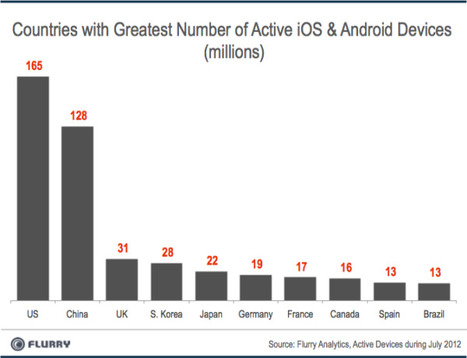
The rate of iOS and Android device adoption has surpassed that of any consumer technology in history.  Compared to recent technologies, smart device adoption is being adopted 10X faster than that of the 80s PC revolution, 2X faster than that of 90s Internet Boom and 3X faster than that of recent social network adoption. 


Five years into the smart device growth curve, expansion of this new technology is rapidly expanding beyond early adopter markets such as such as North America and Western Europe, creating a true worldwide addressable market.


Overall, Flurry estimates that there were over 640 million iOS and Android devices in use during the month of July 2012.

No comment yet.
Scooped by Philippe J DEWOST
June 16, 2012 3:31 AM
Scoop.it!

T-Mobile's USA HSPA+ 42 smartphone users guzzle 1.3 GB per month - FierceWireless

T-Mobile's USA HSPA+ 42 smartphone users guzzle 1.3 GB per month - FierceWireless | cross pond high tech | Scoop.it
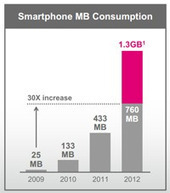
T-Mobile USA subscribers with smartphones capable of accessing the carrier's HSPA+ 42 Mbps network consume an average of 1.3 GB per month. The figure is almost double the 760 MB per month that T-Mobile said its overall smartphone user base consumes, and it highlights the fact that users generally consume more mobile data if they have access to a faster network.

Click here for Ray's full presentation. (PDF)

According to Chetan Sharma Consulting, roughly 30 percent of all U.S. smartphone users download more than 1 GB of data per month.

T-Mobile CTO Neville Ray disclosed the carrier's figures during a presentation at the NGMN conference in San Francisco. Ray also said that video accounts for almost 50 percent of T-Mobile's overall HSPA network traffic.

Currently, T-Mobile offers an HSPA+42 network covering 184 million POPs in 185 markets, and its HSPA+21 network covers around 220 million POPs. The carrier advertises the network as "America's largest" that provides "4G" speeds. Indeed, independent tests have shown that T-Mobile's HSPA+ 42 network offers download speeds of around 8 Mbps, similar to what Verizon Wireless (NYSE:VZ) provides via its LTE network.

No comment yet.