Your new post is loading...
Less than a week after the FTSE Russell index announced plans to exclude Snap Inc. and other companies that offer virtually non-existent voting rights to public shareholders, the S&P Dow Jones went a step (or several) further with a ban on multi-class share structures for new entrants to several of its flagship indices, including the S&P 500.
The changes at both indices follow consultations held in response to Snap's controversial plan to issue
At the 15th year anniversary of Sarbanes Oxley, the label of “quack” corporate governance proved incorrect. SOX succeeded in putting in place mechanisms that p
The Delaware Court of Chancery recently issued a post-trial opinion holding that a controller cash-out merger was “entirely fair” and appraised for a value less than half of the deal price. ACP Master, Ltd. v. Sprint Corp. C.A. No. 8508-VCL (Del. Ch. Jul. 21, 2017).
The former stockholder-plaintiffs asserted “Caremark-type” claims that the Massey Energy directors had failed to exert proper oversight over the company’s operations, resulting in a mining explosion that claimed numerous lives, which then led to the company’s sale. The court found, consistent with long-established law, that these “otherwise valid” Caremark-type claims of breach of the directors’ oversight duty, made before Massey merged with a third party acquiror, “passed” to the acquiror in the merger. The plaintiffs therefore could no longer satisfy the requirement that they had “continuously owned” the claims and, thus, they could no longer bring them. The court rejected the plaintiffs’ contentions that they qualified for an exception to the continuous ownership rule based on the merger having been effected (a) for the purpose of depriving stockholders of standing to bring a derivative action or (b) as a mere reorganization which did not affect the plaintiffs’ ownership interest in the business. The court also rejected the plaintiffs’ argument that they could bring “inseparable fraud” claims.
Median compensation for outside board directors in the Fortune 500 increased by 2 percent last year, the lowest rise since 2010, according to new research from Willis Towers Watson.
In the past few years, investors have begun to embrace the reality that academics have been championing for decades—that a broad-based passive indexing strategy is superior to picking individual stocks or actively managed mutual funds. As a result, millions of investors have abandoned actively managed mutual funds, or “active funds,” in favor of passively managed funds, or “passive funds.” This past year alone, investors withdrew $340 billion from active funds (approximately 4 percent of the total) while investing $533 billion into passive funds (growing the total by 9 percent).
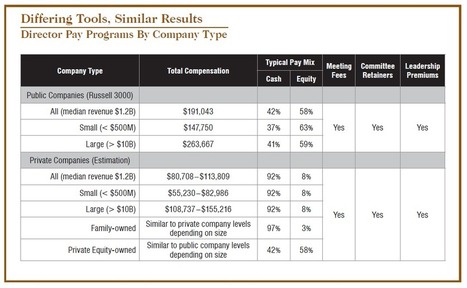
The pay levels and mechanisms for directors at public companies are well studied and benchmarked. Private and family-owned companies? Not so much. Indeed, board compensation norms for these non-public firms (which make up a huge segment of our economy) have long been very obscure. New research sheds light on the topic.
There’s been some interesting chatter this week in board governance. As the proxy season comes to a close, voting data has revealed some interesting trends in shareholder proposals. In addition, we’re seeing a media focus on age diversity in the boardroom, plus the revenue recognition standard continues to loom large overhead. We’ve pulled excerpts from this week’s reports, articles, and videos to pique your interest. Let’s have a look:
Risk aversion, weak customer focus, and siloed mind-sets have long bedeviled organizations. In a digital world, solving these cultural problems is no longer optional.
The Equilar Gender Diversity Index (GDI) has reported that, at the current pace of growth in female representation on public company boards of directors, gender parity would not be reached until Q4 2055 for the Russell 3000. However, annually elected boards may already have an edge against their classified counterparts.
The shareholder empowerment movement (the “movement”), driven primarily by public pension funds and union-related funds with over $3 billion in assets, has renewed its effort to eliminate, restrict, or at least discourage companies from creating dual class share structures in initial public offerings (IPOs). The impetus was the issuance of non-voting stock in the recent Snap Inc. IPO. Such advocacy, if successful, would not be trivial, as many of our most valuable and dynamic companies, including Alphabet (Google) and Facebook, have gone public by offering shares with unequal voting rights.
According to a new report by The Conference Board, in 2016 CEO exits from underperforming companies have risen to a level unseen in 15 years amid record-high dismissals in the retail sector. In particular, last year the CEO of poorly performing companies had a 40 percent higher probability of being replaced than in 2015 and a 60 percent higher probability of being replaced than the CEOs of better-performing companies. The report, CEO Succession Practices: 2017 Edition, annually documents and analyzes succession events of chief executives of S&P 500 companies. In 2016, there were 63 cases of S&P companies that underwent a CEO turnover.
In Brief: The 2016–2017 NACD Private Company Governance Survey presents findings from our annual questionnaire that was in the field from May through July 2016. This report offers new insights on matters important to private companies, such as risk oversight, critical trends impacting the bottom line, and director onboarding and education.
|
If current legislation and SEC rulemaking stand, one big story in public company executive compensation during the 2018 proxy season will be the disclosure of the “CEO Pay Ratio.” Beginning for reporting periods starting on or after January 1, 2017 (spring 2018 proxy filings), companies will be required to disclose the median of employee pay excluding the CEO, CEO pay, and the ratio between the two.1 This disclosure is certain to garner significant media attention, if only from the anticipated magnitude of the ratio itself.2
The Snap, Inc. IPO in March 2017 was the first in which only non-voting shares were offered to the public. In response, the Council of Institutional Investors and others lobbied the major index providers to bar non-voting shares from their indices, arguing that absent this change passive investors such as index funds would be forced to invest in non-voting shares that erode public company governance. In turn, global index providers S&P Dow Jones Indices, MSCI and FTSE Russell initiated market consultations to determine whether to revise their policies. S&P Dow Jones and FTSE Russell recently announced plans to revise their index eligibility rules. MSCI’s consultation remains open until August 31, 2017.
In a new study forthcoming in the Journal of Finance Economics, we present evidence that financial firm CEOs’ incentives for short-term focus played an important role in the subprime crisis of 2007-2009. Prominent policy makers and opinion leaders have asserted that incentives for managerial myopia were important drivers of the crisis. For example, the Financial Crisis Inquiry Commission Report of 2011 asserts the following:
The U.S. Chamber of Commerce Center for Capital Markets Competitiveness (CCMC) released a paper on shareholder proposal reform, which contains a “set of recommendations for the SEC on fixing the broken Rule 14a-8 system in order to protect investors and make the public company model more attractive.” See also the Chamber’s press release, U.S. Chamber Offers Recommendations to SEC on Shareholder Proposal Reform.
On July 25, 2017, the Securities and Exchange Commission (“SEC”) Division of Enforcement issued a report of investigation under Section 21(a) (the “Report”) concluding that blockchain tokens sold by The DAO (“DAO Tokens”) were securities as defined under relevant law. These blockchain tokens are analyzed under the so-called Howey[1] test, and the SEC found that DAO Tokens allowed the holders to profit from the efforts of others, a key element of that test. We labeled a blockchain token that meets the definition of security a “security token” in our memorandum that accompanied “A Securities Law Framework for Blockchain Tokens,” published by Coinbase, Coin Center, Union Square Ventures and ConsenSys.
So far, 2017 isn’t quite the year many deal forecasters were expecting. But at the midway point, it looks on track for a finish that won’t leave dealmakers gritting their teeth.
Your attendance and participation at Deloitte’s second annual Board Symposium made for a memorable and educational event. Judging from the high degree of engagement, we trust that all director attendees benefitted from the opportunity to further their own understanding of important issues and enjoyed sharing their experiences with others.
No topic stirs more widespread debate among shareholders, institutional investors, and the media than CEO compensation. Everyone has an opinion about how executive compensation should be structured, and rarely do those opinions mesh. As implementation of the CEO pay ratio draws near, all parties are directing even more attention to the golden question: Is CEO pay out of balance?
In this episode, Dr. Anastassia Lauterbach explains how today’s boards should be approaching conversations around artificial intelligence (AI).
Cybersecurity is a critical but often misunderstood aspect of companies’ technology infrastructures. Here’s how business and technology leaders can ensure that important corporate assets remain safe.
The corporate governance structure of any public company must enable the company to achieve the appropriate balance between the powers of the board of directors, which is typically composed primarily of independent directors, and those of the CEO. The Commission on Public Trust and Private Enterprise, convened in 2002 “to address the causes of declining public and investor trust in companies, their leaders and America’s capital markets,” concluded at the time that there are three equally valid approaches that issuers can take to strike such a balance:
The “Proxy Access Battlefront” has shifted once again, as reported by Ning Chiu of Davis Polk (The Proxy Access Battlefront for Next Season? SEC Staff Rejects Attempt to Exclude Proxy Access Shareholder Proposal). Chiu’s post captures the trajectory of proxy access amendment efforts.
|