Your new post is loading...
La firme d’ingénierie montréalaise n’a pas précisé combien lui rapporterait le contrat à livraison et quantité indéterminées obtenu par l’entremise de sa filiale Atkins Nuclear Secured Holdings Corporation, mais elle a indiqué qu’il était réparti entre neuf entreprises et que sa valeur avait été plafonnée à 3 milliards US. Les sociétés mandatées par l’Office of Environmental Management devront s’occuper de la désactivation, la mise hors service et l’élimination d’installations nucléaires à l’échelle des États-Unis, ainsi que de la gestion des déchets et du soutien au programme. Le contrat sera pris en charge par SNCL Services d’ingénierie, que la société décrit comme la « pierre angulaire » de sa stratégie visant à augmenter la croissance et le soutien de ses partenaires et clients. « La gestion des déchets et la mise hors service constituent une part importante et croissante des activités nucléaires de SNC-Lavalin, et ce contrat renforce notre position dans cet important marché », a affirmé dans un communiqué le président du secteur de l’énergie nucléaire de SNC-Lavalin, Sandy Taylor.
S&P Global Ratings estime que le Canada a pris les bons moyens pour mitiger les effets de la pandémie sur son économie et maintient la cote triple A de sa dette à long terme, la meilleure de son classement. Contrairement à Fitch, l’agence de crédit qui avait baissé d’un cran la cote de crédit du Canada le mois dernier, S&P croit que l’explosion du déficit et de la dette sera temporaire et restera sous contrôle. Le Canada peut compter sur des institutions solides, une politique monétaire crédible et une économie saine orientée vers l’exportation, soulignent les analystes de l’agence. Ils qualifient la réponse des autorités fiscales et monétaires à la pandémie de « forte et appropriée ». « Bien que le déficit et la dette s’aggraveront en raison de l’ampleur de la réponse sans précédent du gouvernement, nous croyons que l’utilisation par le gouvernement de sa flexibilité politique aidera probablement l’économie et le marché du travail à se redresser », détaillent-ils. La détérioration du bilan du Canada devrait être temporaire. Le déficit devrait être réduit à partir de 2021, et le ratio de la dette par rapport à la taille de l’économie devrait se stabiliser.
Shortly, we will begin publishing our annual proxy season review, analyzing significant developments relating to the 2020 U.S. annual meeting proxy season and highlighting implications for the 2021 proxy season as companies navigate the post-COVID-19 environment. We address issues that U.S. public companies and their boards should consider as they engage with investors, regulators, employees, and other stakeholders, who continue to be increasingly focused long-term sustainability, diversity and inclusion, and social capital.
You cannot escape the everyday realities of Artificial Intelligence (AI). All Fortune 1000 business leaders in diverse industries have AI focused initiatives well underway. Global companies in both enterprise and mid-markets are rapidly innovating to grow new revenues, increase profits, and discover new value in product and service offerings via the alluring promise of an AI advantage. Despite the growth of AI, board Directors and CEO’s are still well behind in AI language literacy, and risk management practices. The acceleration of AI is almost like a tempest, where a perfect storm may be brewing as few board Directors and CEO’s can answer this question. Where are your AI algorithms (Algo’s) and models located and do your AI algos/models have risk profiles? AI growth is like the wild west: a new global research report released in early July, 2020, stated the AI market is growing at over 42% CAGR, and will reach over $733.7B USA. According to MIT Sloan Research over 90% of larger enterprises are using AI to improve their customer interaction journeys. [...] Unfortunately, many companies have been lured into AI programs with black box AI practices, meaning clear accountabilities are not easily evident, transparent, let alone audited to manage risk. Board directors and CEOs know where their employees are located, whether they are working remotely or in an office, who to contact for customer service or personal issues. Yet, I don’t know of one global company where a Board Director or a CEO can produce in less than five minutes, a comprehensive list of all their AI algo/AI model assets across their enterprise operations and know the last revision model date, and have robust risk classification evidence, verified by third party-auditors.
In early 2020, the Government of Ontario established the Capital Markets Modernization Taskforce (the Taskforce) to help transform the regulatory landscape for the capital markets sector and advise the Minister of Finance on how to improve the innovation and competitiveness of the province's capital markets and best help build Ontario's economy. More recently, on July 9, 2020, after consulting with various stakeholders, the Taskforce published its initial Consultation Report which includes 47 policy proposals to modernize the province's capital markets regulations. The full Consultation Report can be accessed here. The Taskforce is seeking written submissions on the proposals contained in the Consultation Report and asks that any comments be submitted by email on or before September 7, 2020 in accordance with the procedure outlined on the Government of Ontario's webpage. The Taskforce's final report and recommendations are expected to be delivered to the Ontario Minister of Finance by the end of 2020.
SEC commissioners in a 3-1 vote Wednesday approved sweeping changes to rules governing proxy advisory firms. The rule amendments make clear that proxy voting advice generally constitutes a solicitation; requires proxy advisory firms to disclose conflicts of interests to clients; allows companies that are the subject of voting advice to be able to access that advice "prior to or at the same time as the advice is disseminated to clients"; and obliges proxy advisory firms to provide clients with access to any response the company provides to the voting advice "in a timely manner before those clients vote," said Commissioner Elad L. Roisman, who spearheaded the commission's efforts on this issue. [...] The amendments will be effective 60 days after publication in the Federal Register, but affected proxy advisory firms are not required to comply until Dec. 1, 2021. Glass Lewis and Institutional Shareholder Services Inc. control about 97% of the proxy advisory market. In a statement, ISS President and CEO Gary Retelny said the measures taken by the SEC “serve as a blow to institutional investors seeking to judiciously monitor portfolio companies.”
The Covid-19 crisis has rattled supply chains around the globe and created serious questions about the future of commerce. Critical to recovery and restoring economic activity is regaining trust in these systems. This challenge presents an opportunity for the integration of blockchain, a technology with the potential to fundamentally alter the future of supply chains. Though digitisation has driven transaction costs down significantly, most business domains still operate in silos, creating accounting discrepancies that need to be aligned. The need to process transactions quickly and verify the creation, transmission and reception of a particular exchange of value is ever more critical to business success. To make a supply chain resilient, there must be transparency and integrity across domains, which can be improved through the deployment of blockchain technologies.
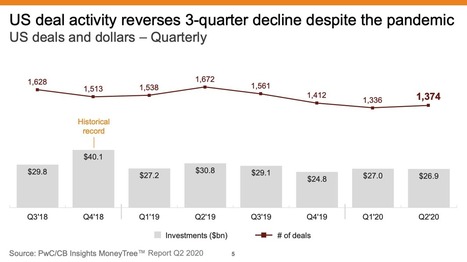
In Q2’20, US-based startups continued to pick up deals and dollars during the Covid-19 crisis. Venture capitalists didn’t let the global pandemic stunt dealmaking in the second quarter of the year. Though funding took a hit in Q2’20 both globally and in the US, deal activity recovered compared to Q1’20. However, the extent of Covid-19’s impact remained visible when compared to 2019 levels. Deal activity in Asia rises 20% in Q2’20, compared to 9% in Europe and 3% in North America. Download the CB Insights and PwC MoneyTree Report to see all the data. We take a look at how the coronavirus pandemic has shaped venture capital financings in Q2’20.
1. VC deals to US-based startups in Q2’20 saw a quarterly increase but were down compared to last year [...]
2. The number of quarterly mega-rounds ($100M+) in the US hit a new record in Q2’20 [...]
3. Unicorn births declined for the fourth consecutive quarter
The number of new unicorns in the US steadily declined over the past year. [...]
4. In the US, IPO exits jumped while M&A activity fell amid the pandemic. [...]
5. Globally, deals recovered compared to Q1’20 while funding dropped [...]
6. Digital health dominated deal activity in the US
Digital health and medical devices saw an increase in deals in Q2’20, as companies scrambled to develop solutions for the pandemic.
This week, Bill Ackman, through Pershing Square Holdings, is sponsoring the largest Special Purpose Acquisition Company ever raised. A SPAC, also known as blank check companies, has no commercial operations and is formed strictly to raise capital through an initial public offering for the purpose of acquiring an existing company. Pershing Square’s SPAC will be called Pershing Square Tontine Holdings and will raise $4 billion by offering 200 million units at $20 per share. Additionally, Pershing Square will be acquiring between $1 billion and $3 billion of units, for a total amount of capital of up to $7 billion. However, based on Pershing Square’s current assets under management, we do not expect their contribution to exceed $1.5 billion, for a total capitalization of $5.5 billion. [...] But the most unique feature of this SPAC and the greatest departure from historical SPACs is the compensation terms for the SPAC sponsor, in this case Pershing Square Holdings. The normal historical SPAC sponsor will partly capitalize the operations of the SPAC by acquiring sponsor warrants giving them a participation in the upside of the company. But that is far from their main compensation. Typically, SPAC sponsors receive 20% of the shares in the SPAC for extremely nominal consideration. These founders shares compensate the sponsor regardless of whether the shares in the company appreciate or decline. [...] Why it’s ‘groundbreaking’ ? But this is not the really groundbreaking feature of the Tontine compensation structure. The truly remarkable departure from SPAC standard terms is that Pershing Square is not taking any founders shares.
Tesla Chief Executive Elon Musk qualified on Tuesday for a payout worth an unprecedented $2.1 billion, his second jackpot since May from the electric car maker following its massive stock surge. Despite Tuesday’s stock dip, and importantly for Musk’s personal finances, Tesla’s six-month average market capitalization for the first time has reached $150 billion. That triggers the vesting of the second of 12 tranches of options granted to the billionaire in his 2018 pay package to buy Tesla stock at a discount. Musk, who is also majority owner and CEO of the SpaceX rocket maker, receives no salary. Even with Tuesday’s decline in Tesla’s stock, its six-month average market capitalization rose, thanks to the stock’s strong rally in recent months. In early May, Musk’s first tranche vested after Tesla’s six-month average stock market value reached $100 billion. Musk has already achieved targets related to Tesla’s financial growth that are also required in order to vest the latest options tranche. Each tranche gives Musk the option to buy 1.69 million Tesla shares at $350.02 each, less than a quarter of their current price. At Tesla’s current stock price of $1,594, Musk would theoretically be able to sell the shares related to the tranche that vested in May and the current tranche for a combined profit of $4.2 billion, or almost $2.1 billion per tranche. Musk’s first tranche was worth about $700 million in May, when it vested, but its value has since increased along with Tesla’s stock price. The median compensation for Tesla employees last year was about $58,000, according to a company filing.
ISS and Glass Lewis have arrogated to themselves the power to make law, promulgating a civil code of astounding breadth and detail, ruling over decisions on board composition, director qualifications, term limits, majority voting standards, executive compensation, capital structure, poison pills, staggered boards, the advisability of mergers, spin-offs and recapitalizations, and, increasingly, ESG policies ranging from animal welfare to climate change, diversity, data security and political activities. They enforce this civil code by advising their clients, institutional investors with huge, varied and increasingly concentrated holdings across the economy, to vote against proposals or against directors if any aspect of the new civil code is disobeyed. The vote of these clients is often decisive, and the implications of the votes – especially when considered in the aggregate – have far-reaching consequences for the operation and performance of US public corporations. ISS and Glass Lewis argue that they are providing advice, not making law, but that is disingenuous
Boards must encourage diversity across all levels – age, gender and expertise – to ensure shareholder interests are represented in significant business decisions, says UNSW Business School's Victoria Clout .The average age a person becomes a CEO in Australia is 47, according to a review of the top 300 companies listed on the Australian Securities Exchange by board advisory firm Blenheim Partners. The firm also finds that 90 per cent of CEOs are already appointed by the age of 55. One explanation for why boards are less likely to appoint someone to the position of CEO who's nearing retirement is because people's minds change the closer they get to retirement. Generally speaking, younger CEOs and independent directors are often opposed to mergers and acquisitions (M&A) because these mean they could risk losing their position on the board. And if they want to continue in their careers, this could be devastating. However, this changes once C-suite level executives approach retirement age. First, it's important to remember why boards seek the expertise of independent directors in the first place. Several corporate accounting scandals that occurred in the US from 2000 to 2002 (notably the Enron Scandal) resulted in the Sarbanes-Oxley Act, which aimed to increase the number of independent directors and also promote a higher proportion of independent directors on audit committees. [...] But in a recent co-authored paper [...] finds that age affects CEO and independent director's independent decision making. Specifically, age influences their likelihood of accepting takeover bids.
Torstar shareholders voted in favour of a $60 million takeover of the newspaper company, despite the presence of a second offer for the company that's worth more on paper. The $60-million acquisition of the Torstar Corp. newspaper group by NordStar Capital LP was approved by shareholders Tuesday, despite a rival group's last-minute offer to increase its cash bid. A preliminary count of votes tallied after a brief online meeting showed the deal recommended by Torstar's board received the necessary support from the company's shareholders. Although the shareholder vote is a critical step in closing the deal, the transaction remains subject to regulatory and court approvals The Ontario Securities Commission had received shareholder complaints after the original rival bid was made public but OSC spokeswoman Kate Ballotta said Tuesday that it can't comment further. Honderich said during the meeting, which lasted about 10 minutes, that Torstar's board operated "to the highest level of corporate governance" and received "excellent" outside legal advice. "I feel our process was very sound," Honderich said.
|
The rapid and deadly spread of the coronavirus has wreaked havoc around the world. As of mid-July 2020, it has already led to over 14 million confirmed cases of sickness and claimed more than 600,000 lives. It has also caused the most serious economic recession since the Great Depression, involving massive unemployment and bankruptcies. With no cure or vaccine on the horizon, the situation will get worse before it gets better. Some of the pandemic’s damages — as traumatic and painful as they are — will be relatively short-lived. Other consequences will have much longer-term influence on societies. One of these longer-term consequences has to do with China’s international relations, in particular its relations with the Western world. As an emerging economy whose rise has been a focus of worldwide fascination, or anxiety, since the late twentieth century, China has also been a central actor in the unfolding of the current global pandemic. As far as we know, the first sign of trouble came at the end of 2019, when a cluster of pneumonia cases emerged in the central Chinese city of Wuhan. Chinese government officials’ knee-jerk reaction was to hide the bad news. But when it became clear the problem was serious and worsening by the day, Beijing took the drastic measure of locking down Wuhan with its 11 million residents.
The impact of the COVID-19 pandemic on deal-making in the first six months of 2020 was significant but not unexpected, yet regional differences in deal performance and volume revealed by M&A data1 from Willis Towers Watson have been more dramatic. Based on share price performance, the latest results from Willis Towers Watson’s Quarterly Deal Performance Monitor (QDPM), run in partnership with Cass Business School, show North America experienced the sharpest fall in M&A performance by some margin. Acquirers underperformed their regional index by -7.2pp (percentage points), with just 137 deals completed in H1 2020 (compared to 188 in H1 2019). This is the lowest number of North American deals for a six-month period since the study began in 2009. In contrast, European buyers performed +10.2pp above their regional index in H1, based on an actual increase in deals completed (80 deals compared to 68 deals in H1 2019). This is also the first time in two years that Europe has recorded three consecutive quarters of positive performance. Meanwhile, U.K. acquirers performed +16.9pp above the index, with 15 deals in the first half of this year. [...] “What previous crises do tell us is that there will be opportunities to make deals, underpinned by vast amounts of capital still waiting to be deployed. Activity, partly driven by distressed M&A and non-core divestitures at bargain prices, will become more selective, deals will take longer and acquirers will need to be prepared for the duration and depth of their due diligence to increase, even as COVID-19 subsides.”
Our concept of risk continues to broaden and now includes instances in which representatives of a company make statements, actions, or decisions that damage the firm by inviting public scrutiny, sparking a reaction among customers, employees, regulators, or the public. This risk, which we describe as “social risk,” is more amorphous than the standard risks included in a company’s risk-management framework — and harder to plan for. In this Closer Look, we use proprietary data from Marketing Scenario Analytica to examine how social risk manifests itself and what actions boards and companies can take to mitigate its impact.
New research suggests activists are skilled at finding deals — but don’t necessarily add value to companies. Are hedge fund activists like Bill Ackman and Carl Icahn good at turning around companies — or just good at picking stocks? A new academic study sought to answer that question, examining whether the investment gains generated by activist hedge funds are due to value creation or simply good stock selection. The paper was authored by Martijn Cremers, dean of the University of Notre Dame’s business school; finance professor Erasmo Giambona of Syracuse University; University of Arizona law professor Simone Sepe; and Ye Wang, assistant professor at China’s University of International Business and Economics. “Some scholars argue that activist hedge funds improve the performance of undervalued firms and promote managerial and directorial accountability, benefitting all shareholders,” they wrote. “Others argue that activist hedge funds are professional arbitrageurs whose activities benefit themselves but not other shareholders, since any initial outperformance by the target companies does not last over the long term.” Under this second hypothesis, the authors added, “activist hedge funds profit from superior stock selection and trading skills, not from turnaround planning that benefits the overall firm.”
The former Dow Chemicals boss reveals the two things modern chief executives must have. The upcoming earnings season is going to require chief executives to pull off a difficult balancing act. How do you present a picture of a short term that has been ruined by a crisis, then sell a long-term vision for a future that is almost impossible to predict? Of course, you might argue that as with so many things, the COVID-19 crisis has simply brought this battle between the short term and the long term into even sharper focus. [...] Liveris argues the steady decline in the number of listed companies around the world, and particularly on Wall Street, is a result of a short-term focus that requires "that 90-day march through the quarter to get within a percentage of guidance". [...]
Liveris' advice to chief executives he works with [...] is to be ready to disrupt your own business model, even when you are running a business where cashflows are strong but margins are steady. [...] The modern board, he says, should be as good at portfolio management – that is, deciding which areas of the business to invest in, which to disrupt and which to exit – as the portfolio mangers that invest in your company. [...] "The nexus between management and portfolio has to be bridged at the board. You can no longer just do the check-the-box on boards. You've basically got to do enterprise risk management based on financial risk." Chief executives also need to think like the activist investors who have become a feature of modern capital markets, stalking companies with ideas to unlock value.
Financial analysts and stock market investors alike are subject to behavioral biases. Objective analyst forecasts can potentially help correct investor misperceptions. On the other hand, biased forecasts can reinforce or incite investor misperceptions. Furthermore, data on analyst behavior provide a rich window of insight into the nature of psychological bias among an important and incentivized group of professionals, since ex post information is available about the accuracy of analyst forecasts under different conditions. Analyst behavior also provides insights into the sources of stock market mispricing. As a possible example of analyst psychological bias, consider decision fatigue, defined as the tendency for decision quality to decline after an extensive session of decision-making. Whether decision fatigue exists has been a topic of controversy as part of the greater replication crisis in experimental psychology. My collaborators Yaron Levi, Ben Lourie, Siew Hong Teoh, and I provide a test of whether decision fatigue affects a set of skilled financial professionals in the field. Specifically, we test whether decision fatigue causes stock market analysts to be more heuristic in their forecasting.
COVID-19 has led companies to patch-up financial reporting by adding estimates of pre-COVID-19 profits to their EBITDA. Recently, COVID-19 prompted measuring-equipment manufacturer Schenck Process, for example, to add back €5.4 million, resulting in an adjusted EBITDA of €18.3 million (termed, unsurprisingly, as ‘EBITDAC’ [1]). This may spark other U.S. corporations to use an EBITDAC metric in initial public offerings, which may result in litigation under Section 11 of the Securities Act of 1933 (Securities Act) over alleged omissions or material misstatements. This post seeks to analyze the use of EBITDAC against the civil liability provisions of Section 11 and argues that EBITDAC may solidify certain unintended underwriting practices.
Le Canada continue d’augmenter sa présence dans les paradis fiscaux. Les entreprises canadiennes ont rapporté en 2019 pour 381 milliards d’actifs financiers dans 12 paradis fiscaux, soit une hausse de près de 3 % par rapport à l’année précédente, a rapporté mercredi le groupe Canadiens pour une fiscalité équitable (CFE). Ces 12 économies, souvent minuscules, comptent ainsi désormais pour plus du quart (27,4 %) des 1391 milliards investis à l’étranger par des compagnies canadiennes, contre seulement 11 % il y a 30 ans. Le rapport se base sur le bilan des investissements directs étrangers (IDE) de l’année dernière dressé récemment par Statistique Canada, où l’on pouvait constater que, tout juste derrière les États-Unis (avec 632 milliards d’IDE) et le Royaume-Uni (107 milliards), viennent des pays plus réputés pour leurs règles fiscales accommodantes que pour les affaires qu’on peut réellement y faire, tels que le Luxembourg (101 milliards), les Bermudes (64 milliards), la Barbade (50 milliards) ou encore les îles Caïmans (43 milliards). En fait, 6 des 10 premières destinations de prédilection de l’IDE des entreprises canadiennes sont généralement considérées comme des paradis fiscaux.
Canada’s annual inflation rate in June posted its biggest jump in more than nine years as restrictions imposed to curb the coronavirus outbreak were lifted, Statistics Canada said on Wednesday. The rate jumped to 0.7 per cent from a 0.4 per cent decline in May but was still well below the Bank of Canada’s 2 per cent target. Analysts polled by Reuters had expected the annual rate to increase to 0.3 per cent. “It’s consistent with an economy that was almost completely shut down in many ways in April but is beginning to heal over the past few months,” said Royce Mendes, senior economist at CIBC Capital Markets. June marked the end of two months of deflation. The Bank of Canada – which says interest rates will remain near record lows for another two years – predicts inflation will remain weak in the near term. The CPI common measure, which the central bank says is the best gauge of the economy’s underperformance, edged up to 1.5 per cent from 1.4 per cent in May. The main drivers of growth included recovering prices for energy, food, passenger vehicles, clothing and footwear, Statscan said.
Bombardier Inc. said it burned through $500-million less cash than expected in its latest quarter and secured new credit worth $1-billion, bolstering its finances as the Canadian manufacturer vies to win regulatory approval and finalize the crucial sale of its rail business to France’s Alstom SA in the months ahead. HPS Investment Partners LLC, a New York-based credit-investment firm with over US$60-billion in assets under management, has agreed to provide a three-year secured term loan to Bombardier of up to US$1-billion, the Montreal-based plane and train maker said in a statement Wednesday. In addition, the company said its cash usage in the second quarter was $500-million better than the previous forecast it gave to investors. It gave no explanation for the change, and a spokeswoman declined to offer more details until the next quarterly earnings report on Aug. 6. “Collectively, these actions provide Bombardier with additional liquidity to operate its business through the COVID-19 pandemic as it works to close the previously announced divestitures undertaken to reshape Bombardier’s capital structure,” the company said in the statement. Bombardier burned through US$2.6-billion of cash in the first half of the year as the coronavirus pandemic led to a slowing of new orders, the suspension of work at factories and the cessation of product deliveries because of border closures. The company’s credit spreads have widened in recent months amid investor concern that it won’t be able to divest its plane parts unit and train assets as previously planned while its liquidity position deteriorates. Those concerns appear to have eased somewhat with Wednesday’s announcement. Bombardier’s widely-held subordinate voting shares climbed 7.7 per cent in early trading on the Toronto Stock Exchange to $0.49.
During the COVID-19 pandemic, many public issuers have experienced increased share price volatility and significant share price decline. As a result, the value of their outstanding equity awards and certain cash incentives have decreased, and in some cases, those awards now provide their management teams with little or no value. As the initial shock and emergency response to the pandemic now transitions to a period of uncertainty—where the pace and stability of business re-openings and market reactions remain in doubt—companies will need to consider how best to incentivize their executives in circumstances of fluctuating share prices and uncertainty in financial performance, while having regard to the long-term best interests of the company and its stakeholders. [...]
(1) Underwater stock options
A precipitous drop in share prices may mean a company’s recent option grants are significantly underwater (i.e., when the exercise price of the stock option is above the current share price). [...]
(2) Stock exchange requirements and shareholder approval Shareholder approval is generally required under stock exchange rules for any amendment to an equity plan that contemplates the potential issuance of shares from treasury, unless the plan permits such amendment without shareholder approval.
Our study examines the effects of mergers and acquisitions deals on the relationship between female leadership and dividend strategies for 90 UK listed firms during the period 2006–2016. Results indicate that firms with a larger proportion of female directors serving on the board are more likely to pay higher dividends, but this positive finding is weaker when the firms experienced a higher number of mergers and acquisitions deals. Interestingly, extended analyses on female directors' positions show the opposing effects of female Chairmen and female CEOs on a firm's payout strategies. Although a female Chairman is associated with higher dividend payout levels, a female CEO shows an adverse impact. Yet these results tend to be reversed for firms with more merger and acquisition transactions. Our findings make a significant contribution to a trendy but relatively limited and inconclusive topic that links gender diversity to scrutiny intensity.
|