Your new post is loading...

|
Scooped by
Institut sur la gouvernance (IGOPP)
August 14, 2020 11:50 AM
|
The top capital-gains tax rate is a favorite policy lever for politicians—and this year’s presidential candidates want to yank it in sharply opposite directions. President Trump said Thursday that he was seeking a 15% rate, down from today’s 23.8%. Democratic rival Joe Biden would raise the top rate to 39.6% to match taxes on ordinary income. Hundreds of billions of investors’ dollars hang in the balance as the two sides spar over whether current tax policies choke off investment or deliver unjustifiably low burdens to the wealthiest Americans. “There were a lot of Democrats who favored favorable capital-gains tax rates,” said Alan Auerbach, an economist at the University of California, Berkeley. “As with a lot of other things between the two parties, the overlap has gone away.” Both campaigns are convinced that they are taking the politically popular side. “I’ve never heard of a politician that got elected [saying] we are going to increase your taxes,” Mr. Trump said on Fox Business on Thursday. President Obama and Mr. Biden called for general tax increases on high-income households in 2008 and 2012; Democrats are now proposing to reverse many of Mr. Trump’s tax cuts on top earners and then raise their burden higher. “Donald Trump’s decision to pitch a capital-gain tax cut to benefit the wealthy few, when every other aspect of the economy is in free fall, is a slap in the face to the middle class families struggling to get by,” said Michael Gwin, a Biden spokesman. For Mr. Trump, a capital-gains tax cut is part of a re-election policy agenda that is just now emerging three months before the election. His 2017 tax cuts didn’t change capital-gains taxes. He also wants Congress to extend tax cuts that expire after 2025 and forgive payroll taxes that workers may be able to defer this fall under his recent executive action.
|
|
Scooped by
Institut sur la gouvernance (IGOPP)
August 14, 2020 11:44 AM
|
Many companies have an investigation protocol in place when a potential compliance or other legal issue arises. However, many Boards of Directors do not have the same rigor when it comes to an investigation, which should be conducted or led by the Board itself. The consequences of this lack of foresight can be problematic, because if a Board does not get an investigation which it handles right, the consequences to the company, its reputation and value can all be quite severe. This last point was vividly driven home by the imbroglio involving McDonald’s and its former Chief Executive Officer (CEO), Steven Easterbrook. In late 2019, Easterbrook was terminated by the company’s Board of Directors for having a consensual, sexting relationship with a subordinate. He was not terminated “For Cause” and this decision allowed him to walk away with some $40 million in benefits. The Board investigation was cursory at best, taking Easterbrook’s word that this was his only transgression with an underling. The investigation confirmed the sexting issue but Easterbrook said that was his only liaison. Dieter Waizenegger, quoted in the Financial Times (FT), said, “The board really didn’t do its job.”
|
|
Scooped by
Institut sur la gouvernance (IGOPP)
August 14, 2020 11:05 AM
|
Freezing China out of the global payments system could have unthinkable consequences. President donald trump’s sabre-rattling against corporate China has had a real but, so far, limited impact on relations between the world’s two biggest economies (see article). That could change if he decided to go all out and cut China off from the global payments system, which America controls thanks to the dollar’s status as the world’s reserve currency and lubricant of commerce. Mr Trump has three main ways to constrain another country financially. He can refuse its banks access to chips, a New York-based clearing house through which 95% of all dollar transactions are routed. He can try to force swift, a Belgium-based messaging system which 11,000 banks worldwide use to make cross-border payments, to expel members from the offending state. And he can slap an embargo on its financial system, threatening to punish any foreign or domestic financial institution that uses dollars—as virtually all do—but continues to transact with the embargoed firms. These tactics have been tested on Iran, North Korea, Venezuela and Myanmar—small economies with which America had few dealings. Mr Trump’s predecessor, Barack Obama, stopped short of deploying them against Russia after its invasion of Crimea in 2014. Doing so against China, with which America trades $560bn-worth of goods annually and whose four mega-banks are the world’s largest by assets, with large dollar loan books and liabilities, looks incomparably more fraught. What would happen if Mr Trump nevertheless tried it? A huge shock wave would hit financial markets, already knocked about by the pandemic. The Chinese currency, along with those which track it, such as the Taiwanese dollar or the South Korean won, would suffer, says Claire Huang of Amundi, an asset manager. Hong Kong would run down its dollar reserves to try to support its peg with the greenback. Money would pour into gold.
|
|
Scooped by
Institut sur la gouvernance (IGOPP)
August 14, 2020 10:03 AM
|
The last six months have been marked by profound changes in how we live and interact with one another. The COVID-19 pandemic has cast a spotlight on societal inequities and racial injustice and reinvigorated dialogue around sustainability and environmental reform. While lawyers have long engaged with corporate governance and more specifically ESG-related issues,[1] the dialogue on those issues has recently focused sharply on the role of the corporation and the extent to which corporations should consider stakeholder interests other than stockholder pecuniary gain. In this post, we take a closer look at online insurer Lemonade, Inc.’s successful July 2 initial public offering (“IPO”) as a means of considering the public’s shifting view of what some have described as “the essential nexus between ‘value’ and ‘values’.” We start with a detailed overview of Lemonade’s IPO and business model, as an insurer and as both a public benefit corporation (“PBC”) and Certified B-Corporation (“B-Corp”), a rarity in the public markets. We then discuss the PBC model and conclude by examining the extent to which Lemonade’s success is attributable to its status as a PBC and whether such a status may be rendered obsolete as corporations feel more pressure to “do the right thing” by various stakeholders other than stockholders.
|
|
Scooped by
Institut sur la gouvernance (IGOPP)
August 14, 2020 9:59 AM
|
Institutional Shareholder Services is pressing ahead with a lawsuit against the Securities Exchange Commission after the securities regulator last month issued a new rule that governs how proxy advisers like ISS advise clients in corporate votes. ISS told the U.S. District Court for the District of Columbia and the SEC on Wednesday that it will “reactivate” a lawsuit it originally filed in October and paused in January to give the SEC time to finalize its rule. The SEC did not immediately respond to a request for comment. Three weeks after SEC commissioners voted three to one in favor of the rule, ISS said it worries the rule will threaten the firm’s independence and the way it informs clients on how to vote in U.S. corporations’ annual meetings. “We remain concerned that the rule will be used or interpreted in a way that could hamper our ability to continue to deliver to you the timely and independent advice that you rely on to help you make decisions with regard to the governance of your portfolio companies,” ISS Chief Executive Gary Retelny wrote to clients in a note obtained by Reuters on Thursday. The rule will take effect for the 2022 proxy season. The lawsuit is the latest turn in a battle between corporate America, proxy advisory firms and the regulator. Corporations have long argued that ISS and its main rival, Glass Lewis & Co, have too much power in guiding investors on hot-button votes like executive pay and should be more transparent about their recommendations. The SEC spent months crafting a new rule that will require proxy advisers to provide a copy of their reports to corporations at the same time they release them to clients. They also will have to inform clients if corporations plan to rebut the reports.
|
|
Scooped by
Institut sur la gouvernance (IGOPP)
August 14, 2020 9:48 AM
|
Financial reporting during the first quarter of the coronavirus disease 2019 (“COVID-19”) pandemic was challenging for most companies. Reporting for the second quarter promises to be even more so given the prolonged impact of the pandemic. As companies continue to grapple with the implications of managing operations remotely, supplier disruptions, government assistance, and more, audit committee oversight will be critical to applying lessons learned thus far to the current quarter. Continued challenges around financial reporting, risk oversight, critical audit matters (“CAMs”), and compliance and fraud risk could impact the audit committee’s focus. Therefore, it may be an opportune time for audit committees to reassess their processes and practices to confirm they support the current and future demands of the committee.
|
|
Scooped by
Institut sur la gouvernance (IGOPP)
August 13, 2020 11:49 AM
|
Workplace diversity can bring out the best in teams by promoting creativity, encouraging greater consideration of alternatives, and providing access to a wider range of information and perspectives. The numerous benefits also extend to employee recruitment and retention. Despite the growing body of evidence of these advantages and the proliferation of company-sponsored diversity initiatives, the advancement of Black professionals up the corporate ladder has been painfully slow and may even be reversing. The underrepresentation of Black professionals is especially bleak in the highest echelon of corporate America: boards of directors. Although newly-appointed directors are increasingly diverse, 37% of S&P 500 firms did not have any Black board members in 2019 and Black directors comprised just 4.1% of Russell 3000 board members that same year. [...] To answer those questions, we draw upon a survey we previously conducted of over 1,000 U.S. board directors between 2015-2016. We note that only 24 of our survey respondents identified as Black/African American, reflecting our own shortcomings in engaging a diverse set of survey respondents as well as the state of board diversity in the U.S. today. Our small sample size necessitates that we be careful in interpreting our results. Nevertheless, we explore the experiences of these 24 Black board members as a starting point in uncovering and understanding the institutional and social barriers that impede our progress toward increasing the representation of Black directors on boards (see the sidebar “About the Research” for an overview of our methodology).
|
|
Scooped by
Institut sur la gouvernance (IGOPP)
August 13, 2020 10:54 AM
|
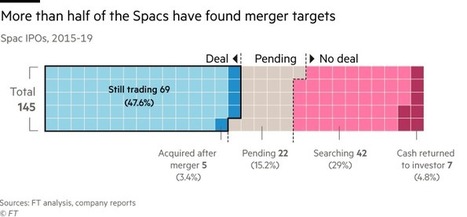
[...] From hedge fund billionaire Bill Ackman to sports executive Billy Beane of Moneyball fame, some of the most high-profile investors have sought to raise cash in blank cheque companies, believing they have the special eye to find under-appreciated businesses which they can bring to the public markets. By using Spacs, they can skip over the expensive and time-consuming IPO process. [...] The boom in Spacs is taking place at a time when trillions of dollars sitting in private equity and venture capital funds and many promising companies feel less pressure to go through the costly and time-consuming process of listing on the stock market in order to raise new money. For retail investors, Spacs present a chance to buy into fast-growing companies that might otherwise remain private. Yet a Financial Times analysis of the US blank cheque companies that were organised between 2015 and 2019 shows that these cash shell structures remain a dicey bet for ordinary investors. The majority lie below $10 per share, the standard price where Spacs first sell their shares to the public. Such disappointments have beset even veteran investors such as private equity firm TPG, which has three Spacs, none of which trade higher than $10.20. The poor investment record of many Spacs is a reminder that when Wall Street pushes a new product, clever financiers invariably find a way to shift the most risk on to ordinary investors - even if a new generation of Spac founders believes they will avoid the problems of the past. “Overall, investing in a Spac is like flipping a coin, where only half of them are shown to be value creating,” says Milos Vulanovic, a finance professor at EDHEC Business School who has studied the structure for years.
|
|
Scooped by
Institut sur la gouvernance (IGOPP)
August 13, 2020 9:35 AM
|
With the proliferation of information signals in both quantity and dimensionality in recent decades, investors face an increasingly complex portfolio choice problem. These forces create a classic signal-to-noise problem, in which an agent must dig through an ever-larger information set to decipher and to create profitable signals. In a Grossman-Stiglitz world, an agent will be happy to collect information up to their private marginal value of expected return from that activity. However, with hundreds of thousands of information signals being produced in any given day, how does an investor reduce the dimensionality of the investment problem sufficiently to know even which subset (or class) of signals have the potential to be informative and provide this return in expectation? Exactly how investors approach this foundational problem has remained largely a black box to researchers. In our paper, we offer a novel window into—as well as providing micro-level foundations with regard to—exactly what large portfolio managers do in the search process.
|
|
Scooped by
Institut sur la gouvernance (IGOPP)
August 13, 2020 9:24 AM
|
On July 22, the SEC finalized a sweeping rule change to enhance the transparency around the role of proxy advisers. This follows an earlier proposal to reform the process for including shareholder proposals in a company’s proxy statement.[1] These developments may give companies more ammunition against shareholder activism, while also highlighting the lack of transparency in the relationship between shareholders and companies. Even though the new rules address proxy advisers, it sets the stage for a closer look at how asset managers handle their relationship with corporations. Virtually every large asset manager relies on proxy advisers in deciding how to cast a ballot at shareholder meetings. [...] The SEC’s recent proxy adviser rule change was long anticipated. While there is no immediate evidence that proxy advisers misuse their influence on a large scale, there seems to be a consensus that their influence itself justifies tighter regulatory oversight and more transparency around potential conflict of interests. I find that an analogous reasoning can also be applied to the proxy voting and proxy-related engagements by the largest asset managers.
|
|
Scooped by
Institut sur la gouvernance (IGOPP)
August 12, 2020 11:44 AM
|
Down rounds—equity financing rounds where the company’s valuation is lower than at least one of its previous rounds of financing—have been rare in the sellers’ market of the past few years, where high valuations fueled by an abundance of capital is the norm. However, as the impact of COVID-19 and other black swan events permeates global economies, an increasing number of companies will grapple with fundraising in an environment of increased investor caution around valuations and deployment of capital, particularly for pre-profit companies in harder-hit sectors. In this installment of the MoFo PE Briefing Room, we discuss a few tips for investors when navigating a down round, both as an existing investor and as a new investor coming into the company.
1. Understand your rights. What are they, and how can you use them?
2. As a new investor, use your negotiation leverage over both the company and the existing investors.
3. Use the down round as an opportunity to renegotiate for better terms.
|
|
Scooped by
Institut sur la gouvernance (IGOPP)
August 12, 2020 10:37 AM
|
McDonald’s board is coming under scrutiny from some investors and corporate-governance groups for failing to fully uncover the extent of former Chief Executive Officer Steve Easterbrook’s inappropriate relationships with employees when concerns first emerged last year. The fast-food giant Monday sued Mr. Easterbrook, accusing him of lying to investigators to cover up relationships with employees to protect his multimillion-dollar severance package. The suit, a rare airing of corporate dirty laundry, follows the board’s decision to fire Mr. Easterbrook without cause last November after he acknowledged a consensual sexting relationship with an employee Outside counsel conducted an investigation into Mr. Easterbrook last fall and shared results with the board, which accepted Mr. Easterbrook’s word that it was his only relationship with a McDonald’s employee, according to the complaint. [...] The company now says he should have been fired for cause, and it is suing to reclaim his severance, now estimated to be worth $57.3 million, according to the executive-pay firm Equilar. [...] “McDonald’s current board of directors is simply not up to the task of overseeing the company for the long term,” said Dieter Waizenegger, CtW’s executive director. [...] The allegation of further relationships “calls into question the vibrancy of the first investigation,” said Charles Elson, a corporate-governance professor at the University of Delaware. [...] Mr. Elson said directors serving on multiple boards can be distracted from an internal investigation into an executive. Seven out of McDonald’s 11 nonexecutive members serve on other boards; average tenure for board members is about nine years, with its longest-serving member, Mr. Hernandez, at 24 years.
|
|
Scooped by
Institut sur la gouvernance (IGOPP)
August 12, 2020 9:52 AM
|
Last August, the Business Roundtable (an organization of around 200 corporate CEOs) announced it was amending its Principles of Corporate Governance to eliminate the statement that the “primary purpose” of a corporation was to serve its shareholders. The CEOs wanted to reconcile the statement of principles to what they felt they actually do – namely, balance the interests of a number of corporate stakeholders, including customers, employees, suppliers, and communities. The amendment reinvigorated the “shareholders vs. stakeholders” debate. The shareholder wealth maximization absolutists, like Professor Stephen Bainbridge at UCLA and a number of op-ed columnists at the Wall Street Journal, were aghast. The anti-corporate crowd, people like Senator Warren, thought it was at least a hopeful first step. My forthcoming article, The False Dichotomy of Corporate Governance Platitudes, suggests there is far less significance to the debate than meets the eye.
|
|
|
Scooped by
Institut sur la gouvernance (IGOPP)
August 14, 2020 11:48 AM
|
On April 12, 2018, Danone North America (NA) held a celebration in Manhattan to mark several recent achievements. Hosted by the company’s CEO, Mariano Lozano, the event would be viewed, either in real time or as a recording, by Danone employees around the world. It was the company’s first birthday—it had come into being the year before, as a merger of Danone’s North American dairy business and WhiteWave Foods. More important, it was the company’s first anniversary as a benefit corporation, an innovative corporate legal form that explicitly recognizes companies’ commitments and accountability to all stakeholders, not just shareholders. In addition, Lozano announced, the company had just become a Certified B Corp—a third-party certification demonstrating its high standards of environmental, social, and governance performance, and its commitment to be transparent about these issues to the public. [...] But critics of such commitments have questioned the extent to which they are just talk without action. For instance, Marriott, one of the BRT signatories, furloughed a large proportion of its US employees during the COVID-19 crisis while at the same time paying out more than $160 million in dividends to shareholders and seeking a raise for its CEO. The Council of Institutional Investors (CII) went so far as to dismiss such a shift in corporate purpose, saying that “accountability to everyone means accountability to no one.” The B Corp model addresses this issue of accountability directly by providing the tools, methods, and legal frameworks for companies to align their operations with long-term values that consider all stakeholders.
|
|
Scooped by
Institut sur la gouvernance (IGOPP)
August 14, 2020 11:18 AM
|
Depuis plus de cinq mois, le Québec est aux prises avec une situation exceptionnelle qui a nécessité, et nécessite toujours, des actions tout aussi exceptionnelles. Le Québec en entier a dû et su adopter de nouveaux comportements et de nouvelles habitudes. La résilience des Québécoises et des Québécois a été mise à rude à preuve, c’est le moins que l’on puisse dire. Cette nouvelle réalité est venue renforcer la solidarité québécoise. Chacun de nous s’est senti investi d’une responsabilité, d’un devoir d’agir pour la société, qui a vu trop de personnes souffrir des impacts de la pandémie sur les plans tant personnel, social qu’économique. Nous avons été interpellés comme citoyens et nos fondations ont ainsi décidé de contribuer à freiner la propagation de la COVID-19. Depuis le mois de mars dernier, un travail étroit de collaboration avec les milieux communautaire et scientifique, les élus locaux et les institutions publiques a été entamé. Ce travail de concertation a permis d’établir des plans d’action basés sur la science, adaptés à la réalité de chacun des territoires soutenus et répondant aux besoins locaux, car chaque communauté possède sa spécificité. Ces plans ont été élaborés par des partenaires sur le terrain qui connaissent parfaitement les enjeux et les solutions les plus propices dans leurs propres communautés. Dans une telle situation, les solutions mur à mur ne fonctionnent pas ; c’est plutôt le sur-mesure qui doit être valorisé.
|
|
Scooped by
Institut sur la gouvernance (IGOPP)
August 14, 2020 10:07 AM
|
Ethics in organisations remains a hot topic for academics and practitioners alike. For instance, most of the UN’s Sustainable Development Goals are related to the ethical behaviour of corporations. In the same vein, the August 2019 declaration of the Business Roundtable, an association formed by the chief executive officers of the largest American firms redefined the purpose of the corporation as “to promote an economy that serves all Americans”. [...] A subsequent, and potentially more fundamental step in this process, is the creation of ad hoc committees on the boards of directors. In that regard, the creation of an ethics committee at the highest organisational level should provide a powerful signal of the commitment of the board to the ethical agenda of the organisation. The study found that almost 40% of the examined firms had at least one committee that could be broadly defined as an ethics committee. [...] The countries with the largest proportion of firms with these types of committees are France (71%) and the Netherlands (53%), followed by Switzerland, the UK, Italy and Ireland, with percentages below 50%. Conversely, they are relatively unusual in Denmark (8%), Sweden (8%) and Germany (14%). Regarding the distribution by industry, not surprisingly, ethics committees are more common in the healthcare sector (explained by the obvious ethical implications of the activity) and the financial sector (in this case, likely representing a straightforward response to the 2008 financial crisis) than in other industries.
|
|
Scooped by
Institut sur la gouvernance (IGOPP)
August 14, 2020 10:02 AM
|
Montréal, le 13 août 2020 - Au terme du semestre terminé le 30 juin 2020, Capital régional et coopératif Desjardins (CRCD) annonce que le prix de son action passe aujourd'hui à 15,07 $, un recul de 0,87 $ par rapport au 31 décembre 2019. Pour le premier semestre de 2020, CRCD a réalisé une perte nette de 115,6 M$ pour un rendement négatif non annualisé de 5,2 %. L'actif net de CRCD se chiffrait à 2 005 M$ au 30 juin 2020. Ces résultats proviennent essentiellement du portefeuille d'investissements à impact économique québécois et de celui des autres investissements qui ont généré des rendements non annualisés respectifs de -9,6 % et de 2,2 %. Le rendement du portefeuille d'investissements à impact économique québécois découle principalement de la baisse de rentabilité de plusieurs entreprises qui ont été grandement affectées par les perturbations économiques. En effet, les entreprises des trois secteurs suivants ont été plus durement touchées, soit, Commerce de détail (B2C), Automobile et Arts, spectacles et loisirs. Cela dit, la crise sanitaire et la mise en arrêt d'une partie de l'économie ont épargné certaines de nos entreprises partenaires qui ont connu une bonne performance, notamment dans les trois domaines que sont le Transport, logistique et entreposage, le Génie civil et les Services professionnels, scientifiques et techniques.
|
|
Scooped by
Institut sur la gouvernance (IGOPP)
August 14, 2020 9:53 AM
|
Frank and Belinda Stronach ended an often-acrimonious three-year battle for control of a billion-dollar family business on Thursday with father and daughter exchanging kind words and agreeing to split their real estate, horse racing and farming businesses. Mr. Stronach, an 87-year-old who made his first fortune manufacturing auto parts, sued his daughter for control of the family company – The Stronach Group or TSG – after she cut off funding in 2017 for his passion project: a massive cattle ranch in central Florida and a planned chain of organic meat stores and restaurants. [...] On Thursday, the Stronachs announced the bulk of the court proceedings have been dropped. The family said they reached an agreement that will see Ms. Stronach continue to run TSG’s horse racing and real estate holdings – which include storied tracks such as Santa Anita in California and Gulfstream in Florida, which have stayed open during the pandemic – along with entertainment and gaming businesses tied to the properties. The 54-year-old is chair and president of TSG and has held the reins since 2011, when Mr. Stronach stepped down to run for political office in his native Austria. Prior to that, Mr. Stronach founded, then sold, Aurora-based Magna International Inc. Mr. Stronach and his wife, Elfriede, will take ownership of the family’s thoroughbred stables in Florida, Kentucky and Ontario, the farm businesses, a Florida golf course and investments in Europe. Going forward, the couple will no longer have any interests in TSG. Andrew Stronach is still suing his sister and sources say the siblings are attempting to resolve the dispute out of court
|
|
Scooped by
Institut sur la gouvernance (IGOPP)
August 14, 2020 9:22 AM
|
Montreal property developer Marcel Adams who survived the Holocaust and fought in Israel’s war of independence has died at the age of 100. Mr. Adams founded privately held Iberville Developments Ltd. in the 1950s, which became one of Canada’s largest shopping mall owners. He died on Tuesday according to a statement from his son Sylvan Adams. Mr. Adams passed away “peacefully at home, just nine days after we celebrated his 100th birthday,” Sylvan said. “He was a great man, a Holocaust survivor, who never complained, never looked back, only forward, as he worked hard to build a better life for himself and his family.” [...] Mr. Adams moved to Montreal in 1966 and expanded into financing with the launch of Les Placements Jeton Bleu Inc., or Blue Chip Investments, which specialized in high-risk commercial lending. When the real estate market took a downturn in the early 1990s, Blue Chip acquired dozens of highly leveraged properties that went into default, including the studio in Miami where the television show Flipper was filmed. By the late 1990s, Mr. Adams’s worth was estimated at $1.8-billion and Iberville owned some of Canada’s largest malls including Carrefour de l’Estrie in Sherbrooke and Les Galeries de la Capitale in Quebec City. The company has since sold those malls along with several others and has concentrated on other developments in Canada and the U.S.
|
|
Scooped by
Institut sur la gouvernance (IGOPP)
August 13, 2020 11:45 AM
|
[...] If corporate leaders have learned one thing from COVID-19, it is that such signs must not be ignored and resiliency must be built into successful business models. Nobody is saying that this is easy, and most organizations have a long way to go. To support this process, we have outlined six key steps that corporate boards may take to prepare for climate risk.
1. Start the conversation
The time is now to add climate risk to your board agenda. [...]
2. Know your ESG blind spots
Climate risk planning falls under the ‘E’ category of environmental, social and governance (ESG). [...]
3. IFTTT scenario plan
To prepare for climate risk, use ‘if this then that’ (IFTTT) scenario planning to map out all potential paths forward – including the most dire possibilities. [...]
4. Build your environmental reporting protocol
In conjunction with identifying your ESG blind spots, develop an ESG reporting system that aligns with your market’s ESG disclosure frameworks. [...]
5. Hold your organization accountable
Linked to required public disclosures, your board should drive your organization’s internal reporting around ESG. [...]
6. Strengthen your bench
Hand-in-hand with knowing your blind spots, you must recognize any organizational gaps in ESG skills and experience.
|
|
Scooped by
Institut sur la gouvernance (IGOPP)
August 13, 2020 10:33 AM
|
The U.S. remains a magnet for initial public offerings of Chinese technology companies, despite rising political, trade and regulatory tensions between the world’s two largest economies. More than 20 companies from China have gone public so far this year on the Nasdaq Stock Market or New York Stock Exchange, raising $4 billion in total, according to Dealogic data. Most specialize in high-tech industries such as software or electric vehicles. The sum already exceeds the $3.5 billion in combined IPO proceeds that 25 Chinese companies raised in the U.S. over the course of 2019. On Thursday, a Chinese online real-estate brokerage raised about $2.1 billion in an NYSE listing, after pricing its IPO above the top of an earlier price range. That will further boost this year’s tally. The company, KE Holdings Inc., is known in the country as Beike Zhaofang and counts SoftBank Group Corp. among its high-profile backers. Its IPO is the largest in the U.S. by a Chinese company since 2018. The deal will value the company at more than $22.5 billion. Banks have an option to increase the total size of the share sale by 15%. “The U.S. market is still the gold standard,” said Drew Bernstein, co-chairman of accounting firm Marcum Bernstein & Pinchuk LLP, whose clients include U.S.-listed Chinese corporations. “If somehow the listing rules are changed and the doors are closed on Friday, you’ll probably see a Chinese IPO on Thursday.”
|
|
Scooped by
Institut sur la gouvernance (IGOPP)
August 13, 2020 9:31 AM
|
Welcome to the “next normal”—the new reality emerging from the ongoing COVID-19 pandemic. How will life, public health, and business continue to change? We’ve chronicled our response in a wide-ranging series of publications—more than 500 articles and counting since the outbreak began. This volume is the first of five edited collections produced to accompany “Our New Future,” a multimedia series we created with CNBC. This collection focuses on the vital role of digital in today’s businesses. Many organizations were already in the throes of digital transformations pre-pandemic, before COVID-19 accelerated the pace of business
across the globe. Some sped up efforts already under way; others implemented digital capabilities for the first time—as a matter of survival. In these pages, we have collected some of the best insights we published during these hectic months— on how top executives have led on digital initiatives, what specific companies across industries have done differently, and the special challenge of cybersecurity.
|
|
Scooped by
Institut sur la gouvernance (IGOPP)
August 12, 2020 11:55 AM
|
An Eastman Kodak board member donated $116m in company shares to an Orthodox Jewish congregation just before their price collapsed, raising further questions about how company insiders benefited from a controversial US government loan. George Karfunkel, a Kodak director, and his wife, Renee, donated 3m shares to Chemdas Yisroel, on July 29, according to a Kodak filing with the Securities and Exchange Commission. The stock donation would entitle the Karfunkels to take a sizeable tax deduction. The shares had spiked more than 1,000 per cent after a US government agency announced it was granting Kodak a $765m loan to begin producing pharmaceutical ingredients to treat Covid-19 patients. Shares peaked at $60 on the day the transfer was made, but averaged nearly $39 that day. The government’s development finance corporation has since said it would delay the loan as questions have swirled about its propriety. Democrats in Congress have called for an investigation, noting that Kodak does not have any experience in the pharmaceuticals business, and raising questions about improper trading by executives ahead of the news.
|
|
Scooped by
Institut sur la gouvernance (IGOPP)
August 12, 2020 10:58 AM
|
The last time Credit Suisse was neck and neck with the likes of Morgan Stanley and Goldman Sachs as a top underwriter of equity offerings, the Zurich-based bank still had the words First Boston in its name. But this year, it has one major Wall Street trend to thank for putting it back in the top three for the first time since 2005: a boom in so-called blank cheque companies. Special purpose acquisition companies, or Spacs, have grown from a niche part of equity markets to become a popular alternative route to public markets. Such vehicles raise money from investors with the aim of finding a private company to buy; if the sponsors fail to do that within a certain period, the Spac is dissolved and the money returned to shareholders. The rise of the Spacs has generated thick streams of fee income for underwriters and prompted several investment banks to reshuffle their equities teams to ride the trend. “The market is booming,” said Christian Nagler, a partner at law firm Kirkland & Ellis. “All the major banks are focused on Spacs and we are seeing a huge increase in high-quality, first-time issuers.” Spacs have raised $23.9bn this year, globally, already eclipsing last year’s record haul by 70 per cent, according to financial data provider Refinitiv. Almost all of that — $23.6bn — was generated in the US. Blank cheque companies now account for one in five dollars raised in initial public offerings: about three times the share of last year.
|
|
Scooped by
Institut sur la gouvernance (IGOPP)
August 12, 2020 9:54 AM
|
Research finds shareholder pay revolts halve year-on-year. Shareholders appear to be happier with chief executive pay levels. Evidence collected by close observers reveals that the number of FTSE 100 companies seeing a shareholder revolt—a vote of less than 80% in favour of a remuneration report—has halved year-on-year. The news comes at a time of renewed interest in chief executive pay prompted by the Covid-19 crisis and a concern that companies move to a “stakeholder” model of governance. Many investors made it clear at the outset of the pandemic lockdown that they expected executives to share the pain of lower wages as their workers were furloughed or laid off. The new research reveals that FTSE 100 pay revolts were cut to 4% during 2020, down from the 7.5% of 2019, which was a reduction from 13% in 2018. Conducted by Deloitte, the research also shows median support for annual remuneration reports at 96%. Deloitte believes increasing shareholder satisfaction is explained by cuts to contractual pensions for existing executives.
|