Your new post is loading...

|
Scooped by
Institut sur la gouvernance (IGOPP)
August 16, 2021 10:45 AM
|
A new initiative seeks to encourage directors, managers, asset owners, and other internal and external stakeholders to collaborate on articulating an actional principle of corporate purpose which will orient firms towards mission-driven growth that delivers both profit and social responsibility.
|
|
Scooped by
Institut sur la gouvernance (IGOPP)
August 16, 2021 10:42 AM
|
New York on Monday becomes the first major U.S. city to launch a vaccine passport system, marking a new phase in its efforts to curb the spread of the coronavirus as caseloads there and across the country rise.
|
|
Scooped by
Institut sur la gouvernance (IGOPP)
August 16, 2021 10:29 AM
|
Europe’s largest lender to pay $575m for insurance assets in city as part of pivot to region
|
|
Scooped by
Institut sur la gouvernance (IGOPP)
August 16, 2021 10:14 AM
|
The pay package of Musk, who is also a major shareholder and CEO of rocket maker SpaceX, requires Tesla's market capitalization and financial growth to hit a series of rising targets.
|
|
Scooped by
Institut sur la gouvernance (IGOPP)
August 16, 2021 9:12 AM
|
A faster short-term U.S. expansion would delay the day when China’s economy overtakes America’s in size
|
|
Scooped by
Institut sur la gouvernance (IGOPP)
August 16, 2021 9:11 AM
|
Federal Reserve officials are nearing agreement to begin scaling back their easy money policies in about three months if the economic recovery continues, with some pushing to end their asset-purchase program by the middle of next year.
|
|
Scooped by
Institut sur la gouvernance (IGOPP)
August 16, 2021 9:03 AM
|
With the increasing internationalization of law and legal scholarship, comparative corporate governance has seen a burgeoning volume of research from a practical, theoretical, and empirical perspective. Practically speaking, both internationally and within individual countries, most corporate governance research deals with the interaction between board members, officers, and shareholders, primarily in large, publicly traded corporations.
|
|
Scooped by
Institut sur la gouvernance (IGOPP)
August 13, 2021 11:13 AM
|
Kansas City Southern said on Thursday it has turned down a US$27 billion bid from Canadian Pacific Railway and will delay a shareholder vote on a US$29 billion deal to sell itself to Canadian National Railway Co if the rail regulator does not rule on the deal in the next five days. Kansas City Southern shareholders are due to vote on the deal with Canadian National in seven days, on Aug. 19, but the Surface Transportation Board (STB) has yet to rule on the proposed “voting trust” structure of the transaction. [...] Canadian Pacific presented the US$27 billion offer for Kansas City Southern on Tuesday, hoping the antitrust concerns would give it an edge. It had said it would allow Kansas City Southern’s board to receive the STB decision before opining on it. Kansas City Southern, however, took two days to review the bid with its financial and legal advisers, and said it found it not superior to the Canadian National deal. Despite the rejection, Canadian Pacific said on Thursday it applauded the Kansas City Southern board decision to adjourn the shareholder vote absent a ruling from the STB. Canadian National said in a statement it also supported Kansas City Southern’s decision to potentially delay the shareholder vote.
|
|
Scooped by
Institut sur la gouvernance (IGOPP)
August 13, 2021 10:37 AM
|
Dan Loeb’s Third Point LLC is a prototypical activist investor, agitating for changes at huge companies such as Intel Corp. , Sony Group Corp. and Prudential PLC. Now his listed investment vehicle is the target of an activist campaign of its own, and while the two sides are at loggerheads, shareholders are enjoying the spoils of the fight. In May, Asset Value Investors, one of the listed fund’s shareholders with a more than 10% stake, began clamoring for changes. The London-based investor, which manages around £1.5 billion, equivalent to $2.1 billion, said it had significant concerns with the performance of the fund related to the discount at which shares trade to their underlying net asset value. Since its inception, Third Point Investors’ shares have traded at a discount. [...] The board of Third Point Investors has rejected the suggestions the activists made, saying they would lead to an exodus of investors from the listed vehicle and that the continuing measures would form a consistent policy over a period of years to fix the issues.
|
|
Scooped by
Institut sur la gouvernance (IGOPP)
August 13, 2021 10:00 AM
|
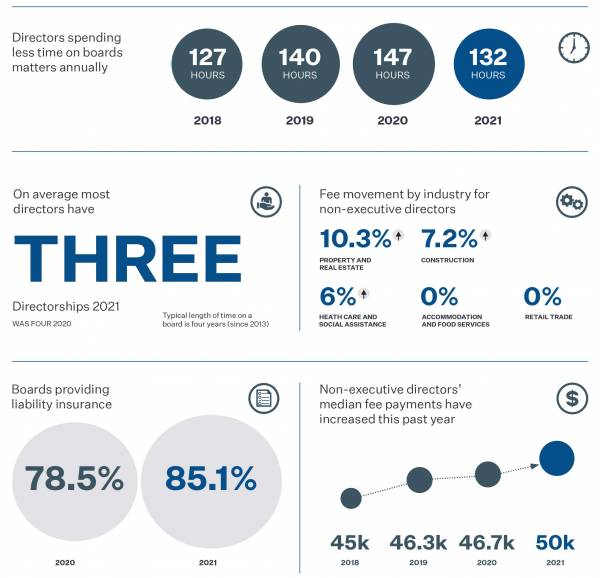
The Institute of Directors (IoD) with EY has released its 2021 Directors’ Fees Report. The report is a key source of information on director remuneration trends in the New Zealand market. This infographic is a snapshot of the results of the survey of 1,768 directorships covering 571 members and 1,039 organisations. Fees paid to directors began to lift during the past year, after many stopped being paid or took reduced fees last year, the Directors’ Fees 2021/2022 Report has revealed. “In last year’s fee survey, many directors reported devoting more time to board duties, often for reduced fees or foregoing payment altogether due to the pandemic,” said IoD General Manager, Learning and Branch Engagement, Dr Michael Fraser.
|
|
Scooped by
Institut sur la gouvernance (IGOPP)
August 13, 2021 9:37 AM
|
Wildfires, US winter storms and tornadoes in Europe helped deal an estimated $40bn blow to global insurers in the first half of 2021, marking the worst start to a year for natural catastrophe insurance in a decade. [...] The rising costs reflect the increased threat to the insurance sector as extreme weather combines with population growth and construction that can result in less water being absorbed into the ground, for example. [...] Insurers are coming under pressure from investors and campaigners to withdraw support for the most carbon-intensive activities, to help limit greenhouse gas emissions to net zero by 2050. [...] On current risk modelling, the insurance sector should have the capacity over the next two decades to absorb the rising costs of natural catastrophes in general, Bertogg said, but he expected more “patches” where buying insurance cover would become uneconomical.
|
|
Scooped by
Institut sur la gouvernance (IGOPP)
August 13, 2021 9:31 AM
|
The Conference Board convened a working group involving over 300 executives from 150 companies to discuss how companies can tell their sustainability stories authentically, reliably, and effectively to multiple constituencies. This overview captures the insights, guidance, and best practices from the working group sessions. Additional details can be found in the four accompanying Practical Guides.
|
|
Scooped by
Institut sur la gouvernance (IGOPP)
August 13, 2021 9:26 AM
|
Congressional critics of the agencies reviewing bank mergers have in recent months claimed that those agencies “rubber stamp” mergers and that merger review standards relating to antitrust are too lax. We believe those critics are misinformed. Bank mergers are among the most regulated in the economy. The Federal Reserve Board (the “Fed”) has extraordinary, virtually carte-blanche power in approving or denying bank holding company mergers (as do the OCC and FDIC with respect to bank mergers), reviewable only by a federal appeals court and under a highly deferential standard of review. Their determinations, especially with respect to facts related to competitive effects, are treated as conclusive in federal appeals court. Merger applicants essentially have no recourse after an adverse decision by the Fed.
|
|
|
Scooped by
Institut sur la gouvernance (IGOPP)
August 16, 2021 10:44 AM
|
As boards of directors reconvene in person and emerge from their virtual boardrooms, they will be well-advised to review and update the purpose of the corporation to reflect the realities of easing pandemic restrictions.
|
|
Scooped by
Institut sur la gouvernance (IGOPP)
August 16, 2021 10:30 AM
|
American tech companies lead the world’s top 10 by market value and many commentators and investors see no reason to question their continued dominance. Dozens of analysts rate each of the big tech firms, and every single one of them currently has a buy rating on Alphabet, Amazon and Microsoft. Apple and Facebook are also more widely favoured than the typical stock.
|
|
Scooped by
Institut sur la gouvernance (IGOPP)
August 16, 2021 10:29 AM
|
Countries from Germany to Italy are deploying measures ranging from more vaccinations to mask mandates ahead of the third pandemic winter
|
|
Scooped by
Institut sur la gouvernance (IGOPP)
August 16, 2021 10:13 AM
|
The key is to first recognize your anxiety, and then find ways to deal with it
|
|
Scooped by
Institut sur la gouvernance (IGOPP)
August 16, 2021 9:11 AM
|
The Covid-19 variant is damping demand and raising costs after a spring and summer that seemed to promise a rapid recovery
|
|
Scooped by
Institut sur la gouvernance (IGOPP)
August 16, 2021 9:09 AM
|
The world’s biggest mining company says it is in talks to sell the division to Woodside Petroleum, among other options
|
|
Scooped by
Institut sur la gouvernance (IGOPP)
August 13, 2021 11:30 AM
|
Kansas City Southern says it will delay a shareholder vote on its deal to be bought by Canadian National Railway Co. that is set for Aug. 19 if a U.S. regulator does not release its decision on a key voting trust by Aug. 17. The trust would allow KCS to remain independent while a full review of the transaction is conducted, but allow shareholders to be paid without having to wait for a final decision on the deal. The U.S. Surface Transportation Board has said it will make a decision on whether to allow CN to use the trust by the end of August. The KCS board also reaffirmed its support for the CN offer despite a sweetened bid by Canadian Pacific Railway Ltd. earlier this week. KCS says the CP Rail’s new offer, which is up from its bid earlier this year, did not constitute a “superior proposal” to the CN deal. CP Rail’s offer valued at US$31-billion is less than CN’s proposal valued at US$33.6-billion, but CP Rail says its offer comes with less risk for shareholders because it is more likely to be approved by regulators.
|
|
Scooped by
Institut sur la gouvernance (IGOPP)
August 13, 2021 10:40 AM
|
[...] Firms that audit private entities essentially police each other, often with no public disclosure. A Wall Street Journal analysis of the system shows that auditors give top grades to one another, hardly ever find fault with the biggest accounting firms and often don’t disclose failures among smaller auditors. Of the firms that disclosed their results, 91% got the highest “pass” grade and only 4% the worst “fail” score on the three-grade scale, the analysis found. None of the biggest 100 firms failed, and 99% of them got the top “pass” score, according to the analysis. Research by the government and data from the auditing industry trade group show significant flaws in audits of private organizations, particularly those done by smaller firms. [...] The flawed audits potentially affect the savings of millions of people. More than 200,000 employee-benefit plans, with $449 billion in total assets, are audited by firms that do fewer than 25 such audits a year, a Journal review of data for plans in 2018 found.
|
|
Scooped by
Institut sur la gouvernance (IGOPP)
August 13, 2021 10:35 AM
|
Shareholders in inhaler company Vectura have been stuck between two less-than-ideal suitors of late. Now, they must decide whether to accept a recommended offer from a tobacco company that could taint their ESG credentials. Late Thursday, Vectura’s board put its weight behind Philip Morris International’s £1.1 billion offer for the company, equivalent to $1.5 billion. [...] Philip Morris thinks it has an ESG angle, although it’s a complicated sell. The tobacco giant wants to reduce its reliance on old-school smokes and make more than half of net revenue from noncombustible products like heated tobacco by 2025. In February, it also set a new target to generate $1 billion in annual revenue from non-nicotine products. The company agreed to buy two inhaler brands this year without much controversy—but both were privately owned. [...] The cigarette giant needs more than half of shareholders to tender their shares to gain control of Vectura. Unless a new suitor emerges from the ashes, investors will have to decide whether taking money from big tobacco is compatible with a reputation for socially responsible investing. How many of them sell out to Philip Morris will be a litmus test of what happens to ESG concerns when hard cash is involved.
|
|
Scooped by
Institut sur la gouvernance (IGOPP)
August 13, 2021 9:42 AM
|
In the wake of the Black Lives Matter Movement of 2020 and the resulting national conversation on race and equity, many companies have taken meaningful steps to achieve greater diversity, equity, and inclusion (DEI) in their respective workplaces. The technology industry, in particular, has made several notable strides towards these laudable goals. We analyzed publicly available DEI information from 25 of the top tech companies [1] in the United States and found several approaches to driving holistic and lasting change in workplaces across all industries. We have highlighted the best practices we have seen as advisors to many companies looking to make progress in DEI while, at the same time, taking steps to minimize legal issues that can arise from some initiatives. These best practices include hiring a Global Head of Diversity, implementing a diverse slate hiring protocol, and creating and supporting employee resource groups (ERGs).
Best Practice 1: Hire a Global Head of Diversity
Best Practice 2: Diverse Slate Protocol
Best Practice 3: Establish Employee Resource Groups (ERGs)
Best Practice 4: Support ERG Leaders
|
|
Scooped by
Institut sur la gouvernance (IGOPP)
August 13, 2021 9:33 AM
|
Employees are taking sensitive computer code from their own companies at three times the rate they were a year ago, according to new research into so-called insider threats, as record numbers of disgruntled workers quit their jobs with pandemic restrictions easing. An analysis of data of 700,000 company devices by the cyber security group Code42 found that there were about 65m attempts made by staff to exfiltrate source code from their corporate network in the three months to the end of June, up from about 20m in each of the previous three quarters. The jump is part of a broader rise in employees exposing company data, either by unwittingly moving it outside of workplace networks or by deliberately taking it, according to Joe Payne, Code42’s chief executive. “We’re just seeing a huge increase in employees taking source code from their companies,” Payne said. “It’s highly correlated to turnover . . . We’ve seen more job changes this quarter than we’ve seen in a couple of years now.”
|
|
Scooped by
Institut sur la gouvernance (IGOPP)
August 13, 2021 9:27 AM
|
In a recent working paper, I explore the intersection of contemporary corporate governance and transnational law. Transnational law is, of course, far from a settled concept. For early theorists, it involved conduct or events that crossed national boundaries. More recent scholarship, however, has focused not on what is being regulated, but rather on how laws and norms are transmitted between supranational and local levels. Corporate governance fits naturally within this modern conception of transnational law. Today’s corporate governance is highly fragmented and includes a complex array of public and private actors. It also embodies legal and non-legal elements, which operate to constrain and enable the behavior of these key corporate actors – a central aspect of transnational legal ordering. Also, financial markets are now global and interconnected and events, such as the 2007-2009 global financial crisis and the current COVID-19 pandemic, exemplify the risk of contagion across markets at a supranational level.
|