Interview with George Siemens for the Brain (Building Research and Innovation Networks) project at Coventry University, UK. Brain was part of the JISC VRE3 p...
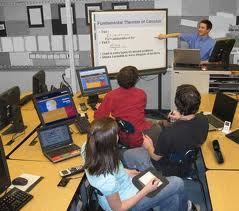
The classrooms are starting to introduce wiki's, blogs, skyping, podcasting, google calendar, and kaboodle just to name a few. Personally I have started to use all of these resources and I love the way the classroom is changing and so do my students.
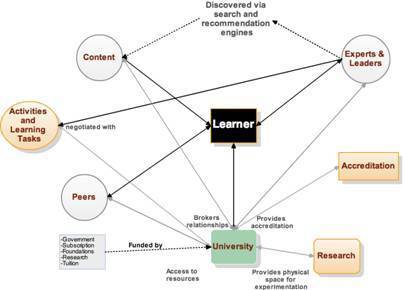
Since Illich's 1970 vision of learning webs, society has moved progressively closer to a networked world where content and conversations are continually at our finger tips and instruction and learning are not centered on the educator. The last decade of technological innovation - mobile phones, social media, software agents - has created new opportunities for learners. Learners are capable of forming global learning networks, creating permeable classroom walls.
Dr. Michael Orey states that social learning theory is a collaborative learning construct where “interaction occurs when students are engaged in constructing things and conversations” (Laureate, 2009).
There is a problem with the conventional categories (such as cognitivism, instructionism / behaviourism, constructivism, connectionist / connectivism, neuroscience) because some (many?) learning theorists bridge more than one category
Connectivisim is a powerful model of knowledge and collaboration. But as a “learning” activity and a theory about how people learn, connectivism does not support students when one of its foundations is the belief that the conduits of learning (the pipes) are more important than the content.
New research seems to show that our memories are less accurate when we know the information is stored somewhere else. Some feel this is going to make us less human in some way, but I for one am glad to outsource parts of my brain.
In one experiment, participants were given pieces of information to type into a computer. Half were told the computer would retain the information and the other half were told it would be erased.
Notwithstanding all that lot, many researchers (e.g Bruning, Eggan etc) argued that knowledge must initially be constructed in a social context before it can be appropriated by individuals and Vygotsky’s basic premise was that meanings and understandings grow out of social encounters.
I am a little behind in my context filtering of the Connectivism conference from the view point of children of poverty - or my attempt at being a Voice for the Voiceless. Reflection is an important part of sharing ideas...
This is a running log of phrases, quotes, words, images, video, and diagrams that are helping me to understand the nature of knowledge, learning, and educational institutions.
The speed at which technology changes has made information time sensitive. Learning in this field can never end unless you wish to focus on a specific tool. The advantages educationally to sharing through networks provides necessary knowledge to evaluate, synthesize, and create learning opportunities for others. Determining value of the ever-increasing technological tools developed helps design appropriate purposes to guide and facilitate users.
What adjustments need to be made with learning theories when technology performs many of the cognitive operations previously performed by learners (information storage and retrieval)?
I have been watching with interest the phenomenal discussion that Jason Hando started about bringing connectivism to the classroom. I'd like to share with you two comments that got me thinking tonight!
Trying to grasp the arguments of Connectivism as a Learning Theory has not been easy for me. I can certainly understand both sides of the argument,....
To get content containing either thought or leadership enter:
To get content containing both thought and leadership enter:
To get content containing the expression thought leadership enter:
You can enter several keywords and you can refine them whenever you want. Our suggestion engine uses more signals but entering a few keywords here will rapidly give you great content to curate.


 Your new post is loading...


 Scoop.it!