


Michele Molnar is a veteran journalist who has written about education at the local and national levels, as well as about business and community associations.

 Your new post is loading...
 Scoop.it! Michele Molnar is a veteran journalist who has written about education at the local and national levels, as well as about business and community associations. 
No comment yet.
Sign up to comment
Scoop.it!

Lori McCall's curator insight,
February 14, 2013 11:16 AM
Okay, this is the first scoop I've done, but this site has some pretty cool info. Tech Integration within the CC is going to be a vital push for media specialists, so get started today!
Scoop.it!

Making the Common Core Practical Study says adults find online information better than teens. PARCC, are you designing your Common Core tests using research-based usability standards?

Jennifer Hurley-Coughlin's curator insight,
February 15, 2013 8:09 AM
Haiku with our embedded videos/multimedia may help...
Scoop.it!
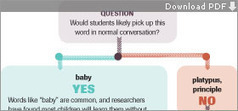
Without better instruction, children starting school with small vocabularies will struggle with common standards, scholars say. "Common core is really pushing you to do two things: Don't neglect vocabulary in the text you are reading, but simultaneously you are responsible for expanding students' vocabulary."
Scoop.it!

Jason Zimba in EdWeek "It is incorrect to say that algebra isn't covered until high school. There is a great deal of algebra in the 8th grade standards. For example, students in grade 8 are expected to solve two simultaneous equations with two unknowns. I don't see a lack of rigor there. The standards actually invest heavily in algebra because of the way they focus so strongly on the prerequisites for algebra in the elementary grades. I actually think the questions about algebra are better formulated as questions about acceleration. How will kids who are ready for advanced work accelerate to reach courses like calculus during high school? But those are questions for policy, not for standards. The standards don't speak to this issue. Decisions about acceleration and ability grouping are still the purview of local districts, just as they've always been. For example, I've seen where the state of Massachusetts has provided some interesting guidance for districts showing several different models for acceleration, all of them ending at calculus in the senior year of high school."

alexparrish's curator insight,
January 16, 2014 7:15 PM
In this article that I scooped the main topic of this is how 8th graders are expected to do a little bit of algebra. Then it talks about how they are supposed to be able to solve a problem that has two unknowns. Then he talks about how it has to do with a lot of algebra because it somehow invests a lot to do with algebra. Then he starts talking about how algebra is better described with questions about acceleration. One way he says its better described in terms of acceleration is they start getting better and accelerating faster. The last part of the paragraph is a little bit confusing to me but I tried to put it in my best words.
Scoop.it!

Reading Wars I: Whole Language vs. Phonics Reading Wars II: Complex Text and Close Reading vs. "Leveled" Text "leveled literacy programs and related assessments fail to measure up to what the CCSS demands."
Mel Riddile's insight:
Key Points for Principals by Kathleen Porter-Magee: 1. Research does not support the use of leveled text! "Unfortunately for students, the popularity of these programs is not driven by convincing research proving their effectiveness. In fact, as noted literacy expert Tim Shanahan discussed in a series ofmust-read posts on his blog nearly two years ago, I have sought studies that would support the original contention that we could facilitate student learning by placing kids in the right levels of text. Of course, guided reading and leveled books are so widely used it would make sense that there would be lots of evidence as to their efficacy.Except that there is not." He goes on to explain: “I keep looking and I keep finding studies that suggest that kids can learn from text written at very different levels.” In short, he argues, “we have put way too much confidence in an unproven theory. “ 2. Quantitative Measures alone are not sufficient to determine the appropriateness of text for all students. 3. Leveled texts set the bar too low and are too easy = low expectations 4. Leveled texts minimize teacher input
Scoop.it!

Judging from students’ initial experience in a new math course, Georgia’s move to a common core of academic standards shared by 44 other states won’t be painless. Just under 59 percent did not meet the standard set for an end-of-course test after they took a new algebra course tied to the common core. "Georgia does not do a good enough job teaching young students the basics of math, a failure that shows up in later years when they are exposed to rigorous material like that found in coordinate algebra. He also said students are expected to retain too much information from a single course."
Scoop.it!

Long before corporate America began its assault on public schooling, American education was in trouble. Here's why, and what to do about it.
Scoop.it!

Mathematical literacy is an important skill for the 21st century. Being to to do simple math in your head is useful and important, and we're losing that ability. "There’s a culture among schoolkids to dislike math and the perception that it’s largely useless." "...as soon as you fear a subject, or don’t want to learn it, you won’t." “I just don’t get math.”
Scoop.it!

One great resource and support for this transition is The Alabama Learning Exchange. This website has practical ideas and examples of alignment and lessons for math and language arts. A unique training strategy Alabama is implementing is the use of Regional Support Teams.
|
Scoop.it!

The Common Core was a hot topic at the ALA midwinter meeting in Seattle, specifically at a standing-room only discussion group where more than 80 librarians gathered to learn more about the new state standards, and to share their own experiences...
Scoop.it!

The case against testing is remarkably weak
Scoop.it!

IRA Reading Today Online by Ruth Culham February 12, 2013 The 4Ws

Jenna Quarelli-Buck's curator insight,
February 13, 2013 2:14 PM
An interesting article... especially if you come from a 6+1 Traits tradition of writing instruction.
Scoop.it!
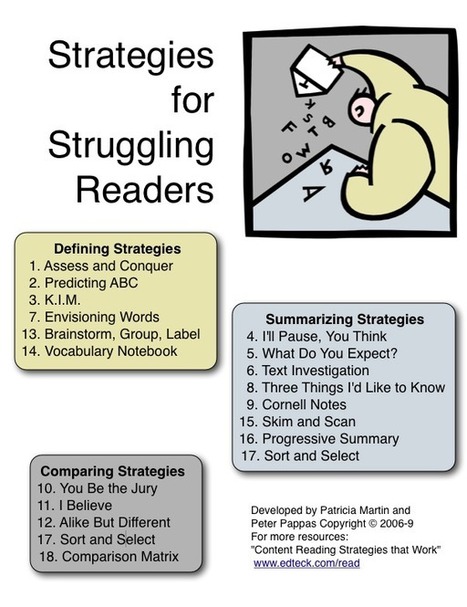
Copy/Paste by Peter Pappas 18 Common Core lessons organized by comprehension strategy – defining, summarizing and comparing. A free PDF download
Scoop.it!
SchoolsMovingUp provides quality resources and online professional development to help educators make sound decisions and take action in their school improvement efforts.
Scoop.it!

In all the hubbub about the balance of fiction and nonfiction in the common core, you might well have been hearing less lately about its other expectations. One of those is a renewed focus on the teaching of vocabulary, especially academic vocabulary. Huge Achievement Gaps "There is too little teaching of vocabulary in general, and that children in higher-poverty schools tend to get even less of it than those in lower-poverty schools. When you combine that with the recognition that children in higher-poverty schools typically learn fewer words at home, as well, it's easy to see huge gaps taking shape."
Scoop.it!

by Rick Hess Straight Up Conversation: Common Core Guru Jason Zimba Key Indicator of Common Core Math Implementation: "Until we see fewer topics and a strong focus on arithmetic in elementary grades, we really aren't seeing the standards being implemented."--Jason Zimba
Scoop.it!

Tim Shanahan on Literacy
Mel Riddile's insight:
Key Point on Increasing Rigor: Instead of asking what book level to teach someone at, teachers should ask, “If I place a student in a book this challenging, how much support will I need to provide to enable him/her to learn from this text?"
Scoop.it!

A great strategy for building vocabulary for any student. Using paint chips, teachers provide students with a visual aid to better understand difficult vocabulary. Covers Common Core for the meaning of unknown and multiple-meaning words.

Renee VanderMeer's curator insight,
February 25, 2013 1:13 PM
Great for teaching nuances in meaning. 
debbie thomas's curator insight,
March 24, 2013 7:26 PM
This is another way to think about word gradients. 
Sayles Yourhistoryteacher's curator insight,
July 30, 2014 2:30 PM
Home improvement meats Webster...
Scoop.it!

The Common Core identifies six instructional shifts needed to effectively implement the standards in ELA/Literacy. Shift 6 suggests an instructional change in the teaching of Academic Vocabulary.
Scoop.it!

By on February 10, 2013 8:17 AM "Unfortunately, try as we may, many of us who are principals have not had to teach the Common Core State Standards. Perhaps we even taught in grade levels that did not have high stakes testing and never felt the immediate pressure of that type of accountability. We discuss, research, and pontificate about student engagement, but the only ones who can account for our own teaching expertise are our former administrators and students."
Scoop.it!

A website for teachers filled with ideas for literacy teaching using visual resources such as film, animation, photographs and picture books. Via Ana Cristina Pratas

Michael Stapleton's curator insight,
February 18, 2013 11:44 AM
A website for teachers filled with ideas for literacy teaching using visual resources such as film, animation, photographs and picture books. |






