 Your new post is loading...

|
Scooped by
Mel Riddile
March 14, 2013 8:40 AM
|
These resources were created to help principals and teacher leaders develop their capacity to facilitate school-based collaborative professional learning focused on teaching and learning. The four units below cover key topics in leading professional learning tied to implementing content standards.
|
|
Scooped by
Mel Riddile
March 13, 2013 3:46 PM
|
"We have a lot of work to do in reorienting what we're doing in the classroom to achieve the [vision] of the common core."
"Many teachers say they do not feel well-equipped to plan lessons that meet the needs of students at varying levels of understanding."
|
|
Scooped by
Mel Riddile
March 13, 2013 6:39 AM
|
What Are The Habits Of Mind?
|
|
Scooped by
Mel Riddile
March 11, 2013 4:01 PM
|
A blue-ribbon panel offers a 10-year plan for assessment systems that go beyond accountability.
|
|
Scooped by
Mel Riddile
March 10, 2013 11:42 AM
|
by Tracee Orman
Common Core Aligned "What's Hot?" and "What's Not?" Alternative Reading Assessment
Use this "What's Hot? What's Not?" activity after reading a chapter, studying a unit, learning a concept, reading a short story, watching a video, etc.
|
|
Scooped by
Mel Riddile
March 10, 2013 11:37 AM
|
- A close reading of text is a rereading of a small slice of a story (or something that is short to begin with, like a poem or an essay)—perhaps rereading it many times.
- Then, through careful inspection of words, sentences, paragraphs, and the way they work as parts and together as a whole, the teacher leads the students to discern the author’s meaning.
- Students are guided to provide “textual evidence” that the author’s meaning is what it is. They can’t guess, based only their prior knowledge and a cursory look at the words on the page, what the author intends. This means, practically, that a Cliff Note’s acquaintanceship with the text won’t cut it.
|
|
Scooped by
Mel Riddile
March 7, 2013 10:34 AM
|
"As the new tests aim to measure students' preparation in new and more subtle ways than the current set of state assessments -- including the measuring of writing abilities at every grade level -- they'll require more time in addition to more computers."
|
|
Scooped by
Mel Riddile
March 7, 2013 10:11 AM
|
- Try telling kids you’re going to read like writers,”
- “We had to change the way [they] thought about text.
- Teachers needed to change their planning and get to know their texts really well.”
- teach close reading in all classes, not just English
- Common Core-aligned texts... are harder than any their students have faced before.
- With a focus on textual evidence under the new standards, “there’s a real ‘right is right’ approach that I’ve never felt as an ELA teacher.”
- “The teacher is prompting and coaching as compared to direct teaching,” “And that means teachers giving up control. That’s hard.”
- “The focus on questions could be really helpful to us.”
- finding texts is one of the hardest parts of adapting classes to the new standards.
|
|
Scooped by
Mel Riddile
March 5, 2013 8:55 AM
|
|
|
Scooped by
Mel Riddile
March 5, 2013 8:47 AM
|
|
|
Rescooped by
Mel Riddile
from Digital Delights for Learners
March 2, 2013 10:56 AM
|
|
|
Scooped by
Mel Riddile
March 1, 2013 5:00 PM
|
|
|
Scooped by
Mel Riddile
March 1, 2013 7:09 AM
|
Digital Text & the Common Core Standards NWP
|
|
|
Scooped by
Mel Riddile
March 13, 2013 4:01 PM
|
Fewer than one in five students who took an Algebra I "honors" class were actually exposed to rigorous mathematics, according to the National Assessment of Educational Progress's latest high school transcript study.
|
|
Scooped by
Mel Riddile
March 13, 2013 2:49 PM
|
|
|
Scooped by
Mel Riddile
March 13, 2013 6:35 AM
|
Elementary school Principal Peter DeWitt writes about students' social and emotional health, and how educators can help young people find common ground. He can be found at www.petermdewitt.com.
|
|
Scooped by
Mel Riddile
March 11, 2013 3:58 PM
|
“The ELA/Literacy Performance-Based Assessments (PBAs) at each grade level will include three tasks - a research simulation
- a literary analysis
- narrative task
|
|
Scooped by
Mel Riddile
March 10, 2013 11:38 AM
|
Teaching students to use textual evidence is a key component of the Common Core. Learn how to teach students to cite textual evidence, engage in collaborative discussions and draw evidence from literary text in preparation for writing.
|
|
Scooped by
Mel Riddile
March 7, 2013 10:50 AM
|
The goal of the Common Core assessments, as with the curricula itself, is to devise a richer, more thoughtful approach to K-12 learning, one that is – in the words of the Common Core developers – “fewer, clearer, higher.”...
- CCSS “will have a huge impact on how teachers are expected to teach, students are taught to think, and how both students and teachers are evaluated.”
- a truly foundational change.
- “With the new standards, teachers will have to have increased content knowledge -- knowledge that looks different than it did in the past,”
- We are going to make sure that we are teaching differently.”
- “But it’s been a really short timeline,”
- The goal of the tests, as with the curricula itself, is to devise a richer, more thoughtful approach to K-12 learning, one that is -- in the words of Common Core developers -- “fewer, clearer, higher.” But while the aim is simplicity, the tasks involved in meeting that goal are exceedingly complex.
|
|
Scooped by
Mel Riddile
March 7, 2013 10:18 AM
|
A Key Common Core Skill > Eye On Education
The importance of critical thinking is noted in the new national standards. The Common Core State Standards (CCSS) Initiative directly identifies higher-order thinking skills as critical to achieving career and college readiness for all students.
|
|
Scooped by
Mel Riddile
March 6, 2013 6:22 PM
|
The Partnership for Assessment of Readiness for College and Careers (PARCC) today announced a new planning tool and guidance for schools and districts that will help them get ready for new, 21st century assessments in the 2014-2015 school year.
The PARCC assessments will include a rich set of performance-based tasks that address a long standing concern among educators about large scale, pencil and paper assessments - they have been unable to capture some of the most important skills that we strive to develop in students. The PARCC assessments are being carefully crafted to accomplish this important goal. They will enable teachers, schools, students and their parents to gain important insights into how well critical knowledge, skills and abilities essential for young people to thrive in college and careers are being mastered in ways that only computer-based assessments can measure.
|
|
Scooped by
Mel Riddile
March 5, 2013 8:50 AM
|
|
|
Scooped by
Mel Riddile
March 2, 2013 11:02 AM
|
"Hundreds of thousands of prepared students in this country either did not take an available AP subject for which they had potential or attended a school that did not offer the subject."
|
|
Scooped by
Mel Riddile
March 1, 2013 5:02 PM
|
|
|
Scooped by
Mel Riddile
March 1, 2013 7:11 AM
|
Educational Leadership:Technology-Rich Learning:New Literacies and the Common Core
Educational Leadership March 2013
By William Kist
The Common Core State Standards recognize that to thrive in the newly wired world, students need to master new ways of reading and writing.
|





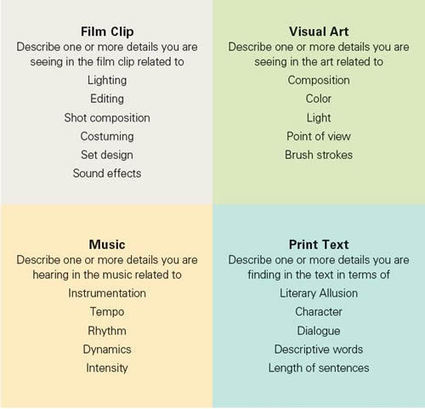





Awesome resource for planning units aligned to the CCCSS