 Your new post is loading...

|
Scooped by
Mel Riddile
May 24, 2013 9:21 AM
|
First Indiana, Oklahoma, Kentucky, and Minnesota.
As reported by Education Week, State Online Testing Problems Continue to Raise Concerns. http://www.edweek.org/ew/articles/2013/05/03/30testing.h32.html?r=946252590
Now Virginia!
The Washington Post reports that Fairfax County Schools (Virginia) acknowledged “significant problems” administering the state standards of learning tests. In one of the nation's largest school districts, thousands of the 41,975 tests administered on Thursday alone are affected and results called into question.
|
|
Scooped by
Mel Riddile
May 23, 2013 9:55 AM
|
Skip Fennell, Jon Wray, and Beth Kobett (who was absent for this presentation) are the leads on the Elementary Mathematics Specialists & Teacher Leaders Project. As the name implies, the focus ...
|
|
Scooped by
Mel Riddile
May 23, 2013 9:41 AM
|
[Alan Schoenfeld] Meeting the Challenges of Common Core Standards
He explained that what you test is what you get (WYTIWYG).
Current tests are skill-oriented but Common Core demands more, which it tries to explain with the mathematical process standards. He says that of course content matters (obviously students have to learn the skills of math), but that the real action is in the practices. You can’t just put these on a list and check them off.
|
|
Scooped by
Mel Riddile
May 22, 2013 6:09 PM
|
An organization that focuses on advancing professional development for educators has said that it's time for state education leaders to reform their training efforts to address the transition to the Common Core State Standards.
|
|
Scooped by
Mel Riddile
May 22, 2013 9:44 AM
|
The District of Columbia has devoted many resources to the standards, resulting in hopes, frustrations, and the knowledge that changes are necessary.
"The district has done this more comprehensively than most places in the country," says Michael D. Casserly, the executive director of the Council of the Great City Schools, which analyzed the district's emerging common-core program. "DCPS is in full tilt, whole-hog."
"Mr. Casserly's report pointed out a pivotal trickle-down challenge facing the district as it puts the common core into practice: "how the reforms conceived at the central-office level are put into place in schools and classrooms." Also daunting: the "significant" amount of professional development teachers need and the "enormous gaps" in students' skills and knowledge."
|
|
Scooped by
Mel Riddile
May 22, 2013 8:59 AM
|
In this post, we suggest asking Who is doing the work? as one lens for analyzing and evaluating Common Core lessons.
|
|
Scooped by
Mel Riddile
May 21, 2013 1:37 PM
|
Commonalities: Math, Science, ELA
|
|
Scooped by
Mel Riddile
May 21, 2013 1:25 PM
|
A $2.2 million grant from the Helmsley Charitable Trust will help Khan Academy expand offerings to help teachers and students with the common-core math standards.
|
|
Scooped by
Mel Riddile
May 20, 2013 6:35 PM
|
One of the few states not to adopt national standards, Virginia is leading the way in moving to online testing.
|
|
Scooped by
Mel Riddile
May 19, 2013 4:29 PM
|
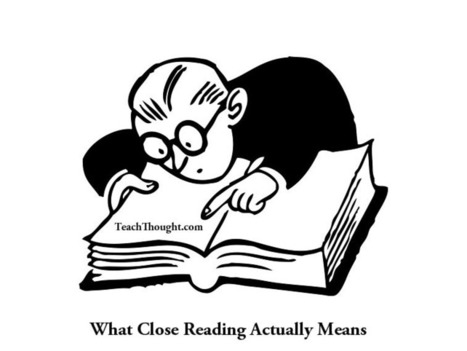
What Close Reading Actually Means
Thus, what “close reading” really means in practice is disciplined re-reading of inherently complex and worthy texts.
As Tim Shanahan puts it in his helpful blog entry, “Because challenging texts do not give up their meanings easily, it is essential that readers re-read such texts,” while noting that “not all texts are worth close reading.”
|
|
Scooped by
Mel Riddile
May 17, 2013 4:00 PM
|
Investment needs for teacher training, curriculum materials, and assessments are likely to slow the pace of implementation.
One of the biggest issues, experts say, and a costly endeavor, is helping teachers deeply understand the vision for science education espoused by the standards and gain the knowledge and skills to effectively deliver on it.
|
|
Scooped by
Mel Riddile
May 17, 2013 8:59 AM
|
I think about how prepared I am to implement the Common Core State Standards (CCSS). I think about how to bridge Common Core State Standards and Career Technical Education (CTE) together. I work in a vocational high school as a CTE commercial art teacher. Most of my CTE colleagues and I have heard of the CCSS, but we aren’t prepared to use the standards in the classroom. In doing my own research, I learned that the mission statement for the CCSS Initiative is to “provide a consistent, clear understanding of what students are expected to learn, so teachers and parents know what they need to do to help them.”
|
|
Scooped by
Mel Riddile
May 16, 2013 12:40 PM
|
Assessment 2.0 will need lots of work to get to version 2.1 and 2.2. States and districts will improve implementation as they learn from pilots and field tests. And teachers will play an absolutely critical role in providing the consortia feedback about what works and what doesn’t work.
|
|
|
Scooped by
Mel Riddile
May 22, 2013 5:56 PM
|
|
|
Scooped by
Mel Riddile
May 23, 2013 9:44 AM
|
What is the Mathematics Assessment Project (MAP)?
The Mathematics Assessment Program (MAP) aims to bring to life the Common Core State Standards (CCSSM) in a way that will help teachers and their students turn their aspirations for achieving them into classroom realities. MAP is a collaboration between the University of California, Berkeley and the Shell Center team at the University of Nottingham, with support from the Bill & Melinda Gates Foundation. The team works with the Silicon Valley Mathematics Initiative and school systems across the US and UK to develop improved assessment
|
|
Scooped by
Mel Riddile
May 23, 2013 6:04 AM
|
The maker of the ACT college entrance exam offers itself as an alternative to common tests being designed by two federally funded consortia designing tests for the common standards.
|
|
Scooped by
Mel Riddile
May 22, 2013 6:07 PM
|
By Jay Mathews
How do you prepare a child for the working world? Experts say the same courses, skills are needed.
|
|
Scooped by
Mel Riddile
May 22, 2013 9:02 AM
|
Grade 5 ELA Common Core Instruction: Making a claim using two texts with similar themes
|
|
Scooped by
Mel Riddile
May 22, 2013 8:55 AM
|
Rep. Todd Rokita, R-Indiana, asked U.S. Secretary of Education Arne Duncan what academic standards besides the Common Core are college- and career-ready.
Duncan said..."Both Virginia and Minnesota have college- and career-ready standards and aren’t in common core. (Actually, Minnesota is a halfway state. It’s adopted common core in language arts, but not math.)"
It’s likely whatever Indiana ends up with will build on the nationally-crafted academic standards currently adopted by 45 states.
|
|
Scooped by
Mel Riddile
May 21, 2013 1:29 PM
|
Critical thinking and analytical thinking are not the same thing. To clarify the difference between these words, let's look at their etymology (word origins). According to the dictionary, "analyze" means to break apart into essential elements. The opposite of analyze is synthesize, or put together. "Criticize" means to evaluate or make a judgment regarding the merits or faults. The opposite of criticize in one sense would be praise, or in another sense absence of judgment. Simply looking at the two definitions, it is glaringly obvious that two different skill sets are required. So why are they often lumped together? The dictionary definition of this answer would be a stupor of thought, or the condition of not thinking.
|
|
Scooped by
Mel Riddile
May 21, 2013 12:46 PM
|
In a rebuttal to the AFT president's call for a moratorium on high-stakes consequences for the common core, Chiefs for Change calls for holding fast to accountability.
|
|
Scooped by
Mel Riddile
May 20, 2013 10:25 AM
|
Academic preparation isn’t the only factor in college readiness. Also helping to determine whether students get to (college) graduation are social behaviors, like whether they show up for class, engage with professors and make eye contact. A new assessment from the Education Testing Service (ETS) seeks to measure those non-academic variables.
|
|
Scooped by
Mel Riddile
May 19, 2013 12:39 PM
|
Marc Tucker addresses recent backlash against the Common Core State Standards and explains why they will benefit disadvantaged students.
|
|
Scooped by
Mel Riddile
May 17, 2013 9:05 AM
|
Look at a job description that a company owner passed along to New York Times columnist Thomas Friedman in a piece he wrote about the paucity of trained American workers. The company owner was looking for a welder and was complaining about the quality of some who had applied:
"They could make beautiful welds," she said, "but they did not understand metallurgy, modern cleaning and brushing techniques" and how different metals and gases, pressures and temperatures had to be combined. Moreover, in small manufacturing businesses like hers, explained [Traci] Tapani, "unlike a Chinese firm that does high-volume, low-tech jobs, we do a lot of low-volume, high-tech jobs, and each one has its own design drawings. So a welder has to be able to read and understand five different design drawings in a single day ... I can't think of any job in my sheet metal fabrication company where math is not important. If you work in a manufacturing facility, you use math every day; you need to compute angles and understand what happens to a piece of metal when it's bent to a certain angle."
|
|
Scooped by
Mel Riddile
May 16, 2013 2:49 PM
|
By Cathryn Berger Kaye and Maureen Connolly
We are all familiar with the idea of service in communities and service in schools. Service learning, however, has distinctive aspects that separate this pedagogy from what we often call “community service” or “project-based learning.” With high-quality service learning, students: - Increase academic rigor through relevance and application of content and skills
- Participate in social analysis as they investigate an authentic community need, typically through action research using media, interviews, surveys, and observation
More
|


















Worth reading Mel Riddle's comment.