


Find education news, teaching strategies, lesson plans, activity ideas and more on the WeAreTeachers blog. Featuring posts by guest bloggers and teachers as well as WeAreTeachers editors.

 Your new post is loading...
 Scoop.it! Find education news, teaching strategies, lesson plans, activity ideas and more on the WeAreTeachers blog. Featuring posts by guest bloggers and teachers as well as WeAreTeachers editors. 
Scoop.it!
NCTM serves math teachers, math educators, and administrators by providing math resources and professional development opportunities. Working for more and better math for all students.
Mel Riddile's insight:
Math teachers support new math standards.
Scoop.it!
The Smarter Balanced Assessment Consortium reported that its system is ready to handle a greater number of students than previously anticipated, so it's expanding its upcoming Field Test to allow member states to administer them to a wider...
Scoop.it!

Rigor is a subjective quality: it depends on a student’s knowledge and experiences. Since different students will have different experiences with a particular question, this poses an obvious challenge for test-makers if the goal is to design questions that produce rigorous responses. For example, the trapezoid problem discussed in Part 1 would produce a rigorous response for one kind of student but not for another.
Mel Riddile's insight:
Key Point from Grant Wiggins: "A test is not intended to be an authentic assessment; it is a proxy for authentic assessment."
Scoop.it!

For those parents and teachers looking for apps for middle-schoolers, check out these five great apps.
Scoop.it!
|

|
Scooped by
Mel Riddile
August 28, 2013 9:29 AM
|
Scoop.it!

Readers know that I am a strong supporter of Standards generally and the Common Core specifically. To me it is simply a no-brainer: there is no such thing as Georgia Algebra or Montana Writing. In ...
|
|
Scooped by
Mel Riddile
August 27, 2013 12:53 PM
|
Scoop.it!

Policies emerging from the two state consortia developing common-core assessments would set limits on the device's use, and likely influence classroom practice.
|
|
Scooped by
Mel Riddile
August 27, 2013 12:45 PM
|
Scoop.it!

|
|
Scooped by
Mel Riddile
August 27, 2013 9:15 AM
|
Scoop.it!

Technology has the potential to transform teaching and learning. It is already sparking a revolution in standardized tests.

After reading this article, I was left with many questions. First, why are some standardized tests so much more expensvie and what are the advantages to those tests? For states and schools that do not have the resources, what are they supposed to do or how can they afford even more expensive technology and tests? Furthermore, I think it is debatable whether students should receive different questions on their tests. The whole purpose of standardized tests is for every student to take the same test, hence the name "standardized". This is the first I have ever heard about having computerized tests that will change the level of difficulty of the following questions depending on the performance of the student. I think all students should take the same test; top students will just earn really high scores, but those are the scores that they deserve. If students are answering different questions how can you compare scores? I also thought it was an interesting point about "cut scores". I recently took the Praxis I exam and noticed that every state had different required scores in order to pass. I do not think that is fair. Who gets to decide what are passing scores and why should it differ from state to state? Although the Huffington Post is a reliable source, I wish this article went into more detail that would have answered some of my questions.
|
|
Scooped by
Mel Riddile
August 26, 2013 6:16 PM
|
Scoop.it!

What do the scores of the new Common Core-aligned tests really mean?
|
|
Scooped by
Mel Riddile
August 26, 2013 3:08 PM
|
Scoop.it!
FairfaxTimes.com
Educators point to new exam, higher expectations...even in states like Virginia, which as not adopted the Common Core Standards.
What this article does not mention is that, for many students, these tests are barriers to graduation. So, a drop in pass rates means that up to three times as many students failed to pass the exams, which means that principals must remediate those students with no additional funding.
|
|
Scooped by
Mel Riddile
August 31, 2013 11:41 AM
|
Scoop.it!

He's (Coleman) heard from organization members, who have said they want the SAT to test things that are relevant to college success. They've told him that students should be able to read and write clearly, and also have mastered a core set of mathematical concepts. "The core aspiration is to build an exam that much more clearly focuses on the skills that matter most," he said. Instead of obscure vocabulary words, students should be expected to show deep understanding of academic terms such as "synthesis" and "transform." Overall, Coleman hopes the exam will be more relevant to high school learning. "It has to engage teachers more deeply," he said.
|
|
Scooped by
Mel Riddile
August 28, 2013 6:44 PM
|
Scoop.it!

Most respondents to a PDK/Gallup poll had never heard of the common standards—and among those who had, fewer than half said the standards would help make students more competitive internationally.
|
|
Scooped by
Mel Riddile
August 28, 2013 4:01 PM
|
Scoop.it!

The results of this year's PDK/Gallup Poll of the Public's Attitudes Towards the Public Schools offers some heartening news for public education advocates.
Before taking the poll, only 38 percent of respondents had heard of the Common Core State Standards -- and just 45 percent of public school parentshad heard of them.

It seems that the content of the standards would be overwhelming to parents. It is more about providing them with an overview of the gist of what parents can do with their child at home that would be most effective. Also providing a graphic organizer with prompts about specific questions to ask their child may be helpful.
|
|
Scooped by
Mel Riddile
August 28, 2013 11:00 AM
|
Scoop.it!
Just because a question comes from a higher grade level doesn’t make it rigorous. And rigor is surely not an absolute but relative criterion, referring to the intersection of the learner’s prior learning and the demands of the question. (This will make mass testing very difficult, of course).
To me, rigor has (at least) 3 other aspects when testing:
The novel (or novel-seeming) aspect to the challenge typically means that there is some new context, look and feel, changed constraint, or other superficial oddness than what happened in prior instruction and testing. (i.e. what Bloom said had to be true of any “application” task in the Taxonomy).
|
|
Scooped by
Mel Riddile
August 28, 2013 10:18 AM
|
Scoop.it!

BOISE • Flash cards are gone from Christy Schwehr’s classroom at Amity Elementary School in Boise.
Education isn’t about cramming facts into kids’ heads any more. It’s not “6 times 8 is 48. Now remember it.”
Students need to visualize numbers and understand those numbers in relationship to each other as they seek to discover the answer. So a strategy card hint for figuring out 6 times 8 may say, “you know what 6 times 5 is...”
|
|
Scooped by
Mel Riddile
August 28, 2013 10:11 AM
|
Scoop.it!
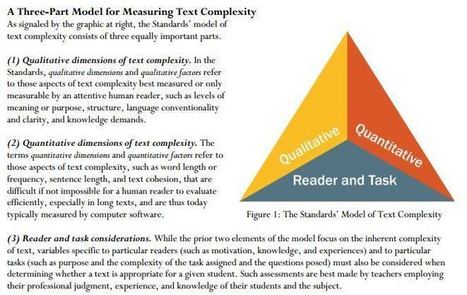
The Common Core specifically says that there are “three equally important parts” of text complexity:

Is an indication of text complexity a useful type of categorisation for school library collections and catalogues?
|
|
Scooped by
Mel Riddile
August 28, 2013 9:26 AM
|
Scoop.it!

In California, the new tests will replace the traditional Standardized Testing and Reporting (STAR) assessments, which were established by the legislature in 1997. The STAR tests passed into history on July 1 although the state has not yet decided what tests, if any, will be used for the current academic year.
|
|
Rescooped by
Mel Riddile
from College and Career-Ready Standards for School Leaders
August 27, 2013 12:47 PM
|
Scoop.it!
The volume of Reading Is Still Important
The Common Core explicitly and implicitly address the issue of reading volume.
Theory to Practice: Lost in the Translation
Somewhere between conception and implementation, most grand ideas grow muddled with translation. In this instance and instances like these, it is important to return to the Common Core document and ask:
Is this understanding a reflection of where the standards demonstrate shortsightedness? Or is this a reflection of what we “think” we’ve read and understood about the Common Core? Our laments must become the “guiding concern” that leads to our own close, careful reading of the Common Core document.

|
|
Scooped by
Mel Riddile
August 27, 2013 12:30 PM
|
Scoop.it!

The Common Core State Standards have been adopted by 45 states and the District of Columbia with the goal of better preparing the nation's students for college or a job.
|
|
Scooped by
Mel Riddile
August 27, 2013 11:55 AM
|
Scoop.it!

Mission Statement
|
|
Scooped by
Mel Riddile
August 26, 2013 6:01 PM
|
Scoop.it!

By The Jose Vilson
This week, a few of us got into a discussion, and involved Grant Wiggins. He calls himself a troublemaker, but I don’t remember seeing him at the last few meetings, and I’m the treasurer.







Some student-friendly insights into writing a persuasive essay.