


Officials in Alabama, Florida, Louisiana, and Michigan aim to reassure school districts that common core won't hurt local control, but some are skeptical.

 Your new post is loading...
 Scoop.it! Officials in Alabama, Florida, Louisiana, and Michigan aim to reassure school districts that common core won't hurt local control, but some are skeptical. 
No comment yet.
Sign up to comment
Scoop.it!

The new Common Core math standards have teachers finding creative examples for lessons and making sure students have strong understanding of basic concepts.
Scoop.it!

These PDF forms, available for each grade 3-11, are based on PARCC’s Model Content Framework, a four-quarter progression delineating the types of texts students should be reading (literary, historical, informational) and the writing tasks they should be practicing in alignment with the Common Core. The document also delineates the topics and standards PARCC Assessment Blueprints has announced as the basis for standards assessment.
Scoop.it!

Testing and teaching are not the same thing. Some educators are blurring the lines. "As a profession, we are confusing reading and writing instruction with assessment of that instruction. Many teachers strive, as I did, to insert “test-like” experiences within the context of their units to decrease the stand alone skills practice that high stakes testing often causes, but the truth is undeniable. We are increasingly blurring the lines between instruction (teaching and learning) and assessment of instruction (tests to measure teaching and learning)."

Dr. Dea Conrad-Curry's curator insight,
November 8, 2013 11:55 PM
I so agree! Good points! Although schools must prepare students for taking assessments, assessment preparation and assessment results should not be mistaken for good teaching and/or actual student outcomes. 
GoogleLitTrips Reading List's curator insight,
November 11, 2013 6:40 AM
If I'm reading this article correctly, the author does call into question elements of the Common Core Assessment's questionable "side affects" while at the same time not condemning the the intent of assessment.
The author's question raises the valid point that there is a difference between instruction and assessment of that instruction. If instruction becomes test prep then test prep becomes the perceived importance of the content. And, in the case of literary reading, the "side effects" of this lack of distinction between what ought to be central and what has become central is perhaps seriously misdirecting student attentiveness.
In my mind, this does not mean that assessment is unimportant and therefore ought to be abandoned. It means that we should be mindful that the purposes for literary reading are not the same as the purposes for attempting to measure the achievement of benefit derived from literary reading. And, if we are mindful of the distinction, then, as was the case for promoting "formative assessment structures," perhaps current literary assessment structures can evolve in such ways as to be less intrusive and thereby less likely to misdirect classroom practices that are more likely to divert students' attentiveness and engagement away from the actual value of literary reading and more likely to capture evidence that students' recognize the reasoning behind the advise provided to those who spend time exploring the wisdoms articulated across time and cultures by history's wisest spokespersons. Perhaps assessment structures can continue to evolve to a point where students will demonstrate understanding beyond merely being able to merely identify WHAT the themes are in a piece of great literature,, but also be able to demonstrate an understanding of WHY those themes are worth his or her engaged and serious contemplation.
I hope that my take is not Panglossian optimism about the potential for further improvement of the current state of literary reading assessment, but rather the optimism of people such as Martin Luther King who perceived a problem long inadequately unaddressed yet continued to believe, in spite of history's significant evidence to the contrary, that good things could still be done to more successfully address issues of serious concern.
Or maybe Atticus Finch was just an old fool.
~ http://www.GoogleLitTrips.com ~ Google Lit Trips is the legal fictitious business name of GLT Global ED, an educational nonprofit 
Jefferson Hall IV's curator insight,
September 7, 2015 5:38 PM
Teaching and the evaluation of teaching need to be further separated nationally in the United States. In my elementary, middle, and high school experiences, there has been too much emphasis placed on the estimation on how much students our learning rather that of what we are learning. Specifically, I can recall teachers giving us there examples of what a proficient and advanced essay should entail and forcing us to regurgitate that form time and time again for the soul purpose of meeting state standards. This process does not promote learning, insight, or originality. It deprives students of the chance to actually learn how to formulate their own well written essay. The author of this article, Mary Rudd, exclaims teaching the “habits of mind” through reading and writing to promote efficient learning. Using reading and writing to instigate critical thinking is very poignant to the learning process. Mary Rudd and her long standing career in education validate her credibility of this article.
Scoop.it!

Advocates hope that the Common Core State Standards (CCSS) Initiative will lead to deeper learning by students – that the standards will result in students learning not only academic content, but how to think critically, work collaboratively, communicate effectively and more. And they recognize that for this to happen, classroom instruction has to change.
Scoop.it!

What is an EBSR?
An Evidence-Based Selected-Response (EBSR) is one of the three “item” types by which PARCC will measure student’s proficiency with achieving grade level reading standards. The other two item types are the Technology-Enhanced Constructed-Response (TECR), and the Prose Constructed Response (PCR), which simply put is an essay. More on those later. Let’s keep our focus here on the EBSR. Essentially, an EBSR is like a conventional multiple choice question. What makes the EBSRdifferent from the conventional multiple choice is the nature of the ”item.”
Scoop.it!
Despite claims by advocates for Common Core, there is no universal timeless interpretation of a text. Meaning then and now is something that we debate, not uncover, while supporting our views with evidence from both the text and from the world.
Scoop.it!

Will States Fail the Common Core? - The Huffington Post
Scoop.it!

This spring new tests, called the Smarter Balanced

Lisa Sayles Kraiza's curator insight,
November 4, 2013 1:19 PM
My district piloted the Smarter Balanced Test last Spring and the students found it quite difficult and cumbersome. I am not confident that the Smarter Balance Test is an accurate determiner of how students are fairing with the Common Core.
Scoop.it!
|

|
Scooped by
Mel Riddile
November 3, 2013 11:19 AM
|
Scoop.it!

How do you reevaluate, adjust, improve, and transition to a new assessment system? In the case of Massachusetts how do you take your now nationally recognized assessment system that his been in th...
|
|
Scooped by
Mel Riddile
November 2, 2013 3:10 PM
|
Scoop.it!

Technology can be a powerful tool to facilitate Common Core writing and research and transform traditional writing assignments.
|
|
Scooped by
Mel Riddile
November 9, 2013 12:16 PM
|
Scoop.it!

As a high school principal, I, like colleagues in 45 other states and the District of Columbia, have had to dissect what Common Core is and isn’t.
|
|
Scooped by
Mel Riddile
November 9, 2013 12:11 PM
|
Scoop.it!

|
|
Scooped by
Mel Riddile
November 8, 2013 10:46 AM
|
Scoop.it!
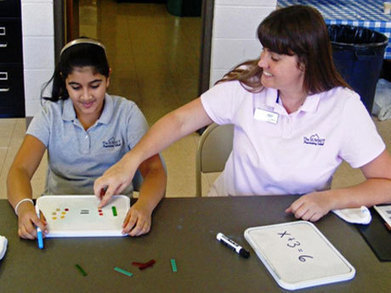
Many teachers this year are updating existing curriculum for the Common Core. And it's going to be a long process for everyone.
|
|
Scooped by
Mel Riddile
November 8, 2013 10:36 AM
|
Scoop.it!

A collection of PDF's detailing the mathematical content emphasized in the Standards by grade level. These can be used as guides to inform instructional decisions regarding time and other resources.
|
|
Scooped by
Mel Riddile
November 4, 2013 5:50 PM
|
Scoop.it!

Two new online resources focused on implementing the standards with English language learners.
|
|
Scooped by
Mel Riddile
November 4, 2013 12:18 PM
|
Scoop.it!

Standardized testing is a big part of modern education, and the Common Core will bring a new set of changes to how Michigan's students are assessed.
|
|
Scooped by
Mel Riddile
November 4, 2013 7:26 AM
|
Scoop.it!

Educator Leslie Laud says that evidence-based practices for teaching writing, including the use of formative-assessment techniques, can dramatically improve students' skills.
|
|
Scooped by
Mel Riddile
November 3, 2013 6:29 PM
|
Scoop.it!

Who I am and why I decided to work on the Common Core State Standards
I am a university-distinguished professor of mathematics at the University of Arizona. My doctorate in mathematics is from Harvard University, and I have been a fellow at the Mathematical Sciences Research Institute at Berkeley and the Institute for Advanced Study in Princeton. In addition to mathematics research and university teaching, I have been involved in K–12 education for 20 years.
|
|
Scooped by
Mel Riddile
November 2, 2013 3:12 PM
|
Scoop.it!

How can pictures help students understand math? It seems that there are some hurdles set up in math education like math anxiety, and the push to learn material (...)

This article talks about how pictures can help students get rid of some anxiety about math. That is because pictures will help with mathematical imagery, and that is what's missing for students. They cannot grasp the concepts easily because they cannot picture how it relates to anything in life. This concept relates to why we use manipulatives in class. In my first grade class, we always encourage students to use all kinds of counters because those help students to be less stressful. Manipulatives can help students transfer the possible stress that they have to do all the math inside their heads to the manipulatives so they can do it easily. I will definitely use more pictures and manipulatives in my future classroom.






