 Your new post is loading...

|
Scooped by
Mel Riddile
August 27, 2014 11:08 AM
|
New York has become the poster child for poor implementation of the Common Core State Standards. A Race-to-the-Top state, New York officials bragged several years ago about how they were ready for the new standards.
The state could not wait for PARCC to develop an assessment system. So, New York developed it's own "Common Core-Aligned" set of state tests and tied the results to teacher evaluations and to graduation requirements. Common sense dictates that new, higher standards, new, more rigorous assessments coupled with a short window for implementation would result in lower scores on the tests. But as Will Rogers once said, "Common sense ain't so common."
The train wreck occurred when officials, knowing that scores would drop, tied those scores (fifty percent) to teacher evaluations and graduation requirements. This initially outraged teachers who saw the handwriting on the wall. After all, if you have been in education for more than a few years, you are all too familiar with botched implementations. Next came parent outrage because their students were failing the required state tests in huge numbers and they would not graduate.
If one wished to devise a plan to sabotage the Common Core State Standards, this plan was virtually foolproof.
As early as three years ago, New York principals, with tears in their eyes pleaded that tying the expected falling test scores to teacher evaluations was eroding the trust they had worked so hard to build and was destroying the culture of their schools. Their pleas went unnoticed--Ready, Fire, Aim.
Implementation of the Common Core State Standards is a necessary, but 'monumental undertaking.' Changing the way teachers teach and how students are assessed, moving the target from high school completion to college and career-readiness, integrating literacy into all content areas, changing teacher evaluation systems, changing state accountability systems are individually multi-year undertakings. Together these and other local and state initiatives--all occurring simultaneously--represent the "perfect storm" for public education--a storm with no end in sight.
|
|
Scooped by
Mel Riddile
August 27, 2014 9:28 AM
|
A pair of wide-ranging polls by PDK/Gallup and Education Next gauge sentiment on the common standards, testing, school funding, and other hot-button issues.
|
|
Scooped by
Mel Riddile
August 27, 2014 9:10 AM
|
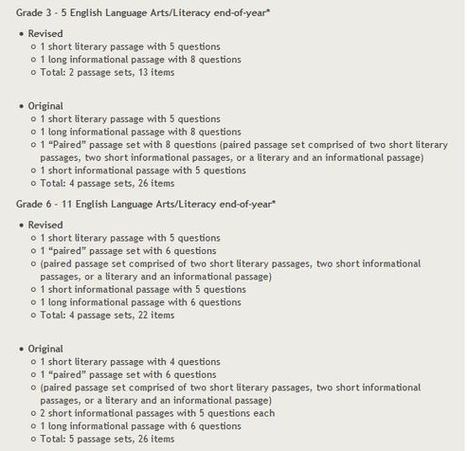
The PARCC consortium drops some items from its literacy test, saying that it could still test the standards sufficiently with fewer items.
|
|
Scooped by
Mel Riddile
August 26, 2014 1:01 PM
|
"I would encourage you to continue to teach comprehension strategies as a scaffold for dealing with challenging text. The point would be to make it possible for kids to make sense of truly challenging texts; the use of strategies could be enough to allow some kids to scaffold their own reading successfully--meaning they might be able to read frustration level texts as if they were written at their instructional level."
|
|
Scooped by
Mel Riddile
August 26, 2014 12:34 PM
|
Conflating testing and evaluation with education standards threatens Common Core.
- assessing students’ knowledge of CCSS material before full implementation
- evaluating educators based on CCSS test scores
These two factors "have caused movement away from the very standards that could benefit students across the country."
|
|
Scooped by
Mel Riddile
August 25, 2014 9:34 AM
|
"Classroom discussions lasted days, homework questions were challenging and reading analyses were time consuming. However, Nick Carlson, a 17-year-old Hamilton High School senior, said he is thankful for the Common Core State Standards, even though they initially left a bad taste in his mouth. “It was just hard to understand and hard to grasp at first, but then as you kept learning, it was easier to understand and made it more fun to learn.”
|
|
Scooped by
Mel Riddile
August 25, 2014 9:23 AM
|
A researcher and education professor at Michigan State University laid out his take on four major problems with how the common-core math standards are being implemented.
|
|
Scooped by
Mel Riddile
August 23, 2014 12:28 PM
|
|
|
Scooped by
Mel Riddile
August 21, 2014 8:20 AM
|
Nearly all American K–12 students are exposed to it every day. It decides, in large part, what students will learn in school and how they will learn it.[1] It is never evaluated for quality in any serious way, but when it is rigorously evaluated, its impact on student achievement is significant.
|
|
Scooped by
Mel Riddile
August 20, 2014 7:16 AM
|
The Washington Examiner (8/19) reports that Education Secretary Arne Duncan on Monday tweeted, “Thanks to the Montgomery County, MD schools for moving their discipline policy away from out-of-school suspensions.” The piece explains that this sentiment “comes as no surprise,” noting that the Administration “has repeatedly called on schools to move away from out-of-school suspensions whenever possible.” The piece notes that Duncan cites criticisms “that minorities tend to be expelled at a much higher rate than their peers,” and quotes him saying in January, “Our department’s Civil Rights Data Collection shows that African-American students without disabilities are more than three times as likely as their white peers to be expelled or suspended. And we know that discipline policy and practices matter tremendously — there is nothing inevitable about high rates of suspension and expulsion. We can, and must, do much better.”
|
|
Scooped by
Mel Riddile
August 18, 2014 11:54 AM
|
One of the most frequent questions I get from coaches is about how to coach teachers in the Common Core (CCSS). While there's some content knowledge you'll need to have about the CCSS, there are many coaching skills that apply regardless of the content.
|
|
Scooped by
Mel Riddile
August 18, 2014 10:54 AM
|
Pressure to meet national education standards may be the reason states with significant populations of African-American students and those with larger class sizes often require children to learn fewer skills, finds a University of Kansas researcher. “The skills students are expected to learn in schools are not necessarily universal,” said Argun Saatcioglu, a KU associate professor of education and courtesy professor of sociology.
|
|
Scooped by
Mel Riddile
August 17, 2014 5:42 PM
|
Can’t get enough Common Core?
"The Center on Education Policy’s got you covered with this hefty compendium of over sixty CCSS-focused studies, including several from Fordham. CEP summarizes each, providing brief overviews of the focus, the findings, and the methodology (only methodologically sound studies were chosen). It’s handy one-stop shopping, covering a wide range of Common Core–related topics. Want to know whether the standards are likely to be effective?"
|
|
|
Scooped by
Mel Riddile
August 27, 2014 9:45 AM
|
Another state, Mississippi, has experienced an expected dip in test scores as schools transition to new college- and career-ready standards.
|
|
Scooped by
Mel Riddile
August 27, 2014 9:23 AM
|
Poll Shows Opposition To Common Core And Misperceptions. A pair of wide-ranging polls by PDK/Gallup and Education Next gauge sentiment on the common standards, testing, school funding, and other hot-button issues. Education Week (8/27, Camera) reports that a PDK/Gallup and Education Next poll shows that Common Core “has a serious image problem” with the American public. The poll reflects that while awareness of the standards have “jumped” in a year, “adults have misperceptions that the standards are a Federal Initiative.” The poll shows that 40 percent of respondents who were opposed to the standards said their reasoning was that it was based on their belief that the Federal government initiated the standards.
|
|
Scooped by
Mel Riddile
August 27, 2014 9:04 AM
|
"The Common Core State Standards are good standards."
"The same ideas we had in Wisconsin about excellence in math and English language arts were being discussed on a national scale, which would ultimately produce a better product, the Common Core State Standards (CCSS)."
|
|
Scooped by
Mel Riddile
August 26, 2014 12:47 PM
|
A brief explanation of the Common Core Standards accompanied by several examples.
|
|
Scooped by
Mel Riddile
August 25, 2014 12:26 PM
|
The state is inviting the public to vote "thumbs up" or "thumbs down" on each standard, and to provide specific, detailed feedback.
|
|
Scooped by
Mel Riddile
August 25, 2014 9:27 AM
|
Final Post in Series Looking at Apps and Tools for the Common Core Literacy Curriculum Reading Strand Dr. Leslie Suter and Dr. Melissa Comer are faculty
|
|
Scooped by
Mel Riddile
August 25, 2014 9:12 AM
|
While the Common Core is a good set of goals, they’re only goals. To work, they must be translated into curricula, textbooks, tests, professional training and phase-in schedules. These have done well in some states, badly in others.
Tennessee's average ACT score, historically slow to improve despite constant attention from educators, has made its biggest year-to-year leap since
"Though its 19.8 composite score is still well below the national average of 21, Tennessee's class of 2014 saw a three-tenths of a point bump from last year, new results released Wednesday show. That's tied with Kentucky and Wyoming for the largest increase among the 12 states that require all students to take the college entry exam."
|
|
Scooped by
Mel Riddile
August 21, 2014 8:17 AM
|
"There is a growing list of large-scale K-12/higher education cooperative efforts. Well before Common Core, there were great examples of K–12 and higher education working together to define common academic expectations for students and create a more seamless pathway between the two sectors."
|
|
Scooped by
Mel Riddile
August 20, 2014 7:09 AM
|
By NCTM President, Diane J. Briars
"The Common Core State Standards for Mathematics are based on evidence about how students learn mathematics. The foundation for CCSSM includes the series of National Research Council reports summarizing research about mathematics education—for example, Adding It Up (2001),How Students Learn: Mathematics in the Classroom (2005), and Mathematics Learning in Early Childhood (2009)—as well as the best of previous state standards and a large body of evidence taken from international comparisons. Research results incorporated into CCSSM include both general findings about how students learn mathematics and specific information about how they learn particular content."
|
|
Scooped by
Mel Riddile
August 18, 2014 11:03 AM
|
'Why would policymakers create tests that are designed to mark as failures two out of every three children?" ....and tie the expected falling scores to teacher evaluations and graduation requirements.
|
|
Scooped by
Mel Riddile
August 18, 2014 10:50 AM
|
MONTPELIER (AP) - Some Vermont schools will open the school year with some revised curriculum to meet more rigorous national education standards called the Common Core while other schools are still working toward implementing them.
"We see it as an opportunity to help our kids reach high standards and to try to figure out how to that," said Pat Fitzsimmons, the Common Core implementation
|










Government issues - I chose this resource because it is a true lesson learned as what not to do when making significant changes to align with required curriculum changes and assessments. International has slowly changed their curriculum, but when we've assessed our students according to common core requirements, they failed miserably. I hope to share this with my supervisor to prove to her that this needs to be a gradual change in order for students to succeed.