 Your new post is loading...

|
Scooped by
Mel Riddile
September 26, 2014 7:37 AM
|
Vermont Science Scores Drop. The AP (9/26, Rathke) reports that Vermont Education Secretary Rebecca Holcombe announced on Thursday that “average science test scores of students in three grades have dropped slightly in Vermont from last year, with the greatest dip among eight-graders.” The article adds that Holcomb said that stagnant science scores suggest “that an emphasis on English language arts and math in the federal No Child Left Behind Act may be overshadowing science instruction.” Vermont Public Radio (9/26) reports that Holcombe “says she is not satisfied with scores from standardized science tests given last spring.” The piece notes that “44 percent of fourth graders scored as proficient or higher, but only 25 percent of eighth graders and 30 percent of eleventh graders reached that mark.” Scores across all grades showed a decline. The piece notes that “a section that requires students not only to solve problems, but to explain their reasoning,” seems to be the part that gave students the most trouble. WCAX-TV Burlington, VT (9/26) quotes Holcombe saying, “We’re concerned about the heavy emphasis on No Child Left Behind and whether it might be discouraging some districts from really investing in science from the earliest grades.” The Rutland (VT) Herald (9/26) also covers this story.
|
|
Scooped by
Mel Riddile
September 25, 2014 8:24 AM
|
Most Tennessee teachers now oppose the academic standards, new statewide survey shows.
Survey: Fewer Tennessee Teachers Support Common Core. The Tennessean (9/24) reports that according to a new survey released by the Tennessee Consortium on Research, Evaluation and Development, a majority of Tennessee teachers now opposes the Common Core Standards, noting that the survey “could provide more ammunition to those who want to roll back the standards.” The Tennessean reports that the number of teachers who said that the Common Core “will improve student learning” fell from 60% to 31% over the course of the past year. Meanwhile, 56% of respondents “want to abandon the standards, while 13 percent would prefer to delay their implementation.”
|
|
Scooped by
Mel Riddile
September 25, 2014 8:14 AM
|
Pennsylvania Approves “Flexible Instructional Days” For Snow Day Classes. The Philadelphia Inquirer (9/25, Boccella) reports Pennsylvania has announced schools can offer up to five “Flexible Instructional Days” annually, allowing teachers to employ nontraditional methods such as cyber education when students cannot attend school, for reasons such as snow days. For nontraditional learning to count toward the 180 school day count, plans must meet 22 state objectives and approval. If instruction requires public broadcast or Internet options, comparable alternatives must be offered to those without access. The decision follows unprecedented snowfalls. The remainder of the article cites the reactions of various school leaders. PHILADELPHIA (AP) â€" Pennsylvania has redefined the concept of the snow day, announcing that schools can offer "cyber days" when kids can't make it into the classrooms. For up to five days a year, the "Flexible Instructional Days" pilot program will allow schools in all 501 school districts, including Philadelphia, to use nontraditional instruction methods, such as cyber school, when bad weather or other emergencies shut down school buildings. After last winter froze out schools for seven or
|
|
Scooped by
Mel Riddile
September 25, 2014 8:08 AM
|
In my experience in classrooms seeing the Common Core math shifts happen, my perspective as a principal has been very different. I see our students and teachers: - focusing on deeper levels of understanding rather than just covering a lot of content
- spending more time persevering on a concept rather than just memorizing a procedure to get through 1-31 odd on a homework assignment and forget it immediately after the test
- working very hard to ensure that students will go forward with a solid foundation of mastery in key concepts that will not have to be taught and reviewed again and again.
|
|
Scooped by
Mel Riddile
September 24, 2014 8:15 AM
|
The beginning of the Common Core story—the creation and deployment of the standards—has come to a close. In Act Two, states will start using new Common Core-aligned exams for accountability...
|
|
Scooped by
Mel Riddile
September 24, 2014 8:09 AM
|
"Common Core has come under attack. Critics say the standards enlarge federal control of education -- and do a lousy job teaching math.
Joseph Almeida has taught math for a decade, first in New York and currently in Massachusetts. In 2008, his students had the second-highest math test scores among charter school children in Manhattan. While he taught successfully even before Common Core came along, Almeida describes the standards as a positive development, primarily due to a winnowing in what teachers are expected to cover in a given year. “They give the teacher a way to teach in-depth, and give a limit to what the teaching is,” Almeida told The Daily Caller News Foundation."
|
|
Scooped by
Mel Riddile
September 23, 2014 7:42 AM
|
Many teachers have yet to begin assigning harder, Common Core-approved books. According to a recent Thomas B. Fordham Institute report, a survey of teachers shows that, while many are aware of Common Core’s requirement for assigning harder books, few have yet to implement the changes because they are more focused on reading skills.
|
|
Scooped by
Mel Riddile
September 22, 2014 11:40 AM
|
The curriculum for boosting K-12 students' academic performance has drawn critics on both sides of the political divide.
|
|
Scooped by
Mel Riddile
September 22, 2014 7:01 AM
|
Close reading is a hot topic that's just getting hotter! Here are 21 anchor charts, bulletin board ideas and other resources that you can bring into your classroom to turn your readers into eve...
|
|
Scooped by
Mel Riddile
September 21, 2014 2:04 PM
|
The Council of the Great City Schools has set out criteria to help educators bring common-core-aligned lessons and materials to English-learners.
|
|
Scooped by
Mel Riddile
September 21, 2014 1:57 PM
|
A collection of PDFs detailing the mathematical content emphasized in the Standards by grade level.
|
|
Scooped by
Mel Riddile
September 20, 2014 10:58 AM
|
|
|
Rescooped by
Mel Riddile
from CCSS News Curated by Core2Class
September 19, 2014 12:21 PM
|
16 Common Core Technology Tools For Speaking & Listening by Dr. Melissa Comer and Dr. Leslie Suters, Presenters at the 2014 Teaching and Learning with the iPad Conference The Speaking and Listening strand of the Common...
Via Deb Gardner
|
|
|
Scooped by
Mel Riddile
September 25, 2014 2:01 PM
|
Students, teachers in NFDL embrace education under Common Core Standards.
Wis. educators say common core has changed teaching, learning
Some Wisconsin educators and students say Common Core State Standards have increased the rigor and depth of instruction. In writing, for example, sixth-grade teacher Lee Skaar said students must support the claims they make in their research, but he is responsible for choosing the reading materials. "There are times we struggle, but they are worthwhile goals so I can't think of any reason to complain," Skaar said. The Reporter (Fond Du Lac, Wis.) (9/20)
|
|
Scooped by
Mel Riddile
September 25, 2014 8:18 AM
|
Move Indicates Teacher Evaluations Weren’t “Doable.” Maureen Downey writes about the move at the Atlanta Journal-Constitution (9/24) “Get Schooled” blog, suggesting that the request for a delay is an indication that the state promised to unattainable goals when it got its Race to the Top grant. Downey writes that she was “astounded” when the state revealed the list of promised reforms at the time, saying that they “did not seem doable, especially overhauling teacher evaluations by holding teachers accountable for student performance.”
|
|
Scooped by
Mel Riddile
September 25, 2014 8:11 AM
|
Some mathematics experts worry the computer-based testing platforms will hamper a key element of the exams: open-ended math-performance tasks that test students' ability to apply their knowledge.
|
|
Scooped by
Mel Riddile
September 24, 2014 8:18 AM
|
Reading Like a Historian: Text, (Math) Textbooks, and Ideology Textbooks as History As a historian, analyzing textbooks from different places and time periods is fascinating to me. I love being abl...
|
|
Scooped by
Mel Riddile
September 24, 2014 8:12 AM
|
Common Core: 5 Technology Tools To Measure Text Complexity
"This post specifically addresses one aspect of text complexity — what the Common Core terms “quantitative evaluation.” It’s important to recognize from the onset that other measures must be in place to adequately explore complexity. Currently, there are many web-based tools that help with the quantitative evaluation of books (for example, you can use Barnes and Noble to search by Lexile measure); however, as our students will likely be reading a combination of print and digital materials (especially in states giving the PARCC test), tools that help identify scales for online or digital text are also necessary. Here are five (mostly free) web-based tools that might be helpful as we curate reading content for students."
|
|
Scooped by
Mel Riddile
September 23, 2014 7:46 AM
|
BY MICHAEL J. PETRILLI AND MICHAEL BRICKMAN:
Educators throughout Illinois have spent the past four years preparing for the new Common Core learning standards by developing curricula, adopting new textbooks, and prepping themselves to teach challenging material. Yet just as Illinois is about to reap the rewards of this long planting season, some want to backpedal. This effort is led by the Chicago Teachers Union, which reversed its earlier support for these new standards.
|
|
Scooped by
Mel Riddile
September 23, 2014 7:40 AM
|
"At the local level, school districts are still working through a range of technical problems. In Los Angeles, principals and test coordinators have identified problems such as not having enough iPads, laptops or desktop computers at some schools for students to take the test in a timely manner. In some instances, Lim said, the field tests were spread out over a six-week period so students could take the tests on a staggered schedule. School personnel said that lengthy period of time was too disruptive of school routines, and that the testing period should be shorter. Officials also reported that students experienced “log-in issues” with Smarter Balanced software, and students “were regularly kicked off.” Diane Hernandez, director of the Assessment Development and Administration Division at the California Department of Education, said that the report to be presented to the State Board of Education in November will give a fuller picture of problems at the school site level. She said there were “some gaps” in broadband access at some schools, but mostly in small rural districts. To fill those gaps, the department last month announced a fund of $26.7 million, known as the Broadband Infrastructure Improvement Grant program. The state last week released a preliminary list of 300 schools – many in remote locations – that may be eligible to apply for the money."
|
|
Scooped by
Mel Riddile
September 22, 2014 10:51 AM
|
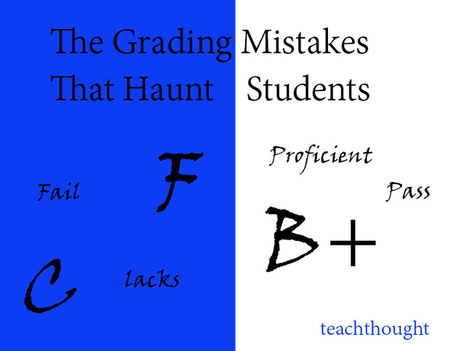
The Kinds Of Grading Mistakes That Haunt Students Our current system of letter grades works well for many kinds of students. These are the students who learn to play the game. Form relationships with teachers. Can see the rules and parts of the games–which assignments matter, what the teacher values, how to format responses, how to use a rubric, how to study, and so on.
|
|
Scooped by
Mel Riddile
September 21, 2014 2:52 PM
|
If you know the Common Core Standards you know that “The need to conduct research and to produce and consume media is embedded into every aspect of today’s curriculum. In like fashion, research and media skills and understandings are embedded throughout the Standards rather than treated in a separate section.” Common Core Learning Standards for ELA & Literacy, Key Design Considerations Innovative educators know that when used in the right way, social networks and other online technologies are great tools to conduct such research and gain knowledge. Not only do they leverage resources students already know and love, but they can also encourage learning in a way that is less restrictive and more open and natural. For example, collaboration in an online group creates relationships “in which people from often widely divergent cultures and who represent diverse experiences and perspectives learn and work together” as called for in the Common Core Standards.
|
|
Scooped by
Mel Riddile
September 21, 2014 1:59 PM
|
Welcome to Explaining Common Core to Californians – a collection of framing research, recommendations, and sample communications designed to help leading voices in California’s education sector increase public understanding of the kinds of instruction, assessment, and systemic supports needed to fulfill the potential of Common Core State Standards.
|
|
Scooped by
Mel Riddile
September 20, 2014 11:00 AM
|
ReadWorks is a great non-profit service that offers hundreds of lesson plans and more than two thousand reading non-fiction and fiction passages aligned to Common Core standards. Recently, ReadWorks added a new batch of science passageswith accompanying question sets to use in high school classrooms.
|
|
Scooped by
Mel Riddile
September 20, 2014 10:26 AM
|
Teaching Channel got the chance to spend two days in David Olio’s literature class at South Windsor High School. Watch students engaging in text analysis through reading and writing.
|


















As long as we value the "standard" procedure for math operations and neglect the exploration and sense making of what is happening, the ability to explain your thinking is about the steps in the procedure, not does the answer make sense.
Identifying common standards is not synonymous with teaching and learning mathematics.
É muito importante que os alunos tenham de explicar o seu raciocínio, para além de resolver o problema. A questão é como?