


Rather than intimidating young readers with ancient pedagogy, encourage and empower them with livelier strategies such as partner reading or the manic Crazy Professor Game.

 Your new post is loading...
 Scoop.it! Rather than intimidating young readers with ancient pedagogy, encourage and empower them with livelier strategies such as partner reading or the manic Crazy Professor Game. 
No comment yet.
Sign up to comment
Scoop.it!

"Have we failed the general public by not sufficiently educating them on what I believe could be a powerful tool in education that would level the playing field for many students and school systems across the country? In our hurry to implement, did we not provide enough reasons for stakeholders in government, business and most importantly, parents, so that they would know what the CCSS stood for and could do for their children? Additionally, have we not responded enough, or placed too much emphasis on specific content related skills, such as close reading? My guess is that if you don’t know much about CCSS, you’ve probably at least heard someone talk about close reading, or you’ve probably seen the picture of the math test I included above in some type of Facebook or social media feed."
Scoop.it!
By Raymond Yannuzzi New Jersey College Chiefs: Common Core Will Cut Down On Need For Remediation. In an op-ed in the Philadelphia Inquirer (11/25), Camden County College President Raymond Yannuzzi and Cumberland County College President Thomas Isekenegbe write to congratulate New Jersey teachers for their hard work over the past four years to implement the Common Core Standards and the associated PARCC test. The writers lament the heavy need for remediation for students who arrive at college unprepared for the academic rigors, and assert that the Common Core will help to reduce this need.
Scoop.it!

"I have asked my staff to focus on two things this year: equity in the classroom and deepened alignment to the Common Core standards." "The “trick” in the 2014-2015 school year is for our school to understand that the adopted standards inform an aspect of our students experience of their educational path, but that the whole journey has to be devised, created, and implemented by our team. We could make that journey single-minded and not embrace the diversity within our community or we can make that journey a robust one; one that pauses for clarity, embraces difficult conversations, and encourages the development of cultural competencies in all of our community members."
Mel Riddile's insight:
Principal: "I have learned the most difficult thing to do as a leader is shift mindsets. I am charged with shifting our staff’s mindset"

Nancy J. Herr's curator insight,
November 24, 2014 11:49 AM
Practitioner's account of the challenges he faces and how he perceives changing mind sets
Scoop.it!

A unique partnership of education schools is exploring ways to adapt secondary-math training programs to the new math standards.
Scoop.it!

Depending on whom you ask, the Common Core emphasis on informational text seems to mean the end of creativity in the classroom. But a focus on informational text doesn’t automatically mandate filling in blanks, answering multiple-choice questions, or writing a traditional three-paragraph essay. In fact, when teachers choose to allow students to explore informational text independently, the opportunity for engaging, creative, and thinking projects emerges!
Scoop.it!

Renaissance Learning, which tracks the reading habits of some 10 million US students, has released a report that not only tallies which books kids are reading, but also analyzes the complexity of the reading material. Students Reading Below College Readiness Standards. The Christian Science Monitor (11/18) reports that according to Renaissance Learning’s latest “What Kids Are Reading” report, US students “are reading more nonfiction, but not as much as Common Core standards recommend, and their reading tends to be far less challenging than it should be to prepare them for college or careers.” The report indicates that only roughly 25% of US students read enough sufficiently challenging material to “experience the most growth in reading.”
Mel Riddile's insight:
In most secondary classrooms, I see very little reading and almost no writing! This report confirms what I have known and observed for years!
Scoop.it!

Core Ready Schools is a tool designed to assist you in benchmarking implementation efforts in your school against a comprehensive roadmap for fully implementing the Common Core State Standards (or your state’s college- and career-ready standards).
Scoop.it!

Dallasnews.com is the official website for The Dallas Morning News newspaper. This page contains Dallas-Fort Worth breaking news, sports news, business news, entertainment news and listings, Texas news, photos and videos, commentary and opinion, and more. New Math Criteria Has Parents And School Districts Worried. The Dallas Morning News (11/15) reports that the Texas State Board of Education is adding a discussion on the state’s math standards over a “widespread” but “not universal” outcry over the state’s new math standards. Some people argue that the new standards “demand too much of young students” while an education official noted that for every complaint they receive there are reports that things are OK. This is the first year for the new standards, which introduce some concepts in much earlier grades and have resulted in frustration from teachers, parents, and local officials.
Scoop.it!

Part Two in my series on close reading includes responses from Sonja Cherry-Paul, Dana Johansen, Stephanie Harvey, Julie Goldman, Diana Sisson and Betsy Sisson.
Scoop.it!

Having the "same" text written for different levels of English comprehension can be a life-saver for a multi-level class of English Language Learners or for a teacher with a mainstream class that i...
Scoop.it!

For a coming student contest in which teenagers are invited to write on an issue they care about, we have gathered a list of 200 writing prompts on a wide range of issues.
Scoop.it!

"There are lots of great apps for gathering information about current events and finding stories that are of high interest to your students. NPR has an easy to navigate website and high quality iPad app that makes it easy to find articles and interviews. In addition to accessing print content that you might find in other newspapers, NPR has audio recordings that students can listen to straight from their device. Not only is this a great option for students who may struggle to follow along with the vocabulary in a news story but it also helps students grow as listeners."
|
Scoop.it!
What does close reading look like? And how do you get students to read the same text more than once?
3 Go-To Close Reading Strategies by Abi Frost "With the shift to Common Core State Standards, there has been lots of talk of “close reading.” As a reading specialist, my responsibility is to help my students reach toward grade level with their reading skills, which most certainly involves having them read texts closely. But, what does close reading look like? And how do you get a reluctant and struggling adolescent reader to read the same text more than once and pay close attention to the details? It is quite a challenge, but these go-to strategies have helped me enable my students, across grades 7-12, uncover the multiple meanings of text."
Scoop.it!

Creating a TED talk can be as educational as watching one. Students and teachers are taking up this activity to grow new skills and learn more about themselves.
Scoop.it!
Members of the Iowa Department of Education’s Assessment Task Force have recommended that Iowa lawmakers adopt the Smarter Balanced Assessments as Iowa’s new
Scoop.it!

The Common Core is now front and center in classrooms across the country, and educators and policymakers are focused on getting implementation right. Education First has released a series of briefing papers and a shortexecutive summary that offer guidance for how professional development needs to change to help educators succeed with the standards. The series:
Scoop.it!

Schools and districts that took part in the PARCC and Smarter Balanced trial runs share their experiences to help you prepare for online testing this spring.
Scoop.it!
A coalition representing 11 state education agencies is setting out to create open educational resources to support math and English/language arts in K–12 schools.
Scoop.it!

Achieve Releases Classroom Sample Assessment Tasks for the Next Generation Science Standards (NGSS) Sample Tasks Demonstrate Ways Middle and High School Teachers Can Combine Content from NGSS and the Common Core State Standards
Washington, D.C. - November 18, 2014 - Achieve today announced the release of Classroom Sample Assessment Tasks for middle and high school grades. These sample tasks, written by secondary science and math teachers, provide examples of how content and practices from both the Next Generation Science Standards (NGSS) and the Common Core State Standards (CCSS) in Mathematics can be assessed together in classrooms.
Scoop.it!

Prediction: more than half of students will fall short of the marks that connote grade-level skills on its tests. "In a move likely to cause political and academic stress in many states, a consortium that is designing assessments for the Common Core State Standards released data Monday projecting that more than half of students will fall short of the marks that connote grade-level skills on its tests of English/language arts and mathematics. The Smarter Balanced Assessment Consortium test has four achievement categories. Students must score at Level 3 or higher to be considered proficient in the skills and knowledge for their grades. According to cut scores approved Friday night by the 22-state consortium, 41 percent of 11th graders will show proficiency in English/language arts, and 33 percent will do so in math. In elementary and middle school, 38 percent to 44 percent will meet the proficiency mark in English/language arts, and 32 percent to 39 percent will do so in math."
Mel Riddile's insight:
Level 4, the highest level of the 11th grade Smarter Balanced test, is meant to indicate readiness for entry-level, credit-bearing courses in college, and comes with an exemption from remedial coursework at many universities. Eleven percent of students would qualify for those exemptions.
Scoop.it!
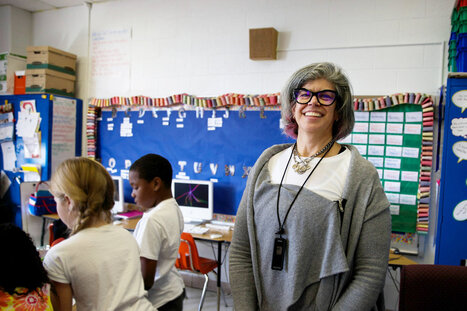
All week we've been reporting on big changes in reading instruction brought on by the Common Core State Standards: a doubling-down on evidence-based reading, writing and speaking; increased use of nonfiction; and a big push to get kids reading more "complex texts." In the last of a four-part series on the Common Core’s impact on reading instruction, NPR’s Weekend Edition Saturday (11/17) reports on efforts to teach students to find evidence within the text of reading materials to answer questions. The segment describes the complexity of the assignments, and narrates on in which students gather in groups to scan through informative texts in search of information to answer a teacher’s questions. Text of this story can be seen here (11/15).
Scoop.it!

Today's guest responses on the "what, why and how" of close reading come from Christopher Lehman, Cris Tovani, Pernille Ripp, Jan Burkins and Kim Yaris.
Scoop.it!

By Liana Heitin
Mel Riddile's insight:
"Fractions instruction in schools has long been seen as a problem area. In 2010, the U.S. Department of Education's Institute of Education Sciences released a report on effective K-8 fractions instruction as part of its What Works Clearinghouse. The report noted that half of 8th graders could not place three fractions in order from least to greatest on the 2004 National Assessment of Educational Progress in math. It also found that fewer than 30 percent of 17-year-olds could convert 0.029 into a fraction."
Scoop.it!

With EQuIP's Student Work Protocol teachers are able to find ways to strengthen lesson plans. This protocol works in groups or on an individual basis. Watch how a group of teachers use the protocol for Math and ELA lessons.
|




