Your new post is loading...

|
Scooped by
Mel Riddile
April 27, 2012 11:38 AM
|
Nothing positive will happen if we allow the debate around the Common Core standards — created by professional educators and others with relevant expertise — to be controlled by people who, while well-meaning, are thoroughly unqualified to judge the quality of the standards.
Great Point!
Now, remember the U.S. before the Common Core, when every state had its own isolated education standards. Entrepreneurs, researchers and other innovators only had motivations to pay attention to Texas, California, Florida and other large markets. Utah was ignored and left to adopt products designed for other states. By adopting the Common Core, Utah's children and teachers now have access to a nationwide market of commercial and noncommercial innovations, which give them access to the very best educational materials and experiences available anywhere. Do we really want Utah to pull out of this nationwide market?
|
|
Scooped by
Mel Riddile
April 26, 2012 7:23 PM
|
|
|
Scooped by
Mel Riddile
April 26, 2012 7:16 PM
|
It seems that everyone now has a book about the Common Core and that everyone’s curricular materials now align with the Common Core. But this alignment can mean something different for every item you purchase, every article you read, and every lesson you download. How do we know how well or how thoroughly something aligns to the Common Core? Which materials are the products of “close readings,” both of the standards and of the context surrounding them? Which materials are closely/deeply/tightly aligned (ALIGNED!!) and which are aligned-ish? Not surprisingly, we have some thoughts on this, which we will share with you tomorrow.
|
|
Scooped by
Mel Riddile
April 26, 2012 2:41 PM
|
by Joellen Killion
Senior Advisor, Learning Forward Education Week March 19, 2012
Instructional Leadership
While principals need not be experts in the all aspects of the standards, they must demonstrate sufficient understanding to be instructional leaders within their schools.
Change Leadership - School leaders' must manage the change process. Most change efforts in education are short-lived, not because they aren't needed, but rather because they are poorly managed.
- Managing small changes within a school can be taxing; managing the implementation of college- and career-ready standards, along with new assessments and the essential revamping of instruction, is monolithic in scope.
- Providing Resources
- Frontline Communicators
- Clear Process of Change
|
|
Scooped by
Mel Riddile
April 26, 2012 11:19 AM
|
In the end, though, Loveless is right to challenge us with the hard facts of the failed approaches of the past. And the only way for states to see the kinds of achievement gains that the small handful of gap-closing schools have seen is to focus less on forcing the compliance-oriented implementation that Loveless describes and more on trying to understand how to empower teachers and leaders on the ground level to embrace the standards and to actually use them as the starting point for all curriculum development, formative and summative assessment, and instruction.
|
|
Scooped by
Mel Riddile
April 25, 2012 7:07 PM
|
by Catherine Gewertz Education Week
The two consortia of states--SBAC and PARCC--that are designing the tests issued joint technology-purchasing guidelines to help schools and districts as they buy technology now. The outline helps them decide on hardware and operating systems that lend themselves to the new tests.
Computers should have the following: - processors that run at 1 GHz or faster
- at least 1G of RAM
- be running Windows 7 or Mac 10.7 (other operating systems are listed, too)
- have a wired or wireless network connection.
- Desktops and laptops aren't the only acceptable devices, either; tablets and netbooks that meet the specifications are fine, too.
For the full run-down of specifications, see the guidelines themselves.
|
|
Scooped by
Mel Riddile
April 25, 2012 6:27 PM
|
The Smarter Balance Assessment Consortium (Smarter Balanced) and the Partnership for Assessment Readiness for College and Careers (PARCC) today issued future purchasing guidance designed to inform schools and districts on hardware and operating...
|
|
Scooped by
Mel Riddile
April 25, 2012 6:23 PM
|
Last week 2010 National Teacher of the Year Sarah Brown Wessling addressed the Implementing Common Core Standards Network of the Council of Chief State School Officers. In her remarks, Wessling described how she is altering her classroom curriculum and instructional practices to implement the English/Language Arts Common Core.
Wessling made a number of very important points in her remarks. Among the many profound comments she shared was one that requires thoughtful consideration and immediate action by state and district leaders responsible for Common Core. "If teachers are not a part of the conversations," she said, "we cannot construct our own learning that enables us to do our work."
|
|
Scooped by
Mel Riddile
April 25, 2012 4:29 PM
|
Understanding Language is devoted to improving education for English Language Learners in light of the new Common Core State Standards and Next Generation Science Standards.
|
|
Scooped by
Mel Riddile
April 25, 2012 10:12 AM
|
Dedicated to improving outcomes for students and youth with disabilities through shared work and learning.
|
|
Scooped by
Mel Riddile
April 25, 2012 9:15 AM
|
Many teachers are broaching math topics at grades higher or lower than what the standards prescribe—and across more years than called for.
|
|
Scooped by
Mel Riddile
April 24, 2012 1:56 PM
|
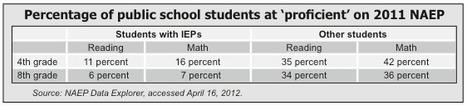
Will NAEP Proficiency Rates Predict Common Core Success?
|
|
Scooped by
Mel Riddile
April 24, 2012 11:23 AM
|
English-Learners will have to go beyond the fundamentals and master 'academic language,' experts say.
|
|
|
Scooped by
Mel Riddile
April 27, 2012 11:33 AM
|
For nearly two years, California’s unwieldy eighth grade math standards have lain untouched like an unexploded IED, a roadside bomb of the math wars. But with middle and high school math teachers clamoring for guidance and new assessments two-plus years away, the Legislature and State Board must soon answer the question, What about Algebra I in eighth grade?
|
|
Scooped by
Mel Riddile
April 26, 2012 7:19 PM
|
In many waivers to the main K-12 education law, states propose testing students in science, social studies, and writing, too.
|
|
Scooped by
Mel Riddile
April 26, 2012 6:28 PM
|
Text Complexity by Barbara Blackburn
|
|
Scooped by
Mel Riddile
April 26, 2012 11:25 AM
|
Vicki Fisher, director of curriculum and instruction for Avon Local Schools, and Mark Gleichauf, director of teaching and learing K-12 for Lakewood City Schools discuss what to expect in the classroom and assessments with the transition to the...
|
|
Scooped by
Mel Riddile
April 25, 2012 7:09 PM
|
Although mastering algebra is widely seen as a gateway to higher mathematics, and as a stepping stone to being prepared for college, new studies suggest that taking the subject in middle school may not be such a great idea for low-performing students, my colleague Sarah D. Sparks reports.
|
|
Scooped by
Mel Riddile
April 25, 2012 7:04 PM
|
Many educators have inferred that the common core bans the practice of providing students with context and content before they read text.
Kelly Gallagher on Pre-reading and the Common Core
"CCSS call for students to be able to read "independently" and "proficiently," without "significant scaffolding"—instructional supports—by teachers. The standards also note that students may have added need for teacher assistance when wrestling with material above their reading level. "If someone is reading that as eliminating prereading activities, they're reading it incorrectly," said Kelly Gallagher.
|
|
Scooped by
Mel Riddile
April 25, 2012 6:25 PM
|
The thread of literacy found in the Common Core State Standards (CCSS) suggests a way to get to the heart of problem solving. When you say that someone is literate, you are not saying that they know how to read; you are saying that they are well read or have read a lot. And not only that but the assumption is that they have acquired the knowledge gained from reading (it is part of them and it is used both to support and to contradict what this literate person believes or doesn't believe). A literate person therefore has evidence to bolster and base beliefs upon and ammunition to argue against other beliefs. As the CCSS explain in the Appendix A, this is more than simple persuasion. The argument must be compelling, believable and irrefutable.
|
|
Scooped by
Mel Riddile
April 25, 2012 6:18 PM
|
Tennessee is increasingly expanding resources for teachers and school leaders to successfully implement the Common Core State Standards.
|
|
Scooped by
Mel Riddile
April 25, 2012 4:27 PM
|
To meet expectations of the common standards, Kentucky’s social studies and science teachers are teaching reading and writing strategies.
|
|
Scooped by
Mel Riddile
April 25, 2012 10:07 AM
|
But researchers raise concerns about drawing overly broad conclusions about the effectiveness of the software.
|
|
Scooped by
Mel Riddile
April 25, 2012 9:10 AM
|
Nine testing companies recently demonstrated that "machine scoring engines did as well or better than the human graders," as reported by Dr. Mark Shermis.
"To be a better writer, you need a lot of practice, you simply have to write more. " We think if students have to write more on state tests, they will write more in classrooms. When every teacher has an automated scoring engine and every student has an access device, we'll see a dramatic increase in writing across the curriculum in American schools.
|
|
Scooped by
Mel Riddile
April 24, 2012 11:26 AM
|
This special report maps out the landscape of academic content and instruction in the common-core era.
|