


Algebra 1 Teachers is a site for teachers that are impementing Common Core State Standards with a scope and sequence, lessons, and assessments.

 Your new post is loading...
 Scoop.it! Algebra 1 Teachers is a site for teachers that are impementing Common Core State Standards with a scope and sequence, lessons, and assessments. 
No comment yet.
Sign up to comment
Scoop.it!
By 2020, there will be about 38 million to 40 million too few college and university graduates to satisfy the demands of the global labor market, a report issued this month has found. http://www.mckinsey.com/insights/mgi/research/labor_markets/the_world_at_work
Scoop.it!

Why would the common core not include comprehension strategies? The reason that these strategies were not included in the standards is because the standards are learning goals. That is, they are the learning outcomes that we are striving to for students to accomplish. Strategies are not an outcome. Neither the PARRC or Smarter Balanced tests will test students’ knowledge of strategies; they will test ability to read and interpret text.
Scoop.it!
Find 400,000+ lesson plans and worksheets reviewed and rated by teachers. Lesson plans for all subjects including science, math, language arts and more.
Scoop.it!

Educator engagement in the implementation of Common Core State Standards is critical if we really want to see a quantum leap in college readiness.
Scoop.it!

Scoop.it!

Unable to reach consensus, one of the common assessment consortia goes back to the drawing board to define "college readiness."...
Scoop.it!

Although not a silver bullet, the common-core standards reflect "the highest-quality academic standards our country has seen," writes Gene Wilhoit.
Scoop.it!

This weekend, I wandered through Central Park and passed through Strawberry Fields with a fellow English teacher and dear friend, Stacey. I also received several emails…...
Scoop.it!

No teacher or administrator should use or support the use of Khan Academy videos without watching the first episode of Mystery Teacher Theater 2000 or MTT2K. Khan Academy teaches only one part of mathematics—procedures—and that isn't the most important part. Writing about mathematics, developing a disposition for mathematical thinking, demonstrating a conceptual understanding of mathematical topics are all more important than procedures. That said, procedures are still important, and Khan Academy provides one venue where students can learn them. In the end, I think every young person should have an account there. Even if only one in a thousand or ten thousand benefit, that would be a terrific outcome.
Scoop.it!

Mel Riddile, the National Association of Secondary School Principals’ associate director for High School Services, has a special perspective on the effect of the CCSS on ELLs thanks to his own experience of improving outcomes at a school with students from 88 countries who spoke 66 languages. As Principal, Riddile increased the percentage of students taking the International Baccalaureate (IB) from to 15 to 48 percent, and the school’s ranking became comparable to some of the top private institutions. He sees the similarity between the IB and the CCSS. The biggest change he predicts is that the standards will require a school-wide focus on literacy — every class will need to emphasize literacy and an on-going professional development program will be essential. “We teach using language and it is the teacher’s job to teach the language of their content area,” explains Riddile, while stressing that the key is consistency, “We must look at the CCSS as a long-term effort and keep working at it year-in, year-out.”
Scoop.it!

Career Technical Education (CTE) State Directors unveiled the Common Career Technical Core (CCTC), a shared set of high-quality CTE standards. The CCTC is a state-led initiative to ensure that CTE programs are consistent and high-quality across our nation. Download: https://careertechorg.presencehost.net/file_download/d88705f7-46ce-4148-b144-1a3496928df5.pdf
Scoop.it!

The enthusiasm with which states and districts have taken to the Common Core is certainly heartening, but it still remains to be seen what implementation of the standards will look like within the classroom.
|
Scoop.it!

A state-led testing consortium is inviting public comment on two sets of "model content frameworks" in mathematics that aim to serve as a "bridge" between the Common Core State Standards and the aligned assessments under development. The voluntary resources from the 24-state Partnership for Assessment of Readiness for College and Careers (PARCC) are offered as a way to help curriculum developers and teachers as they work to implement the new standards, as well as to inform the development of item specifications and blueprints for the forthcoming PARCC assessments.
Scoop.it!

So far, 45 states and the District of Columbia have adopted both sets of standards, and Minnesota has adopted only the language arts standards. The first assessments tied to the common core are due to come online in the 2014-15 school year. So far, the tally this year is:
Scoop.it!

"So much is expected of teachers today, but too little is offered in the way of resources, support and professional development."--Randi Weingarten This fall, millions of teachers will be expected to start teaching to the Common Core State Standards. These standards, if implemented right, have the potential to help students acquire the subject knowledge, deep understanding and skills to apply concepts that will prepare them for college, career and life. Most teachers have not received the tools and preparation they need to meet these instructional challenges because of budget cuts or inadequate implementation.
Scoop.it!

Yes, says education expert Chester E. Finn Jr., because it will ensure that students have the skills they need to compete globally. No, says Jay Greene of the University of Arkansas, because progress comes from letting schools experiment.
Scoop.it!

A recent survey indicates that 45 percent of employers say they are increasing employee training in grammar and related skills.
Scoop.it!

To fully reflect the standards, for example, the publishers' criteria for grades 3-12 note that "80 to 90 percent of the Reading Standards in each grade require text-dependent analysis; accordingly, aligned curriculum materials should have a similar percentage of text-dependent questions."
Scoop.it!

How Quick Bursts of Writing Connect to the Common Core State Standards • Writing is present in all the standards (If you’ve studied the standards, you know this well. Hooray! Writing should be part of everything we are doing and studying across the curriculum. Putting writing in its proper place at the head of the table right alongside reading will help us better meet Common Core expectations. Quick Bursts help us efficiently infuse writing into much more of what we do.)
Scoop.it!

Teachers typically have particular texts that they need to teach. What does it mean for a teacher to teach a text with a 700 Lexile?
Scoop.it!
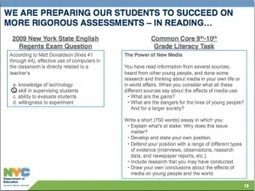
City and state officials have promised that new curriculum standards, known as the Common Core, would de-emphasize rote learning in favor of critical thinking.
Scoop.it!
EMBEDDING LITERACY LEARNING IN ALL SUBJECTS One of the most significant ways the Common Core State Standards are integrated, or cross-disciplinary, is the way they address literacy. Rather than viewing literacy as an isolated set of skills to be taught only in English language arts classes, the Common Core suggests that literacy is the responsibility of all teachers. The Common Core includes reading standards for literacy in history/social studies, for example, and writing standards for literacy in science.
Scoop.it!

NCTM’s Mathematics Teaching in the Middle School, Focus Issue on Fostering Mathematical Reasoning, February 2012 is a direct connection to promoting inquiry, risk-taking, and metacognition where teachers and students alike make their thinking public that were discussed in past blogs. The articles in this focused issue gave examples of how to provide opportunities for mathematical reasoning for younger students so that their conceptual understandings can expand to the high school skill set and more importantly to bridge the concrete to the abstract.
Scoop.it!

By Joanne Allain & Nancy Eberhardt "In our previous entry, we proposed that RtI and the Common Core State Standards (CCSS) initiatives share a common goal: increased rigor for all students. The next step is to ensure that we seize the golden opportunity to use existing RtI structures and systems to facilitate the implementation of CCSS, the “new initiative on the block.”" "Let’s take a look at a couple ways in which we can capitalize on the complementary aspects of these two initiatives."
|




