The primary purpose of sharing item and task prototypes is to provide information and to support educators as they transition to the CCSS and the PARCC assessments.
Note: The item and task prototypes were developed primarily for the purposes of communications and training. They are not test samplers, and are not meant to mirror full-length assessments.
Robert Rothman chronicles two decades of Hunt’s leadership culminating with the critical role played by the Hunt Institute (where I was a founding director). Rothman also notes the pivotal role that two other former governors, Roy Romer on development and Bob Wise on adoption. President Bush also deserves credit for his advocacy of high standards.
On ways that Common Core is different and higher, Rothman points to Anchor Standard 1 which states, “Read closely to determine what the text says explicitly and to make logical inferences from it; cite specific textual evidence when writing or speaking to support conclusions drawn from the text.”
“Student will also do a lot of writing that asks them to draw on evidence to make logical and reasoned arguments.”
Jonathan Wray is the instructional facilitator for secondary mathematics curricular programs in the Howard County (Maryland) Public School System and is an elected member of the National Council of Teachers of Mathematics board of directors.
The United States recently ranked 25th out of 34 developing countries in mathematics falling behind countries such as Japan, Germany and France.
"A key step is for all educational stakeholders to approach our mathematics challenges in a more collaborative manner."
"There’s been a lot of talk about the new Common Core State Standards—how they will impact students, what the new expectations will be for math and rea...
Amanda Adrian and Heather Rader look at how the Common Core is helping teachers rethink vocabulary instruction in this feature from the archives. They include a simple activity for literacy leaders to try with teachers to help them understand how different tiers of words work:
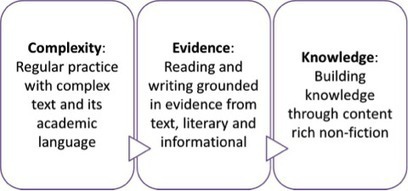
The new Common Core Standards call for students to read a great deal more content-rich non-fiction in high school. But what’s a “complex” text anyway and how do teachers select such texts?
In an opinion post in response to a recent New York Times essay, a city English teacher writes: "If algebra can be tossed by the wayside, why not Austen?" And he laments, that is already happening.
As district and school leaders plan how they will meet the standards, it is crucial that they take three preliminary steps:
review research on change in education,
reflect on and mine past change efforts for lessons learned
clarify the fundamental assumptions that drive their decisions
Implementing new standards is not a light-switch change. The process will extend over multiple years with multiple adjustments and refinements in the process.
Starting in the 2014-15 school year, the state will swap the reading and math portions of the FCAT with a new test that will bring Florida in line with other states.
There are going to be some dramatic changes between how special education (at least in my school and other schools I’ve worked in) is done now and how it will be done when the Common Core State Standards (CCSS) is completely initiated.
Common core state standards provide a foundation of which to build from. The accountability piece is what is important in all of these changes in the past few years. Do I like that up to 50% of my evaluation can be based on student achievement? Not really, but I do believe that numbers don't lie. Data will show what is working or not. If a particular curriculum or instructional practice is not working, any good teacher would want to make it better. It is extremely important for teachers to be able to explain what and why they are teaching a certain topic a certain way. It causes us them to evaluate what works best for our learners. A continuous cycle of improvement is needed and CCSS helps us to plan, do, check and adjust according to student's needs.
When the Common Core=Teaching Reading Strategies 2.0 by Rachel Levy August 17th, 2012
"Vital to teaching anything (okay, vital to teaching reading) for mastery to any students, is background knowledge. The Common Core is supposed to go further than just asking students to learn from text by relating the general themes in the text it to their own personal experiences. As it should, but that doesn’t mean we should limit what they are learning to the content of the texts they are studying."
"The key to reading success is a vocabulary and knowledge-rich curriculum and a lot of practice reading."
The 6th Common Core language anchor standard is about being able to acquire, use, and grapple with unknown words. Vocabulary builders, this is your standard!
"Ultimately, college and career readiness is all about independence; for L.CCR.6, that means being able to handle unknown words on one’s own."
If the average American teen sends a staggering 3,000 text messages a month, you can be sure that there are more than a few letters, commas and apostrophes missing.
"In order to effectively roll out the Common Core State Standards (CCSS) to teach the new generation of English Language Learners (ELLs), now more than ever, it is critical for current and future teachers to have a deep understanding of language learning research-based theory and practice. In order to remain relevant, teachers need to be well prepared to address the linguistic and cultural diversity in their classrooms."
If you're a teacher or administrator in a district with a diverse student body, you may be asking how the PARCC assessments will be tailored to meet the vari...
The Council of the Great City Schools' parent roadmaps in English language arts/literacy and in mathematics provide guidance to parents about what their children will be learning and how they can support that learning in grades K-8. These parent roadmaps for each grade level also provide three-year snapshots showing how selected standards progress from year to year so that students will be college and career ready upon their graduation from high school.
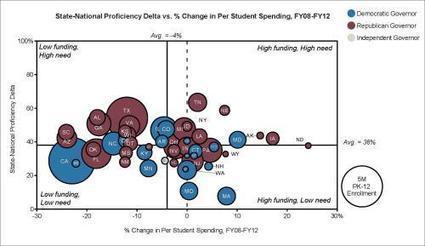
"A state like Tennessee, where education spending increased between 2008 and 2012 but state test scores wildly overrate students compared with NAEP, goes in the upper right.
It's in the states in the upper right that the best business opportunity—for both for-profit and non-profit investors, publishers, vendors, and, most importantly, education service providers—can be found, Lytle said."
To get content containing either thought or leadership enter:
To get content containing both thought and leadership enter:
To get content containing the expression thought leadership enter:
You can enter several keywords and you can refine them whenever you want. Our suggestion engine uses more signals but entering a few keywords here will rapidly give you great content to curate.


 Your new post is loading...