CCSS Tip: Week 6
Developmental Studies Center

 Your new post is loading...
 Scoop.it! CCSS Tip: Week 6 Developmental Studies Center 
No comment yet.
Sign up to comment
Scoop.it!

Mrs. Orman's Classroom "You've probably seen the pictures on Pinterest proclaiming that "Said is Dead!" with columns of alternative attributions to use for more descriptive writing. I've never understood this. "Said" serves a useful purpose in writing and quoting dialogue."
Scoop.it!

Each Friday we post three Common Core-aligned reading and writing tasks inspired by New York Times reporting and opinion pieces, and classroom-designed and tested by teachers Sarah Gross and Jonathan Olsen and their ninth grade humanities students.
Scoop.it!

Some 40 percent of students are failing to graduate from college in six years. A study calls for higher-quality college prep, with more advanced math, advanced placement classes, and better advising.
Scoop.it!

As more schools invest in student iPad programs, one question still unanswered is whether or not those devices can be used for the high-stakes online tests coming in 2014.
Scoop.it!
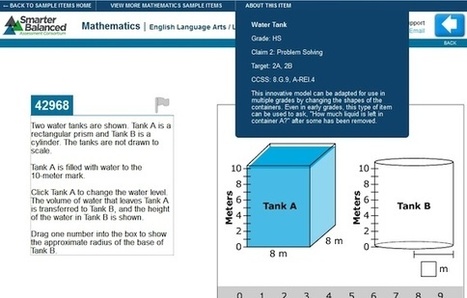
Smarter Balance has released sample items and performance tasks for their version of the Common Core assessments: http://www.smarterbalanced.org/sample-items-and-performance-tasks/ "The samples include nearly 50 assessment items and performance tasks, including examples of innovative, technology-enhanced items that take advantage of computer-based administration to assess a deeper understanding of content and skills than would otherwise be possible with traditional item types. In addition, sample performance tasks showcase the extended classroom-based activities students will experience as part of the Smarter Balanced assessment system.
Scoop.it!

General Educators Trained in Universal Design for Learning Most general educators will be prepared in the Common Core Standards and the general curriculum, but most will NOT be prepared in making the necessary accommodations and modifications to provide access to students with special needs. Universal Design for Learning is a powerful framework to increase accessibility and engagement that special educators are rallying around. General educators will need to be trained in the fundamentals of UDL and use of accommodations and modifications should be incorporated into their ongoing coaching and evaluation.
Scoop.it!

Smarter Balanced sample items illustrate the rigor and complexity of the English language arts/literacy and mathematics items and performance tasks students will encounter on the Consortium’s next-generation assessments.
Scoop.it!
|

|
Scooped by
Mel Riddile
October 9, 2012 7:44 AM
|
Scoop.it!

via Teaching Channel
Grades 9-12, History, Curriculum
Reading Like A Historian curriculum is a unique and effective way to teach High School History. By turning students into history investigators, teachers help them develop critical thinking skills and increase student engagement.
|
|
Scooped by
Mel Riddile
October 8, 2012 9:22 AM
|
Scoop.it!

The College Board today announced the release of redesigned AP programs for U.S. history and physics, with a focus on reducing the amount of content coverage required to allow more time for studying key concepts in greater depth.
The new exams for both subjects will feature fewer multiple-choice questions and increase opportunities for students to apply their skills and knowledge.
In U.S. history, for instance, the number of multiple-choice questions will be chopped down from 80 to 36.
As for U.S. history, the key objectives of the changes include:
• Alignment with evolving U.S. history curriculum at the nation's top colleges and universities;
• Providing teachers and students flexibility to focus on specific historical topics, events, and issues in greater depth; and
• Increasing student practice of historical thinking skills as central to understanding history.
|
|
Scooped by
Mel Riddile
October 7, 2012 6:22 PM
|
Scoop.it!

Along the socioeconomic spectrum in the student population, there is a corresponding vocabulary gap for children beginning in kindergarten.
Children of professionals were, on average, exposed to approximately 1,500 more words hourly than children growing up in poverty. This resulted in a gap of more than 32 million words by the time the children reached the age of 4.
As the education theorist E. D. Hirsch recently wrote in a review of Paul Tough’s new book, “How Children Succeed,” there is strong evidence that increasing the general knowledge and vocabulary of a child before age 6 is the single highest correlate with later success. Schools have an enormously hard time pushing through the deficiencies with which many children arrive.
|
|
Scooped by
Mel Riddile
October 7, 2012 12:38 PM
|
Scoop.it!

October 1, 2012
The Tennessee Department of Education provides this clear and easy to understand presentation to help school leaders assess technology readiness for Common Core Assessments.
|
|
Scooped by
Mel Riddile
October 14, 2012 11:18 AM
|
Scoop.it!
By Dian Schaffhauser
10/10/12
The Smarter Balanced Assessment Consortium released a sizable sampling of online assessment items, giving teachers, educational leaders, and members of the public an early look at what kinds of items and tasks will appear on the high-stakes tests that are due to debut in the 2014-2015 school year. Smarter Balanced is one of two consortia issued grants from the United States Department of Education to develop an assessment system that aligns with the Common Core State Standards.
The other consortium, Partnership for Assessment of Readiness for College and Careers (PARCC), shared its samples in August.
|
|
Scooped by
Mel Riddile
October 14, 2012 9:44 AM
|
Scoop.it!

Receptive vs. Productive Vocabulary : Vocabulary.com
In Vocabulary at the Core , Amy Benjamin and John T. Crow assert that word study should play a more significant role in English class and across the curriculum — as emphasized by the Common Core State Standards.
An important distinction exists, therefore, concerning the words that you have locked in your brain. To capture this distinction, we use the terms receptive and productive:
|
|
Scooped by
Mel Riddile
October 13, 2012 7:00 PM
|
Scoop.it!

Bethany Little noted that Common Core State Standards implementation offers a "once in a generation opportunity" to dramatically improve the quality of student learning.
The Big Drop
Two years from now the conversation in most states will be monopolized by the precipitous drop in test scores brought about by new tests of higher standards. In some states, the controversy starts sooner. Kentucky will release results of Common Core-aligned assessments next week.
About the challenge of deeper learning and better preparation, moderator Virginia Edward, the EdWeek publisher, pointed to the need for:
1) Capacity: From schools to state departments, capacity for a complex change agenda is weak
2) Communication: Clarity of intent with examples of success; and
3) Culture: The need, in many places, for wholesale change to a focus on student success.
|
|
Scooped by
Mel Riddile
October 11, 2012 8:17 PM
|
Scoop.it!

Teachers with Apps
How to Write a Paragraph, by Classroom Complete, is another smash success on the iPad! We recently reviewed, How to Write an Essay and have been using it ever since in our classrooms with a wide cross-section of students. We have found it to be an incredible tool, the simple interactivity helps students get past writer’s block and get excited about writing.
|
|
Scooped by
Mel Riddile
October 11, 2012 8:13 PM
|
Scoop.it!

Officials warn that because of the state’s adoption of the Common Core State Standards and the new, more rigorous K-PREP assessments tied to those standards, school districts across the state can expect anywhere from a 10- to 40-point drop in the proficiency rates.
Clark County Superintendent Elaine Farris said the district has sent letters to parents notifying them of the upcoming results and explaining the new testing system.
|
|
Scooped by
Mel Riddile
October 10, 2012 11:00 PM
|
Scoop.it!

|
|
Scooped by
Mel Riddile
October 10, 2012 8:48 AM
|
Scoop.it!

Teaching Argumentative Writing
Argument writing is one of three types of writing stressed in the Common Core Standards for English, history, and science/technical studies.
|
|
Scooped by
Mel Riddile
October 9, 2012 7:35 AM
|
Scoop.it!

Compass Learning curriculum expert, George Rislov, answers questions about Common Core assessments.
A: In terms of computer-based assessments, advances in technology, together with innovative assessment task design and advanced psychometric and cognitive models, make it possible for us to be better informed about what students know and can do than ever before. PARCC and SBAC will be using new formats as well, so they bear watching as we see how well some of the new formats work. One quick example from PARCC is the use of technology to capture student comprehension of texts in authentic ways that in the past have been difficult to score by machine for large scale assessments. Examples include shade text, drag and drop, moving items to show relationships, cut and paste, just to name a few. As I mentioned, PARCC has released sample items and task prototypes in the last month, and SBAC is expected to have a release in early 2013.
|
|
Scooped by
Mel Riddile
October 7, 2012 10:06 PM
|
Scoop.it!

By Larry Ferlazzo
Word Ahead is one of the best vocabulary-learning sites I’ve seen for advanced English Language Learners and mainstream students. It uses SAT words, and shows the word and representative image, plus provides audio support for text showing the word being used in context.
|
|
Scooped by
Mel Riddile
October 7, 2012 12:44 PM
|
Scoop.it!
Governors Work to Implement the Common Core State Standards
“Teachers and principals remain our strongest tool in educating our children,” said Tennessee Gov. Bill Haslam. “Governors should work with chief state school officers and state boards of education to ensure that policies are aligned and educators are both prepared and supported.”
Governors should consider taking the following actions to support successful implementation: