Your new post is loading...

|
Scooped by
Roxana Marachi, PhD
January 20, 2018 3:01 PM
|
"Teacher at a *~bAy aReA cHaRteR~*. While I am lucky to get to work with children every day, there is no limit to how awful these privately-owned, racist and exploitative companies can be. I try to take a break from eternally rolling my eyes at these neoliberal a$$holes to write about how removed from reality a charter school can be." Want to talk to me? Communicate with me on my Twitter account. More about my school. We have: - no cafeteria
- no school nurse
- no on-site custodian
- no school library
- school is 7:45 - 4 PM (8.25+ hours) daily
- recess is 15 minutes and running is prohibited
- lunch is 15 minutes and kids are not allowed to talk during lunch
- every student (from pre-K to 5th grade) has mandatory computer class for 90 minutes a day"
https://charterschoolnightmares.tumblr.com/ Related post documents link where blog is indicated as having been written by teacher at Rocketship
https://deutsch29.wordpress.com/2017/12/17/bay-area-rocketship-charter-where-vomit-stays-on-the-carpet/
|
|
Scooped by
Roxana Marachi, PhD
April 25, 2017 9:20 PM
|
To download, click on title above.
|
|
Scooped by
Roxana Marachi, PhD
March 31, 2017 2:36 PM
|
"It was just a matter of time before the wheels came off Nashville's charter school industry. This year, it's finally happening. Advocates for charters — publicly funded private schools — have long argued they’re the best approach for improving K-12 public education. But national research shows, and now a series of new local developments reinforces, that charters are just a collective ruse pushed by special interests trying to privatize our school system. The latest example is RePublic Schools. In March a federal judge certified a class-action lawsuit brought by Nashville parents who complained their families are being subjected to illegal hardball recruiting tactics by the charter chain. RePublic allegedly sent text messages to thousands of parents. As it turns out, RePublic harvested student and family contact information from a Metro Nashville Public Schools database, then turned over the personal information to an out-of-state vendor that generated the texts. Sending unsolicited text messages is a violation of federal law. In their class-action lawsuit, the parents are seeking damages of up to $1,500 per person — leaving RePublic potentially on the hook for millions in penalties. Of course, the irony here is: RePublic — which boasts it's “reimagining public education” — is at the forefront of a movement that claims students and families are flocking to charters. The reality is: Demand for RePublic is anemic, which is why the chain is sending mass text messages in a bid to draw more students and more public money. Rocketship is another charter chain that isn't living up to its own marketing hype. Worse, Rocketship is failing some of Nashville's most vulnerable kids and, like RePublic, operating in violation of federal law. On March 7 WSMV-TV reported that California-based Rocketship isn’t providing legally required services to students with disabilities and English language learners. A report by the Tennessee Department of Education even found that Rocketship is forcing homeless students to scrape together money to pay for uniforms. Despite failing to serve its current students, Rocketship routinely makes end-runs around the local school board to seek state approval of more charters. That’s because Rocketship’s growth isn’t driven by what’s best for kids but rather by its real-estate deals with Turner-Agassi Charter School Facilities Fund, a for-profit investment fund co-managed by tennis star Andre Agassi. Finances also are an issue with LEAD charter schools. Tennessee’s Comptroller of the Treasury recently flagged “major issues” in three LEAD charters with operating deficits totaling nearly $2.7 million. Only after pressure at a January school board meeting did LEAD’s accountants admit that running the chain requires “a significant amount of fundraising and grant proceeds” on top of the public funds it receives. In other words, contrary to popular myth, charters do not deliver equal educational services at equal or less value than traditional schools. Despite LEAD’s financial deficits — and the closure of an underperforming school less than two years ago — the chain is now back at the taxpayer trough looking to expand. My view: Enough, already. Independent studies have found charters are draining resources from Metro Nashville Public Schools at a time when our public schools are showing real promise. Now, the local charter industry is unraveling. Many people predicted this day would come. We just weren’t sure when.
Will Pinkston represents South and Southeast Nashville on the Metro Nashville Board of Public Education. For original post, see; http://www.tennessean.com/story/opinion/2017/03/29/nashvilles-charter-school-industry-unraveling/99747782/
|
|
Scooped by
Roxana Marachi, PhD
July 1, 2016 4:02 PM
|
By Thomas Ultican "This January (2016), Fortune Magazine announced that Netflix CEO, Reed Hastings, has launched a new $100-million-dollar fund to support education initiatives and other groups.
The notice goes on to state: “Hastings is the fund’s sole trustee while Neerav Kingsland, the former CEO of charter school supporter New Schools for New Orleans, is serving as CEO. The fund’s website explains its philanthropic mission: “Currently, too many children do not have access to amazing schools. Our aim is to partner with communities to significantly increase the number of students who have access to rich and holistic educational experiences.” The “rich and holistic educational experience” is to be delivered by charter schools employing competency based education (CBE).
Competency Based Education
The United States Department of Education promotes and describes CBE: “Transitioning away from seat time, in favor of a structure that creates flexibility, allows students to progress as they demonstrate mastery of academic content, regardless of time, place, or pace of learning. Competency-based strategies provide flexibility in the way that credit can be earned or awarded, and provide students with personalized learning opportunities. These strategies include online and blended learning, dual enrollment and early college high schools, project-based and community-based learning, and credit recovery, among others.” Instead of a structured course with a teacher, students will log into a computer and earn badges for demonstrating competencies in an online environment. “Personalized learning opportunities” is a euphemism for a computer based course delivered in isolation. It is a terrible idea! The last thing a 21st Century student needs is to be shoved in front of another inert digital device. Students need to interact with “highly qualified” certificated teachers, adults who they can trust. Students need to; measure, calculate, weight, work in small groups, discuss ideas, write, and get professional feedback. Students need structure, stability and direction. None of this is provided online. Technology in education is more of an expensive mirage than a useful tool and competency based education (CBE) is fool’s gold. In 2003, I took the state of California’s 52-hour life insurance course. That meant 52 hours of seat time with an insurance industry veteran who made the subject come alive. Today that insurance course is online with an online exam. No real industry context is imparted and cheating on the exam is rampant. This is the kind of education Hastings and his ilk are vigorously promoting. CBE means lower quality education delivered at great profit to corporate providers and testing companies. CBE learning is embraced by President Obama, Bill Gates, Eli Broad, Reed Hastings, Education Secretary John King, The Walton family, the new federal education law, Pearson Corporation and many business executives. Few experienced education professionals not profiting from one of these entities support it. Computers are good at drilling information and conducting fact checks. However, educators have known for more than a century that this kind of teaching is destructive. To create understanding, all of the modes of learning must be actively engaged. Drill and skill destroys the desire to learn and undermines development of creativity.
Big Money Being Poured into CBE
In 2004, the Don and Doris Fisher Foundation along with the Schools Future Research Foundation each provided $100,000 to start the Charter Schools Growth Fund in Broomfield, Colorado. The Fisher Foundation is based on profits from GAP Inc. and the School Future Research Foundation was a Walton Family Foundation supported fund that seems to have disappeared. The original elected board of directors for the Charter School Growth Fund was comprised of John Walton, Don Fisher, and John Lock. In 2010, the President-CEO of the Charter School Growth Fund, Kevin Hall, decided to purchase the struggling Dreambox Inc. of Bellevue, Washington for $15,000,000. By then the fund was so large and he could do it. He subsequently invested another $10,138,500 into Dreambox. [data from 2014 form 990]
A recent National Public Radio report on the Rocketship schools reported: “Rocketship students often use adaptive math software from a company called Dreambox Learning. The company was struggling when Reed Hastings, the Netflix founder turned education philanthropist and investor, observed it in action at a Rocketship school several years ago. His investment allowed Dreambox to become one of the leading providers of math software in North America, currently used by about 2 million students.” Kevin Hall left his $465,000 a year position at the Charter School Growth Fund to join Hastings on the board of Dreambox Inc. This company is now positioned to be the dominant supplier of software products into the CBE market. Pearson corporation has been positioning itself to be the company that tests students and issues completion badges. If the big standardized test goes away, Pearson will do just fine supporting CBE."... For full post, see https://tultican.wordpress.com/2016/06/29/californias-charter-school-led-cbe-invasion/
|
|
Scooped by
Roxana Marachi, PhD
April 27, 2016 11:02 PM
|
|
|
Scooped by
Roxana Marachi, PhD
March 9, 2016 9:52 PM
|
|
|
Scooped by
Roxana Marachi, PhD
March 9, 2016 9:39 PM
|
|
|
Scooped by
Roxana Marachi, PhD
December 28, 2015 12:02 AM
|
By James Hoover
"What can be more important to save in a viable democracy than education and the assurance that it is easily accessible for all, whatever your skin color or financial means? Unfortunately the best vehicle for that endeavor, public education, has figured prominently in quick-profit schemes of private investors, some stemming from honest attempts to improve education, but many motivated by pure greed.
For the latter, it’s beginning to take the character of the Wall Street frenzy that passed off toxic securities as AAA rated, and sold them full price to unsuspecting buyers. For the most part, Wall Streeters, having a culture of entitlement, gave no apology for their greed.
On the other hand, for-profit education defenders tend to peddle what they call education reform in the guise of superior for-profit charter schools using public money. They tend to obfuscate the “for-profit” motives in the process. While corporate-run schools do provide somewhat comparable student success rates, it’s usually at a higher cost, even though they pay lower salaries to inexperienced teachers, who have a higher turnover. Furthermore, they cherry-pick students, teach to tests, winnow out the most intractable students, and provide little accountability to the community.
In states like Arizona, some of the same investors run state prison systems whose lobbyists work overtime to augment prison populations, even supporting harsh imprisonment laws to boost their prison profits and keep penitentiaries full. Public records, for example, show that the so-called “war on drugs” aggressive policing, supported and exploited by corporate interest running privatized prisons, quickly drove up the percentage in state prisons for drug offenses from 6.4% in 1980 to 22% in 1990, with that higher percentage only now declining nationwide.
Somehow, the taxpayers seem to pick up the tab for profit-driven enterprises, whether new sports stadiums, privatized prisons, for-profit health care costing double that of other advanced countries, bailed-out banks, and now education.
Education Reform Only for the Poor Wisconsin is another state taken over by Republicans. Scott Walker was elected governor in 2010, intrinsically connected with Koch brother funding and programs. He oversees the usual regimen of cutting spending in education, privatizing so-called low-performing schools and dismantling public unions.
Granted a contract by a GOP majority, Rocketship Education has a contract to open schools in Milwaukee, Wisconsin, one of several other large cities. Its model has four principles: 1. Cut costs by eliminating teachers and computerize instruction; 2. Hire inexperienced low-cost teachers; 3. Focus on math and reading; 4. Teach to the test. These are the schools for poor kids.
Rich people send their kids to the top ten elementary schools in Milwaukee. These schools look nothing like Rocketship Education schools. They have twice as many licensed teachers per student; offer music, art, libraries, foreign languages and guidance counselors. Students are taught by experienced teachers, not through programmed learning on computers.
Rocketship has contracts in several large cities, and like other charters pushes teaching-to-tests in its schools, seeing it as reform. Charter advocates promote themselves as education reformers, civil-rights crusaders, who challenge failed traditional schooling. They blame teachers, teacher unions, bureaucracy, and bloated budgets for claimed failures. They promise to empower parents in low-income minority communities, citing teachers and administrators as the heavies. These promises and claims turned out to be bogus, and the reforms self-serving."...
For full post, click on title above or here: http://dissidentvoice.org/2014/10/scam-goes-education/
|
|
Scooped by
Roxana Marachi, PhD
November 8, 2015 3:32 AM
|
By Donald Cohen
"Did you know that one of the fastest growing sectors of the charter school industry are ‘virtual’ charter schools, where K-12 students learn from home in front of their computers? No school buildings, no recess with friends, no shared learning. It’s true. The largest virtual charter company, a publicly traded corporation called K12, Inc., provides education to over 120,000 public school students across the country. Last year, they made more than $900 million in revenue, most of it taxpayer money earmarked for public education. But virtual charters are starting to pile up bad news and serious questions about their priorities.
A study released last week by the Center for Research on Education Outcomes (CREDO) found that students attending virtual charters learn significantly less in math and reading than similar students attending brick-and-mortar schools. So significantly less that the Washington Post’s Lyndsey Layton wrote, “In other words, when it comes to math, it’s as if the [online] students did not attend school at all.”
This week, news broke that California’s Attorney General is investigating the entire virtual charter industry. And for good reason. Earlier this year, we looked under the hood of California Virtual Academies (CAVA), the state’s largest provider of online public education, and what we found was clear: CAVA’s manager and primary vendor, a subsidiary of K12 Inc., has put their responsibility to maximize profits for shareholders above investing in educating children.
Virtual charters are starting to pile up bad news and serious questions about their priorities.
While the overall percentage of U.S. students who attend online schools is small, in some states—like California, where CAVA teachers are organizing to serve students and families, not corporations—online education has become yet another path towards the privatization of public education. Online charters are a significant issue in Pennsylvania’s ongoing budget standoff between legislative leaders and the governor, as the state has the second-highest online enrollment in the country.
An increasing number of charter schools are using ‘blended learning’ models, where students go to school but spend lots of time in front of keyboards and screens. A former executive of the charter school chain Rocketship—which is one of the largest users of online learning—called blended learning “stripped-down efficiency model.”
Along with a growing crowd, we have concerns about an overreliance on technology in the classroom, but fully online schools go too far. While high quality virtual charters can be useful for certain students, like actors, artists, or Olympic hopefuls, the majority of kids need teachers to interact with and classmates to socialize and study with. And a pro-charter think-tank (CREDO), California’s attorney general, and many others, including teachers, seem to agree.
To follow up our CAVA report, we’re going to be looking even harder at virtual charters. Let us know if companies like K12, Inc., are recruiting students in your community. We’d love to hear from you. Send us an email: info@inthepublicinterest.org"...
For full post, click on title here: http://www.inthepublicinterest.org/yes-virtual-charter-schools-exist-and-theyre-growing/
|
|
Scooped by
Roxana Marachi, PhD
December 8, 2014 2:59 PM
|
By Barbara Miner
"Like most principals, Brittany Kinser is a cheerleader for her school. “I just want to make sure you’ll be positive,” she says when I visit the Rocketship charter school in Milwaukee.
Looking younger than her thirty-seven years and with the physique of a long-distance runner, Kinser has a seemingly endless supply of energy and enthusiasm. It’s hard not to like her. Following one of the school’s axioms—Dress for Success—she is wearing a magenta pencil-skirt that nicely sets off her black sweater, tights, and four-inch stiletto heels. Her Dress for Success message is clear: I am competent and I am in charge.
At the same time, Kinser is nervous about my visit. It’s understandable. For almost a quarter century, I have criticized using public tax dollars to fund private voucher schools and privately run charter schools. Rocketship, an entrepreneurial network of charter schools based in the Silicon Valley, has become a national poster child for the privatization of public education. It is particularly known for its bare-bones curricular focus on standardized test scores in reading and math, its use of computer-based “learning labs” that cut down costs, and its promotion of the Rocketship brand—including a daily pep rally where students chant that they are “Rocketship Rocketeers.”
After visiting Rocketship Southside Community Prep, as Milwaukee’s K4 through fifth-grade school is formally known, I could see why some people might react positively. Students were well behaved. Parents were welcome. The young teachers were energetic.
But as I left the school, I couldn’t help thinking: Can young students dress their way to success? Or chant their way to academic achievement? Are computerized worksheets the answer to reducing the achievement gap?
Rocketship opened its Milwaukee school in 2013, serving overwhelmingly low-income, Latino students on the city’s South side. The local chamber of commerce raised $2.5 million in private contributions to help fund Rocketship’s expansion to eight schools in Milwaukee by 2017.
Just inside the main entrance, there are banners from various universities hanging from the ceiling—part of the school’s message that students should be thinking about college. At the students’ eye level are Dress for Success posters featuring young children wearing the school uniform of khaki pants and a blue polo shirt with the Rocketship logo.
I’m not opposed to uniforms. I wore them throughout high school and appreciated that I didn’t have to figure out every morning what to wear. But the nuns never told us that our uniforms were the key to success. The policy was based more on a Catholic school philosophy that worried about the sin of pride and that discouraged too much attention to individual appearances. At Rocketship, I couldn’t quite figure out the laser-like focus on Dress for Success. They don’t take it lightly. The school handbook notes that students who do not wear their uniform “may lose recess, lunch or other privileges.”... For full article published on "The Progressive", click on title or image above or here: http://www.progressive.org/news/2010/12/187931/rocketship-lands-milwaukee#sthash.YGLtwC0G.dpuf For recent news related to the illegal forced parent work policies that are central to Rocketship's parent engagement model (revealed by the Public Advocates report) please visit: http://sco.lt/9FGAkr For other Rocketship related posts: http://www.scoop.it/t/charter-choice-closer-look?q=rocketship  and www.stoprocketship.com.
|
|
Scooped by
Roxana Marachi, PhD
October 3, 2014 3:18 PM
|
By David Bacon (Image by Ethan Heitner)
"Nearly every metropolitan area these days has its own wealthy promoters of education reform. Little Rock has the Waltons, Seattle has Bill and Melinda Gates, Newark has Mark Zuckerberg, and Buffalo has John Oishei, who made his millions selling windshield wipers. Few areas, however, have as concentrated and active a group of wealthy reformers as California’s Silicon Valley. One of the country’s fastest-growing charter school operators, Rocketship Education, started here. A big reason for its stellar ascent is the support it gets from high tech’s deep pockets, and the political influence that money can buy.
Rocketship currently operates nine schools in San Jose, in the heart of Silicon Valley. It opened its first school in Milwaukee last year and one in Nashville, Tennessee, this fall. Its first two schools in Washington, D.C., where almost half the students already attend charters, open next year. Rocketship plans include running eight schools in Milwaukee, in Nashville, and in D.C. in the near future. Rocketship also proposed a charter school in Morgan Hill, just south of San Jose. But there they ran into resistance from parents, teachers, and the teachers’ union. That successful campaign to block Rocketship and protect local public schools highlights the importance of confronting charter chains as they try to infiltrate school systems across the country.
For full post, click on title above or here: http://www.rethinkingschools.org/archive/29_01/29_01_bacon.shtml
|
|
Scooped by
Roxana Marachi, PhD
April 20, 2014 4:08 PM
|
Picture caption: "In the center of the room, a software program delivers lessons tailored to the individual skill levels of a second group of Mateo Sheedy students. An hourly-rate aide oversees the students." by Rahim Rahimian of EdWeek Article by Benjamin Herold of EdWeek Selected quote: "...Although test scores have steadily declined as the network has added schools and students, Rocketship has maintained its voracious appetite for growth. Rather than resolve that tension, the new flexible classrooms have, by Rocketship’s own admission, further strained the organization and exposed underlying problems glossed over during the group’s ascent. Some Rocketship leaders, for example, now acknowledge that their original blended learning model—which powered the organization’s initial growth, to nine schools and 5,200 students, before its impact could be rigorously studied—may be more effective at teaching students to follow directions than to think for themselves."... For full story, click on title above or here: http://www.edweek.org/ew/articles/2014/01/21/19el-rotation.h33.html?tkn=RRYF1gcvzhe8L6wfH%2F0k64DTHTNJY48UkPQP&cmp=clp-edweek
|
|
Scooped by
Roxana Marachi, PhD
March 10, 2014 3:19 AM
|
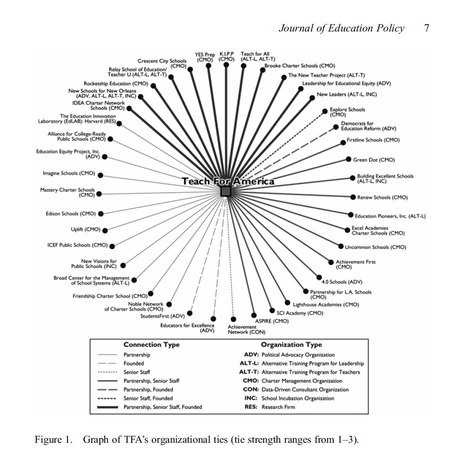
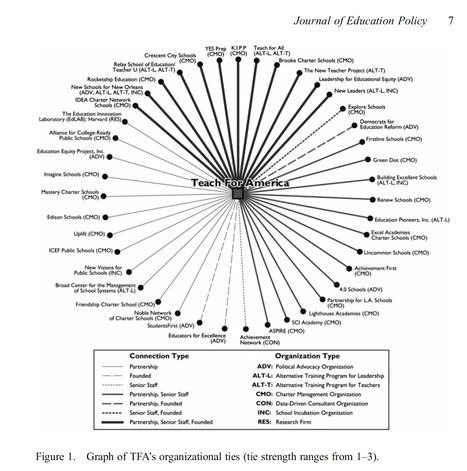
ABSTRACT from Journal of Education Policy - "In this paper, we illustrate the relationships between Teach For America (TFA) and federal charter school reform to interrogate how policy decisions are shaped by networks of individuals, organizations, and private corporations. We use policy network analysis to create a visual representation of TFA’s key role in developing and connecting personnel, political support, and financial backing for charter reform. Next we examine how the networks unfold at a local level by zooming in on a case study of New Orleans. By mapping out these connections, we hope to provide a foundation for further investigation of how this network affects policies."... For main journal publication page, click on title or image above. For pdf of article, email authors of the manuscript or curator of this collection. For subset of TFA-related articles in the Charters & Choice: A Closer Look collection, click here: http://www.scoop.it/t/charter-choice-closer-look?q=TFA 
|
|
|
Scooped by
Roxana Marachi, PhD
May 31, 2017 12:53 PM
|
To download full document, click on title above or here: https://emma.msrb.org/ER1035280-ER811630-ER1212694.pdf ____________________
According to the following Stradling Attorneys at Law announcement:
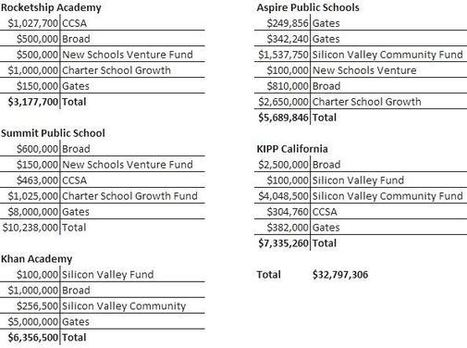
Rocketship Education Finances Charter School Facilities in California, Wisconsin, and Tennessee
"On February 22, 2017, Rocketship Education and its affiliate, Launchpad Development Company, closed simultaneous issues of charter school revenue bonds in California, Wisconsin, and Tennessee, each underwritten by Stifel, Nicolaus & Company, Incorporated.
The California School Finance Authority issued $23,095,000 in Series 2017A bonds and $3,665,000 in Series 2017B bonds. The Wisconsin Health and Educational Facilities Authority issued $7,160,000 in Series 2017C bonds and $250,000 in Series 2017D bonds. The Health and Educational Facilities Board of the Metropolitan Government of Nashville and Davidson County, Tennessee issued $7,740,000 in Series 2017E bonds and $250,000 in Series 2017F bonds."...
http://m.sycr.com/rocketship-education-finances-charter-school-facilities-in-california-wisconsin-and-tennessee/
|
|
Scooped by
Roxana Marachi, PhD
March 31, 2017 3:00 PM
|
"Rocketship Education won't be allowed to open another Nashville school through the Tennessee State Board of Education next year. The board voted unanimously to uphold the Nashville school board's decision to deny the charter operator a new school after a review of the application found it came up short in every category. Still, the charter operator plans to continue working with the Achievement School District to open a new Nashville school. Sara Heyburn, state board executive director, said at a Thursday agenda meeting the application didn't meet or exceed the state's requirements to overturn an appeal.
Heyburn said the review Nashville's decision to deny the charter operator this year wasn't "contrary to the best interests of the pupils, school district, or community." And the state board requires a complete plan for a school, Heyburn said.
"That couldn't be articulated in the application to the review team," she said. The state board has been allowed to overhear charter school appeals since a law was enacted in 2014 as a reaction to Metro Nashville Public Schools' 2012 decision to deny Great Hearts Academies a charter school."....
For full post, see:
http://www.tennessean.com/story/news/education/2016/10/14/rocketships-nashville-charter-school-application-denied/92020040/
ABSTRACT from Journal of Education Policy - "In this paper, we illustrate the relationships between Teach For America (TFA) and federal charter school reform to interrogate how policy decisions are shaped by networks of individuals, organizations, and private corporations. We use policy network analysis to create a visual representation of TFA’s key role in developing and connecting personnel, political support, and financial backing for charter reform. Next we examine how the networks unfold at a local level by zooming in on a case study of New Orleans. By mapping out these connections, we hope to provide a foundation for further investigation of how this network affects policies."... For main journal publication page, click on title or image above. For pdf of article, email authors of the manuscript or curator of this collection. For subset of TFA-related articles in the Charters & Choice: A Closer Look collection, click here: http://www.scoop.it/t/charter-choice-closer-look?q=TFA 
|
|
Scooped by
Roxana Marachi, PhD
June 25, 2016 7:54 PM
|
[Selected quote] ..."as Rocketship has pushed to expand, some parents, teachers and community members have objected in public meetings, raising concerns about the school's tech-heavy instruction model, student-teacher ratio, and student health and safety. In interviews over the past two months, current and former employees at Rocketship Schools emphasized the pressures on employees and students. They recounted instances of inadequate supervision, bathroom accidents and even infections due to denial of restroom visits. And they voiced concerns about a disciplinary measure the company calls Zone Zero. Several current and former staffers said this practice, in effect, amounted to hours of enforced silence."... For full post, click on title above or here: http://www.npr.org/sections/ed/2016/06/24/477345746/high-test-scores-at-a-nationally-lauded-charter-network-but-at-what-cost For subset of articles related to Rocketship on Charters and Choice: A Closer Look collection here: http://www.scoop.it/t/charter-choice-closer-look?q=rocketship
|
|
Scooped by
Roxana Marachi, PhD
March 13, 2016 5:31 AM
|
[3/10/16 Update]: Despite strong community opposition and unanimous denials by district and county level school boards, the State Board of Education voted to allow Rocketship to expand their corporate charter school chain to the Monument Corridor in Concord, California. For more background on how decisions like these are set in motion, see here. ##
Why is there so much controversy surrounding the proliferation of Rocketship Schools? A brief glance at their website wouldn’t hint at any problems, and may even sway critics to want to join the team. The marketing is stellar, pitching the “rethinking [of] elementary schools from the ground up” in order to “eliminate the ‘achievement gap’ in our lifetime.” Their promises go straight to our visceral wish for the new, the shiny, the forward reaching. I know current and former teachers, parents, administrators, and community members, all of whom are hard working people who want the best for their children. Perhaps bearing witness to the community fracturing with the expansion of the schools locally (with nine campuses over the past nine years) is what makes this post both difficult and necessary to write. So many questions abound. Do Rocketship’s claims of positive outcomes actually match reports of what’s happening on the ground? Might a narrow focus on test scores in a tech-heavy environment carry social, emotional, or physical costs that aren’t being considered? And why does the organization move with such an aggressive press for expansion when they are already struggling with such serious, ongoing (and unaddressed) issues at their current sites? Since corporate and tech-billionaire led foundations fund the proliferation and marketing of the schools, it’s rare for the public to hear voices expressing ground-level concerns (unless one happens to follow stoprocketship.com). In much the same way that controversies surrounding Teach For America are emerging with counter-narratives getting more airtime, concerns regarding Rocketship appear to also be growing in parallel with their expansions. The following letters and documents were among many sent to the California State Board of Education to recommend denial of the Rocketship Mt. Diablo appeal petition. They are shared with permission from the authors."... For full post, click on title above or here: http://eduresearcher.com/2016/03/09/rocketship-pushes/
|
|
Scooped by
Roxana Marachi, PhD
March 9, 2016 9:43 PM
|
|
|
Scooped by
Roxana Marachi, PhD
February 9, 2016 3:19 PM
|
By Valerie Strauss “No excuses” charter schools have become a prominent feature of modern school reform. What exactly are they? This is how Joan Goodman, a professor in the Graduate School of Education at the University of Pennsylvania and director of the school’s Teach For America program, defined them in this post: These schools start with the belief that there’s no reason for the large academic gaps that exist between poor minority students and more privileged children. They argue that if we just used better methods, demanded more, had higher expectations, enforced these higher expectations through very rigorous and uniform teaching methods and a very uniform and scripted curriculum geared to being successful on high-stakes tests, we can minimize or even eradicate these large gaps, high rates of drop outs and the academic failures of these children. To reach these objectives, these schools have developed very elaborate behavioral regimes that they insist all children follow, starting in kindergarten. Submission, obedience, and self-control are very large values. They want kids to submit. You can’t really do this kind of instruction if you don’t have very submissive children who are capable of high levels of inhibition and do whatever they’re told. Here is an open letter from Ramon Griffin, the former dean of students at a New Orleans “no excuses” charter school, who urges teachers and staff at such schools to question the model’s social and emotional costs on young people. Griffin was also a charter school teacher and a juvenile probation and detention officer. He is currently working on his doctorate in educational administration at Michigan State University. Contact him at griff519@msu.edu, or visit his website. This appeared on the website of Jennifer Berkshire, freelance journalist and public education advocate who worked for six years editing a newspaper for the American Federation of Teachers in Massachusetts. She gave me permission to run this post. Here is Ramon Griffin’s open letter to teachers and staff of no-excuses charter schools: Dear You: You were selected to teach at your school because of your intelligence, spunk, tenacity, vigor and, most of all, your passion for public education. You are a risk-taker. You have a can-do attitude with swag to match. You believe that every child has the capacity to achieve academically and are committing your life to ensuring that you affect change in every student you encounter. Your dedication to ensuring that traditionally marginalized students receive a first-class education is commendable. But do you know how much power you hold? Do you truly understand the “no excuses” school culture that you are part of? Do you know the psychological and emotional costs that the “no excuses” model has on students of color? Furthermore, do you care to know? Two years ago, I wrote a blog post entitled “Colonizing the Black Natives: Reflections from a former New Orleans Charter School Dean of Students.” I started the piece by asking if some charters’ practices were new forms of colonial hegemony. It is vital to add that while I was employed at the school, this thought never crossed my mind. My writings were taken by some charter management administrators and staff as an “attack” instead of an opportunity critically engage and refine, deconstruct and reconstruct practices that are doing more harm than good. This time around, I’m hoping to encourage teachers and staff at “no excuses” charter schools to acknowledge what is transpiring in their schools so that we can begin to push back against these practices and transform our schools. I’ll start by offering a few examples of my own. When I chased young black ladies to see if their nails were polished, or if they had added a different color streak to their hair, or when I followed young men to make sure that their hair wasn’t styled naturally, I could have been critically engaging my administrative peers on why these practices were the law at our school—and how exactly they contributed to getting students into and through college. When my school punished young people for not having items school leaders knew their families couldn’t afford, I could have been pushing back against policies that effectively punished students for being poor. When we pulled students out of their classrooms for countless hours for minor infractions even as we drilled them constantly on the importance of instruction time, we could have been taking our own advice. Or when we suspended students from school for numerous days, we could have been providing alternatives that disciplined them but kept them in school. I recently spoke on a panel in Nashville about the psychological and emotional costs that “no excuses” school cultures have on students of color. Afterwards, I was approached by a young white male who told me that he couldn’t understand why parents of color complained about “no excuses” school cultures when they’d chosen to enroll their children in the schools. But the idea that parents should not complain because they purposely enrolled their children in these schools is flawed. Parents, whether they’re in Nashville or New Orleans, desire that their children attend schools that will provide them a rigorous and first-class education. They’re sold a school culture “package” that claims to bring out the best in every student, challenging them to be creative, take risks and think critically. Yet too often, once the package is unwrapped and a culture of compliance is unveiled, students and families feel that they have been sold a dream. Is it realistic to expect parents to inherently grasp the psychological and emotional costs of the “no excuses” model when many of the teachers and school disciplinarians who enforce these policies don’t have a deep understanding of their effects either? In my experience, staff members are trained to follow the rules regarding discipline and school culture without questioning school leaders about why rules and practices exist in the first place. The idea of critically engaging administrators at these schools seems to intimidate staff, who fear potential backlash for speaking out against culture and disciplinary practices they don’t agree with. They don’t know how to push back critically and meaningfully without being disciplined or even losing their jobs. Whatever the reason, the lack of inquiry by and pushback from highly educated professionals regarding the questionable socialization practices and disciplinary policies of “no excuses” schools is striking. Even more astonishing is that the same things young people of color are punished for in these schools, their teachers were probably raised and encouraged to value. As students themselves, they were probably given the opportunity to be critical, to take risks, to disagree, to not conform, to ask for clarity, to push back, to show emotion and to be relentless about finding their own truth. Many of these educators are no doubt raising their own children to do similar things. But as teachers and staff at
“no excuses” charter schools, they are trained to instill the opposite values in youth of color, even punishing students for being critical or showing emotion. Why? I ask this question, not as a researcher or as a doctoral student, but as a colleague who has navigated the same terrain that you are currently treading. I understand—trust me. I am truly concerned that we are not asking the right questions. Why has “no excuses” been celebrated, packaged and sold to people of color as the prescription for educational and career excellence? Why is it “no excuses” for some and not for all? Ask yourself if you would allow your own children to be treated the way that some of your students are being treated. If the answer is “no,” then there is no excuse for complying with rules and policies you’d never tolerate where your own children or loved ones are concerned. Your students are young people, not robots. They are human children and sometimes their circumstances do warrant exceptions to the rules. Sometimes their excuses are legitimate. For example, a student who shows up out of uniform because he doesn’t have a washer/dryer at home has a legitimate excuse. A kid whose family has been transient and is currently homeless has a legitimate excuse to not be in proper uniform. The school should be aware of the situation and at least attempt to provide clothing for the young person. A kid who has three younger siblings he has to care for, clean up, help with homework, protect and teach because they live with their elderly grandmother who was thrust into legal guardianship because his mother was abusive and they never met their father has a legitimate excuse. A kid who has witnessed his mother being shot by his father has a legitimate excuse to not want to walk on a line, talk to anybody or participate in class. A kid who hasn’t eaten a nutritious meal in weeks, but makes it to school every day has a legitimate excuse to feel tired, to not want to participate in an activity or to look at an adult in the eye while shaking their hand. But what happens at most “no excuses” schools is that students get detention or worse because there are no excuses. Is this what John Dewey meant when he described school as “the social center” of the community and as a site for building a democratic society? Are “no excuses” schools preparing citizens, training workers or preparing individuals to compete for social positions? If the answers to these questions aren’t clear, it may be time to seriously re-evaluate the goals of your school. Lastly, I believe that it is time for a thorough examination of the psychological and emotional impact of “no excuses” policies and school cultures. It is time for everyone involved to start asking some critical questions. Stop being fearful. Let your voices be heard. Ask questions, push back, critically engage, and transform your school and your workplace."... For full post, click on title above or here: https://www.washingtonpost.com/news/answer-sheet/wp/2016/01/26/former-dean-questions-costs-of-no-excuses-charter-schools-on-students-of-color/
|
|
Scooped by
Roxana Marachi, PhD
November 21, 2015 2:39 PM
|
By Austin Walsh "An effort to build a new charter school building in Redwood City may be waylaid by fear of potentially exposing students to dangerous contaminants found in the soil at the school site. City and county officials charged with monitoring the environmental impacts of an effort by Rocketship Education to construct a new school at 860 Charter St. in Redwood City elected to put the building application on hold until a cleanup plan for the site can be approved by a state agency, according to Redwood City spokeswoman Meghan Horrigan. School and government officials will provide an update on the mitigations required for constructing the Rocketship Education school proposed to serve 450 students during an upcoming Redwood City Elementary School District Board of Trustees meeting Wednesday, Nov. 18.
Chris Murphy, a spokesman for Rocketship, said in an email the charter school is in the process of working with the property owner and state officials to develop a plan which will be submitted for review to mitigate the concerns about soil quality.
While working through the process which may eventually lead to construction of a school, ensuring student safety is a primary concern for the charter school, David Kuizenga, Bay Area vice president of Rocketship Education, said in an email.
“The health and safety of our students is our top priority. We do environmental testing on all our schools and are well aware of the environmental concerns with this particular site,” he said. “We have been in open and ongoing conversations with the city and county planners from the moment we began seriously considering the site.” Traces of benzene, dichloroethene, trichloroethylene and vinyl chloride have all been detected at the site, which could potentially contaminate the air and soil at the property, according to the California Water Resources Control Board website. According to the U.S. Department of Labor, those who have sustained exposure to benzene, which is used to manufacture plastics, detergents, pesticides and other chemicals, have contracted leukemia and died. Other symptoms include drowsiness, dizziness and unconsciousness.
Dichloroethene and trichloroethlylene are also potential carcinogens which can be hazardous to humans, known to cause skin irritation, lung damage and harm to the cardiovascular system in some instances, among other potential health issues, according to the website.
Vinyl chloride is commonly used to make plastic pipes as well as wire and cable coatings, which can lead to respiratory damage, as well as loss of consciousness plus lung and kidney irritation, among other concerns, according to the Environmental Protection Agency website.
Horrigan said no plan to mitigate the potential health hazards has been developed yet, as the property owner is still addressing the issue with the state Department of Toxic Substance Control. Rocketship Education just joined the district this year, and is currently splitting its students between Taft and Hoover elementary schools, while working toward constructing its own site. Murphy noted the soil contaminants were identified when the charter first applied to join the district."... [Emphasis added] ## For full post, click here: http://www.smdailyjournal.com/articles/lnews/2015-11-17/soil-toxins-slow-construction-of-new-school-redwood-citys-rocketship-education-project-held-up-by-dangerous-contaminants/1776425153692.html Note: The Redwood City site is not the first site that Rocketship has pitched to be built on toxic soil. The Tamien site proposed in 2013 had also been found to have environmental toxins: http://www.sanjoseinside.com/2013/01/22/1_22_13_county_education_board_rocketship_charter_school/
|
|
Scooped by
Roxana Marachi, PhD
December 8, 2014 10:53 PM
|
"By Ruth Conniff
"This animated video by Pulitzer Prize-winning cartoonist Mark Fiore looks at school privatization through the eyes of little Timmy, a kindergartener who likes his public school. Timmy gets a confusing lesson in corporate education reform, starting with the rightwing mantra: “Public schools have failed.”
“But I like my public school,” Timmy protests. A top rightwing think tank has devoted more than $30 million to spread the message that public education is failing. According to a report by One Wisconsin Now, the Milwaukee-based Bradley Foundation is a major underwriter of this propaganda effort. Bradley spent millions on shoddy research, media punditry, and a lobbying campaign to promote the idea that public schools have failed and to push school vouchers and other privatization schemes as the “solution”. Large, national charter-school chains have been major of the beneficiaries of the campaign to fix “failing” public schools. Among them, Rocketship––“a low-budget operation that relies on young and inexperienced teachers rather than more veteran and expensive faculty,” according to a report by economist Gordon Lafer for the Economic Policy Institute. Not all charter schools are bad. Some offer high-quality, alternative models classrooms that are enriching for kids. But over the last decade, the charter school movement has morphed from a small, community-based effort to foster alternative education into a vehicle for privatizing public education, pushed by free-market foundations, big education-management companies, and profit-seekers looking for a way to cash in on public-education funds."... For full post on The Progressive:
http://www.progressive.org/news/2014/12/187929/profitship-learning#sthash.dnE8ChWh.dpuf For Mark Fiore's animated video, click here:https://www.youtube.com/watch?v=opcHQ_v6PuU For additional articles related to Rocketship:
http://www.scoop.it/t/charter-choice-closer-look?q=rocketship  and www.stoprocketship.com
|
|
Scooped by
Roxana Marachi, PhD
November 22, 2014 3:18 PM
|
"Public Advocates researched 555 charter schools in California and found that almost one-third of them (30%) require parents to do work at the school for a set quota of hours. This practice is illegal under the California constitution and the Education Code. In our report, we expose the extent of the practice and explain why it is illegal. We have sent a demand letter to the California Department of Education and the State Board of Education urging them to take immediate steps to abolish the practice. At our online appendix, we provide a list of all the charter schools we found that have such a practice, with a link to their policy documents." [Emphasis added]
Read the report Charging for Access: How California Charter Schools Exclude Vulnerable Students by Imposing Illegal Family Work Quotas
Let us know if you have experienced charter schools' forced parent work policies"
- ACE Alum Rock MS
- ACE Charter Academy MS
- ACE Charter High
- ACE Franklin McKinley
- Discovery Charter School I
- Discovery Charter School II
- Rocketship Academy
Brilliant Minds - Rocketship Alma Academy
- Rocketship Discovery Prep
- Rocketship Los
Suenos Academy - Rocketship Mateo
Sheedy Academy - Rocketship Mosaic Academy
- Rocketship Si Se
Puede Academy - Rocketship Spark Academy
- University Preparatory
Academy Charter - Village School
|
|
Scooped by
Roxana Marachi, PhD
April 25, 2014 6:55 PM
|
By Dr. Gordon Lafer - Economic Policy Institute "During the past year, Wisconsin state legislators debated a series of bills aimed at closing low-performing public schools and replacing them with privately run charter schools. These proposals were particularly targeted at Milwaukee, the state’s largest and poorest school district. Ultimately, the only legislation enacted was a bill that modestly increases school reporting requirements, without stipulating consequences for low performance. Nevertheless, the more ambitious proposals will likely remain at the core of Wisconsin’s debates over education policy, and legislative leaders have made clear their desire to revisit them in next year’s session. To help inform these deliberations, this report addresses the most comprehensive set of reforms put forward in the 2013–2014 legislative session. Backers of these reforms are particularly enamored of a new type of charter school represented by the Rocketship chain of schools—a low-budget operation that relies on young and inexperienced teachers rather than more veteran and expensive faculty, that reduces the curriculum to a near-exclusive focus on reading and math, and that replaces teachers with online learning and digital applications for a significant portion of the day..." For full report, click on title above or here: http://www.epi.org/publication/school-privatization-milwaukee/ For EPI's reply to Rocketship response: http://www.epi.org/blog/epi-stands-rigorous-methods-findings-report/
|
|
Scooped by
Roxana Marachi, PhD
March 12, 2014 3:17 AM
|
|