Buzz e-sante
243.8K views | +7 today
Buzz e-sante
Le média du digital santé
Curated by Rémy TESTON
Your new post is loading...
Rescooped by Rémy TESTON from Santé, prévention, maladies, patients
February 4, 2018 5:29 PM
Scoop.it!

Thèse : Utilisation des applications de santé et des objets connectés par les médecins et les pharmaciens d’officine français en 2017

Thèse : Utilisation des applications de santé et des objets connectés par les médecins et les pharmaciens d’officine français en 2017 | Buzz e-sante | Scoop.it


L’avènement des smartphones et des tablettes a donné un élan de créativité aux développeurs d’applications. La « santé mobile » est l’un des domaines privilégiés par les fabricants d’objets connectés. Les applications de santé pullulent sur les stores d’Apple ou de Google tandis que l’internet des objets est en pleine croissance.
Un développement technologique qui a pour cible principale le patient car celui-ci tend à devenir un véritable acteur de sa propre santé. Ses plus proches soignants sont-ils prêts à cette évolution ?
Méthodologie :
Deux questionnaires différents ont été distribués à des médecins et à des pharmaciens d’officine en France métropolitaine. Nous leurs avons demandé quelle utilisation actuelle ils font de la santé mobile et comment ils voient son évolution et son développement dans le futur. Leur niveau de connaissances sur le sujet et l’intérêt qu’ils y portent ont pu être mis en évidence.


Via Vigipharm
Jean-Christophe Lévêque's curator insight, February 5, 2018 4:15 AM

Manifestement l'adhésion des pharmaciens et des médecins aux applications de santé ou aux objets de santé connectés reste encore à développer en France. Un gros travail de formation et de gestion de l'écosystème reste à faire pour que ces technologies, qui mettent le patient au coeur du système, atteignent le niveau d'adhésion qu'elles promettent. #MBAMCI #hcsmeufr #esanté

Rescooped by Rémy TESTON from New pharma
May 16, 2014 4:20 AM
Scoop.it!

Samsung the pharmaceutical company, and the coming changes in rheumatoid and psoriatic arthritis

Samsung the pharmaceutical company, and the coming changes in rheumatoid and psoriatic arthritis | Buzz e-sante | Scoop.it

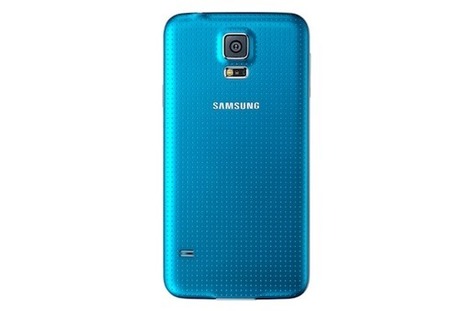
In case you haven’t heard: Samsung is now a pharmaceutical company, or at least on the point of becoming one. Subsequent to its having invested at least $2b in biopharmaceuticals, the South Korean giant will be bringing a biosimilar version of Amgen’s Enbrel to market in 2016.

That’s right.

In 2016, a company best known for its consumer electronics and heavily invested in mobile health is going to start producing pharmaceuticals, and will apparently begin by bringing a treatment to market which will presumably make it a dominant force overnight in the two disease areas in which Enbrel has indications, namely moderate to severe rheumatoid arthritis, and psoriatic arthritis.

The implications of this for legacy pharmaceutical companies are wide-reaching and significant. Let’s consider a few of them (I anticipate updating this post over the next few months):

- Samsung now has more touch points across the health ecosystem than any other pharmaceutical company. ...

- Samsung’s total focus on customer experience and design makes it a credible champion of the participatory patient’s interests. ...

- Hundreds of millions of people carry this pharmaceutical company’s brand with them day and night. ...

- Consumers will think of Samsung as a consumer electronics company that makes pharmaceuticals. ...

- Samsung will be the first consumer technology company to enter the pharmaceutical marketplace, but it will not be the last.


If this thought doesn’t focus legacy pharmaceutical companies into throwing everything they have into reforming themselves as social business, nothing will. The survival of even the largest companies is far from certain when giants such as Samsung have set their sights upon entering the industry.


Samsung doesn’t think like a pharmaceutical company.


Pharmaceutical companies better start thinking like Samsung.


Via rob halkes
rob halkes's curator insight, May 14, 2014 12:53 PM

Great blog by Andrew Spong, keen enough to see the great potential.. very much inspiring to all of pharma ;-) 

Must read, and still more: must think!

Scooped by Rémy TESTON
April 22, 2016 3:33 AM
Scoop.it!

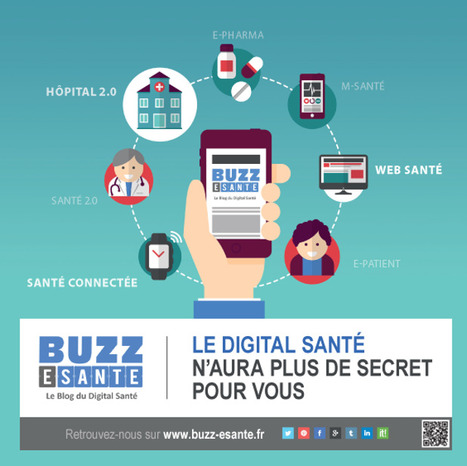
Le Digital Santé n'aura plus de secret pour vous sur Buzz E-santé

Le Digital Santé n'aura plus de secret pour vous sur Buzz E-santé | Buzz e-sante | Scoop.it
Blog d’information sur l’univers du digital santé et de l’e-santé en général. Le web santé, la mSanté, la santé connectée, l’e-pharma, les médias sociaux, l’hôpital 2.0, la télémédecine… n’auront plus de secret pour vous sur http://buzz-esante.fr
No comment yet.
Rescooped by Rémy TESTON from eHealth - Social Business in Health
February 21, 2014 2:25 AM
Scoop.it!

Integration should be the trend of health care development 2014 | Health Business Consult

Integration should be the trend of health care development 2014 | Health Business Consult | Buzz e-sante | Scoop.it

Health care is very much „in transition”. Have a quick look at the trends in health care 2014 . Now, try to predict what the outcomes will be of all these well intended developments?
Due to changes in structure of processes, organizations, patients’ journeys, devices, drugs, apps, telemonitoring – health care will run the risk of becoming highly fragmented, maybe even chaotic. Let’s hope that professionals and their patients still do know their way around.

Can this be prevented? As costs will drive change for the coming years, I guess not. Health care is fundamentally being transformed. Why? Because it has been righteously disrupted and it will take time before a new satisfactory system has emerged. Do we need to wait for that? No! We have to see how we can construe things in a more informed perspective. ..

..there is a sure direction to give that constitutes the basic principle for moving forward: both because it is immanent to all needed developments to better care, and because it creates the opportunity to developments in oversee-able steps of change. Every party can draw its own choice on this to design a proper blue print to their process of change.

This principle directive is: Integrate, integrate, integrate.

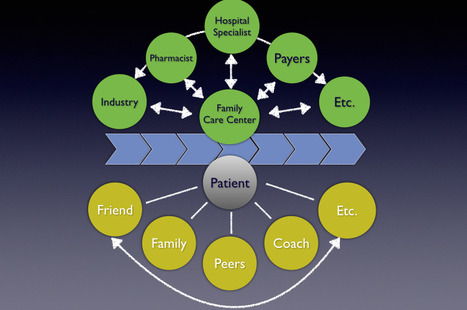
Integration in care is about the unification of both parties and activities, aided by technology, devices, information and medications, to create better care for health and its outcomes.
Integration will lead to better connections of different partners who are needed for a specific path or process of care. It will stimulate collaboration and coordination of activities between them. They will aim for better outcomes and higher effectiveness of care. It will lead to opportunities for more efficient arrangements of expertise and allocation of capacity of care givers.
With the compound of the interests of the key players in care (and I mean of course, patients included), costs can be more rationally arranged and may lead to lowering prices of care per patient per year. Also, it will inspire higher transparency of processes and clarity to patients about details of the caring activities themselves.

There are three different kinds of integration. Each, open to start with. So, any party may pick and start its own game changer. Even any couple of parties as intended partners, may do so too. Choose the most easiest entry to your future development together and enjoy the ride!

1. Integration by Co-Operation
2. Integration by Co-Creation. 3. Integration by “Experience Co-Creation”.

..


Via rob halkes
rob halkes's curator insight, February 19, 2014 4:05 AM

See what you think of this: Can it be done? Will different and several parties be as bold to set things into motion. We know there are. Why don't you?

rob halkes's curator insight, February 19, 2014 4:06 AM

;-)