Your new post is loading...

|
Scooped by
Janine Benyus
February 15, 2024 8:45 PM
|
Researchers from the National Graphene Institute (NGI) have created "intelligent" membranes whose "memory" can be used in areas like smart separation technology, wound management, drug delivery, sensors and memory devices.
|
|
Rescooped by
Janine Benyus
from Biomimicry
February 9, 2024 2:44 PM
|
"Army ants form colonies of millions yet have no permanent home. They march through the jungle each night in search of new foraging ground. Along the way they perform logistical feats that would make a four-star general proud, including building bridges with their own bodies. Much like the swarms of cheap, dumb robots that I explored in my recent article, army ants manage this coordination with no leader and with minimal cognitive resources."
Via Miguel Prazeres
|
|
Rescooped by
Janine Benyus
from Communicating Science
February 9, 2024 2:41 PM
|
We characterized the human body’s immune cells distribution and provided its total weight. Our findings show that an average individual’s immune system consists of approximately 1.8 trillion cells, weighing around 1.2 kg. Lymphocytes make up 40% of the total number of immune cells and 15% of their mass. Similarly, neutrophils account for comparable proportions. Notably, macrophages constitute 10% of immune cells but contribute nearly 50% of the total cellular mass due to their large size. This knowledge gives an integrative quantitative view of the immune system and facilitates the development of models. The immune system is a complex network of cells with critical functions in health and disease. However, a comprehensive census of the cells comprising the immune system is lacking. Here, we estimated the abundance of the primary immune cell types throughout all tissues in the human body. We conducted a literature survey and integrated data from multiplexed imaging and methylome-based deconvolution. We also considered cellular mass to determine the distribution of immune cells in terms of both number and total mass. Our results indicate that the immune system of a reference 73 kg man consists of 1.8 × 10¹² cells (95% CI 1.5–2.3 × 10¹²), weighing 1.2 kg (95% CI 0.8–1.9). Lymphocytes constitute 40% of the total number of immune cells and 15% of the mass and are mainly located in the lymph nodes and spleen. Neutrophils account for similar proportions of both the number and total mass of immune cells, with most neutrophils residing in the bone marrow. Macrophages, present in most tissues, account for 10% of immune cells but contribute nearly 50% of the total cellular mass due to their large size. The quantification of immune cells within the human body presented here can serve to understand the immune function better and facilitate quantitative modeling of this vital system.
Via The Science & Education team
|
|
Scooped by
Janine Benyus
February 9, 2024 2:37 PM
|
|
|
Scooped by
Janine Benyus
February 9, 2024 2:33 PM
|
MAHLE engineers have developed a bio-inspired structure for cooling channels in a battery cooling plate that significantly improves the thermodynamic performance and structural-mechanical properties of the cooling plate.
|
|
Scooped by
Janine Benyus
December 29, 2023 1:43 PM
|
AMOLF researcher Christiaan Van Campenhout has found a new, simple method to create a material with a regular pattern of crystalline bands. The pattern formed by the crystals is not a coincidence.
|
|
Scooped by
Janine Benyus
December 27, 2023 8:12 PM
|
A team led by University of South Australia researchers has pioneered a new soil remediation technique that is significantly faster, simpler, safer, and more cost-effective than currently available methods.
|
|
Scooped by
Janine Benyus
December 27, 2023 8:09 PM
|
The phenomenon of how cyanobacteria obtain nutrients for its survival from rocks inspired scientists to consider them as tools to develop colonies on moon and Mars
|
|
Scooped by
Janine Benyus
December 27, 2023 6:36 PM
|
The biochemical process by which cyanobacteria acquire nutrients from rocks in Chile's Atacama Desert has inspired engineers at the University of California, Irvine to think of new ways microbes might help humans build colonies on the moon and Mars.
|
|
Scooped by
Janine Benyus
December 27, 2023 5:52 PM
|
A gliding sensor inspired by Javan cucumber seeds could be used for environmental monitoring, and then quickly biodegrade, leaving no waste behind...
|
|
Scooped by
Janine Benyus
December 27, 2023 5:49 PM
|
Airbus’ presentation of its Airspace Cabin Vision 2035+ gave a number of interesting clues to Airbus’ future thinking for the passenger.
|
|
Scooped by
Janine Benyus
December 27, 2023 5:47 PM
|
An interdisciplinary team of biologists, chemists and engineers have become the first to successfully grow a limpet inspired biomaterial with extreme strength.
|
|
Scooped by
Janine Benyus
December 27, 2023 5:45 PM
|
Taking inspiration from nature, scientists create a two-component catapult that overcomes limitations in 4D printing.
|
|
|
Rescooped by
Janine Benyus
from Biomimicry
February 9, 2024 2:44 PM
|
"New power sources bear a shocking resemblance to the electricity-making organs inside electric eels. These artificial electric eel organs are made up of water-based polymer mixes called hydrogels. Such soft, flexible battery-like devices, described online October 13 in Nature, could power soft robots or next-gen wearable and implantable tech."
Via Miguel Prazeres
|
|
Rescooped by
Janine Benyus
from Biomimicry
February 9, 2024 2:44 PM
|
"Maple trees (genus Acer) accomplish the task of distributing objects to a wide area by producing seeds, known as samaras, which are carried by the wind as they autorotate and slowly descend to the ground. With the goal of supporting engineering applications, such as gathering environmental data over a broad area, we developed 3D-printed artificial samaras. [...] This study demonstrated a bioinspired design for the dispersed deployment of sensors and provides a better understanding of wind-dispersal of both natural and artificial samaras."
Via Miguel Prazeres
|
|
Rescooped by
Janine Benyus
from Communicating Science
February 9, 2024 2:40 PM
|
Cooperative transport allows for the transportation of items too large for the capacity of a single individual. Beyond humans, it is regularly employed by ants and social spiders where two or more individuals, with more or less coordinated movements, transport food to a known destination. In contrast to this, pairs of male and female dung beetles successfully transport brood balls to a location unknown to either party at the start of their co mmon journey. We found that, when forced to overcome a series of obstacles in their path, transport efficiency of pairs of beetles was higher than of solo males. To climb tall obstacles with their common ball of dung, the female assisted the leading male in lifting the ball by steadying and pushing it upwards in a ‘headstand’ position during the climb initiation. Finally, we show that pairs were faster than single beetles in climbing obstacles of different heights. Our results suggest that pairs of Sisyphus beetles cooperate in the transportation of brood balls with coordinated movements, where the male steers and the female primarily assists in lifting the ball. Taken together, this is to our knowledge, the first quantitative study of cooperative food transport without a known goal to aim for.
Via The Science & Education team
|
|
Scooped by
Janine Benyus
February 9, 2024 2:35 PM
|
The researchers from the Institute of Microbiology of the Chinese Academy of Sciences have developed a miniaturized bionic ocean-battery, a bio-solar cell that converts light into electricity, by mimicking the basic ecological structure of marine microbial ecosystems.
|
|
Rescooped by
Janine Benyus
from Communicating Science
January 3, 2024 3:45 PM
|
The synthetic fibre is an aerogel coated with polyurethane and is flexible, washable and wearable. NEWS 21 December 2023 Correction 21 December 2023 Polar bear fur-inspired sweater is thinner than a down jacket — and just as warm The synthetic fibre is an aerogel coated with polyurethane and is flexible, washable and wearable. By Gemma Conroy Twitter Facebook Email A polar bear appears to wave as it sits upright on a snowy landscape in Russia. Chinese scientists have created a sweater as snuggly as this bear, using synthetic fibres.Credit: Belfalah Soufian/500px via Getty A sweater knitted from a fibre that mimics polar bear fur offers as much warmth as a down jacket, despite being one-fifth as thick, according to a study published today in Science. The fibre — made from a light, synthetic material known as an aerogel — maintains its heat-trapping properties even after being stretched, washed and dyed. The proof-of-concept fibre might one day be used for clothing that need to be lightweight and durable — such as sportswear, military uniforms and spacesuits — without the need for animal fur or down, says study co-author Weiwei Gao, a materials scientist at Zhejiang University in China. Studies have found that aerogels are among the best heat-locking materials around2, and they have been used as insulation in buildings3. But fibres made from aerogels are often too brittle and fragile to be weaved into wearable textiles, and they tend to lose their insulating properties after washing and in humid environments.
Via The Science & Education team
|
|
Scooped by
Janine Benyus
December 27, 2023 10:25 PM
|
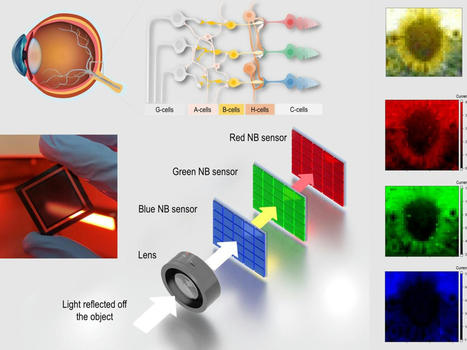
Drawing inspiration from nature, Penn State scientists have developed a new device that produces images by mimicking the red, green and blue photoreceptors and the neural network found in human eyes.
|
|
Scooped by
Janine Benyus
December 27, 2023 8:10 PM
|
To survive in extreme habitats, many animals and plants have developed brilliant abilities that we otherwise only know from superheroes in movies. In most cases, their abilities are based on the extraordinary properties of their surfaces. Mimicking these properties offers enormous potential in the engineering field for developing new products and solving technical problems. Research teams from Bochum and Kiel have succeeded in mimicking the structural color of the famous blue Morpho butterflies using a high-precision 3D printing technology referred to as two-photon polymerization (2PP). The researchers present their newest findings in a paper published in the Journal of Optical Microsystems on September 2, 2022.
|
|
Scooped by
Janine Benyus
December 27, 2023 8:08 PM
|
Inspired by barn owls, researchers have developed an innovative localization system that combines state-of-the-art sensors with a neuromorphic computational map based on resistive random-access memory (RRAM).
|
|
Scooped by
Janine Benyus
December 27, 2023 6:33 PM
|
360-degree vision is now possible with a novel artificial vision system inspired by fiddler crab’s eyes, reports researchers from South Korea and the United States.
|
|
Scooped by
Janine Benyus
December 27, 2023 5:51 PM
|
New research from UNSW Canberra reveals the amazing natural design of a honey bee's stinger, and the potential advancements it could inspire in the next generation of micro medical tools.
|
|
Scooped by
Janine Benyus
December 27, 2023 5:48 PM
|
A study describes a wood-based, three-tailed, biodegradable seed carrier that self-drills into the ground in response to moisture fluctuations with a success rate higher than that of natural self-drilling seeds.
|
|
Scooped by
Janine Benyus
December 27, 2023 5:46 PM
|
Today, humanity enjoys the benefits of the economic growth of the last decades. While the global poverty rate is reduced, we are facing the existential ...
|