Your new post is loading...

|
Scooped by
Janine Benyus
Today, 5:47 PM
|
Over millions of years, evolution has produced the diverse, weird and wonderful ecosystem our planet boasts today. It is n
|
|
Scooped by
Janine Benyus
Today, 5:43 PM
|
Researchers developed a five-fingered biomimetic robot hand combining 3D-printed bones and a reinforced silicone membrane that achieved thumb opposition and maintained grasp stability against high dynamic accelerations.
|
|
Scooped by
Janine Benyus
Today, 5:42 PM
|
Maintaining a uniform and stable temperature within a battery pack is essential for ensuring battery efficiency, safety, and service life. Excessive heat generation and non-uniform temperature distribution during charging and discharging can accelerate degradation and increase safety risks, creating a need for effective battery thermal management systems (BTMSs). This review examines recent biomimetic and bio-inspired approaches for battery thermal management and categorizes them into liquid-cooling channels, phase-change material-based biomimetic channels, and biomimetic composite PCM. The review establishes a structure-mechanism-performance-application framework linking biological inspiration and functional pathways with engineering geometry and thermal–hydraulic behaviour. Particular attention is given to maximum battery temperature, temperature difference, pressure drop, manufacturability, scalability, and experimental validation. Leaf-vein, spider-web, fishbone, shark-skin, and other nature-inspired architectures are discussed together with biomimetic PCM and CPCM systems. A study-specific comparison of reported thermal and hydraulic performance is presented while accounting for differences in battery configuration, coolant, flow conditions, geometry, and boundary conditions. The emerging role of artificial intelligence in biomimetic BTMS is also discussed, including physics-informed machine learning, and intelligent cooling control. Finally, challenges associated with pumping energy, system mass and volume, leakage, clogging, manufacturability, long-term reliability, and pack level validation are identified, and future research directions are proposed.
|
|
Scooped by
Janine Benyus
Today, 12:54 PM
|
A gold nanoparticle-decorated MBene thin-film transistor array detected salivary microRNA-27a down to 3.2 femtomolar and distinguished a small preliminary cohort of head and neck cancer patients from healthy controls.
|
|
Scooped by
Janine Benyus
Today, 12:53 PM
|
Biochemical researchers unravel how spiders transform liquid spidroin silk dope into ultra-tough solid fibers via microfluidic ion gradients.
|
|
Scooped by
Janine Benyus
Today, 12:52 PM
|
A systematic review of 347 studies finds that combined aerodynamic devices on heavy-duty trucks can cut drag by up to 45% and fuel consumption by up to 8%. Two newer strands get their first systematic treatment here. Biomimetic approaches, adapting forms and surface textures from nature, show promise but sparse coverage: a bio-inspired truck cabin modelled on a rainbow trout achieved a drag reduction of up to 40.7% in one study, while shark-like groove patterns and other non-smooth surfaces drawn from bat pelage and pigeon feathers delivered friction resistance reductions of up to 11%. The authors note that no study on bio-inspired surfaces for road vehicles was published before 2011 despite extensive aeronautical work. Artificial intelligence appears even more rarely in the analysed bibliography, but the reviewed examples are instructive: one artificial neural network optimising five input parameters of an active side skirt achieved an 8.1% drag reduction, and another ANN exploring 64 rear shapes of a sedan found a maximum drag reduction of 5.6%. A shape mining framework for integrating heterogeneous design data has also been demonstrated on car aerodynamic parameters including drag and lift.
|
|
Scooped by
Janine Benyus
Today, 12:49 PM
|
By examining engineering designs inspired by the natural world, students can think like inventors, engineers, and designers while discovering how ideas evolve through observation and iteration.
|
|
Scooped by
Janine Benyus
November 26, 4:44 PM
|
A comprehensive scientific review outlines how nature's chemical secretions and physical microstructures are guiding the development of advanced bioinspired adhesives for surgical sealing, drug delivery, and tissue regeneration.
|
|
Scooped by
Janine Benyus
November 26, 4:43 PM
|
|
|
Scooped by
Janine Benyus
November 26, 4:42 PM
|
|
|
Scooped by
Janine Benyus
November 26, 4:30 PM
|
Achieving precise and on-demand steering of the oxygen reduction reaction (ORR) pathway between the efficient 4e− route to H2O and the valuable 2e− route to H2O2 remains a pivotal challenge in electrocatalysis. Herein, we address this challenge by designing a bioinspired molecular magnetic field-responsive catalyst (MMFR-C) via magnetic single-atom-anchored Salen-based covalent organic frameworks (MSA-Salen COFs) onto magnetic nanoparticles (single/multi-domain Fe3O4). Mimicking cytochrome c oxidase, the MMFR-C employs MSA-Salen COFs as an ordered proton-transfer channel and well-defined N2-M-O2 moieties as enzymatic O2 activation sites, with Fe3O4 providing a built-in magnetic field for remote regulation of the active-site electronic structure. The bioinspired MMFR-C exhibits switchable ORR pathways. Relative to the pristine Co-Salen COF (26% H2O2 selectivity, n = 3.48), the MMFR-C integrated with a single-domain Fe3O4 exhibits a remarkably enhanced H2O2 selectivity of 63.9% (n = 2.72), while that with a multi-domain Fe3O4 diverts the ORR pathway toward the 4e− route (n = 3.67). (i) We elucidate that the uniform magnetic field from the single-domain Fe3O4 in MMFR-C favors orbital hybridization between its active N2-M-O2 moieties and the *OOH intermediate, with moderate *OOH adsorption suppressing O–O scission and thus steering ORR selectivity toward H2O2. (ii) In contrast, the enhanced specific magnetism from its multi-domain Fe3O4 core optimizes the d-band center of MMFR-C’s active sites, stabilizes triplet O2 adsorption, and reduces spin-forbidden transition barriers, thereby facilitating O–O cleavage and diverting its ORR pathway to the 4e− route.
|
|
Scooped by
Janine Benyus
October 17, 10:18 AM
|
A new type of fire-safe coating is turning to nature for inspiration, using a skin-like design to overcome a major weakness of many flame-retardant materials: poor durability in humid environments.According to researchers led by Wendong Liu at Dalian University of Technology in China, conventional...
|
|
Scooped by
Janine Benyus
June 19, 12:26 PM
|
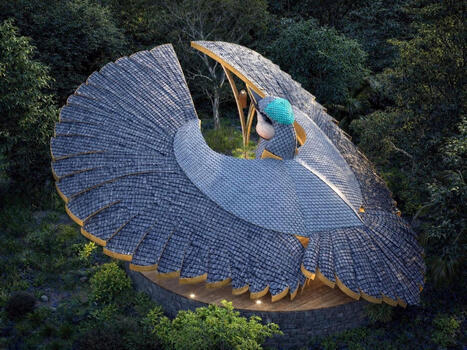
Biomimicry in architecture usually means borrowing structural logic from nature. Honeycomb patterns for strength, lotus leaves for water repellency, termite mounds for passive cooling. Thilina Liyanage takes a different approach.
|
|
|
Scooped by
Janine Benyus
Today, 5:47 PM
|
The next time you board an aircraft, pause to consider how copying sharks, owls, geese, and eagles has made your journey just that little bit smoother and more sustainable.
|
|
Scooped by
Janine Benyus
Today, 5:43 PM
|
The EU building sector accounts for around 40% of energy use and 36% of energy-related greenhouse gas emissions, with heating and cooling responsible for about 80% of this demand. As the construction sector works towards the targets of the European Green Deal, there is an increasing need for sustainable building materials that can reduce energy …
|
|
Scooped by
Janine Benyus
Today, 12:56 PM
|
A new review examines how artificial intelligence and machine learning could transform the design of sustainable, non-toxic marine antifouling coatings while warning that data scarcity and limited field validation still stand in the way. Biomimetic microstructures, fabricated by additive manufacturing, lithography and nanoimprinting, add a purely physical defense mechanism, reducing the effective contact area available to settling organisms without releasing any chemical at all.
|
|
Scooped by
Janine Benyus
Today, 12:53 PM
|
Researchers have engineered salamander-inspired gold-silver nanocages that cascade-target injured kidney cells and their mitochondria, delivering the antioxidant idebenone while enabling CT visualization, and significantly reversing ischemia-reperfusion acute kidney injury in mice.
|
|
Scooped by
Janine Benyus
Today, 12:53 PM
|
atmos cofounder willow defebaugh explores how ecological wisdom and biomimicry can reconnect human design with nature.
|
|
Scooped by
Janine Benyus
Today, 12:50 PM
|
Nature’s game of hide and seek is entering the age of intelligent machines. A new article in National Science Review traces how animal camouflage, advanced materials and artificial intelligence are converging to reshape the contest between detecting an object and keeping it concealed.
|
|
Scooped by
Janine Benyus
November 26, 4:46 PM
|
|
|
Scooped by
Janine Benyus
November 26, 4:44 PM
|
Researchers developed lightweight solar panels inspired by nature's honeycomb structure. These new modules are significantly lighter than conventional panels, which aids installation. The honeycomb design maintains mechanical strength and passes international durability tests successfully. This innovation could expand solar adoption across various buildings and applications. Biomimicry continues to drive advancements in renewable energy technology.
|
|
Scooped by
Janine Benyus
November 26, 4:43 PM
|
|
|
Scooped by
Janine Benyus
November 26, 4:30 PM
|
Extracellular vesicles (EVs) have shown great potential for disease detection from liquid biopsies. However, the lack of optimized isolation and detection methods limited their clinical application. Here we engineer a bioinspired, reconfigurable, self-powered bubble motor (Butor) microswarm to streamline intelligent isolation and ultrasensitive profiling of circulating EVs for cancer liquid biopsies. Butor microswarm shows jellyfish-like, self-propelled lifting locomotion along lumen-like vertical or inclined tubular path in parallel, allowing rapid isolation (10 min, near 90%) of EV subtypes via three-dimensional directional scanning capture even in high-viscosity biofluids. Furthermore, the buoyancy-activated Butors achieve ultrasensitive EV profiling near a single-particle level, enable early diagnosis of non-small cell lung cancer with an accuracy of up to 94% (95% sensitivity) in a pilot cohort and improve the outcome in cancer staging (I–IV) discrimination, response monitoring of surgical treatment and efficacy prediction of immunotherapy in patients with non-small cell lung cancer. Our self-powered motor represents an intelligent, fast, inexpensive, sensitive and multiplexed liquid biopsy tool for accurate cancer diagnostics and treatment monitoring in clinical settings. A self-powered bubble motor inspired by microswarm motion enables ultrasensitive extracellular vesicles profiling, monitoring of surgical treatment response, staging discrimination, prediction of immunotherapy and early diagnosis in patients with non-small cell lung cancer.
|
|
Scooped by
Janine Benyus
November 26, 4:29 PM
|
Nature-inspired design yields new class of metamaterials November 12, 2026 Researchers find that introducing controlled disorder into engineered materials can improve their ability to withstand impacts Researchers supported by the U.S.
|
|
Scooped by
Janine Benyus
October 5, 2:54 AM
|
Hybrid systems could bring efficiency gains at the edge, but conventional infrastructure isn't going anywhere fast...
|