Aux origines
33.2K views | +0 today
Aux origines
Aux origines de l'univers de la vie et de l'humanité...
Your new post is loading...
Scoop.it!

Archéologie: le plus vieux calendrier du monde découvert en Ecosse

Archéologie: le plus vieux calendrier du monde découvert en Ecosse | Aux origines | Scoop.it
Des archéologues de l'université britannique de Birmingham ont mis à jour ce qui pourrait être un calendrier lunaire vieux de 10 000 ans. C'est le plus vieux découvert à ce jour.
No comment yet.
Scoop.it!

How rice twice became a crop and twice became a weed -- and what it means for the future

How rice twice became a crop and twice became a weed -- and what it means for the future | Aux origines | Scoop.it
The evolutionary biologist Stephen Jay Gould once asked whether the living world would be different "if the tape were played twice." If there were a duplicate Earth evolving quietly beside ours, would we observe the emergence of creatures like...
No comment yet.
Scoop.it!

Stone Age post found at wind farm

A wooden carving that is thought to be one of the oldest artefacts of its kind in Europe is unearthed at a wind farm development in south Wales.
No comment yet.
Scoop.it!

Ancient farmers manured the land

Ancient farmers manured the land | Aux origines | Scoop.it
Europe's first farmers used sophisticated muckspreading techniques to keep their land fertile some eight millennia ago, according to new research.
No comment yet.
Scoop.it!

Stone Age Farmers Showed Sophisticated Use of Fertilizers

Stone Age Farmers Showed Sophisticated Use of Fertilizers | Aux origines | Scoop.it
Irrigation and manuring were common in Stone Age agriculture, and grains may have been more commonly eaten than previously thought.
No comment yet.
Scoop.it!

The Surprising Origins of Evolutionary Complexity

The Surprising Origins of Evolutionary Complexity | Aux origines | Scoop.it
Scientists are exploring how organisms can evolve elaborate structures without Darwinian selection
No comment yet.
Scoop.it!

Hallan en Alcácer do Sal (Portugal) la tumba de una mujer con 8.000 años de antigüedad

Hallan en Alcácer do Sal (Portugal) la tumba de una mujer con 8.000 años de antigüedad | Aux origines | Scoop.it
Fuente: publico.pt | Teresa Firmino | 11 de julio de 2013

La colocaron con cuidado sobre su espalda, con los brazos sobre el estómago y las piernas bastante…
No comment yet.
Scoop.it!

Les coquillages alimentaires des dépôts et amas coquilliers du Mésolithique récent/final de la façade atlantique de la France

Les coquillages alimentaires des dépôts et amas coquilliers du Mésolithique récent/final de la façade atlantique de la France | Aux origines | Scoop.it
Les populations mésolithiques vivant à proximité ou sur des zones de déchets coquilliers ont, par le passé, été associées à une image très négative.
No comment yet.
Scoop.it!

Ancient farmers used manure on crops

Ancient farmers used manure on crops | Aux origines | Scoop.it
Europe's first farmers used livestock manure on their crops 8,000 years ago, new research shows.
No comment yet.
Scoop.it!

Les modèles biologiques sont-ils utiles pour penser l’évolution des sociétés ?

Les modèles biologiques sont-ils utiles pour penser l’évolution des sociétés ? | Aux origines | Scoop.it
L’article se veut une critique systématique de quelques tentatives de transposition (Luca Cavalli-Sforza, Pascal Jouxtel) du modèle « néo-darwinien » aux faits sociaux ou culturels.
No comment yet.
Scoop.it!

2900-1900 av. n.-è. Une méthodologie et un référentiel pour un millénaire de produits céramiques dans le Sud-Est de la France

2900-1900 av. n.-è. Une méthodologie et un référentiel pour un millénaire de produits céramiques dans le Sud-Est de la France | Aux origines | Scoop.it
Pour restituer une histoire sociale durant le Néolithique, le mobilier céramique est aujourd’hui encore un des mediums les plus efficaces.
No comment yet.
Scoop.it!

The beginning of time? World's oldest 'calendar' discovered

The beginning of time? World's oldest 'calendar' discovered | Aux origines | Scoop.it
British archaeology experts have discovered what they believe to be the world's oldest 'calendar', created by hunter-gatherer societies and dating back to around 8,000 BC.
No comment yet.
Scoop.it!

Manure used by Europe's first farmers 8,000 years ago

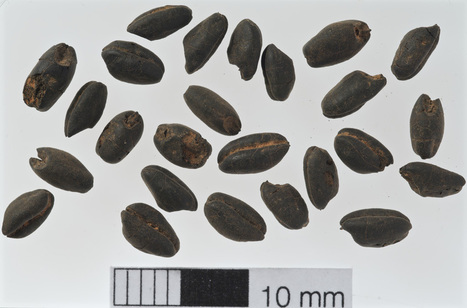
A new study says Europe's first farmers used far more sophisticated practices than was previously thought. A research team led by the University of Oxford has found that Neolithic farmers manured and watered their crops as early as 6,000 BC.

It had always been assumed that manure wasn't used as a fertiliser until Iron Age and Roman times. However, this new research shows that enriched levels of nitrogen-15, a stable isotope abundant in manure, have been found in the charred cereal grains and pulse seeds taken from 13 Neolithic sites around Europe.

The findings are published in the early edition of the journal Proceedings of the National Academy of Sciences. The study suggests that Neolithic farmers used the dung from their herds of cattle, sheep, goats and pigs as a slow release fertiliser for crops.

Manuring involves a long-term investment in arable land because dung breaks down slowly and crops benefit from its nutrients over many years. This new theory indicates a long-term approach to farming.


No comment yet.
Scoop.it!

Le fossile d'un dinosaure à cornes découvert aux Etats-Unis

Le fossile d'un dinosaure à cornes découvert aux Etats-Unis | Aux origines | Scoop.it
Baptisée Nasutoceratops titusi, la créature se caractérise par un museau surdimentionné. Elle mesurait 4 mètres de long, cornes et queue comprises.
No comment yet.
Scoop.it!

Karen Baab en PLos One, el Hobbit no era Homo sapiens.

Karen Baab en PLos One, el Hobbit no era Homo sapiens. | Aux origines | Scoop.it
Un nuevo estudio corrobora que el fósil conocido como El Hobbit, hallado hace una década en la isla indonesia de Flores, pertenece a una especie distinta de la humana y no a un Homo sapiens con pro...
No comment yet.
Scoop.it!

Bizarre New “Texas Longhorn” Dinosaur Bolsters Controversial Theory of Dino Diversity

Bizarre New “Texas Longhorn” Dinosaur Bolsters Controversial Theory of Dino Diversity | Aux origines | Scoop.it
A newly unearthed dinosaur has been called the
No comment yet.
Scoop.it!

Découverte d'une inscription antérieure de 1400 ans à la plus ancienne langue écrite chinoise

Découverte d'une inscription antérieure de 1400 ans à la plus ancienne langue écrite chinoise | Aux origines | Scoop.it
Une hache de pierre trouvée près du site de Zhuangqiao montrerait une forme primitive d'écriture, selon les archéologues
No comment yet.
Scoop.it!

One of Europe's oldest decorative wood carvings unearthed on Welsh mountainside

One of Europe's oldest decorative wood carvings unearthed on Welsh mountainside | Aux origines | Scoop.it
The timber - with intricate pattern on one side and oval motif at one end - is thought to be a marker post for a tribal boundary, hunting ground or sacred site
No comment yet.
Scoop.it!

The Archaeology News Network: 10,000 year old calendar discovered in Scotland

The Archaeology News Network: 10,000 year old calendar discovered in Scotland | Aux origines | Scoop.it

British archaeology experts have discovered what they believe to be the world’s oldest ‘calendar’, created by hunter-gatherer societies and dating back to around 8,000 BC.

No comment yet.
Scoop.it!

The Archaeology News Network: 8,000 year old grave dug up by Lisbon

The Archaeology News Network: 8,000 year old grave dug up by Lisbon | Aux origines | Scoop.it

A grave dating back some 8,000 years has been discovered by a team of archeologists from the University of Lisbon and Spain's University of Cantabria, at a dig near Alcaçer do Sal in the Alentejo, it was revealed this week.

No comment yet.
Scoop.it!

Researchers Discover First Use of Fertilizer

Researchers Discover First Use of Fertilizer | Aux origines | Scoop.it
Researchers Discover First Use of Fertilizer - ScienceNOW
No comment yet.
Scoop.it!

Le Sud-Est de la France entre 4400 et 3400 avant notre ère. Sériation céramique et outillage lithique

Le Sud-Est de la France entre 4400 et 3400 avant notre ère. Sériation céramique et outillage lithique | Aux origines | Scoop.it
Ces dernières décennies, notre connaissance du Néolithique moyen du quart sud-est de la France a considérablement évolué. Ceci est lié au renouvellement profond des méthodes d’étude et des sources documentaires.
No comment yet.
Scoop.it!

Caractérisation chronoculturelle du mobilier funéraire en Provence au Néolithique final et au Bronze ancien

Caractérisation chronoculturelle du mobilier funéraire en Provence au Néolithique final et au Bronze ancien | Aux origines | Scoop.it
Les trois périodes principales d’utilisation ou de réutilisation des sépultures collectives, le Néolithique final I, II et le Bronze ancien sont difficiles à dissocier dans les tombes dont les contenus ne sont pas distincts en général.
No comment yet.
Scoop.it!

'World's oldest calendar' in field

Archaeologists believe they have discovered the world's oldest known calendar in an Aberdeenshire field.
No comment yet.
Scoop.it!

Bradford academics help discover 'world's oldest calendar'

Bradford academics help discover 'world's oldest calendar' | Aux origines | Scoop.it
A team of British archaeology experts, including two from Bradford University, have discovered what they believe to be the world’s oldest ‘calendar’.
No comment yet.