Aux origines
33.2K views | +0 today
Aux origines
Aux origines de l'univers de la vie et de l'humanité...
Your new post is loading...
Scoop.it!

Neanderthals diet: 80% meat, 20% vegetables: Isotope studies shed a new light on the eating habits of the prehistoric humans

Neanderthals diet: 80% meat, 20% vegetables: Isotope studies shed a new light on the eating habits of the prehistoric humans | Aux origines | Scoop.it
Scientists have studied the Neanderthals' diet. Based on the isotope composition in the collagen from the prehistoric humans' bones, they were able to show that, while the Neanderthals' diet consisted primarily of large plant eaters such at mammoths and rhinoceroses, it also included vegetarian food.
No comment yet.
Scoop.it!

Macaques, suivez mon regard !

Macaques, suivez mon regard ! | Aux origines | Scoop.it
A l’instar des humains, les macaques rhésus peuvent suivre le regard de quelqu’un, d’après une étude américaine. Ce mécanisme serait-il apparu plus tôt dan
No comment yet.
Scoop.it!

Neanderthals may have starved in the bitter cold

Neanderthals may have starved in the bitter cold | Aux origines | Scoop.it
Archaeologists at the University of Colorado, Denver, analysed the bones of deer butchered by Neanderthals and found they may have struggled to get enough calories in cold periods.
No comment yet.
Scoop.it!

New research suggests climate change may have contributed to extinction of Neanderthals

No comment yet.
Scoop.it!

A Shocking Start to Life? Impact Craters May Have Triggered Life’s Origin

A Shocking Start to Life? Impact Craters May Have Triggered Life’s Origin | Aux origines | Scoop.it
Researchers studying a giant impact crater in Ontario, Canada, have uncovered evidence that early life may have evolved in self-contained hydrothermal systems existing within such impact basins.
No comment yet.
Scoop.it!

Premiers amérindiens sans descendance - Hominidés

Une etude de l'ADNmt des premieres populations du continent américain montre qu'ils ont disparus génétiquement dans les population
No comment yet.
Scoop.it!

Une pyramide d'Egypte dévoile ses secrets grâce aux particules cosmiques

Une pyramide d'Egypte dévoile ses secrets grâce aux particules cosmiques | Aux origines | Scoop.it
La pyramide de Dahchour a terminé de révéler ses secrets
No comment yet.
Scoop.it!

L'empreinte d'un dinosaure a été retrouvée en Espagne

L'empreinte d'un dinosaure a été retrouvée en Espagne | Aux origines | Scoop.it
ARCHÉOLOGIE - Une trace fossile trouvée près de Barcelone aurait été laissée par un reptile qui vivait avant le Jurassique, il y a 240 millions d'années. Il s'agit de «l'empreinte de dinosaure la mieux conservée de la Péninsule ibérique», selon The Local.
No comment yet.
Scoop.it!

La découverte d'un géoglyphe relance le mystère des lignes de Nazca

La découverte d'un géoglyphe relance le mystère des lignes de Nazca | Aux origines | Scoop.it
Tracé il y a 2 000 à 2 500 ans, ce dessin long de trente mètres a été repéré dans le sud-ouest du Pérou fin 2015 par une équipe d'archéologues en mission.
No comment yet.
Scoop.it!

Early Humans Colonized Europe In A Series Of Separate Waves

Early Humans Colonized Europe In A Series Of Separate Waves | Aux origines | Scoop.it
Modern humans have been present in Europe for at least the last 45,000 years. Even when massive ice sheets crept south, covering much of the continent around 20,000 years ago, some people still managed to cling on to existence in the harsh environment. But how these changing environmental conditions influenced the early European populations, especially during this period when humans took their first steps into Europe, has remained somewhat of a mystery.
No comment yet.
Scoop.it!

DNA secrets of Ice Age Europe unlocked - BBC News

DNA secrets of Ice Age Europe unlocked - BBC News | Aux origines | Scoop.it
Genetic analysis unlocks the secrets of Europe's Ice Age inhabitants.
No comment yet.
Scoop.it!

Hominins may have been food for carnivores 500,000 years ago

Hominins may have been food for carnivores 500,000 years ago | Aux origines | Scoop.it
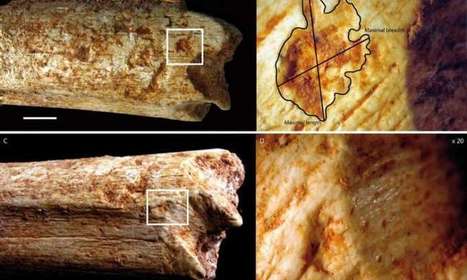
Tooth-marks on a 500,000-year-old hominin femur bone found in a Moroccan cave indicate that it was consumed by large carnivores, likely hyenas, according to a study published April 27, 2016 in the open-access journal PLO
No comment yet.
Scoop.it!

Il menù dell’uomo di Neanderthal

Il menù dell’uomo di Neanderthal | Aux origines | Scoop.it
L’analisi isotopica del collagene di ominidi e animali dal sito di Goyet (Belgio) rivela la composizione della dieta tipica dell’uomo di Neanderthal, andando a mettere in discussione alcune convinzioni sulla sua alimentazione. E non solo
No comment yet.
Scoop.it!

Practopoiesis: Where does intelligence come from?

Practopoiesis: Where does intelligence come from? | Aux origines | Scoop.it
How does a set of living cells become intelligent? What is the origin of intelligence? The theory of Practopoiesis aims to answer that question.
No comment yet.
Scoop.it!

Neandertal raclait les os pour manger à sa faim - Hominidés

Neandertal raclait les os pour manger à sa faim - Hominidés | Aux origines | Scoop.it
Neandertal raclait les os pour manger à sa faim. Le changement climatique peut avoir contribué à l'extinction des Néandertaliens. En effet, selon cette étude,  le peu de nourriture disponible a obligé les néandertaliens à nettoyer plus précisement les os des animaux qu’ils chassaient comme les cerfs…
No comment yet.
Scoop.it!

Comment le cinéma s’est inventé dans les grottes préhistoriques ? - RFI

Comment le cinéma s’est inventé dans les grottes préhistoriques ?  - RFI | Aux origines | Scoop.it
Nos invités du jour, Marc Azéma et Jean-Jacques Salgon s'interrogeront autour de la question suivante : «Commen
No comment yet.
Scoop.it!

Comprendre les mystères du peuplement avec la génétique des populations ?

Comprendre les mystères du peuplement avec la génétique des populations ? | Aux origines | Scoop.it
Comment la génétique met-elle en lumière l'épopée humaine ?
No comment yet.
Scoop.it!

The 2 million year melee—neanderthals vs. humans

The 2 million year melee—neanderthals vs. humans | Aux origines | Scoop.it
"Forget this image," says Dimitra Papagianni, pointing at the depiction of human evolution projected behind her: an ape crouched on all fours, followed by the early hominids carrying rock tools and spears, walking ultimatel
No comment yet.
Scoop.it!

Interroger l'art pariétal. La Frise Noire Du Pech Merle (1984) [J.-Pierre Baux]

No comment yet.
Scoop.it!

Homo floresiensis y nuestra ilustre genealogía

Homo floresiensis y nuestra ilustre genealogía | Aux origines | Scoop.it
Los fósiles encontrados en la cueva de Liang Bua, en la isla de Flores, siguen despertando un enorme interés entre los especialistas. No es para menos, porque nadie hubiera imaginado encontrar nada igual en el registro fósil. Mientras el debate sobre el significado de estos fósiles continua entre los especialistas en crecimiento y paleopatología, los […]
No comment yet.
Scoop.it!

Préhistoire : Les humains auraient servi de repas aux carnivores selon des ossements retrouvés au Maroc

Préhistoire : Les humains auraient servi de repas aux carnivores selon des ossements retrouvés au Maroc | Aux origines | Scoop.it
Préhistoire : Les humains auraient servi de repas aux carnivores selon des ossements retrouvés au Maroc. La richesse en fossiles du Maroc n’a pas fini de surprendre les chercheurs. Après de nombreuses découvertes liées aux dinosaures notamment, des paléontologues Européens ont récemment
No comment yet.
Scoop.it!

Genetic analysis of Ice Age Europeans

Genetic analysis of Ice Age Europeans | Aux origines | Scoop.it
Analyses of ancient DNA from prehistoric humans paint a picture of dramatic population change in Europe from 45,000 to 7,000 years ago, according to a new study led by Howard Hughes Medical Institute Investigator David Reic
No comment yet.
Scoop.it!

Des archéologues découvrent des traces rares d'Hatchepsout, première femme pharaon d'Egypte

Des archéologues découvrent des traces rares d'Hatchepsout, première femme pharaon d'Egypte | Aux origines | Scoop.it
Des archéologues allemands ont mis au jour des blocs d'un ancien temple montrant la reine Hatchepsout
No comment yet.
Scoop.it!

Just a Few Men Controlled Reproduction in Prehistory and Dominate World Genetics Today

Just a Few Men Controlled Reproduction in Prehistory and Dominate World Genetics Today | Aux origines | Scoop.it
A new genetic study of male ancestry shows there were periods in human prehistory when just a few elite men controlled reproduction.For example, one man about 190,000 years ago was the ancestor of 1,200 living men from 26 groups around the world whose
No comment yet.