


Jonas Nordby, un runologue norvégien de l’Université d’Oslo est parvenu à déchiffrer un message codé...

 Your new post is loading...
  Scoop.it! Jonas Nordby, un runologue norvégien de l’Université d’Oslo est parvenu à déchiffrer un message codé... 
No comment yet.
Sign up to comment
Scoop.it!

Nos invités du jour, Pascal Depaepe (archéologue, Directeur inter-régional, Inrap Nord-Picardie) et Jean-Luc Rieu (Attaché de conservation du Patrimoine au musée départemental de Préhistoire d'Ile-de-France à Nemours), s'interrogeront autour de la question suivante : "Que sait-on de Néandertal?"
Scoop.it!

Genetic variations associated with some modern maladies are extremely old, scientists have discovered, predating the evolution of Neanderthals, Denisovans (another ancient hominin) and contemporary humans.
Scoop.it!

Une espèce humaine inconnue, aujourd'hui éteinte, a-t-elle vécu autrefois en Asie de l'ouest, dans la région de la Chine et de Taïwan ? C'est en tout cas l'hypothèse qui pourrait être formulée suite à
Scoop.it!
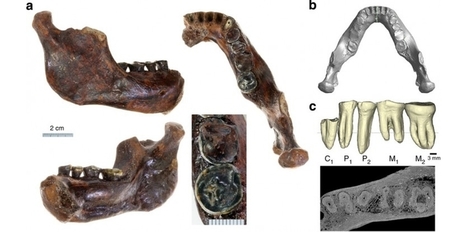
Une mâchoire intrigante a été repêchée entre la Chine et l’île de Taiwan. Ce fossile humain pourrait avoir une origine différente de celles des Homo erectus, les plus anciens hommes découverts en Asie.
Scoop.it!

A Spanish-Italian archaeological team, in cooperation with the Egyptian Ministry of Antiquities, has made an incredible discovery in the necropolis of Sheikh Abd el-Qurna, on the West Bank at Thebes,
Scoop.it!

From leaps forward in evolution to devastating asteroid impacts, these were the turning points that shaped our world.
Scoop.it!

Les restes découverts dans le mystérieux tombeau antique d'Amphipolis, le plus grand jamais fouillé en Grèce, appartiennent à "au moins" cinq personnes, dont une femme d'une soixantaine d'années, deux hommes plus jeunes et un nouveau-né, a annoncé...
Scoop.it!

The development of Arkaim is simply amazing. The settlement was built according to a radial scheme, with the outer diameter of the circle having around one hundred and sixty meters with a moat approximately two meters deep surrounding
Scoop.it!

SCIENCE - Des chercheurs de l'Université de Montréal ont découvert en juin 2014, un outil en os taillé par l'homme, sur le site archéologique de la grotte du Bison, en Bourgogne, rapportait ce vendredi Radio Canada....
Scoop.it!

The municipality of Chongqing, southwestern China appears to have been a very active area archaeological and zoologically, during the Pleistocene.
Scoop.it!

SCIENCE - Découverte en 1722 par le navigateur hollandais Jakob Roggeveen, l'île de Pâques fascine. Avec ses 2000 statues (les Moaï), ses lacs et cratères volcaniques, son écriture unique, ce petit lopin de terre...
Scoop.it!

Il existe 95 % de similarités entre l’Homme et le chimpanzé. Le génome humain est donc très proche de celui de certains animaux. Nous avons rencontré Jean-Louis Serre, professeur de génétique, pour qu’il nous parle plus précisément des similitudes entre l’Homme et l’animal.
|
Scoop.it!

Le Grand Trou Bleu, une dépression circulaire située au large du Belize fournit de précieuses informations sur...
Scoop.it!

NOVOSIBIRSK, SIBERIA—Neurosurgeon Aleksei Krivoshapkin and scientists from the Institute of Archaeology and Ethnography at the Siberian Branch of the Russian Academy of Science examined the holes in the skulls of ancient human remains discovered in the Altai Mountains, and concluded that brain surgery was performed some 2,500 years ago with just one tool. “Honestly, I am amazed. We suspect now that in the time of Hippocrates, Altai people could do a very fine diagnosis and carry out skillful trepanations and fantastic brain surgery,” Krivoshapkin told The Siberian Times. The analysis showed that one of the patients, a man between 40 and 45 years old, had suffered a head trauma and developed a blood clot that probably resulted in headaches, nausea, and movement problems. Healing in the bone showed that the hematoma had been removed and that the man lived for years after the surgery. The second skull belonged to a man who may have suffered from a congenital skull deformity that the surgeon fixed. In both cases, the holes in the skulls were small and placed to minimize damage to the patient. “It is clearly seen that the ancient surgeons were very exact and confident in their moves, with no traces of unintentional chips, which are quite natural when cutting bone,” Krivoshapkin said. Archaeologists suspect that the surgeons used bronze knives for the surgery, which have been found in graves from this era. Krivoshapkin used a replica knife to recreate with some difficulty the ancient surgical techniques on a modern skull. “I think it is important to remember that here in the fifth century B.C. Altai was a big center for bone cutting production. People here were very skillful in making different objects from animal bone.” To read about trepanation in prehistoric Europe, see "Bodies of the Bogs."
Scoop.it!

Notre connaissance de la préhistoire progresse à pas de géant ces dernières années, et plus particulièrement celle du sujet passionnant...
Scoop.it!

Quatre fossiles de serpent datant de 140 à 167 millions d'années ont été découverts. Ces fossiles, les plus anciens connus à ce jour, reculent dans le temps de quelques 70 millions d'années la date d'
Scoop.it!

SCIENCE - La découverte d'une calotte crânienne datant de 55.000 ans avant notre ère dans une grotte en Israël est la première preuve concrète de la présence de l'homme moderne au Moyen-Orient &a...
Scoop.it!
Scoop.it!

From
phys

Earth's earliest primates have taken a step up in the world, now that researchers have gotten a good look at their ankles.
Scoop.it!

Le site de fouilles français est l'un des plus anciens du monde. On y a découvert le fossile d'un crâne plus ancien que le Neandertal ou l'homo sapiens: Homo heidelbergensis.
Scoop.it!

La grande galerie de notre évolution se révèle beaucoup plus foisonnante que ne l'imaginaient les paléontologues. En commençant par ces hominidés qui ont donné naissance au genre Homoet dont les derniers fossiles exhumés viennent enrichir notre arbre généalogique.
Scoop.it!

Des chercheurs de l’institution montréalaise ont découvert en juin dernier un outil en os datant de l’époque néandertalienne.
Scoop.it!
Lorsque l'on expose les représentants préhistoriques du genre humain, il s'agit généralement d'individus masculins... Un peu comme si l'humanité ne pouvait être représentée qu'à travers les traits du mâle, celui-ci en train de chasser, de fabriquer des outils ou de s'adonner à la peinture rupestre. La femme préhistorique, quant à elle, lorsqu'elle est présente, est le plus souvent cantonnée à des tâches subalternes pour ne pas dire domestiques.
Scoop.it!
New data on stone percussive activities carried out by hominids at Orce 1.4 to 1.3 million years ago
Percussive technology dates back to the earliest stages of humanization and is therefore a key aspect for understanding how first cultures evolved Photos – català – español Percussive activities an...
|





