


Egypt on Saturday said there is a 90 percent chance that hidden chambers will be found within King Tutankhamun's tomb, based on the preliminary results of a new exploration of the 3,300-year-old mausoleum.

 Your new post is loading...
  Scoop.it! Egypt on Saturday said there is a 90 percent chance that hidden chambers will be found within King Tutankhamun's tomb, based on the preliminary results of a new exploration of the 3,300-year-old mausoleum. 
No comment yet.
Sign up to comment
Scoop.it!
Scoop.it!

Some of you may have noticed an evolution-themed Google Doodle appear today; the more curious probably discovered that it links to Lucy, the name given to the reconstructed fossilized remains of an ape that stalked the plains of Ethiopia around 3.2 million years ago – roughly 3 million years before anatomically modern humans (Homo sapiens sapiens) officially appeared on the world stage. Today marks the 41st anniversary of her discovery.
Scoop.it!

Forty years ago today, a young American paleoanthropologist named Donald Johanson made the discovery of a lifetime in the arid badlands of Ethiopia's remote Afar region: a 3.2-million-year-old skeleton of a small-brained creature that walked upright like we do.
Scoop.it!

Les migrations humaines n’ont jamais cessé au cours de l’Histoire. L’Homo sapiens, le dernier stade de l’évolution des singes humanoïdes, est apparemment
Scoop.it!

Des chercheurs britanniques ont déterré d'anciennes forêts fossiles sous les glaces de l'Arctique. Elles sont vieilles de 400 millions d'années.
Scoop.it!

Teeth from these diminutive individuals suggest they belonged to a unique species rather than a modern human with a growth disorder, as previously suspected
Scoop.it!

VIDEO: If the history of Earth was on a timeline from Los Angeles to New York, the American Revolution would have been fought 8 inches ago.
Scoop.it!

On nous explique souvent que l’une des raisons pour laquelle notre société actuelle attribue des rôles inégaux aux hommes et aux femmes, c’est parce que ce serait, avant tout, ...
Scoop.it!

L’ADN d’hommes fossiles révèle qu’un groupe de chasseurs cueilleurs du Caucase a également contribué au patrimoine génétique des Européens modernes. Une quatrième "tribu" d’Homo sapiens ferait donc partie de nos ancêtres. Explications.
Scoop.it!

DNA from Denisovans suggests they lived in Siberia for millennia and were more genetically diverse than Neandertals, but less diverse than modern humans
Scoop.it!

The myriad of skin tones and eye colors that humans express around the world are interesting and wonderful in their variety. Research continues on how humans acquired the traits they now have and when
Scoop.it!

Ever dreamed of travelling through Britain & Ireland, visiting the standing stones and ancient monuments our ancestors left us? You will love this film.
|
Scoop.it!

Une nouvelle analyse statistique du génome des variétés de riz suggère qu'il y a eu trois foyers distincts de domestication. Mais la controverse fait rage…
Scoop.it!

New research by an archaeologist at the University of York suggests that betrayals of trust were the missing link in understanding the rapid spread of our own species around the world.
Scoop.it!

Thoth Hermes Trismegistus is portrayed by the Egyptians as the moon god with the body of a man, head of an ibis, and a crescent moon over his head. His symbol was the winged serpent staff. He was the
Scoop.it!

Written language, the hallmark of human civilization, didn't just suddenly appear one day. Thousands of years before the first fully developed writing systems, our ancestors scrawled geometric signs across the walls of the caves they sheltered in. Paleoanthropologist, Genevieve von Petzinger has studied and codified these ancient markings in caves across Europe. The uniformity of her findings suggest that graphic communication, and the ability to preserve and transmit messages beyond a single moment in time, may be much older than we think.
Scoop.it!

On November 24, 1974, archaeologists working in Ethiopia discovered an ancient skeleton that would turn out to be a massive part of the puzzle of how humans evolved from apes.
Scoop.it!
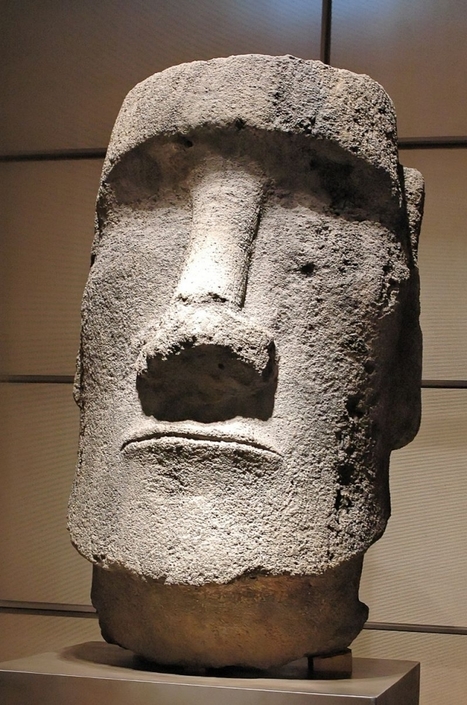
Elle a été sculptée dans un bloc de pierre prélevé dans la carrière du volcan Rano Raraku, elle provient sans doute d’une statue qui mesurait au total 5 mètres de haut. Des vestiges d’un colorant blanc naturel ont pu être identifiés. Ces moaï, peut-être des représentations divinisées de l’aïeul du clan, des figures de grands ancêtres, étaient placés sur des plates-formes cérémonielles (ahu), où l’on avait procédé à des ensevelissements. Les figures de ces protecteurs aux oreilles allongées et au front bas étaient orientées vers les populations sur lesquelles elles exerçaient une forme d’autorité protectrice.
Scoop.it!

Humans are possibly the weirdest species to have ever lived, with freakishly big brains and virtually hairless bodies. How did such a bizarre creature evolve?
Scoop.it!

Entre Permien et Trias, il y a 252 millions d’années, la vie terrestre a connu l’extinction de masse la plus meurtrière. De nombreuses études ont abordé les perturbations environnementales en...
Scoop.it!

À son apogée, la ville de Teotihuacán était la plus peuplée et la plus influente de Méso-Amérique. Les archéologues pensent…
Scoop.it!

Un squelette découvert dans la grotte du Bichon à La Chaux-de-Fonds offre de nouvelles indications sur les populations à l'origine des Européens actuels, a indiqué lundi l'Université de Neuchâtel.
Scoop.it!

DNA analysis of 13,300 and 9,700-year-old remains found in the Caucasus has revealed a previously unknown “fourth strand” of ancient European ancestry.
Scoop.it!
Una cuarta línea de ascendencia europea se originó con los cazadores-recolectores aislados por la Última Glaciación en una zona concreta del Cáucaso
|





