


Photo credit: Pitulko et al., Science (2016) By Laura Geggel The slashed and punctured bones of a woolly mammoth suggest that humans lived in the far northern reaches of Siberia earlier than scient…

 Your new post is loading...
  Scoop.it! Photo credit: Pitulko et al., Science (2016) By Laura Geggel The slashed and punctured bones of a woolly mammoth suggest that humans lived in the far northern reaches of Siberia earlier than scient… 
No comment yet.
Sign up to comment
Scoop.it!

Extensive explosive underwater volcanic activity around 720-640 million years ago changed the chemistry of the oceans and could have provided the catalyst for the origins of animal life on Earth, according to new research. The volcanoes were a major feature of "Snowball Earth", a period when most of the surface of the planet was covered in ice.
Scoop.it!

L’exceptionnelle collection de maquettes de foies de mouton du musée du Louvre est en cours de numérisation. Cette modélisation en 3D ...
Scoop.it!

Vienne (AFP) - Des archéologues autrichiens pensent avoir découvert la plus ancienne prothèse connue en Europe sous la forme des restes d'un pied en bois vieux d'envir...
Scoop.it!
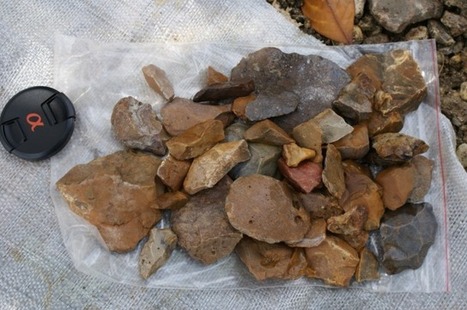
Stone tools discovered on the island of Sulawesi, Indonesia, date back to at least 118,000 years – suggesting that an archaic human species first colonized the island many millennia before our own species arrived. Exactly who they were, though, remains a mystery. The findings are published in Nature this week.
Scoop.it!

L’analyse de son estomac révèle la présence d’Helicobacter pylori. Le profilage génétique de ce microbe, responsable d’ulcères, permet de retracer les migrations humaines.
Scoop.it!

Lower Cretaceous sediments from an unexplored area of Tunisia have yielded the fossilized remains of a 10-meter-long marine crocodile – the largest ocean-dwelling croc ever discovered. Researchers named the new extinct species Machimosaurus rex, and it’s described in Cretaceous Research this week.
Scoop.it!

D’énigmatiques tracés en forme de panache dans la célèbre grotte de Chauvet-Pont d’Arc, en Ardèche, représenteraient...
Scoop.it!
Scoop.it!

Selon des scientifiques, ces allergies actuelles proviendraient de gènes hérités des Neandertaliens et Dénisoviens, cousins très éloignés de l...
Scoop.it!

From
qz

By the time Dietmar Mueller arrived at the University of Texas as a graduate student in the mid-1980s, scientists had already long embraced a once-astonishing idea: that the continents on which all human history has unfolded, rather than fixtures of constancy, were orphans of a former grand supercontinent called Pangaea. Showered with awards, the pioneers of this theory—plate tectonics—had by and...
Scoop.it!

Des gerbes ont été tracées sur les parois de la caverne ardéchoise il y a 36 000 ans, à une époque où des volcans étaient actifs dans le Vivarais tout proche.
Scoop.it!

SCIENCES - Selon deux études parues jeudi, nos allergies seraient causées par des gènes hérités des Néandertaliens.
|
Scoop.it!

The remains of a clearly butchered wooly mammoth in Siberia date to 45,000 years ago, 10 millennia earlier than when humans were thought to have crossed north of the Arctic circle
Scoop.it!
Dans les années 1990, Ötzi avait permis aux scientifiques de remonter le temps de 5 300 ans et de découvrir comment vivaient nos ancêtres. Aujourd...
Scoop.it!

A dinosaur youngling belonging to the same group of beasts as Triceratops has been described in detail in the Journal of Vertebrae Paleontology. This ancient juvenile, which lived at the twilight of the age of the dinosaurs, will help to fill in several key evolutionary gaps that paleontologists have been puzzling over for some time.
Scoop.it!

Des chercheurs de l'Université d'Oregon pensent avoir trouvé comment la vie multicellulaire s'est développée sur Terre
Scoop.it!

A quoi ressemblait l’ancêtre de Néandertal et de l’homme moderne
Scoop.it!

Just one random mutation 600 million years ago made it possible for our earliest, single-celled ancestors to evolve into complex organisms. According to a new eLife study, changing the function of one ancient protein led to multicellular life as we know it.
Scoop.it!

Volcanology is a fairly ancient science, with descriptions of dramatic eruptions going back at least as far as the year 79 C.E., when Pliny the Elder sailed into the pyroclastic flows emerging from Vesuvius and his heir detailed the unfolding destruction. Now, a study in PLOS ONE has described what may be the earliest known images of erupting volcanoes. These paintings, found in the Chauvet caves of France, are at least 36,000 years old.
Scoop.it!
Durant les 3 millions d'années d'histoire humaine, les pierres coupantes comme le silex ont constitué, pendant la majeure partie de cette évolution, les prin...
Scoop.it!

Les quelques pourcentages d'ADN néadertalien et Dénisovien que possede Homo sapiens le rende plus fort contre les infections et plus sensible aux allergies...
Scoop.it!
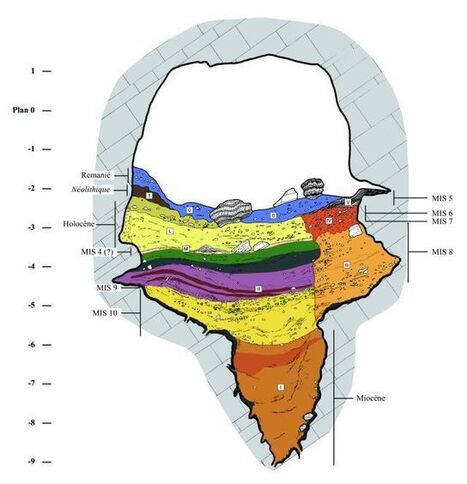
La grotte de la Baume Bonne. Etude et visite de la grotte utilisée par des groupes humains il y a 400 000 ans : restes de la faune chassée, les outils utilisés...
Scoop.it!

We may owe our ability to fight disease to our extinct relatives - the Neanderthals and Denisovans.
Scoop.it!

Il a des pommettes de sapiens mais un bourgeon à l’arrière de la tête annonçant le chignon néandertalien : le crân...
|





