


"Whether you are part of a family, organizational team or business in a supply chain, systems thinking is a valuable approach to understanding the complexity of today's world. Peter Senge, author of The Fifth Discipline, Senior lecturer at MIT and Founder of the Society for Organizational Learning shares his perspectives on leadership and systems thinking with IBM. Senge focuses on the problems that are most difficult to solve and the mental models today's leaders need in order to build a smarter planet. Leaders today need to be able to be prepared reassess their strategies, work across multiple groups to find solutions and have the vision to work through high leverage solutions over time. Working smarter means working in ways that are collective and are based on collective intelligence across cities and supply chains to produce social, ecological and economic well being."

Augmented Collective Intelligence
25.6K views |
+0 today
Technology enables all of us to know more than any of us
Curated by
Howard Rheingold
 Your new post is loading...
 Scoop.it! 
"Want to see how people feel about the weather in San Diego, right now? Check out the weather sentiment prediction web app. Read about how Google Prediction API and DialogueEarth.org's Crowd Sourced data was used to train the cloud!" 
Scoop.it!

"In the Congo Basin, Bayaka pygmies patrol their forests with handheld tracking devices. Using the devices to record instances of poaching, industrial roads and illegal logging, they map their landscape, documenting the course of deforestation and harmful development. The project is part of an emerging field that its champions describe as the 'new wave' of citizen science. With endeavours ranging from air-pollution assessments in Europe to chimpanzee counting in Tanzania, the next generation of citizen science attempts to make communities active stakeholders in research that affects them, and use their work to push forward policy changes"
Scoop.it!
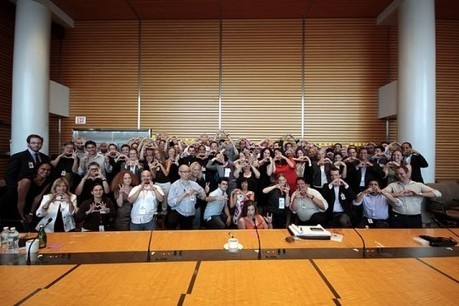
"On January 12, 2010 Haiti was struck with a devastating earthquake. Within minutes of the news, the informal networks which supported the first CrisisCamp event began to connect with both formal and informal organizations and individuals to answer the question, “What can we do to help?” Within 24 hours of the earthquake, CrisisCamp announced it would host two CrisisCamps the following Saturday. Three other cities created CrisisCamps in California, New York and Colorado. The next week 13 other cities around the world joined in to create CrisisCamp events in their cities. Since then there have been over 63 CrisisCamp events in 28 cities across eight countries who supported the Haiti and Chilean earthquakes alone. Since then, the community has rallied and provided support and attracted new volunteers to support response efforts to assist Pakistan, Nashville and Thailand floods and the Gulf Coast Oil Spill."
Scoop.it!
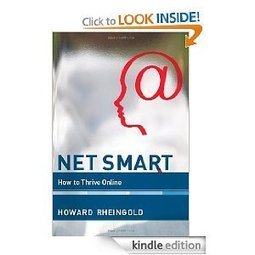
""Once again, Howard Rheingold has found a way of journeying into the future and coming back with gold. The questions he tackles here could not be more pertinent. Whether you're thrilled at the amazing potential for online collaboration, or just stressed by your email in-box, his insights on how to achieve a new form of digital literacy deserve wide adoption."--Chris Anderson, Curator of TED (Technology, Entertainment, Design)"
Scoop.it!

"Research often involves teams of scientists collaborating across continents. Now, using the power of the Internet, non-specialists are participating, too. Citizen Science falls into many categories. A pioneering project was SETI@Home, which has harnessed the idle computing time of millions of participants in the search for extraterrestrial life. Citizen scientists also act as volunteer classifiers of heavenly objects, such as in Galaxy Zoo. They make observations of the natural world, as in The Great Sunflower Project. And they even solve puzzles to design proteins, such as FoldIt. We'll add projects regularly—and please tell us about others you like as well."
Scoop.it!
Video: "Douglas Engelbart is the inventor of the computer mouse and led research teams at Stanford Research Institute that developed hypertext, networking computing and early graphical user interfaces. He has been honored with the MIT-Lemelson Prize, the Turing Award, the 2000 National Medal of Technology, and the Ben Franklin Award. For 57 years, Doug has worked on increasing human capability using Social Networks. The question topmost on his mind: What tools are needed to harness the collective intelligence of many people to apply to common problems and reach collective goals? This event took place August 22, 2007 at Google Headquarters in Mountain View, CA".
Scoop.it!

"In Reinventing Discovery, Michael Nielsen argues that we are living at the dawn of the most dramatic change in science in more than 300 years. This change is being driven by powerful new cognitive tools, enabled by the internet, which are greatly accelerating scientific discovery. There are many books about how the internet is changing business or the workplace or government. But this is the first book about something much more fundamental: how the internet is transforming the nature of our collective intelligence and how we understand the world."
Scoop.it!

"A central challenge in crowd computing is the workflow design problem: how can we divide a complex job — for instance, editing a paper or writing a computer program — into a sequence of microtasks that can be solved by a pool of crowd workers on the web? Effective workflow design is a difficult process, requiring careful task design, extensive software development, and iterated testing with a live crowd. The complexity of workflow design limits participation in crowdsourcing marketplaces to experts willing to invest substantial time and effort, and limits the kinds of tasks that can be crowdsourced today. What if we could use the crowd to attack the workflow design problem itself? We present Turkomatic, a tool that allows requesters to collaboratively design and execute workflows in conjunction with the crowd."
Scoop.it!

"Today, TED announced the winner of the 2012 TED Prize: the City 2.0. Breaking from their tradition of recognizing an individual global innovator, TED is embracing the concept of crowd-sourcing urbanism (an idea we obviously support at Open Source Cities). The organizers published this call-to-arms in seeking ideas on the City 2.0: “The City 2.0 is the city of the future … a future in which more than 10 billion people on planet Earth must somehow live sustainably, together. The City 2.0 is not a sterile utopian dream, but a real-world upgrade tapping into humanity’s collective wisdom. The City 2.0 promotes innovation, education, culture and economic opportunity. The City 2.0 reduces the carbon footprint of its occupants and eases the environmental pressure on the world’s rural areas. The City 2.0 is a place of beauty, wonder, excitement, inclusion, diversity, life. The City 2.0 is the city that works.”"
Scoop.it!
"In what might be a significant breakthrough in HIV/AIDS research, online gamers playing a game called Foldit have cracked a key protein structure problem that has had scientists scratching their heads for years. And the gamers did it in three weeks. You can read a scientific account of how researchers recruited Foldit players to work on the modeling problem and ultimately solve the crystal structure of M-PMV retroviral protease in a paper published online this week in the journal Nature Structural & Molecular Biology."
Scoop.it!
"Why the growing interesting in Q&A applications? Perhaps because it’s a pain point all of us – from front-line worker to senior executive – can relate to in our everyday work experience. All of us can recall situations when we’ve had a question about something and have not been able to find an answer through the information and contacts at our disposal. We ask our colleagues. We send out e-mails. We might try discussion forums, knowledge-base applications, and of course – search engines. However, even if we are fortunate enough to find the content, the information may not be presented in a fashion that addresses our need. Sometimes the “question” is not easily resolved by locating content related to the question. Often, what people are asking for (indirectly) when they pose a question is to have a conversation with someone to “make sense” out of that issue. Connecting co-workers via Enterprise Q&A enables people to reach consensus, collaborate on a response, and co-create a workaround. Beyond “answering the question”, this type of conversation allows participants to contribute personal experiences and share work practices that are not formally documented."
Scoop.it!

"SOPA blackout: Wikipedia reports 162 million people saw its blackout page, 8 million looked up their congressional reps."
|
Scoop.it!
"With recent advances in harnessing the knowledge and skill of large groups of (unknown) network-connected humans, researchers and practitioners have been designing systems that make contributions of users entertaining and more engaging. Game mechanics are being applied to the traditional human computation tasks, such as transcription, classification and labeling. Seminal examples of such applications include ESP game and FoldIt. At the same time, companies seek strategies to include elements of gaming into business processes to increase productivity and engagement of employees. Framing a business goal in the form of a game is also a promising method for motivating newer generations in the workforce."
Scoop.it!
"Want to see how people feel about the weather in San Diego, right now? Check out the weather sentiment prediction web app. Read about how Google Prediction API and DialogueEarth.org's Crowd Sourced data was used to train the cloud!"
Scoop.it!
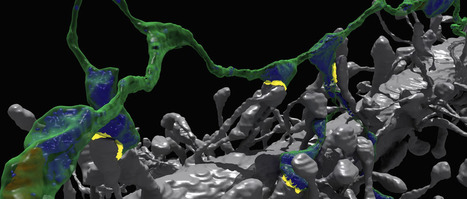
"The solution is WiredDifferently, which will enlist “citizen scientists” to analyze nanoscale brain images using web browsers and mobile devices. They will trace the “wires” of the brain as if absorbed in play with a 3D jigsaw puzzle consisting of image pieces computed by artificial intelligence. The experience will rely on the spectacular graphics and other motivators of video gaming, but allow users to apply their minds to a worthy cause. WiredDifferently will transform 21st century science and society by mobilizing our collective hearts and minds to understand how the brain works and why it malfunctions."
Scoop.it!
"Collective intelligence has existed at least as long as humans have, because families, armies, countries, and companies have all--at least sometimes--acted collectively in ways that seem intelligent. But in the last decade or so a new kind of collective intelligence has emerged: groups of people and computers, connected by the Internet, collectively doing intelligent things. For example, Google technology harvests knowledge generated by millions of people creating and linking web pages and then uses this knowledge to answer queries in ways that often seem amazingly intelligent. Or in Wikipedia, thousands of people around the world have collectively created a very large and high quality intellectual product with almost no centralized control, and almost all as volunteers!
These early examples of Internet-enabled collective intelligence are not the end of the story but just the beginning. And in order to understand the possibilities and constraints of these new kinds of intelligence, we need a new interdisciplinary field. Forming such a field is one of the goals of this conference.
We seek papers about behavior that is both collective and intelligent. By collective, we mean groups of individual actors, including, for example, people, computational agents, and organizations. By intelligent, we mean that the collective behavior of the group exhibits characteristics such as, for example, perception, learning, judgment, or problem solving."
Scoop.it!

"Wouldn't it be great if your business's institutional memory was easier to access, share, and preserve? A company wiki might help."
Scoop.it!

"You thought Google+ was just one social network, right? Technology-wise it’s all bundled in as one application – true. But the ecology of this knowledge network contains 3 different hidden networks we all overlook. I’ll show you the 3 hidden networks, the part you & your collaborators play in this and why you should even care… especially if you’re doing business on G+."
Scoop.it!
I want to share with you the process that was used to create, edit and publish something that is produced by multiple people.
Scoop.it!

"Now, Schmidt is leveraging his expertise in online search and communication to discuss one of the most important emergent technological developments of the 21st Century: Collective Intelligence. Formed as huge numbers of people share incredibly enormous amounts of data freely over the net, Collective Intelligence is seen popularly in Wikipedia, Linux, and Yahoo Answers. This past fall at the MIT Sloan School of Management, Schmidt presented his thoughts on how the focus on hardware and software will fade in importance to harnessing the globally generated network of knowledge and data. See all of Schmidt’s talk, “The Future of the Global Mind”, followed by an entertaining Q&A session in the video below."
Scoop.it!
"The notion of “collective intelligence” has interested me for some time and Jenkins, through Lévy provides a definition that fits with the way a large number of people use the Internet in their day to day lives. According to Jenkins, experiencing the various forms of media that we have available to us is no longer an activity that takes place in the comfort of our homes or in the cinema; people now consume their media as a group. The primary viewing of a television show may be done alone or with a small group of friends or family, but once that has been completed, fans across the globe flock to message boards and websites to analyze, discuss and dissect that episode. The fans no longer have to rely on their friends and family members who happen to enjoy the same program to discuss what a particular line of dialog meant or what contestant will get voted off the island on Survivor."
Scoop.it!
From
fold

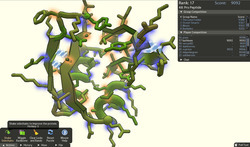
Crowdsourced science, citizen science, whatever you want to call it, meets gamification. Understanding how proteins fold is essential to research into cancer, HIV/AIDS, Alzheimers. "Foldit is a revolutionary new computer game enabling you to contribute to important scientific research. This page describes the science behind Foldit and how your playing can help."
Scoop.it!
(Video) Google Tech Talks February 15, 2007 "The emergence of Social Web has resulted in a spectrum of collaborative information environments. These social software span from systems with lightweight collaboration that identify faddishness of information (digg.com) to heavyweight collaboration systems that produce encyclopedia content (Wikipedia). We are interested in understanding the emerging behavior in social software, particularly how they enable social search, foraging and sensemaking. We summarized initial results from PARC's Augmented Social Cognition research project, where we studied both Wikipedia and del.icio.us to characterize their evolution."
Scoop.it!

"Even though the problem of what to do about global climate change is very complex, recent examples like Wikipedia, Google and Linux show that it’s possible to harness the collective intelligence of thousands of people around the world to solve complex global problems. Our goal with the Climate CoLab is to apply that approach to the problem of climate change,” says MIT Sloan Professor Thomas Malone, director of the MIT Center for Collective Intelligence, which leads the Climate CoLab"
|




