


Share your videos with friends, family and the world
Follow, research and publish the best content
Get Started for FREE
Sign up with Facebook Sign up with X
I don't have a Facebook or a X account
Already have an account: Login

A-level: Tudors
6.3K views |
+0 today
 Your new post is loading...
 Your new post is loading...
Your new post is loading...
 Scoop.it!
Claire Ridgway, creator of The Anne Boleyn Files website, discusses which portrait of Anne Boleyn is the most accurate.
Kent College History's insight:
'Claire Ridgway, creator of The Anne Boleyn Files website, discusses which portrait of Anne Boleyn is the most accurate.'

Scoop.it!
Kent College History's insight:
Pretty much spot on.
Scoop.it!
Kent College History's insight:
The lives of Henry VIII's wives in pie-charts by Joanne Paul.
Scoop.it!
Kent College History's insight:
'Tudor England was a dangerous place - there were plagues and wars, perilous childbirths and shocking infant mortality to contend with. A new four-year study Everyday Life and Fatal Hazard in Sixteenth-Century England is looking into the alarming risks that Tudors faced as they bustled about their daily lives.'
Scoop.it!

On the morning of 19 May 1536, Anne Boleyn climbed the scaffold erected on Tower Green, within the walls of the Tower of London. She gave a speech praising the goodness and mercy of the king, and asked those gathered to pray for her.
Kent College History's insight:
'Was she ensnared by a conspiracy, the victim of her own loose tongue, or simply guilty as charged? Suzannah Lipscomb tries to unearth the real reason why Henry VIII sent his second wife, Anne Boleyn, to the block.'
Scoop.it!
Kent College History's insight:
'Anne of Cleves has gone down in history as the ugly wife. Henry VIII was so revolted when he first clapped eyes on her that he immediately instructed his lawyers to get him out of the marriage. Thereafter, his poor, spurned fourth queen retreated quietly into obscurity to hide her face from the world, while Henry joyfully married the infinitely more desirable Catherine Howard.'
Scoop.it!

Henry VIII is the most famous king in English history. Like all fame, Henry’s is a mix of fact and myth. He is most famous for having six wives, which he did.
Kent College History's insight:
Glenn Richardson of St. Mary’s University, London on Henry's royal fatness.
Scoop.it!
Kent College History's insight:
David Starkey on Henry VIII, part 1.
Scoop.it!
Kent College History's insight:
12:30 onwards on the King's Great Matter. 40:00 collapse of Boleyn marriage.
Scoop.it!
Kent College History's insight:
Suzannah Lipscomb's article from 2011: 'The popular myth about court fools and one that some historians have perpetuated is that they were simply clowns aping foolishness for a laugh. Yet my research suggests that many – perhaps all – court fools in the early Tudor period were ‘natural fools’, or what we today would characterise as people with learning disabilities and that explains much about their prominent position.'
Scoop.it!

Melvyn Bragg and guests discuss the life and work of Hans Holbein the Younger (1497-1543) during his two extended stays in England, when he worked at the Tudor Court and became the King's painter
Kent College History's insight:
Melvyn Bragg, John Guy and Maria Hayward discuss the life and work of Hans Holbein the Younger.
Scoop.it!

We all think we know Henry VIII (r. 1509-47) and all there is to know about him. The Holbein portraits, the profusion of television dramas and films, the novels and histories set in his world make him ubiquitous.
Kent College History's insight:
Who was Henry VIII, and where did it all go wrong? Suzannah Lipscombe's History Today article from 2009.
|
Scoop.it!
The History Faculty - University lectures for secondary schools
Kent College History's insight:
Glenn Richardson of St Mary's University, Twickenham, on Henry VIII and Wolsey. 2/2
Scoop.it!
The History Faculty - University lectures for secondary schools
Kent College History's insight:
Glenn Richardson of St Mary's University, Twickenham, on Wolsey's rise and fall. 1/2
Scoop.it!
Kent College History's insight:
Charles Laughton in "The Private Life of Henry VIII" (1933). Hilarious stuff.
Scoop.it!
Kent College History's insight:
'Was Henry VIII a good-natured buffoon or an egotistical tyrant? Your answer is likely to depend on which cinematic portrayal you have seen most recently.'
Scoop.it!

There's a common misconception that the Mary Rose sank on her maiden voyage. In fact, she was a successful warship, in the service of Henry VIII for 34 years, almost the entire duration of his reign, and fought in three wars.
Kent College History's insight:
The Mary Rose was a successful warship, in the service of Henry VIII for 34 years, and fought in three wars.
Scoop.it!
Share your videos with friends, family and the world
Kent College History's insight:
Useful ideas on Tudor husbandry.
Scoop.it!

Archaeologists at Hampton Court Palace have uncovered the remains of one of the palace’s famous five lost Tiltyard Towers.
Kent College History's insight:
'Archaeologists at Hampton Court Palace have uncovered the remains of one of the palace’s famous five lost Tiltyard Towers.'
Scoop.it!
Kent College History's insight:
Starkey on Henry VIII, part 2. 34:00 Wolsey
Scoop.it!
Kent College History's insight:
The film covers the later part of the reign: the Dissolution of the Monasteries, the Pilgrimage of Grace, the Device Forts, the foundation of the Royal Navy, the English Reformation, the Great Bible, the Six Articles, Jane Seymour (32:10) and his final three wives.
Scoop.it!
KING SINGERS Henry VIII - Pass time with good company Pastime with good company I love and shall unto I die; Grudge who list, but none deny, So God be please...
Kent College History's insight:
An English folk song composed by Henry VIII.
Scoop.it!

Hans, the Younger Holbein - Homepage. The complete works, large resolution images, ecard, rating, slideshow and more! One of the largest Hans, the Younger Holbein resource on the web!
Kent College History's insight:
Wonderful, human portraits. Holbein has surely contributed as much as anyone to our perception that the Tudor Court was part of a recognisably modern world.
Scoop.it!
Kent College History's insight:
My favourite is Lady Margaret Bacon Butts.
|


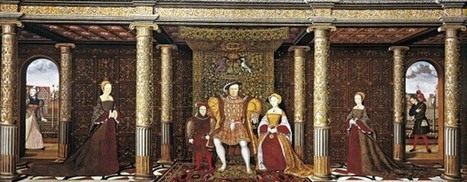







Suzannah Lipscombe and Sam Willis on the reasons for studying Tudor history.