Media Arts Watch Lab - www.arts-numeriques.info - laboratoire de veille Arts Numériques - twitter @arts_numeriques - @processing_org - @DigitalArt_be - by @jacquesurbanska @_Transcultures
Organisé par Le Lavoir public, le festival Ladybug vise à lutter contre les stéréotypes sexistes dans le monde du numérique et de l’informatique.
Si les femmes sont sous-représentées et subissent des inégalités de traitement dans le spectacle vivant, la situation n’est pas meilleure dans le monde du numérique, tant l’informatique continue d’être perçu comme un univers exclusivement masculin. Afin de lutter contre cette idée reçue et ces stéréotypes sexistes, le Lavoir public, sous l’impulsion de Julien Ribeiro, organise du 22 au 25 mai Ladybug, le premier festival européen dédié aux artistes féminines qui travaillent sur les technologies numériques. Ces quatre jours seront donc l’occasion de découvrir des œuvres qui utilisent les possibilités du numérique ou interrogent notre rapport à ces nouvelles technologies.
Se succéderont ainsi autour du bassin de l’impasse de Flesselles et sur la scène du Théâtre Les Ateliers des artistes d’horizons divers comme la Néerlandaise Annie Abrahams, pionnière de la performance en réseau, la Française installée en Belgique Lucille Calmel ou encore la Canadienne Sonia Paço-Rocchia. Fidèle à son esprit d’ouverture et de mélange des genres, le Lavoir public recevra également des couples d’artistes homme/femme (dont Adrien Monod et Claire Bardainne), le Women Multimedia Network (WMN) pour une soirée clubbing ou encore des représentants d’institutions culturelles et associatives pour une conférence autour de la question des technologies et du genre. Une programmation qui devrait permettre d’en finir avec les clichés et de se familiariser avec ces nouvelles formes d’expression artistique qui trouvent leurs racines dans une culture populaire en pleine expansion.
Marking the launch of the publication You Are Here: Art After the Internet (18 Jun 2014), this panel discussion explores both the effects and affects of the Internet on contemporary artistic practices. Responding to an era that has increasingly chosen to dub itself as 'post-internet', this presentation will trace a potted narrative exploring broad ranging issues such as sincerity and authenticity in the digital sphere. Led by Omar Kholeif, the panel will raise urgent questions about how we negotiate the formal, aesthetic and conceptual relationship of art and its effects after the ubiquitous rise of the Internet.
Chinese media artist Aaajiao combines visual and musical aspects to create works of art that imitate nature in thought-provoking new ways.
Aaajiao (XU Wenkai) was born in 1984 in Xi'an, and later moved to Shanghai, where he continues to live and work. Aaajiao is one of China's foremost media artists, bloggers and free culture developers. In 2003 he established the sound art website: cornersound.com, and in 2006 he founded the Chinese take on the blog We Make Money Not Art: We Need Money Not Art. He is devoted to Processing, an open source visual programming software, Dorkbot, a non-profit initiative for creative minds, and eventstructure, an interdisciplinary center for art, media technology and academic research based in Shanghai. In his works in general, Aaajiao focuses on the use of data and its various forms of display, and how meaning is understood through the process of transforming the movement from reality, to data, and back again. His most significant aesthetic contribution to new media in China is a social one, acting as a vector for the interpretation and communication of international and local trends in the usages of software in artistic practice.
An ecosystem of worms, sowbugs, plants and bacteria live and eat at this table. They are a part of the digestive system that starts with a person discarding food leftovers and shredded paper into the portal at the top. The bacteria and sowbugs begin breaking down the waste and the worms soon join in to further digest it into a rich compost that sprinkles out of the bottom of the fabric bag that hangs beneath the table. This compost is used as a fertilizer for plants, such as those at the base of the table.
The human plays an important part at the table by eating, feeding the food waste to the worms, feeding the resulting fertilizer to the plants, or by simply sitting and appreciating the living ecosystem she/he is a part of. A cross-section of the activity inside the top 9 inches of the compost is made visible using an infrared security camera connected to an LCD screen built into the table. On the screen, viewers can see the live movements of the worms and sowbugs inside.
Developing a serious academically rigorous discourse, concerning the evolution of digital art, from its original elite origins to today’s ubiquitous world-culture was a focus of two consecutive evenings in Los Angeles in early 2014.
As part of USC One Archive’s three-month long retrospective series on EZTV’s early history (read the KCET Artbound article here) , these two related and back-to-back events, on April 15th & 16th focused on the dialogue between critical practice and an arts practice based on the ever-evolving journey of digital art.
EM15: E comme dans Elektra, M comme dans Mutek et 15 comme dans 15 ans. Les deux festivals montréalais soulignent leur anniversaire en plein Printemps numérique.
Depuis les révélations sans fin d’Edward Snowden – on s’en afflige à chaque épisode, mais ces révélations en continu ont au moins le mérite de nous tenir éveillés -, l’innovation technologique a la gueule de bois… Et ce qui s’annonce risque d’être pire. Car les promesses que l’internet n’a pas transformées risquent demain de se révéler encore plus douloureuses à porter.
Alors peut-être est-il temps de dresser le bilan… de nos rêves et espoirs déçus. C’est ce à quoi voudrait s’intéresser ce dossier.
Pour cela, il faut nous intéresser aux legs de la contre-culture, “aux formes politiques qui ont été déposées par les pionniers dans le réseau des réseaux”, comme les synthétise le sociologue Dominique Cardon dans sa remarquable introduction au livre de Fred Turner consacré à Steward Brand, Aux sources de l’utopie numérique. ...
Le Graffiti Research Lab (G.R.L. F.R.) France est un collectif ayant vocation à fournir aux graffeurs, artistes et militants des technologies open source de communication urbaine. Actuellement en résidence à La Gaîté Lyrique, le G.R.L. F.R. poursuit ses recherches dans les domaines de l'électronique, des nouveaux médias et du D.I.Y.
This staging is an algorithmic interpretation of "Comedy of errors" by William Shakespeare where luminescent lamps perform the play in accompaniment of generative sound and graphics - all based on the original text.
Here lamps are actors, and projected scenery represents constantly flowing river of time. Text is the structural basis and joint of the time.
Full script of the play is divided into acts and scenes, each scene is analyzed by the program. Part of the graphics represent statistical data of the script: acts are visualized as circles with scenes as smaller rounds within acts, where diameters correspond to scene length counted in lines of text.
Every character is listed on the screen and associated with an unique color, and all monologues in a scene are graphed as rays of according length and color growing from the center of the scene’s circle. ...
L’institut Arts, Cultures et Technologies (iACT) est un regroupement de chercheurs de l’Université de Montréal qui a été fondé en 2008. L’organisme rassemble des chercheurs qui relèvent de trois facultés : Arts et Sciences, Musique et Aménagement. L’iACT se donne pour mandat de réunir des créateurs-chercheurs de différents domaines (informaticiens, artistes visuels, designers, musiciens, architectes et cinéastes) dans le but de travailler, au sein d’une équipe transdisciplinaire, à la recherche de formes nouvelles de création médiatique.
Everyday Listening collects inspiring and remarkable sound art and creative sound design projects, installations, reviews of urban soundscapes, places, contemporary or experimental, mostly electronic music. The term Everyday Listening is used to describe the way we use sound to find our way in our everyday life.
Hugo Verweij founded Everyday Listening in 2009 and currently works as a sound designer for Apple in California. Previously he designed sound in various contexts: Installations, apps, interfaces, radio, motion graphics, contemporary dance. He has almost a decade of experience in education as a lecturer on sound design, music production and related subjects at HKU University of the Arts Utrecht. His work focuses on the synergy between what’s audible, visible and tactile.
Mark IJzerman is a sound artist and composer with a great interest in interactive and procedural sound.
LINK Editions is a publishing initiative of the LINK Center for the Arts of the Information Age. LINK Editions uses the print on demand approach to create an accessible, dynamic series of essays and pamphlets, but also tutorials, study notes and conference proceedings connected to its educational activities. A keen advocate of the idea that information wants to be free, LINK Editions releases its contents free of charge in .pdf format, and on paper at a price accessible to all. Link Editions is a not-for-profit initiative and all its contents are circulated under an Attribution-NonCommercial-ShareAlike 3.0 Unported (CC BY-NC-SA 3.0)
Every morning, at about 8 a.m., Anthony Levandowski walks out of his house in Berkeley and folds his six-foot-six-inch frame into the driver's seat of his white Lexus. Levandowski is embarking on his daily commute to work. It's the most ordinary, familiar moment there is. Most of us perform this ritual five times a week, 50 weeks out of the year. Levandowski's commute, however, is decidedly different. He's got a chauffeur, and it's a robot.
Levandowski backs out of his suburban driveway in the usual manner. By the time he points his car down the street, it has used its GPS and other sensors to determine its location in the world. On the dashboard, right in front of the windshield, is a low-profile heads-up display. manual, it reads, in sober sans serif font, white on black. But the moment Levandowski enters the freeway ramp near his house, a colorful graphic appears. It's a schematic view of the road: two solid white vertical lines marking the boundaries of the highway and three dashed lines dividing it into four lanes. The message now reads go to autodrive lane; there are two on the far side of the freeway, shown in green on the schematic. Levandowski's car and those around him are represented by little white squares. The graphics are reminiscent of Pong. But the game play? Pure Frogger. ...
The Mapping Festival, dedicated to audiovisual art and digital culture, celebrates this year its tenth edition that will take place from May 22 to June 1, 2014, in Geneva.
The festival is now a major event in the fields of the image generation, creation and technological exploration, attracting both professional and mainstream audience. Considered as a unique platform of production and diffusion in Switzerland, it also enjoys an international reputation thanks to the quality of its programming and diversity, which aims to encourage emerging artists of the field. Working with several venues and open spaces in the city, it alternates audio-visual performances, installations, clubbing, architectural mapping, as well as workshops and conferences.
The Mapping Festival is also a meeting point, a creative and collaborative platform with innovative spirit. Over the course of nine editions the Mapping Festival has grown steadily and emerged as one the most important events of its kind in Europe.
TECHNO - Si jamais vous en doutiez, voici un preuve que les robots nous remplaceront un jour au bureau. Le 13 mai, la société hongkongaise Deep knowledge ventures, ou DKV, a nommé un algorithme à son conseil d'administration. Le logiciel siégera donc aux côtés d'êtres en costume, qui respirent et sûrement diplômés d'universités prestigieuses. ...
Random Screen is a mechanical thermodynamic screen that the user can’t control and that functions without any electricity. Conventional tea candles illuminate and generate the changes on the 5x5 pixel screen. (early version 4x4)
This work is one of a series of low-tech screen projects that was originally inspired by the Blinkenlights media façade of the Chaos Computer Club in Berlin. The predecessor of Random Screen is the Papierpixel project in which a manual screen was controlled by a punched tape system that had to be pre-programmed by hand. Random Screen takes the reduction of the electronics one step further. The pixels become independent and fire goes digital.
Les Nouveaux médias, pour prendre la définition la plus simple que proposait le chercheur Lev Manovitch (@manovich) dans son article originel “New Media from Borges to HTML” en 2003, sont les activités médiatiques (lui-même disait “artistiques”) qui reposent sur l’ordinateur. Mais la définition du champ qu’ils recouvrent n’a jamais été précise, évoluant au gré des auteurs qui s’en sont saisis. C’est dans ce champ flou de l’impact du numérique sur les médias et l’art que c’est développé depuis une importante littérature critique. ...
Difficile de ne pas signaler cette somme, intitulée The Emergence of Video Processing Tools, qui comprend deux forts volumes publiés par The University of Chicago Press, et qui retrace le parcours des artistes et des inventeurs les plus marquants de cette période qui a vu apparaitre, se développer puis disparaitre, avalé pourrait-on dire par la publicité et les effets spéciaux au cinéma, ce système de création électronique original qu'on a appelé "l'Art Vidéo". Pour mieux comprendre le projet et l'influence réelle exercés par ceux qui ont porté ce mouvement, peut-être est-il utile d'effectuer un bref retour en arrière et de regarder les conditions qui ont permis l'émergence de cette forme d'art, fondée pour la première fois sur des outils technologiques issus de l'électronique et des systèmes de communication.
On sait que, depuis le début des années 1950, les médias traditionnels - c'est à dire principalement la photographie, la radio, le film et la télévision - avaient vu leur 'spectre' considérablement élargi avec l'apparition de nouvelles technologies telles que la télévision en couleurs, la diffusion par satellite et surtout l'enregistrement de la vidéo sur bande ou sur cassette, puis l'apparition de matériel portable - l'omniprésent U-Matic et ses héritiers...
Philip Beesley is a talented practitioner of architecture and digital media art, as well as being a professor in the School of Architecture at the University of Waterloo in Canada. He is currently exhibiting his spectacular ‘Epiphyte Membrane’ installation at Berlin’s Opernwerkstätten as part of the Olympus OM-D: Photography Playground. Philip was kind enough to give us a fascinating insight into the piece when we met him; we think you’ll be left totally inspired after reading this Spotlight interview!
uses multiple large-scale projections, 3D depth cameras, and surround array of active speakers. It invites visitors to experience mirror existences of themselves taking upon new roles as sources of energy and kinetic disturbance within a virtual ecosystem, to experience extended space as a different form of augmented alternative reality.
A.N. is the artistic partnership of Haru Ji and Graham Wakefield, who have worked together since 2008. (artificialnature.net)
A media performance involving an actor, an encephalograph, and media synthesis means electroencephalography - Emotiv EPOC, high resolution, neuro-signal acquisition and processing wireless neuroheadset data processing - Pure Data, Nord Modular, Nord Modular G2 and ::vtol:: Tx-61 MIDI interface
Neen was introduced at the Gagosian Gallery in NYC, on May 31 May 2000 on a conference with Yvonne Force, (Neen project's producer), Miltos Manetas, (artist), Peter Lunenfeld, (writer), David Placek, (President of Lexicon Branding), J.C.Herz (writer and giornalist), Steven Pinker (MIT Professor, and writer) and Joseph Kosuth (artist). The whole project was organized and sponsored by Art Production Fund and venture capitalist Louis Marx Junior. ...
The website and database GPS Museum try to give a clear overview of what is geolocation in the field of Audiovisual and Multimedia. You will find some technical descriptions of this technology and a list of stunning Locative Media creations. Check our free educational resources for teachers and researchers in our Lab section.
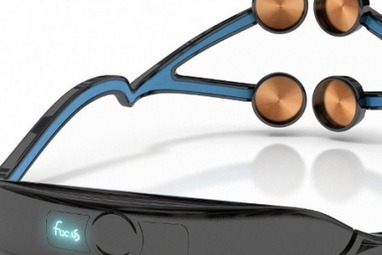
Deux électrodes pour stimuler votre cerveau, voilà en substance le descriptif du casque Foc.us destiné aux gamers qui vient de recevoir sa certification FCC.
Au-delà de l’IRL – entendez au-delà du réel. IRL (In Real Life), ainsi les protogeeks se donnaient-ils rendez-vous dans la "vraie" vie. AFK (Away From Keyboard), lui préfèrent aujourd’hui les partisans de Pirate Bay pour dire l’intrication de nos vies "en" et "hors" ligne, de nos façons de nous connecter et d’être au monde, fût-il 100% numérisé. Annick Rivoire, journaliste critique française, fondatrice de Poptronics.fr, observe et analyse la culture digitale depuis... la préhistoire du réseau.
Ils sont partout et ont été logiquement l’un des cartons de ce Noël 2013. Le marché mondial des drones est estimé à 5,2 milliards de dollars cette année (chiffres Teal Group), 500 000 AR Drone du français Parrot ont été vendus dans le monde… et 4700 morts l’auraient été par des attaques de drones américains. Les drones ne sont plus seulement l’arme "idéale" des guerres à distance contemporaines mais préfigurent des usages civils tous azimuts : la surveillance et les loisirs d’abord (agriculture, police, protection des espèces, photographie et cartographie aériennes), le commerce demain (la livraison, comme l’affirmait récemment le joli coup de pub d’Amazon), et pourquoi pas la culture (Lady Gaga et sa robe drone, autre joli coup de buzz). L’avènement du drone pour tous file la métaphore de l’évolution des technologies et de l’appropriation collective des réseaux informatiques. Mais faut-il voir dans le drone civil un dépassement de l’objet militaire, une forme de hacking social néoluddite ? ...
To get content containing either thought or leadership enter:
To get content containing both thought and leadership enter:
To get content containing the expression thought leadership enter:
You can enter several keywords and you can refine them whenever you want. Our suggestion engine uses more signals but entering a few keywords here will rapidly give you great content to curate.


 Your new post is loading...