Your new post is loading...

|
Scooped by
Jacques Urbanska
September 25, 2014 3:42 PM
|
In this project I worked with a group of microorganisms that are capable of producing tangible matter, with the particular focus on exploring the biological material ‘Bacterial Cellulose’. The future potential of this material that can be ‘grown’ rather than ‘manufactured’ has been recognised and developed during the last decade by both scientists and designers alike. Through this project I aim to explore potential manufacturing processes and applications for this living material, experimenting with different patterns of feeding and nuturing to control growth. My practical research led me to develop a concept for a device capable of controlling the growth of bacterial cellulose, in effect a biological printer. But instead of printing the material, the device feeds it in the area where we d like to stimulate the growth.
Rather than propose a viable new manufacturing process I am keen to pose the following questions: How could such a device alter our current perception and understanding of consumer products? Would the patience required in using growth processes to acquire goods lead to changes in attitudes towards material culture? Could it lead to new ways of material engineering?
By employing technology in order to manipulate organic matter I also aim to question our constant efforts to control nature and it’s unpredictable patterns.
Video by : Sandra Fruebing
MA Textile Futures 2014
|
|
Scooped by
Jacques Urbanska
September 25, 2014 3:31 PM
|
PROJECT OMOTE IS A COLLABORATION BETWEEN JAPANESE MEDIA ARTIST NOBUMICHI ASAI, MAKEUP ARTIST HIROTO KUWAHARA AND FRENCH DIGITAL IMAGE ENGINEER PAUL LACROIX.
|
|
Scooped by
Jacques Urbanska
September 25, 2014 3:19 PM
|
In this book, Rosa Menkman brings in early information theorists not usually encountered in glitch’s theoretical foundations to refine a signal and informational vocabulary appropriate to glitch’s technological moment(um) and orientations. The book makes sense of recent glitch art and culture: technically, culturally, critically, aesthetically and finally as a genre.
The glitch takes on a different form in relation to noise, failure or the accident. It transitions between artifact and filter; between radical breakages and commodification processes. Menkman shows how we need to be clearer about the relationship between the technical and cultural dimensions of glitch culture. Honing in on the specificities of glitch artifacts within this broader perspective makes it possible to think through some of the more interesting implications of glitched media experience.
|
|
Scooped by
Jacques Urbanska
September 25, 2014 3:06 PM
|
Metaphors from the 1990s like "information superhighway" have proven surprisingly persistent, taking on new forms and meanings. Metaphors like "the cloud" are explaining newer parts of the web, and subtly telling us how the internet ought to be used
|
|
Scooped by
Jacques Urbanska
September 24, 2014 9:18 AM
|
Plasticien et artiste numérique, Fabien Zocco crée des installations ouvertes et intelligentes, dont les processus autonomes s’appliquent au monde pour en exprimer la structure.
Dans l’espace-temps délimité et conditionné par ses installations, les phénomènes visés se révèlent. Qu’il explore la matière, le virtuel ou l’écriture, c’est toujours avec poésie et pertinence que Fabien Zocco nous invite à reconsidérer ces notions. ...
|
|
Scooped by
Jacques Urbanska
September 24, 2014 5:09 AM
|
EBOOW, Site Français d'actualité sur les objets connectés, domotique, innovation, applications, smartphones, quantified self, internet of things, web des objets
|
|
Scooped by
Jacques Urbanska
September 24, 2014 5:03 AM
|
Rosa Menkman, in her inspired treatise on glitch art, The Glitch Moment(um), speaks of the RUPTURE – the departure from conditions of the expected, the normality of the mediated experience – into the BEYOND, where systems fail, aberration prevails, and our preconception of systems and their flow of information is disrupted or even halted...
|
|
Scooped by
Jacques Urbanska
September 24, 2014 4:54 AM
|
Dans le cadre de l’inauguration du FabLab Mons (rassemblant 6 partenaires fondateurs : l’UMONS, La Maison du Design, ARTS², la HEH, Transcultures, Technocité et 3 partenaires institutionnels : la ville de Mons, Mons2015 et le Mundaneum) venez découvrir ,de manière conviviale, le fonctionnement d’une imprimante 3D, d’une découpeuse laser, d’un scanner 3d, d’une découpeuse vinyle, d’une CNC,…
|
|
Scooped by
Jacques Urbanska
September 23, 2014 4:42 PM
|
What happened since Rosalind Krauss introduced the term “postmedia,” full of semiotic contradictions? After Felix Guattari used the expression “post-media era” and producer and consumer melted within the media, dissecting themselves? What happened after Miss Krauss wrote A Voyage in the North Sea. Art in the Age of the Post-Medium Condition, chatting about post-medium, killing with her thoughts put into words any medium-related stuff Clement Greenberg had ever given birth to? After Peter Weibel curated his Post-Media Condition art show, reinforcing the concept that all art is post-media because it is embraced by the media?
There is no Art beyond the Media: aesthetic experience comes from a media experience. Art Stack. There was the terminal and beyond, an endless line of warehouses. The media itself is pretty lame, unless you’re into a retro version of some new neoclassical art. Per instance, Martine is Mouchette. I want to be the fly on her background image. ...
|
|
Scooped by
Jacques Urbanska
September 23, 2014 4:32 PM
|
This project came about as a design discourse on digital technologies, and the invisible infrastructure underpinning it. I believe our interaction with this landscape of electromagnetic signals, described by Antony Dunne as Hertzian Space, can be characterised in the same terms as that with ghosts and spectra. They both are paradoxical entities, whose untypical substance allows them to be an invisible presence. In the same way, they undergo a process of gradual substantiation to become temporarily available to perception. Finally, they both haunt us. Ghosts, as Derrida would have it, with the secrets of past generations. Hertzian space, with the frustration of interference and slowness.
But it is these same traits of Hertzian Space that affords the potential for a spatially rich interaction with information systems, one that more closely resemble the interaction with real architecture. The challenge however lies in how to design with systems that are fundamentally invisible. ...
Digital Ethereal is a research through design project by Luis Hernan
Luis Hernan is a doctoral researcher at ArchaID, Newcastle University
|
|
Scooped by
Jacques Urbanska
September 23, 2014 4:26 PM
|
|
|
Scooped by
Jacques Urbanska
September 23, 2014 4:14 PM
|
Honey, I shrunk the passers-by! 400 jars filled, 400 packaged for a magical, offbeat experience that’s constantly being reset. 400 mini creatures from Brussels, transformed for an evening at least, posing in their glass prisons, thinking about something else.
Unidentified luminous object.
Stéphane Masson (conception), Alain Chaix (programmation)
|
|
Scooped by
Jacques Urbanska
September 23, 2014 5:42 AM
|
Le symposium « Tools for Unknown Futures» est un rendez-vous professionnel ouvert au public.
Des professionnels belges et internationaux sont invités à partager leur expertise par le biais de présentations, panels et études de cas. « Tools for Unknown Futures » explore les liens de plus en plus étroits existant entre la création numérique et l'innovation technologique. Co-création, pratiques transversales, perméabilité des sphères artistiques et commerciales, mais aussi en termes de recherches scientifiques, nouveaux modes de financement, sont autant de défis et, peut-être, de contraintes, qui marquent aujourd'hui le milieu culturel. Ce symposium propose ainsi de réunir des professionnels issus de la culture, des arts, technologie et science afin de débattre de ces questions. ...
Organisé en partenariat avec ICT Art Connect, Bozar, TodaysArt , Alpha-Ville et Digicult.
|
|
|
Scooped by
Jacques Urbanska
September 25, 2014 3:34 PM
|
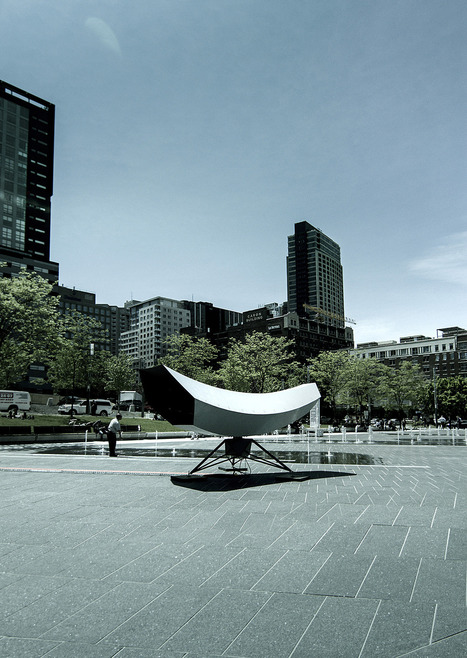
Eotone is an installation that occupies the urban space while streaming a brand-new numerical symphony through wired objects.
Eotone is an interactive installation created by artists Herman Kolgen (QC) and David Letellier (FR). Four pieces of five meters in diameter each mark the meteorology data of four cities; the first ones will be Montreal, Quebec, Nantes and Rennes. Indicators for the wind strength and direction will turn into a harmonic choir that will be live broadcasted by the fourth structures set up within the urban space.
Eotone is the result of a new international cooperation between Acreq - Elektra (Montréal), Electroni[k] (Rennes), Recto Verso (Québec) and Stereolux (Nantes).
|
|
Scooped by
Jacques Urbanska
September 25, 2014 3:29 PM
|
Torque brings together a diverse collection of essays and artworks, many newly commissioned for the project, that reflect upon the plasticity of the brain, the adaptability of technology and the malleability of language, and their twisting together through past, present and future cultures. The contributors and their work each offer unique models of navigating this territory, making their own artefacts, writing their own scripts, forging critical space and examining the blind spots.
Torque#1. Mind, Language and Technology is the result of a wide range of cross-disciplinary conversations, taking place across symposia, online forums, live events and workshops, produced by the book’s editors: Nathan Jones and Sam Skinner. According to Professor Mike Stubbs, Artistic Director at FACT Liverpool: “Torque activities and this publication bravely push our boundaries of cognition and thinking, through striking essays, tricky concepts, and beautiful, arresting imagery.”
Contributors: Lambros Malafouris, Emil Alzamora, Anna Munster, Benedict Drew, Esther Leslie, Cécile B Evans, Hannah Proctor, Nathan Jones, Stephen Fortune, Dennis Oppenheim, Lawrence Abu Hamdan, Holly Pester, Geoff Cox, Alex McLean, Kate Sicchio, Karl Heinz Jeron, Mez Breeze, Robert Sheppard, Chris Boyd, Imogen Stidworthy.
|
|
Scooped by
Jacques Urbanska
September 25, 2014 3:08 PM
|
Dominic Wilcox is a British artist whose works balance on the margins of bizarre, yet somehow very logical and poignant at the same time. His cutting-edge inventions vary from unbelievable tech-wizardry (GPS shoes), to everyday objects that would actually find a place in our househo
|
|
Scooped by
Jacques Urbanska
September 25, 2014 6:25 AM
|
L'Internet Yami-Ichi 5 Brussels (Marché Noir d'Internet) est une sorte de marché aux puces où artistes, créateurs et makers vendent des objets dérivés d'Internet.
Initié au Japon par le collectif IDPW.org, l'Internet Yami-Ichi veut créer un espace (physique) qui rassemble l'enthousiasme, la liberté et l'anarchie des premières heures du web. Une réponse – voire un remède – à la désillusion d'un monde en ligne de plus en plus irrespirable, surveillé et contraignant. Pendant le Yami-Ichi, Internet régnera sur le monde réel! Venez "surfer" en face à face, et parcourir les marchandises post-numériques de JODI, Glitchaus (Jeff Donaldson), Nukeme, Dorita, Matthew Plummer-Fernandez, Julien Deswaef, Jan Vantomme, La Villa Hermosa, Dennis de Bel, John Wild, Jacob Eriksen, BrowserBased et bien d'autres! Le marché finira en beauté avec un concert-performance audiovisuel d'Exonemo (JP) à 20h30.
L'Internet Yami-Ichi 5 (seconde édition en dehors du Japon) est proposé par iMAL, Exonemo et IDPW.org, avec support des Ateliers des Tanneurs.
|
|
Scooped by
Jacques Urbanska
September 24, 2014 5:12 AM
|
Anne-Cécile Worms est depuis longtemps passionnée de l’univers croisé entre l’art et les nouvelles technologies. A l’origine de la start-up Art2M (Art to Machine), spécialisée dans la production et la diffusion d’œuvres d’art numérique, elle est également la fondatrice et directrice éditoriale du Magazine des cultures digitales (MCD) qui vient de publier un très large panorama théorique et pratique sur les relations entre l’art numérique et l’industrie. Entretien.
« Art et Industrie », est-ce le moment d’interroger cette relation dans le domaine des arts numériques ?
...
|
|
Scooped by
Jacques Urbanska
September 24, 2014 5:06 AM
|
Des robots créés par une équipe de chercheurs de l’université de Californie à Santa Barbara peuvent voir à travers des murs et détectent les objets qui se trouvent derrière en utilisant seulement...
|
|
Scooped by
Jacques Urbanska
September 24, 2014 4:58 AM
|
A series of speaker, each one of them spread a word, and each word is repeated with a different time interval. They arrange together a meaningful sentence, but it happens just one time every X minutes.
|
|
Scooped by
Jacques Urbanska
September 23, 2014 4:55 PM
|
L’archéologie des média est quasiment inconnue en France, bien qu’elle ait plus de vingt d’existence. Pourtant, elle a produit (et continue de produire) des effets majeurs dans le champ de la création, de l’exposition, de la médiation, de la conservation et de la théorisation des œuvres médiatiques et numériques. Héritant d’esprits indisciplinés de Marshall McLuhan, de Michel Foucault et de Friedrich Kittler, l’archéologie des média est multiple, inter- et a-disciplinaire. Le numéro MCD #75 sera à son image.
Pour la première fois, MCD confie la direction d’un numéro à une école d’art. Au croisement de la création et de la conservation-restauration, l’École Supérieure d’Art d’Avignon, et en particulier le laboratoire PAMAL (Preservation, Archaeology, Media Art Lab), entre en dialogue, dans un esprit de questionnement et de diversité, avec ce courant atypique de la pensée d’aujourd’hui, qui interroge principalement la temporalité et la matérialité des média.
Emmanuel Guez
|
|
Scooped by
Jacques Urbanska
September 23, 2014 4:39 PM
|
Dans We are numérique, l'art, la littérature et la poésie sont à l'honneur. A l'occasion de la sortie du 6ème numéro de la Revue du Cube (Centre de création numérique basé sur la commune d'Issy-les-moulineaux),HORTENSE GAUTHIER, appartient au collectif nommé « Hp Process » qui fait la part belle au corps, à l'écriture et la poésie.
|
|
Scooped by
Jacques Urbanska
September 23, 2014 4:29 PM
|
Create recipes to automate your home and life using your favourite smart devices, Raspberry Pi and Arduino, your favourite websites and your smartphone ...
|
|
Scooped by
Jacques Urbanska
September 23, 2014 4:20 PM
|
En 2006, James Kirby composait une oraison à la culture rave avec le sombre mausolée The Death of Rave, vingt heures de musique construite à partir de fragments d’hymnes du dancefloor qu’il «dépouille de leur énergie et de leur esprit pour les transformer en ombres, en fantômes». La dark ambient de Kirby, qui déplorait l’incapacité de notre époque à accoucher d’un mouvement à la hauteur de cette utopie, revient en mémoire en pénétrant dans l’installation de Lauris Paulus présentée à Langenthal, chill out spectral et mutique, espace incertain aux murs badigeonnés de peinture phosphorescente où trônent des platines en verre. ...
|
|
Scooped by
Jacques Urbanska
September 23, 2014 4:01 PM
|
How the Low-Poly aesthetic extends the timeless ideals of modern art.
1. Past Is Present
In February 1997, Next Generation magazine splashed its cover with an image of a red-eyed reptilian humanoid boasting an Olympian’s physique and a pair of Wolverine-esque knuckle-mounted claws. The creature’s confrontational pose dominated the frame, leaving only enough space for an abbreviated view of a beige stone castle and a murky lime sky behind it. The creature’s contours were all hard, straight edges rather than organic curves. Its face was a lifeless, scowling mask. The textures on its mottled flesh and the castle’s craggy stones looked equally and obviously manufactured. And it felt as though one could individually count every polygon on display. Yet a one-word headline doubled as the featured game’s title and the editors’ breathless opinion about the image’s quality: “Unreal!” And lest its readers miss the point, Next Generation tagged on the gushing parenthetical “Yes, this is an actual PC game screenshot…
part 2 : http://killscreendaily.com/articles/poly-generational-2
part 3 : http://killscreendaily.com/articles/low-poly-3
|