Media Arts Watch Lab - www.arts-numeriques.info - laboratoire de veille Arts Numériques - twitter @arts_numeriques - @processing_org - @DigitalArt_be - by @jacquesurbanska @_Transcultures
The new article by Mario Margani on Digicult. An interview to Oliver A. I. Botar, curator of the exhibition "Sensing the Future: László Moholy-Nagy, Media and the Arts", just closed at Bauhaus Archive in Berlin, first shown at Plug In Institute of Contemporary Art, Winnipeg, Canada. Enjoy
Wandering the halls at CES this year, you would have been forgiven for thinking it was still 2014. Bluetooth speakers crowded the shelves, wearables were everywhere, and wherever you looked there was another blistering 4K display. Screens from Samsung, LG and others dominated the eye space with multicolor demos, yet we’re still to see 4K content that really makes us feel a deep longing for that new TV.
Enter Samsung and LG’s unlikely bedfellow in 2015 – the art world. Traditionally, art has been sluggish in going digital, and the first wave of art startups (Artsy, Artbinder, etc.) existed mainly to service an incumbent, analog industry.
All that will change this year, though, and websites selling paintings and prints will give way to platforms like Electric Objects, FRAMED and my company Depict, which use art discovery apps and physical displays to enable a new generation of digital art collectors. In the hunt for new ways to get TV screens into our living rooms, hardware giants might have found the perfect new medium...
L'âge du faire - Hacking, travail, anarchie est un essai sur un nouveau modèle d'activité, inventé par les hackers : le faire (make), vient de paraître aux Editions du Seuil, dans la collection La couleur des idées.
L'auteur Michel Lallement, est sociologue et professeur au CNAM, spécialiste de la sociologie du travail, il est par ailleurs membre du Laboratoire interdisciplinaire pour la sociologie économique au CNRS.
Dans cet ouvrage, Il explique les sources de ce mouvement en Europe et les conditions de son implantation en Californie : l'émergence d'un nouvel âge du travail, qui bouleverse les pratiques et reconfigure les représentations.
Michel Lallement a séjourné plusieurs mois en Californie dans un Hacker space près de San Francisco, situé à Noise Bridge, dans un quartier populaire de SF et créé en 2007. ...
The Space is an online gallery for contemporary digital arts, where digital artists showcase their work. The Space also commissions new work from contemporary artists pushing the boundaries of art, technology and code.
The Space is a website for artists and audiences to create and explore exciting new art, commissioned by us and shared around the world. We support new talent and great artists from all art forms, creative industries, technical and digital backgrounds, through regular Open Calls and partnerships.
With around 50 new commissions a year, The Space is one of the most exciting places on the internet to find new art, free for audiences and artists to explore, express and enjoy.
The Space never closes its doors to anybody. It is a constant growing art collection that changes with every visit. Every Friday lunchtime is the launch of a new collaboration.
Set up by the BBC and the Arts Council of England, The Space is a free public space, a not-for-profit public service for artists and audiences around the world.
“404 International Festival of Art & Technology”, born in Argentina in 2004, is a non-profit organization which main objective is to promote artistic productions that bring together Arts and Technology, generating an environment where the artists can relate with the community.
Over a decade, it has been presented in different countries, such as Italy, Spain, Switzerland, Austria, Belgium, Taiwan, Argentina, and Russia.
“404 Festival””, the oldest festival of New Media in Argentina, launches its 12th open-call destined to artists and researchers from all over the world with the aim to spread and stimulate New Media creations.
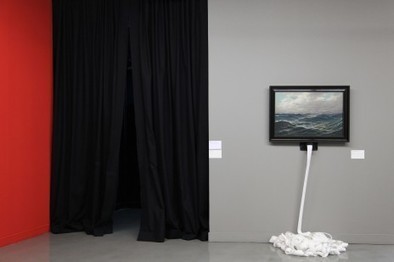
La toile ressemble à toutes les marines qu’on trouve dans les salles d’attente de médecins ou les chambres d’hôtel : une croûte de bonne facture. Mais dès que quelqu’un s’arrête pour la regarder, un petit boîtier s’empresse de crachoter un long ruban couvert de chiffres.
Cette installation s’appelle « La Valeur de l’Art » et elle interroge ironiquement d’où vient la valeur dans une économie de l’attention. C’est une des pièces phares de la petite mais riche exposition d’art numérique qu’organise la Maison Populaire de Montreuil.
This sounds like something out of a Dan Brown book, but it isn't: The whole Internet is controlled by seven actual, physical keys. The Guardian's James Ball was recently allowed to observe the highly secure ritual known as a key ceremony.
The people conducting the ceremony are part of an organization called the Internet Corporation for Assigned Names and Numbers (ICANN). ICANN is responsible for assigning numerical Internet addresses to websites and computers and translating them into the normal web addresses that people type into their browsers...
Athens Video Art Festival changes into Athens Digital Arts Festival In 2014, Athens Video Art Festival celebrated its 10th anniversary and it is already organising its next edition to be held in spring 2015. On this occasion, we would like to inform you that the Festival changes its name into Athens Digital Arts Festival (ADAF). The new identity reflects the festival’s expanding programme which includes a wide range of art forms based on digital technologies.
Athens Digital Arts Festival (ADAF) is an International Festival which celebrates digital culture through an annual gathering bringing together a global community of artists and audiences. Athens Digital Arts Festival aims to encourage, stimulate and promote all aspects of digital creativity by hosting local as well as international artists and communities.
Through its multidisciplinary program Athens Digital Arts Festival offers a wide range of Exhibitions, Screenings, Live Performances, Workshops and International Tributes showcasing artworks that display distinctive characteristics of the digital medium and reflects on its language and aesthetics.
J‘ai choisi, dans ce deuxième article (voir le premier ici ) consacré à Max Neuhaus, de vos présenter l’intégralité d’une conférence donnée pa r l’artiste à Tokyo, questions du public comprises. Max Neuhaus insiste d’ailleurs pour que le public pose des questions qui lui permettront de préciser des aspects techniques, contextuels, des processus de création, liés à son travail. Si quelques questions peuvent sembler un brin naïves ou redondantes, ou au contraire très techniques, elle nous éclairent cependant judicieusement, nous offrant la possibilité de mieux cerner des objectifs et des contraintes très importantes dans l’élaboration des installations sonores de l’artiste. Le choix du lieu, et des sons retenus et composés, façonnés pour ce dernier, la prise en compte du cadre visuel, de l’impact social, des résidents, des publics, le fait que ces œuvres soient justement accessibles à tous, sans toutefois être trop imposées, laissant des alternatives d’implication ou de non implication aux visiteurs, le degré de participation, voire l’interaction que pourra avoir le public dans ces processus artistiques…
(English below ) ------------------------------------------------------------------------------------------------------------------------------------------- La Chambre Rouge sera présentée dans le cadre du Mirage Festival le Samedi 28 Février 2015 à Lyon miragefestival.com/ ------------------------------------------------------------------------------------------------------------------------------------------- La chambre est rouge et la porte ouverte. Il y a des traces de passage. Des voix résonnent du dehors tandis que je suis là. Je tourne, entre la mémoire et l’oubli.
La Chambre Rouge est une installation qui capte, enregistre, diffuse et altère des paroles rassemblées ici et là. C’est une expérience sensible et un objet de réflexion sur les thèmes du temps, de la mémoire, de l’oubli et de l’identité. Des paroles, extraites d’interview, sont diffusées et progressivement effacées par le dispositif, auquel est aussi connecté un micro, ouvert en permanence, invitant le public à témoigner de sa présence.
Par son apparence fragmentée et la coexistence de deux boucles de bande magnétique, captant les mêmes information du dehors mais les reproduisant autrement, l’installation évoque symboliquement la coexistence en notre être de différentes mémoires (consciente, inconsciente, corporelle, émotionnelle...) et de leur rapport différents au temps, à l’altération et à l’oubli.
The room is red and the door open. There are traces of passage. Voices are sounding from outside while i am here. I’m turning, between memory and oblivion.
La Chambre Rouge is an installation that perceives, records, emits and transforms words gathered from here and there. It is a sensitive experience and an objet issued from the reflexion about the subjects of time, memory, forgetting and identity. Words, extracts from interviews, are played and progressively erased by the device, to wich is also connected a microphone that records permanently , inviting an audience to share its presence.
By its fragmented appearence and the coexistence of two differents tapes’ loop that are recording the same exterior information, but reproducing them differently, the installation symbolically evoke the internal coexistence of different memories ( conscious, unconscious, corporal, emotionnal) and their different relation to time, alteration and oblivion.
Conception et Réalisation : Julien Grosjean Prises de vue : Rose-Mary Loisy - indelebile.fr Montage : Julien Grosjean Contact et Diffusion : jjuull@free.fr
Produit grâce à l'aide et au soutien de l'ENSA de Bourges
Pour sa deuxième édition, Tropisme déploie une vaste machine
à habiter en répondant à l’invitation de La Panacée à occuper ses murs à travers une programmation qui mêlera installations, concerts, créations architecturales et culinaires, rencontres, projections, jeux vidéo, boums et ateliers. Au centre de ce projet, le collectif EXYZT signera là sa dernière action avant de tirer sa révérence après 12 ans d’activités. Composé d’artistes, d’architectes, de constructeurs, de botanistes et de graphistes, EXYZT a été remarqué notamment en 2006 pour leur participation à la Biennale d’architecture de Venise. Pour Tropisme, le collectif transformera La Panacée en lieu de vie modulable, pensé comme une boite à outils permettant de multiples déploiements.
Cette machine à habiter s’emparera des espaces d’expositions qui deviendront tantôt salon de conversations, ciné-club, chambres à coucher, mini-discothèque pour enfants, plateau radio, imprimerie… Du 25 février au 15 mars, Tropisme fait de La Panacée un vaste terrain de jeu aux allures de caravansérail.
Pulso est une compagnie corégraphique, à la direction de Rocio berenguer, naît en 2010 motivé par la rencontre avec l’artiste cubaine Keyla Ramos et l’artiste allemagne marja freigang. Pulso base sa recherche sur la dramaturgie du corps et les nouvelles medias. La dramaturgie du corps.
La dramaturgie des corps utilise les langages de la theânse et la poëlitique. La Poëlitique ;questionner, partager, dialoguer les questions politiques d’une façon poétique. S’approprier des questions politiques de l’actualité sociale et trouver ses analogies dans l’individualité, dans le particulier, dans l’intime. La thêanse ;Ce concept vient de la fusion entre le théâtre et la danse. Est un outil de représentation et aussi de recherche. Est un Langage. Se situe aux limites de la représentation. Influencé par le théâtre de l’invisible, cherche à se fondre dans le réel, pour y placer des troubles, et de petites interférences. Travaille avec les utopies du corps et les utopies de l’espace qu’on transite. Comment lire le corps à travers l’espace ? Comment lire l’espace à travers le corps ? Thêanse, état de transe, transition, instant fugace frontalier, trouble, l’endroit confus d’entre deux.
The interactive installation EGO re-stages and reverses the process of alienation by enhancing and deforming the mirror image by the movements of the users.
Although an abstraction, it quickly becomes the self and reestablishes the tension between the real and the symbolic, the Ego and the It, the subject and the object.
Since the dawn of time—or at the very least, since the early days of Cosmopolitan—we’ve been preoccupied with the question of whether we’re good in bed. There’s no shortage of surgical or pharmaceutical options available to make us harder, better, faster, and stronger. More recently, we’ve even started using sex-tracking apps, so we can record every thrust and whimper between the sheets.
But all of these hacks we employ to improve our sex lives have the disadvantage of being relatively impermanent. No matter how many pills we pop, sex toys we buy, or Tantra workshops we take, there’s no way for us to permanently hack our own bodies to become the sleek, ultra-libidinous pleasure machines some of us so desperately want to be.
Rich Lee, a 32-year-old salesman from St. George, Utah, thinks he’s found the solution to this problem. He calls it the Lovetron9000, and it’s an implant embedded underneath the male pubic bone that causes the penis to vibrate. His goal, he told me during a phone conversation a few weeks ago, is to “turn your boyfriend into a vibrator.”
FILE is an e-book promoted by M0us310n.net which analyses the intersections between Philosophy, Art, and computing communication processes on the internet. FILE is an open call for dialogue that attempts to bring together different theoretical and practical fields of criticism and reflection on digital art. Developed from an academic context, but emerging from a need to reach beyond it and to establish links with the artistic production, FILE is created with the intention of compile essays in order to link theoretical perspectives, practices, and reflection on the Digital Arts.
FILE Digital Aesthetics E-BOOK should be seen as a meeting point for artists, academics, or implementers of art/development projects. We welcome proposals for both chapters and case studies from academics, photographers, artists and other visual practitioners. We are seeking for contributions that deal with a wide range of issues in connection with the impact of computing communication processes on the internet within the production and reception of Art.
FILE #01 is an ISBN registered publication with free online distribution, licensed under aCreative Commons Attribution NonCommercial-NoDerivatives 4.0 International License.
Author of “A Hacker Manifesto” and “Gamer Theory”, McKenzie Wark has responded to our questions post-Transmediale on his hacktivist theory for the Anthropocene.
His intervention at the closing conference of Transmediale left a bit hungry for more. For Makery, McKenzie Wark, the author of ‘A Hacker Manifesto’ and ‘Gamer Theory’, tells us more on his hacktivist theory for the anthropocene.
The Alternate Anatomies Lab is an interdisciplinary lab that interrogates the aesthetics, the ethics and the engineering of prosthetics, robotics and virtual systems. Its interest encompasses the post-modern condition, post-humanism, identity, embodiment and the evoking of agency in machine systems. Thus it creatively incorporates biomechanics and biomimicry in exploring aliveness with robots. AAL aims to generate concepts of the future that can be contested, critically examined and possibly appropriated.
From the 15th of january in\visible call for applications we are looking for artists from all europe, who want to explore the city and act on it through digital art and multimedia...
The first edition of the Festival dedicates some sections to the topic “Cities and wars”, exploring the impact on the urban spaces and people living in them, the history and the memories conserved in the cities, along the streets, in the buildings but also inside domestic spaces.This topic will be explored and told through installations, works and especially shows of video-mapping projected on historical buildings in the city centre...
Un Canadien vient de mettre au point un logiciel qui sélectionne automatiquement les profils les plus susceptibles de nous plaire, puis engage la conversation.
Un grand pas pour l’informatique, un petit pas de plus dans la dématérialisation de nos prises de décisions. Un jeune chercheur en informatique canadien, Justin Long, vient de mettre au point un logiciel nommé Tinderbox. Celui-ci permet de mettre votre Tinder en “pilote automatique” et informe donc l’application, à votre place, de vos goûts en matières d’hommes ou de femmes. Tinderbox peut également démarrer des conversations tout seul.
What is continually changing, always expanding, and ultimately boundless? If you spend more time staring at a computer screen than you do looking up at the stars, your answer might not be the universe, but the internet. ...
Personne n’est trop puissant pour être épargné par les Yes Men. A la Berlinale cette semaine était présenté leur dernier documentaire "The Yes Men Are Revolting".
Les Yes Men sont sortis d’un œuf et viennent de Zorcon… Andy Bichlbaum et Mike Bonanno ont trouvé comment se définir en quelques mots absurdes. Depuis 20 ans, ces deux Américains portent l’art de la provocation et de la dérision au sommet de l’activisme anti-libéral. Ils combattent leurs ennemis comme les grands groupes industriels, les géants de la finance ou les dirigeants politiques à coup d’impostures toujours ultra-médiatisées. C’est ainsi qu’ils s’en sont pris à George W Bush, au Quai d’Orsay, à l’Organisation Mondiale du Commerce.
The complete records of this investigation can be found at cms.mit.edu/research/theses.php and present the reader with an elaborate discussion of the key players, institutions and discourses on aesthetics, economics and exhibition methodologies that characterize Internet art's relation with the traditional institutions for contemporary art. The sociological analysis of the past and current situation aims to offer a solid ground for extrapolations and predictions for Internet art's future as an art world, and its relation to the traditional art institutions. An essay based on this research is scheduled to be published in February 2008 in "The Weight of photography" (tentative title).
Note: All texts were proofread by the respective interviewees and are published with their consent.
The app automatically gets live stream from /r/WatchPeopleCode subreddit, so if you want to start live streaming, submit a link to your youtube stream or twitch channel to /r/WatchPeopleCode
Since 2005, Kurye Video has been organizing international festivals, screenings, exhibitions, live AV events, workshops and seminars in the field of digital arts and design both in Turkey and abroad. Aside from maintaining a video archive of more than a thousand works and organizing two festivals of its own (Kurye Festival on digital arts and Space Invaders on video game art), Kurye Video has also started bringing internationally renowned festivals to Istanbul with the OFFF event that took place in March 2012.
Grid Istanbul founded in 2012 is the more commercially inclined face of Kurye Video: a production and event management company specializing on code-based and digital design. Its first large scale international event called Grid was a digital design festival bringing the best in digital art, design and advertising to Istanbul. The event will continue to run biannually in Istanbul, while also going abroad as the first such Turkish festival to be exported -starting with a London edition this coming October. Grid also has been organizing monthly exhibitions called PopUp since last September. Constituting Grid’s first non-digital event format, PopUp series focusing on illustration and street art have attracted great attention both here and abroad with artists already lined up for the whole year ahead.
We have taken ‘INTEGRITY’ as global theme for this year’s semester project. From this global theme we have derived multiple sub- themes: artifact, doubt, evidence, fact, guess, hypocrisy, manipulate and tweak. The students work in groups of typically three, each with their own sub-theme.
The semester project has three phases. First of all the students are asked to explore their theme in the broadest sense (social, mathematical, biological, etc) and discover what it could possibly relate to. After gaining sufficient insight they formulate compelling statements related to the theme. Only once this stage is completed they translate their statements into an installation. Together these installations form the semester project exhibition.
To get content containing either thought or leadership enter:
To get content containing both thought and leadership enter:
To get content containing the expression thought leadership enter:
You can enter several keywords and you can refine them whenever you want. Our suggestion engine uses more signals but entering a few keywords here will rapidly give you great content to curate.


 Your new post is loading...