Media Arts Watch Lab - www.arts-numeriques.info - laboratoire de veille Arts Numériques - twitter @arts_numeriques - @processing_org - @DigitalArt_be - by @jacquesurbanska @_Transcultures
Open-source effort bring Internet to Facebook users. You post link to our wall, we reply with JPG photo album of webpage.
Last week I heard about the launch of Internet.org, and then about the new $12 Facebook-only Sprint plans, and realized that we're quickly moving towards a world in which we'll have people on Facebook, who do not have the Internet. (You may need to read the last half of that sentence again.)
An idea entered my mind, and I wasn't sure whether to laugh or cry, but I built it - JPG Internet.
This is not a startup, it's a Facebook Page where you can post a link on the wall*, and servers will grab a screenshot of the website, upload it to Facebook, and reply with a link to the JPG, so you can view the Internet on Facebook. If it is a long webpage, it will cut the image into pieces and upload it as a correctly ordered photo album.
In late May, hacker artist David Huerta, co-organizer of Art Hack Day and Cryptoparty, sent the NSA one hell of a snail mail. Huerta built a DIY encrypted mixtape using an Arduino board and a transparent acrylic case, containing a "soundtrack for the modern surveillance state." It's a mixtape the NSA won't be able to listen to because of the power of private key-based cryptography.
Originally, Huerta wanted to make a traditional mixtape and share it with friends and co-workers. But, without a cassette recorder, he didn't get very far. That's when his DIY hacker artist instincts kicked in, and he started building the encrypted mixtape at NYC Resistor. ...
In the world of digital activism, distributed denial of service attacks present relatively low barriers to popular participation, have a high potential for attracting large numbers of first-time and repeat participants, and can attract large amounts of media attention. But though such actions popular, are they ethical? In this talk I will be presenting an ethical framework for the analysis of activist DDOS actions. The framework is grounded in a historical analysis of various activist DDOS actions, such as the IGC attacks in Spain in the late 90s, Electronic Disturbance Theater actions in the early 2000s, and the Anonymous-led Operation Payback attacks in 2010. Each historical case study presents a unique confluence of technological, political, legal and operational factors allowing for a full spectrum of ethical analysis. ...
Use this handy augmented reality app that visualises nearby privacy intrusions based on open data about surveillance cameras worldwide (and it accurately maps your fellow Google Glass users too!)
Solar Roadways is a modular paving system of solar panels that can withstand the heaviest of trucks (250,000 pounds). These Solar Road Panels can be installed on roads, parking lots, driveways, sidewalks, bike paths, playgrounds... literally any surface under the sun. They pay for themselves primarily through the generation of electricity, which can power homes and businesses connected via driveways and parking lots. A nationwide system could produce more clean renewable energy than a country uses as a whole (http://solarroadways.com/numbers.shtml). They have many other features as well, including: heating elements to stay snow/ice free, LEDs to make road lines and signage, and attached Cable Corridor to store and treat stormwater and provide a "home" for power and data cables. EVs will be able to charge with energy from the sun (instead of fossil fuels) from parking lots and driveways and after a roadway system is in place, mutual induction technology will allow for charging while driving.
The European election will take place between 22 and 25 May 2014. Citizens, promise to vote for candidates that have signed a 10-point charter of digital rights! Show candidates that they need to earn your vote by signing our charter!
Find out which candidate has promised to stand up for digital rights
My artistic research considers how society is organized and impacted by economies of distribution, the control of information, and radical strategies for communication. Utilizing online platforms, performance, and visual language, I manipulate and critique the informational elements and networks of public relationships that shape social realities, and the operations of social, economic and cognitive structures.
With cognitive structures, I reconfigure and reveal the construction and perception of reality through visual language and re-contextualizations of informational entities. This practice examines the management of knowledge, and productions of meaning and cultural values created by modern social conditions. With economic structures, I investigate and propose economic models that challenge the creation of monetary value and its distribution.
Through this development of economic systems I seek to highlight creative possibilities for reshaping economic abuses, and exploring the potential within the processes that determine financial instruments. With social structures, I create and explore existing political, collective and legal orders. I criticize and design protocols and policies surrounding transparency, public participation, as well as forms of oppression and alienation that affect democracy. Each critique in these three areas is comprised of ephemeral structures, and complex materials that I assemble and perform to unveil and manipulate the flow of power dynamics among individuals, society, governments and corporations. ...
Biohackers explores fundamental changes occuring in the circulation and ownership of scientific information. Alessandro Delfanti argues that the combination of the ethos of 20th century science, the hacker movement and the free software movement is producing an open science culture which redefines the relationship between researchers, scientific institutions and commercial companies. ...
Alessandro Delfanti teaches New Media at the University of Milan.
The Force Of Freedom is a Rotterdam based collective founded by Micha Prinsen and Roel Roscam Abbing in 2009. In their work they react critically but playfully to new emerging technologies and developments on the internet.
Dirty Wars follows investigative reporter Jeremy Scahill, author of the international bestseller Blackwater, into the heart of America’s covert wars, from Afghanistan to Yemen, Somalia and beyond.
Part political thriller and part detective story, Dirty Wars is a gripping journey into one of the most important and underreported stories of our time.
What begins as a report into a U.S. night raid gone terribly wrong in a remote corner of Afghanistan quickly turns into a global investigation of the secretive and powerful Joint Special Operations Command (JSOC).
As Scahill digs deeper into the activities of JSOC, he is pulled into a world of covert operations unknown to the public and carried out across the globe by men who do not exist on paper and will never appear before Congress. In military jargon, JSOC teams “find, fix, and finish” their targets, who are selected through a secret process. No target is off limits for the “kill list,” including U.S. citizens.
The Hole is proud to present a solo booth at the first Silicon Valley Art Fair by multi media artist KATSU. In a fair focusing on art and technology, we will present a series of abstract paintings by KATSU that are made by drone aircraft (flight). The booth will also feature a video that documents how the paintings were made and the technology used to make them.
The artworks in this exhibition are a completely new type of painting that has never been made before. As drone aircraft (drones) have become more affordable to consumers, KATSU has been working to develop a way to make them paint. Originally developing technology so drones could be programmed to write illegal graffiti, KATSU created the hardware and software to have a drone carry a spray paint can and a mechanism to press the can to emit spray. These pasts months he has experimented with the weight of the paint, the straw for the sprayer, the sensor for the can activation, the flight of the drone and different paint and surfaces to achieve the artworks he sought.
The current techno-economic paradigm of Web 2.0 has challenged notions of art and hacktivism within digital culture. The book “Networked Disruption” takes up this challenge and discusses a new perspective on political and social criticism. It simultaneously asks what are the conditions for hacker and artistic practices under Web 2.0 and how can social networking be seen to build on and incorporate artistic practices from the earlier decades of digital and network culture.
Through its theoretical discussion of contemporary art and hacktivism, the book maps out a new contradictory space for art and criticism: Networked disruption.
PRISM reveals information about wireless devices present in its vicinity. By intercepting network protocol messages, data such as username, hostname and IP address are publicly displayed. Observers can gaze into the rotating prism and read disclosed personal information about the people around them.
Current discussions about art are very much centered on the question of art activism—that is, on the ability of art to function as an arena and medium for political protest and social activism. The phenomenon of art activism is central to our time because it is a new phenomenon—quite different from the phenomenon of critical art that became familiar to us during recent decades. Art activists do not want to merely criticize the art system or the general political and social conditions under which this system functions. Rather, they want to change these conditions by means of art—not so much inside the art system but outside it, in reality itself. Art activists try to change living conditions in economically underdeveloped areas, raise ecological concerns, offer access to culture and education for the populations of poor countries and regions, attract attention to the plight of illegal immigrants, improve the conditions of people working in art institutions, and so forth. In other words, art activists react to the increasing collapse of the modern social state and try to replace the social state and the NGOs that for different reasons cannot or will not fulfill their role. Art activists do want to be useful, to change the world, to make the world a better place—but at the same time, they do not want to cease being artists. And this is the point where theoretical, political, and even purely practical problems arise. ...
As a teenager, Aaron Swartz was a computer-programming prodigy with an unquenchable thirst for knowledge. After emerging as a pioneer of Internet activism, education, and politics, he was indicted on multiple federal charges in 2011 and 2012, setting off a complex chain of events that left the Internet community reeling. Shortly thereafter, at the age of 26, Swartz was found dead of an apparent suicide in his Brooklyn apartment. His family, friends, and supporters immediately blamed the prosecutors of the case, who aimed to put him in jail for 35 years and brand him a convicted felon for life. Swartz was persecuted for the very rights and freedoms for which he stood, and that ultimately broke him.
Weaving together home video footage and anecdotal interviews from his closest confidants, Brian Knappenberger creates a dynamic portrait of a precocious boy who grew up to lead the Internet community into a new age of data sharing and free speech. - R.K.
Edit any webpage and share your mischievous creation with a short URL.
Designer Alexander Griffioen has created a weapon of mass delusion. His site, dubbed ShrtURL, lets users input any web address on the Internet and renders a version that can be customized with their own text and images. Thing is, the design, fonts and general style of the page remain identical. The site is making headlines because it was used to create this fake TechCrunch post claiming venture firm Andreesseen Horowitz is buying Y Combinator for $266 billion. The pages created at Shrturl last for 48 hours before expiring. ...
You've been participating in the tech and art community for over a decade now. You're work spans everything from establishing an artistic game-development collective to pushing the boundaries of privacy on public wireless networks with custom hardware. Just this past year you published the Critical Engineering Manifesto with Gordan Savičić and Danja Vasiliev. Was there a specific event or moment that inspired its creation and were there any earlier iterations of the ten statements that didn't make the final cut?
Danja, Gordan and I felt a long standing need to frame our respective practices a little more acutely, foregrounding the languages and cultures of Engineering, rather than Art, in the creative and critical process. We'd each found ourselves frustrated under the vague, ballooning term of Media Artist - like trying to swim in a bathrobe. This came up in conversation enough times to explore alternatives. Afterall, it didn't seem to matter whether we called what we made 'art', even ourselves 'artists', people were quick to do it for us anyway. ...
Uncomfortable with surveillance cameras? "Identity replacement tech" in the form of the Personal Surveillance Identity Prosthetic gives you a whole new face.
If the world starts looking like a scene from "Matrix 3" where everyone has Agent Smith's face, you can thank Leo Selvaggio.
His rubber mask aimed at foiling surveillance cameras features his visage, and if he has his way, plenty of people will be sporting the Personal Surveillance Identity Prosthetic in public. It's one of three products made by the Chicago-based artist's URME Surveillance, a venture dedicated to "protecting the public from surveillance and creating a safe space to explore our digital identities."
Je ne résiste pas à la tentation de vous reparler des trublions de Ztohoven que vous avez pu découvrir hier ici même. Le détournement, ils l’ont dans la peau. Pour la petite histoire, ces artistes multitâches ont commencé leur aventure en s’attaquant à une énorme œuvre d’art qui illumina la ville de Prague fin 2002, un cœur en néon rose de 16m de haut, érigée à la gloire du président Vaclav Havel et réalisé par l’un de ses amis plasticiens, Jiri David.
qaul.net implements a redundant, open communication principle, in which wireless-enabled computers and mobile devices can directly form a spontaneous network. Chat and Twitter functions or movie streaming is possible independent of internet and cellular networks. qaul.net can spread like a virus, and an Open Source Community can modify it freely.
In a time of communication blackouts in places like Egypt, Burma, and Tibet, and given the large power outages often caused by natural disasters, qaul.net has taken on the challenge of critically examining existing communication pathways while simultaneously exploring new horizons.
We are developing qaul.net and will release it at the ARS electronica 2012 At the festival, we will install wifi stations to seed the network-’virus’ and spread the word about our project. Visitors to the exhibition in Linz will carry on qaul.net on their devices and might broadcast it elsewhere soon. From the ARS electronica, qual.net will grow and spread around the world."
Collectively, Stealth Wear is a vision for fashion that addresses the rise of surveillance, the power of those who surveil, and the growing need to exert control over what we are slowly losing, our privacy.
Adam Harvey in an artist in NYC exploring the future impacts of new technologies. He currently workds as the creative director at Undisclosed in NYC.
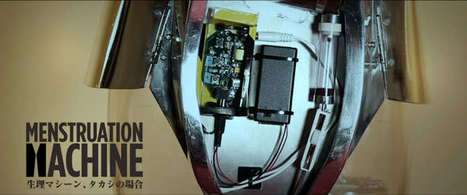
Quand il s’agit de combattre les stéréotypes de genre, cette jeune femme de 28 ans sort l’artillerie créative : pour sa vidéo intitulée « Menstruation Machine », elle a consulté des biologistes, afin de fabriquer une machine scientifiquement étayée qui reproduise exactement les sensations que provoquent les menstruations. Les douleurs au ventre sont assurées par des électrodes et un réservoir laisse s’écouler des gouttes de sang à intervalles réguliers.
Pour blinder la Toile, des chercheurs proposent de créer des services en ligne où les données ne sont déchiffrées que dans les navigateurs, jamais côté serveur. Subtil, mais faisable.
To get content containing either thought or leadership enter:
To get content containing both thought and leadership enter:
To get content containing the expression thought leadership enter:
You can enter several keywords and you can refine them whenever you want. Our suggestion engine uses more signals but entering a few keywords here will rapidly give you great content to curate.


 Your new post is loading...