


Durant le festival Electropixel#3, organisé sur l'Ile de Nantes par l'association APO33, Desartsonnants était invité chaque jour à proposer une balade sonore, ainsi qu'une rencontre avec les promeneurs écoutants,...
Via Desarts Sonnants
Get Started for FREE
Sign up with Facebook Sign up with X
I don't have a Facebook or a X account


 Your new post is loading...
 Your new post is loading...
Your new post is loading...
 Scoop.it!
Durant le festival Electropixel#3, organisé sur l'Ile de Nantes par l'association APO33, Desartsonnants était invité chaque jour à proposer une balade sonore, ainsi qu'une rencontre avec les promeneurs écoutants,... Via Desarts Sonnants 
No comment yet.
Sign up to comment
Scoop.it!

"Lessons in NetArt" has introduced users since 1999 to the possibilities of artistic creativity on the Internet. "Lessons in NetArt" appears in irregular intervals, and has been available in English translation since August 2003.
The lessons usually deal with websites of artists and artists´ groups. One or more net projects have been in function and reacted to operations of users (or allowed interactions between users and/or participants in a part of the project) when the lesson was published.
Scoop.it!

It might sound rather frightening to have your arm move involuntarily, controlled by some unseen puppet master — but for researchers at the University of Washington, it represented a major breakthrough in human-to-human brain interfaces. Using a non-invasive brain-to-brain setup, a researcher in one lab was able to send a signal from his brain to control the movements of a second researcher in a lab on the other side of campus. It's believed to be the first human brain-to-brain interface; previous demonstrations have featured rat-to-rat and human-to-rat communication. ...
Scoop.it!

« Sortez et faites quelque chose! » Tel est le slogan de Sylvia, une jeune américaine de 12 ans, icône du mouvement des « makers » (littéralement, « faiseurs »). Le mouvement trouve écho dans certaines écoles, où on considère que chacun a le droit et l’habileté de fabriquer, refaire ou améliorer quelque chose. Du concret, quoi. Aidée de son père et de sa mère, Sylvia en est à sa troisième saison de publication de capsules vidéo sur son site, dans lesquelles elle présente un projet de fabrication d’objet. Sa plus récente capsule explique comment bâtir un pendentif qui scintille au rythme des battements du cœur de la personne qui le porte.
En 1994, Steve Jobs, l’homme derrière l’empire Apple, a affirmé ceci : « tout ce qui vous entoure a été créé par des gens qui n’étaient pas plus intelligents que vous. Vous pouvez vous aussi fabriquer des choses que les autres utiliseront. » Ce principe peut-il entrainer une petite révolution en éducation? Certains croient que oui.
Dans un article du site TheDigitalShift, on entre dans la classe de Andrew Carle, enseignant en Viriginie, qui organise des périodes de création libre pour ses élèves du 1ère cycle du secondaire. Il parsème les tables de matériel comme des fils, des outils, des livres de référence, des ordinateurs, etc. L’espace d’une heure, les élèves deviennent des consultants, des designers, des inventeurs.
.... Via frederique
Scoop.it!
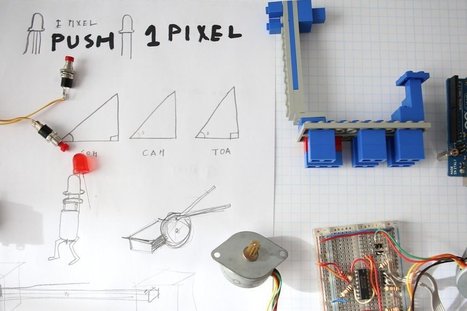
Trying to bridge the gap between computer programming, engineering, design and art, four instructors in Brooklyn have started a new school to help students revel in the poetic possibilities of technology.
New computer science graduates jumped by nearly 30 percent last year, and a bevy of professionally oriented programming courses have erupted to teach start-up ready skills like, “How to Build a Mobile App.” So it makes sense that programming is widely considered to be this generation’s “Plastics” — a surefire professional skill that can bring success, security and maybe even stock options.
But fewer people talk about how programming and engineering can be used for pleasure, beauty or surprise. Now, four people with a variety of backgrounds — in computer science, art, math and design — have banded together in Brooklyn to rethink how programming is taught.
Scoop.it!

Dans le dialogue entre technologie et Art qu'incarnent actuellement les arts numériques, il y a des outils qui semblent exclus. Par exemple : le robot industriel typique des chaînes d'assemblage.
Comme souvent face à un élément si étranger, des artistes se sont laissés tenter, ont été inspiré. Le bien sage et redondant robot s'est alors découvert un potentiel insoupçonné. ...
Scoop.it!

The project uses digital practices and processes to blur the lines between photography, data visualization, textile design, and computer science.
Back in february 2012 we wrote about Phillip Stearns and his methodology of using short circuited cameras to create glitch like blanket patterns. Since then, Phillip’s work has not only been covered extensively in media but also exhibited around the world. Phillip now also runs an online store where these blankets can now be purchased.
One of the later pieces, titled Fragmented Memory, is a triptych of large woven tapestries completed in May 2013 in Tilburg, NL at the Audax Textielmuseum’s Textiellab. The project uses digital practices and processes to blur the lines between photography, data visualization, textile design, and computer science. The result are works that serve not only to render visible the invisible processes mediating everyday experience, but also to operate as distinctly tactile and lo-fi digital storage media—the process becomes a means to capture, record, and transmit data. Via Vavdo
Scoop.it!

Polyplane et Samara sont deux petits drones à usage unique et biodégradables. Inspirés de l'avion en papier et de la feuille d'érable, ils pourraient bien sauver quelques forêts cet été. Via Gauthier Bouly
Scoop.it!

Commanding machines using the brain will no longer be just a science fiction stuff. Currently, brain implants allow people to control robots and stuff using their minds, forecasting the time when patients will overcome disabilities using bionic limbs and mechanical exoskeletons. But instead of the invasive brain implants, electrical engineer Todd Coleman at the University of California in San Diego is researching noninvasive devices for mind guided, remotely controlled machines. His team is developing wireless, tattoo-like flexible electronics one can apply on the forehead to read brain activity.
Via Frederik De Wilde
Scoop.it!

From
phys

Using nanostructured glass, scientists at the University of Southampton have, for the first time, experimentally demonstrated the recording and retrieval processes of five dimensional digital data by femtosecond laser writing. The storage allows unprecedented parameters including 360 TB/disc data capacity, thermal stability up to 1000°C and practically unlimited lifetime. Using nanostructured glass, scientists at the University of Southampton have, for the first time, experimentally demonstrated the recording and retrieval processes of five dimensional digital data by femtosecond laser writing. The storage allows unprecedented parameters including 360 TB/disc data capacity, thermal stability up to 1000°C and practically unlimited lifetime.Read more at: http://phys.org/news/2013-07-5d-optical-memory-glass-evidence.html#jCpUsing nanostructured glass, scientists at the University of Southampton have, for the first time, experimentally demonstrated the recording and retrieval processes of five dimensional digital data by femtosecond laser writing. The storage allows unprecedented parameters including 360 TB/disc data capacity, thermal stability up to 1000°C and practically unlimited lifetime. Read more at: http://phys.org/news/2013-07-5d-optical-memory-glass-evidence.html#jCpUsing nanostructured glass, scientists at the University of Southampton have, for the first time, experimentally demonstrated the recording and retrieval processes of five dimensional digital data by femtosecond laser writing. The storage allows unprecedented parameters including 360 TB/disc data capacity, thermal stability up to 1000°C and practically unlimited lifetime. Read more at: http://phys.org/news/2013-07-5d-optical-memory-glass-evidence.html#jCpUsing nanostructured glass, scientists at the University of Southampton have, for the first time, experimentally demonstrated the recording and retrieval processes of five dimensional digital data by femtosecond laser writing. The storage allows unprecedented parameters including 360 TB/disc data capacity, thermal stability up to 1000°C and practically unlimited lifetime. Read more at: http://phys.org/news/2013-07-5d-optical-memory-glass-evidence.html#jCpUsing nanostructured glass, scientists at the University of Southampton have, for the first time, experimentally demonstrated the recording and retrieval processes of five dimensional digital data by femtosecond laser writing. The storage allows unprecedented parameters including 360 TB/disc data capacity, thermal stability up to 1000°C and practically unlimited lifetime. Read more at: http://phys.org/news/2013-07-5d-optical-memory-glass-evidence.html#jCpUsing nanostructured glass, scientists at the University of Southampton have, for the first time, experimentally demonstrated the recording and retrieval processes of five dimensional digital data by femtosecond laser writing. The storage allows unprecedented parameters including 360 TB/disc data capacity, thermal stability up to 1000°C and practically unlimited lifetime. Read more at: http://phys.org/news/2013-07-5d-optical-memory-glass-evidence.html#jCp
Jacques Urbanska's insight:
Using nanostructured glass, scientists at the University of Southampton have, for the first time, experimentally demonstrated the recording and retrieval processes of five dimensional digital data by femtosecond laser writing. The storage allows unprecedented parameters including 360 TB/disc data capacity, thermal stability up to 1000°C and practically unlimited lifetime. Read more at: http://phys.org/news/2013-07-5d-optical-memory-glass-evidence.html#jCpUsing nanostructured glass, scientists at the University of Southampton have, for the first time, experimentally demonstrated the recording and retrieval processes of five dimensional digital data by femtosecond laser writing. The storage allows unprecedented parameters including 360 TB/disc data capacity, thermal stability up to 1000°C and practically unlimited lifetime. Read more at: http://phys.org/news/2013-07-5d-optical-memory-glass-evidence.html#jCpUsing nanostructured glass, scientists at the University of Southampton have, for the first time, experimentally demonstrated the recording and retrieval processes of five dimensional digital data by femtosecond laser writing. The storage allows unprecedented parameters including 360 TB/disc data capacity, thermal stability up to 1000°C and practically unlimited lifetime. Read more at: http://phys.org/news/2013-07-5d-optical-memory-glass-evidence.html#jCp
Scoop.it!

Notre objectif ? Interroger une réalité fabriquée par le déplacement, l’échange et l’archivage d’informations, que ce soit dans le contexte urbain ou sur les réseaux. Nous explorons salles et couloirs, rues, cartes, œuvres et sites Web. Techniques mixtes: marche à pied, transports publics, écriture, photographie, dessin, vidéo, animation… Ces expériences sont documentées ici dans notre journal de bord.
Les articles sont de plusieurs types: Brève : annonce d’un événement, exposition, conférence, etc. avec mention de la source de l’information (communiqué de presse, site Web).
Les notices, critiques, dérives et protocoles sont signés. Les citations figurent entre guillemets avec attribution de source sous forme de note de bas de page.
Scoop.it!

Marc De Pape's The Chime, a complex assemblage of sensors that composes generative music from ambient environmental data
The urban soundscape has been a renewed topic of inquiry within media art over the last several years. This is not entirely surprising, as, given the propagation of cheap sensors, there is the possibility for much more granular analysis and engagement than was available to the recorder-toting acoustic ecologists of the late 20th century. Marc De Pape’s recent project, The Chime, is an elaborate environmental ‘meter’ that translates local acoustic and kinetic data into lush musical compositions.
he Chime is essentially a sensor-jukebox with a set of baseline playback modes that are driven by environmental fluctuations. Authentically ambient, the instrument embodies Brian Eno’s blueprint for generative compositions that evolve organically over time. Approaching the device sets off flutter of xylophone tones, back away and the mix foregrounds moody strings. ...
Scoop.it!
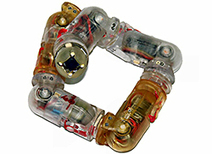
Des chercheurs de l'Université Polytechnique de Madrid ont mis au point des robots constitués de différents modules qui gèrent leur comportement grâce à des algorithmes génétiques. Le système de contrôle de ces robots doit tout d'abord comprendre de quelles parties ils sont formés avant d'analyser les meilleures solutions à mettre en place pour le déplacement par exemple. Un exemple concret d'un domaine en pleine expansion: la mécatronique. ... Via Gauthier Bouly
|
Scoop.it!
The world's first JavaScript microcontroller for beginners or experts, now Open Source. Be creative with intelligent control!
Espruino is a small computer that anyone can use to control things around them. Its JavaScript interpreter gives you instant feedback so that you can experiment and develop whatever your level of experience. Even if you can’t program, you can still get started quickly with our Web-based graphical code editor! Via anthony cocherie
Scoop.it!

La dataviz, ce n'est pas seulement de l'art ou du design : nous poursuivons notre exploration de cette galaxie, en présentant quelques-unes de ses utilisations les plus institutionnelles. Et vous verrez qu'elle peut devenir une arme politique.
Et la dataviz fit son apparition dans des rapports annuels et autres projets très officiels... : non, les éditeurs de beaux livres ou les designers très branchés ne sont pas les seuls à jouer la carte de la visualisation de données.
Depuis quelques années, des entreprises, des institutions, voire des politiques, ont également recours à ce genre à part entière. Pour comprendre cette évolution, nous avons identifié quatre étapes distinctes dans la manière dont la dataviz s'est peu à peu étendue aux publications institutionnelles - sans prétendre, évidemment, avoir épuisé le sujet.
L'objectif du recours à la dataviz est double : évidemment, il s'agit d'être un peu sexy, et éviter ces « longs écoulements textuels gris » vilipendés par Alain Joannès. Mais elle permet également de faire passer des messages, via une nouvelle forme narrative. Et, comme souvent, les Etats-Unis ont un cran d'avance en la matière : nous irons jeter un oeil à certains exemples récents.

Mélifeu's curator insight,
December 1, 2017 3:03 AM
Un angle très large des différents aspects de la datavisualisation ; outre son aspect très design et esthétique, la dataviz est utilisé dans de nombreux champs y compris en politique, et en entreptrises. On évoque une nouvelle forme narrative, le storytelling. Les USA sont précurseurs en la matière.
Scoop.it!

Last week, ANIMAL videotaped artist Anthony Antonellis getting an RFID chip implanted into a fleshy part of his left hand — from the initial slice of the skin, to the stretching and pulling apart of the flesh, to the implantation to the… TA-DA!.. functionality. The RFID chip stores
Anthony’s unique 1KB favicon gradient GIF and is readable by compatible mobile devices — a changeable, digital net art tattoo.
It’s been getting around in the news and “the news,” so we thought we’d check in with the artist. How are you feeling, Anthony?
Scoop.it!

Ford has developed a new 3D printing process it calls Ford Freeform Fabrication Technology, or F3T.
With F3T, Ford is looking ahead to the day when 3D printing is firmly ensconced as part of the manufacturing process. Along with prototyping, Ford is investigating how it can use AM to build custom designs for its customers. At some point, instead of selecting the interior and paint color of a new car, customers may be able to select specific designs printed into the body of the car itself. With F3T, Ford is looking ahead to the day when 3D printing is firmly ensconced as part of the manufacturing process. Along with prototyping, Ford is investigating how it can use AM to build custom designs for its customers. At some point, instead of selecting the interior and paint color of a new car, customers may be able to select specific designs printed into the body of the car itself. “The technology behind F3T is yet another example of Ford leading in the advanced manufacturing space,” said John Fleming, executive vice president, global manufacturing and labor affairs. “As we forge ahead with cutting-edge technologies in manufacturing like flexible body shops, robotics, 3D printing, virtual reality and others, we want to push the envelope with new innovations like F3T to make ourselves more efficient and build even better products.” - See more at: http://www.rapidreadytech.com/2013/07/ford-delves-further-into-additive-manufacturing/?goback=.gde_2861019_member_257734946#!With F3T, Ford is looking ahead to the day when 3D printing is firmly ensconced as part of the manufacturing process. Along with prototyping, Ford is investigating how it can use AM to build custom designs for its customers. At some point, instead of selecting the interior and paint color of a new car, customers may be able to select specific designs printed into the body of the car itself. “The technology behind F3T is yet another example of Ford leading in the advanced manufacturing space,” said John Fleming, executive vice president, global manufacturing and labor affairs. “As we forge ahead with cutting-edge technologies in manufacturing like flexible body shops, robotics, 3D printing, virtual reality and others, we want to push the envelope with new innovations like F3T to make ourselves more efficient and build even better products.” - See more at: http://www.rapidreadytech.com/2013/07/ford-delves-further-into-additive-manufacturing/?goback=.gde_2861019_member_257734946#!Via Growthobjects, Kalani Kirk Hausman
Scoop.it!

Having once made the statement above, I have declined all opportunities to enlarge upon it or defend it. That seemed to be a fool's errand, especially given the volume of messages I receive urging me to play this game or that and recant the error of my ways. Nevertheless, I remain convinced that in principle, video games cannot be art. Perhaps it is foolish of me to say "never," because never, as Rick Wakeman informs us, is a long, long time. Let me just say that no video gamer now living will survive long enough to experience the medium as an art form.
What stirs me to return to the subject? I was urged by a reader, Mark Johns, to consider a video of a TED talk given at USC by Kellee Santiago, a designer and producer of video games. I did so. I warmed to Santiago immediately. She is bright, confident, persuasive. But she is mistaken. ...
Scoop.it!

Download 750 free courses from Stanford, Yale, MIT, Harvard, Berkeley and other great universities to your computer or mobile device. Via Xavier Leton

Xavier Leton's curator insight,
August 15, 2013 5:07 AM
Get free online courses from the world’s leading universities. This collection includes over 750 free courses in the liberal arts and sciences. Download these audio & video courses straight to your computer or mp3 player. Note: you can find a new collection of certificate-bearing courses here.
Scoop.it!

Dans une chambre noire, prenez une lampe torche et une boîte à chaussures. Soulevez le couvercle de la boîte, éclairez l'intérieur et éteignez dès que vous avez refermé le couvercle. Attendez une minute. Rouvrez la boîte. Que se passe-t-il ? Rien et c'est normal. Pourtant, des chercheurs allemands viennent de concevoir un système, une espèce de boîte dans laquelle la lumière est stoppée et réémise une minute plus tard, dès que la boîte s'ouvre ! Pour comprendre à la fois la physique et l'enjeu de cette expérience époustouflante, il faut faire un détour par le monde curieux de l'information quantique. Tout ce que vous voyez sur votre écran, le texte de ce billet, l'image qui l'accompagne, a été codé sous forme de bits. Il en va de même pour les clichés que vous prenez avec votre appareil photo numérique, pour les films de vos DVD, pour la musique de votre lecteur MP3... Toutes ces informations visuelles ou sonores ont été passées à cette moulinette et quand les informations voyagent sur Internet dans les impulsions lumineuses de la fibre optique, elles empruntent aussi cette forme. Dans le monde actuel de l'informatique classique, le bit est ou bien 0 ou bien 1, et rien d'autre. Un jour viendra pourtant où l'on s'affranchira de cette tyrannie du binaire, où tout est noir ou blanc, ouvert ou fermé, haut ou bas. Dans le monde futur, à peine ébauché, de l'informatique quantique, le bit pourra à la fois être 0 et 1. Comme le disent les physiciens, dans le monde quantique les particules peuvent avoir deux états superposés, être ici et là, comme ci et comme ça. Grâce à sa souple gestion des possibles, le bit quantique (aussi connu sous l'abominablement obscène abréviation de qubit) permettra des tâches impossibles au bit classique
Scoop.it!
This is the question that some heads are beginning to ask themselves, as soon as the topic starts to become mainstream; for instance, De Biase’s head, some days ago, on “Il Sole 24 ore” (an italian newspaper dealing with economy, n.d.t.), after having talked about the experience of Francesco Bombardi with the Fablab of Reggio Emilia, identifies the fundamental challenge that awaits the FabLab in the connection and integration of its activities with industrial and craft production. It’s something WE have to ask ourselves, if we don’t want adapt passively to the ‘stuffy narrative that has developed in social and economic contexts very far from our own, and that we risk import just as they are, although the way in which they can operate in an American FabLab is surely not the same way they should work here. Moreover, the Fab Charter is sufficiently wide to allow to create a real FabLab without copying it from the existing ones. Via Aurelie Ghalim

Growthobjects's comment,
July 21, 2013 1:05 PM
Interesting article like manifesto or decalogue of the Fab Labs!!
Scoop.it!

Surgeons could one day restore lost feeling in humans by using artificial skin that's been augmented with flexible sensors, and a new development from researchers at the Technion-Israel Institute of Technology may bring that closer to reality. The research team has developed a flexible sensor that can detect touch, temperature, and humidity — and can reportedly be built at a low cost.
Lead researcher Hossam Haick told the American Technion Society that it is the first artificial skin sensor built with the ability to detect temperature and humidity, and that its touch sensitivity is 10 times greater than any electronic skin that came before it. ...
Scoop.it!

The Emergent City. From Complexity to The City of Bits captures the changes over time in the environment (city) and represents the changing life and complexity of space as an emergent artwork. The installation goes beyond simple single user interaction to monitor and survey in real time the whole city and entirely represent the complexities of the real time city as a shifting morphing and complex system.
The artwork explores new ways of thinking about life, emergence and interaction within public space and how this affects the socialization of space. The project uses environmental monitoring technologies and security based technologies, to question audiences' experiences of real time events and creates visualizations of life as it unfolds. The interactions of all this data are re-formed and re-contextualised in real time artwork.
Scoop.it!

En navigant de sites internet en festivals, d'installations en performances, je croise parfois des pratiques récurrentes liées à des objets qui se déclinent sous différentes formes, esthétiques, projets.
En puisant dans le vaste répertoire des arts sonores, j'ai eu envie aujourd'hui de vous parler d'histoires de parapluies, non pas dans sa fonction classique d'abri contre l'élément liquide, mais dans des fonctions d'objets sonores divers.
Parapluie pour des promenades écoute, parapluie installation, parapluie diffuseur, l'esthétique de cet objet parabole, réfléchissant, intime, isolant mais pas trop, a inspiré artistes plasticiens, musiciens et créateurs sonores de tous crins.
Je vous présente donc ici quelques réalisations, pour montrer les déclinaisons d'un objet dans différentes œuvres et performances sonores.
Scoop.it!

1.0 WHAT IS NET.ART?
|




