Media Arts Watch Lab - www.arts-numeriques.info - laboratoire de veille Arts Numériques - twitter @arts_numeriques - @processing_org - @DigitalArt_be - by @jacquesurbanska @_Transcultures
An openLAB Masterclass with Marius Watz This openLAB is the first masterclass on Digital Fabrication in Brussels. With an emphasis on forms generated by code, it will culminate with an exhibition featuring the participants' works. Together, they will explore how dynamic software processes can be combined with digital fabrication to produce physical objects, using 3D Printers (Makerbots), and a laser cutter machine. Their freshly made projects are exhibited at the end of the lab.
Loin du fixisme de l'antiquité et des divines proportions, l'art numérique explore de nouvelles voies. Les œuvres naissent, vivent, meurent et échappent à leur créateur.
En perpétuelle transformation, ces œuvres évoluent avec le spectateur qui devient interacteur. Quelles sont les alliances et non alliances avec la science ? Comment l'art numérique, qui repose sur des algorithmes, interpelle-t-il la science ? Entre confrontations et enrichissements mutuels, qu'apportent ces deux disciplines dans notre perception du monde ?
319 Scholes supports digital arts and experimentation through exhibitions, lectures, panels, participatory workshops, and live performances. We use a multidisciplinary approach to examine technology and its effects on our communities, relationships, and the body. Grounded in the belief that art is the best way to navigate the potential of networked culture, we aim to cultivate challenging and experiential modes of engaging with new media. Established in 2009, 319 Scholes is run by artists, curators and a core group of collaborators, operating out of a 3,000 sq. ft. gallery space in Bushwick, Brooklyn.
In Human Body Communication (HBC) we use the body as the communication channel. Very weak signals pass through the body from a smartphone for example to exte...
Minority Report science adviser and inventor John Underkoffler demos g-speak -- the real-life version of the film's eye-popping, tai chi-meets-cyberspace computer interface. Is this how tomorrow's computers will be controlled?
Remember the data interface from Minority Report? Well, it's real, John Underkoffler invented it -- as a point-and-touch interface called g-speak -- and it's about to change the way we interact with data.
Waterbear is a toolkit for creating drag-and-drop programming languages, with some example languages you can play around with and learn from. The goal is to make it easy to wrap other existing languages with Waterbear blocks to create draggable, snappable syntaxes for them.
SparkFun is an online retail store that sells the bits and pieces to make your electronics projects possible. Whether it’s a robot that can cook your breakfast or a GPS cat tracking device, our products and resources are designed to make the world of electronics more accessible to the average person. In addition to products, SparkFun also offers classes and a number of online tutorials designed to help educate individuals in the wonderful world of embedded electronics.
Founded in January 2009 in Berlin, kom.post is an interdisciplinary collective made up of thirty+ international artists and researchers. Kompost members base their research and actions on process. They attach less importance to the production of a collective work than to setting in motion a terrain for interrogation which activates creative ”micro-groups”. As the work methods are diverse, each member is able to nourish, prolong, and counterbalance the research of another member or that of the group as a whole, following the principles which are dear to kom.post : the ”exchange of knowledge” and the ”reprise”, or re-take. The roles of author, contributor, and spectator
V2_Institute for the Unstable Media in Rotterdam is internationally recognized like one of the main centres for research and practice for what concerns new media art and technological and artistic experimentation.
This document traces the practice of data visualization, showing general examples ranging from 2 & 3-dimensional visualization to spatial immersion. Its objectives are to position the infra|vergence project within the bounds of visualization as both a cultural and professional practice ; demonstrate the sophisticated use of locational information in visualizations that employ spatial immersion, progressing from simple montage of maps in 2 or 3 dimensions to the actual integration of visualization objects into the geospatial landscape; and, establish infra|vergence as both Project and Pedagogy, a tool for the creation and diffusion of knowledge.
Krzysztof Wodiczko (born 1943, Warsaw, Poland) has been creating site-specific slide and video projections both within galleries and using architectural facades and monuments as backdrops for nearly thirty years. These politically-charged works of art, which have been shown in over a dozen countries around the world, speak to issues of human rights, democracy, violence, alienation, and inhumanity, and using sound and motion often include testimonies of the people whose plights they address...
Jean-Marc Bonnet-Bidaud est astrophysicien au Commissariat à l'énergie atomique et aux énergies alternatives (CEA), spécialiste de l'astronomie des hautes énergies et des étoiles en fin de vie. Avec l'historien et philosophe des sciences Thomas Lepeltier, il a co-dirigé la publication de l'ouvrage collectif Un autre cosmos ? qui vient de paraître dans la collection "Philosophie des sciences" de l'éditeur Vuibert (150 p., 19 €). L'idée centrale du livre est d'inciter les chercheurs à se pencher sur des modèles cosmologiques alternatifs à celui du Big Bang.
Next time you're photographing a monument, take a second to look at the people around you who are also photographing that monument. That's what Corinne Vionnet did while visiting the Leaning Tower of Pisa; she wondered what it would look like to combine the tourist photos.
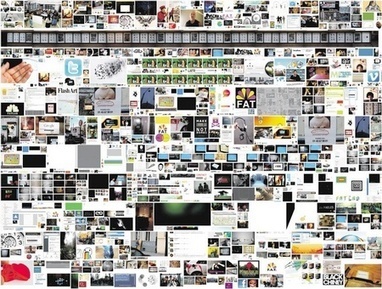
En pénétrant dans le cube blanc de la Maison des arts électroniques de Bâle qui accueille l’exposition « Collect the WWWorld », on est saisi d’une impression étrange. Comme si le Web s’était déversé dans l’espace physique. Que la gigantesque banque d’images numériques avait jailli de l’écran pour s’imprimer sur des cravates, serviettes et tee-shirts, se matérialiser dans des toiles, photographies, sculptures. Une tendance forte chez cette nouvelle génération d’artistes issus du Net, traduisant ce double mouvement à l’œuvre : un monde réel qui se numérise à grande vitesse en ligne, et un monde virtuel qui devient, lui, de plus en plus réel, pénétrant et façonnant notre vie et relations sociales.
The House of Electronic Arts is dedicated to exploring art that applies, addresses and reflects on new media and technologies. As sole successor to [plug.in] Art & New Media and Shift –Electronic Arts Festival, the House of Electronic Arts combines their previous activities and its new agenda under one roof. The House of Electronic Arts also pursues research into how best to conserve, archive and document digital artworks. In early 2011, the Christoph Merian Foundation, the predecessors, and Canton Basel City launched the House of Electronic Arts Basel Foundation as the official Board of Trustees. The new House of Electronic Arts was opened officially on May 27th 2011.
NASA’s Kepler mission is doing what we may one day call NASA’s most important project. It’s searching for habitable planets--second Earths--that our grandchildren’s grandchildren may call home, or that could contain life as we know it.
Can you build a human body? An interactive guide to some of the latest developments in bionic body parts...
Technology has always strived to match the incredible sophistication of the human body. Now electronics and hi-tech materials are replacing whole limbs and organs in a merger of machine and man.
#3 Most Important Technologies in the next 5-10 years
Bionics and medical technology
Human-technology mergers are no longer reserved for sci-fi movies. Bionics have allowed us humans to overcome our physical limitations and will continue to do so in the future. We are in a sense turning ourselves into super humans.
I believe bionics is one of the 5 most important technologies to consider for the next 5 -10 years not only because of its amazing transformative power, but also because of the questions we will face in implementing this technology in the future such as - should insurance or medicare cover the cost of bionics? Can those who can afford it decide to replace human body parts with upgraded bionics/prostetics? Will this technology create a sub species of perfect humans vs the rest of the world?
Scratch: a programming language for everyone. Create interactive stories, games, music and art - and share them online.
Scratch is developed by the Lifelong Kindergarten Group at the MIT Media Lab, with financial support from the National Science Foundation, Microsoft, Intel Foundation, MacArthur Foundation, Google, Iomega and MIT Media Lab research consortia.
Scratch est un nouveau langage de programmation qui facilite la création d’histoires interactives, de dessins animés, de jeux, de compositions musicales, de simulations numériques, etc. et leurs partage sur le web.
Il est conçu pour initier les enfants, à partir de 8 ans à des concepts importants en mathématiques et informatique, tout en apprenant à développer une pensée créative, un raisonnement systématique et à travailler en équipe.
Artist and innovator Daan Roosegaarde (1979) explores the dawn of a new nature that is evolving from technological innovations by creating social designs that instinctively respond to sound and movement. Roosegaarde’s remarkable works of art function as an exploration of the dynamic relation between architecture, people, and technology.
Studio Roosegaarde is the social design lab of artist Daan Roosegaarde with his team of designers and engineers. By creating interactive designs that instinctively respond to sound and movement, Roosegaarde explores the dawn of a new nature that is evolving from technological innovations.
DEAF2012 is a platform for a dynamic generation of creative individuals that mean to change the world through art and design. It refuses to be held back by traditions, boundaries or rules when addressing key issues in culture, politics and society. While remaining firmly rooted in today’s reality, the sky is the limit at DEAF2012.
Ever wanted to move Pac-Man using pencil drawings, make music with bananas or type an email with alphabet soup? Now you can thanks to Makey Makey, a simple circuit board that turns almost any object into a computer key
LEFT your phone at home again? A solution is at hand: make sure it is with you at all times by having it implanted in your arm.
But given the opportunity, would you want your gadget to be a permanent part of you? The question may need answering sooner than you think.
Researchers at Autodesk, a software company in Toronto, Canada, checked to see whether the methods we currently use to interface with our gadgets work when the device is implanted in human tissue. The answer was a resounding "yes".
A button, an LED and a touch sensor all functioned appropriately when embedded under the skin of a cadaver's arm. The team was even able to communicate transcutaneously using a Bluetooth connection and charge the electronics wirelessly.
"That's the bottom line," says Christian Holz of the Autodesk team, who presented the work this week at the Conference on Human Factors in Computing Systems in Austin, Texas. "Traditional user interfaces work through the skin."
To get content containing either thought or leadership enter:
To get content containing both thought and leadership enter:
To get content containing the expression thought leadership enter:
You can enter several keywords and you can refine them whenever you want. Our suggestion engine uses more signals but entering a few keywords here will rapidly give you great content to curate.


 Your new post is loading...


 Scoop.it!