Media Arts Watch Lab - www.arts-numeriques.info - laboratoire de veille Arts Numériques - twitter @arts_numeriques - @processing_org - @DigitalArt_be - by @jacquesurbanska @_Transcultures
The biennial festival NODE – Forum for Digital Arts gathers designers, creative coders, digital artists and creatives of the digital media scene since 2008.
NODE aims to foster a critical reflection within the creative coding scene. The forum is supporting the creation of an innovative and responsible movement by encouraging new collaboration, interdisciplinary exchange and open knowledge sharing.
The main goal of the forum is to empower individuals by encouraging them to experiment, prototype, and develop new things, to ask new questions and to provide answers.
Après l’exposition Irisations présentée tout l’été dans le cadre des 40 ans de la Fondation Vasarely, puisun mois de Rentrée Numérique en septembre, Chroniques déroule son troisième et dernier acte à partir du 29 janvier, cette fois à Marseille, sur la Canebière et invite les arts numériques à révéler le patrimoine de la célèbre artère phocéenne.
Révélations prendra place dans le cadre du premier Dimanche de la Canebière, rendez-vous mensuel, local et convivial de la Mairie du 1er et 7ème arrondissements de Marseille. Révélations marquera aussi le lancement de la plateforme creative Future DiverCities en invitant des artistes européens à rejoindre la programmation aux côtés des artistes français et locaux.
15 jours durant, marseillais, touristes et visiteurs sont invités à re-découvrir le centre-ville. Du vieux port au boulevard Longchamp, en passant par le cours Belsunce, c’est au total une douzaine d’œuvres qui prendront place dans des lieux symboliques de la Canebière et dans l’espace public. Un parcours insolite pour poser un regard nouveau sur Marseille, se réapproprier son histoire, son identité et ses symboles.
Bientôt le printemps...... après les tensions, les incertitudes, les sensations d’impasse auxquelles chacun peut se trouver confronté dans ses projets... il y a la projection vers des promesses... d’un lieu (re) trouvé (chapelle de l’oratoire) pour faire briller les artistes, des œuvres que nous découvrons et que nous allons partager ; il y a les nouveaux partenaires et l’excitation que suscitent l’exploration de pistes inexplorées, la relance avec les réseaux de proximité et aussi les projets d’aventure comme le label (2+3) à découvrir sur notre site.... après l’hiver... après les fêtes... du John Sanborn en majesté et, comme dans chaque numéro, une artiste à découvir... Christine Maigne !
Festivals come in all shapes and sizes. EFFE primarily considers festivals a cultural event that takes place in a specific place, over a specific period, and that are conceived as a total package. This is a loose definition and all festivals that think they represent the criteria are welcome to apply! Visit the guidelines for more details.
How to Apply:
Start by registering on the EFFE Professional Community or log in if you already have a festival profile. Click “Yes, I want to apply” when saving your profile. Detailed instructions on how to apply can be found here. Use your login to sign in and begin your application. You can save the application and complete it later. You can spend as much time as you want working on your proposal – we can't view it until you submit it. All required fields must be filled in. The administration fee must be paid before the application is confirmed, either by credit card (PayPal) or Bank transfer. The deadline is 17 February 2017. Don’t miss it!
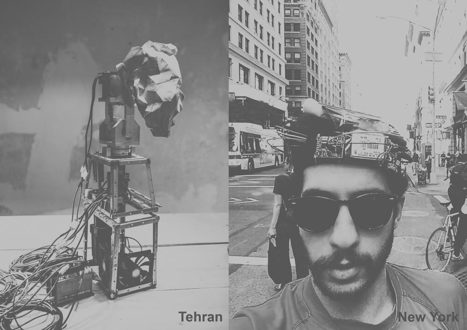
In a little over a week, the 6th edition of TADAEX festival (Tehran Annual Digital Art Exhibition) takes place at Mohsen Gallery in Tehran, Iran. It’s a strong manifestation of the digital scene in Tehran and the people who make it possible, it features Iranian digital artists as well as far reaching international network of collaborators thanks to an ongoing residency program with NODE Forum for Digital Arts. The initiative enables joint projects of one Iranian and one German artist who work together at both festivals; this year it will be Lilian Nejatpour and Simon Weckert.
Similarly, the exchange with Ars Electronica Festival and the Austrian Cultural Forum brings Austrian Artists to Tehran and provides a platform for TADAEX and its ideas: Ali Panahi, the festival’s director gave a talk on current developments and this year’s edition edition at Ars Electronica Festival 2016. In addition, TADAEX programme also includes exchange artists from Brazil, France, Japan, Kuwait and the Netherlands.
On August 20, 2012, Iran’s Ministry of Science, Research and Technology announced that thirty-six universities would cut seventy-seven fields of study from the female curriculum, making them male-only fields. They include archaeology, nuclear physics, computer science, electrical engineering, industrial engineering and business management, among others. The ban resulted from Iran’s government’s perceptions about the already-greater and still-increasing number of women attending universities in Iran in comparison to men, and it made news around the world. From London The Telegraph observed, “Iran has the highest ratio of female to male undergraduates in the world, according to UNESCO. Female students have become prominent in traditionally male-dominated courses like applied physics and some engineering disciplines.” Consequently, it reported, “[s]enior clerics in Iran’s theocratic regime have become concerned about the social side-effects of rising educational standards among women, including declining birth and marriage rates.” As a result, many programs would become “‘single gender’ and effectively exclusive to men.”...
We believe in pursuing creative passions and celebrating the joy of discovery and community. The way we pursue our creative passions is by creating a world class music and arts festival that delivers a depth and diversity of experiences, in a fun and wonderful setting. Success for us is measured in the experiences people have at Clockenflap.
We love hearing from participants about their festival experiences, particularly where it has created an opportunity to showcase creativity or resulted in a moment of delight. We want to share some of these stories with you.
Below we’ll be adding videos from previous Clockenflap participants, ranging from artists and musicians to attendees. We hope you’ll enjoy the videos and take something away from them about why Clockenflap is special. We hope to see you at Clockenflap.
Millenium Web Meetings is the must-go meeting-point for fans of new technologies and new communication means. Its growing success during the Millenium festival made us decide to organise an edition specifically dedicated to a new genre of storytelling from 1 – 5 December 2016.
Not only is the Millenium Web Meetings an excellent opportunity to try-out this original genre of storytelling, it is also a great chance for making contacts in the field of interactive web-creations. We encourage creative encounters, which is the reason that we invite participants, professionals and amateurs to participate in our events! In short, it is the occasion to push an emerging, incredibly exciting genre forward with the goal of giving a helping hand in its diffusion.
As part of the Millenium Web Meetings, David Dufresne will give a master class on Monday 5th of December. As creator of "Fort McMoney" and his latest project DADA-DATA, David Dufresne has collaborated with the Millenium Web Meetings various times in the past years. The master class is the opportunity for fans of new technologies to learn from the forerunner in this genre. The master class will be followed by the announcement of the winning Cross-Over Lab teams and a drink to celebrate the end of the event.
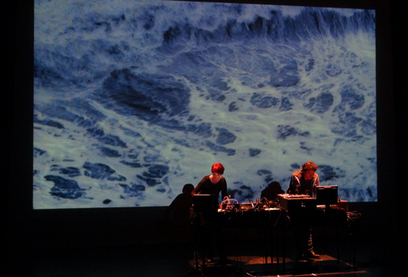
Nous avons là la mise en scène d'un système nerveux augmenté, un spectacle qui bas comme un muscle, une machine synesthésique, un tout intrinsèque, organique et numérique... Le cadre esthétique de la performance est dressé : des impulses, du nerf, et toujours la nécessité de repousser les limites des champs du cognitif. Nous interrogeant en filigrane sur les limites de perception de notre propre corps, les relations ambigües qu'entretiennent notre individu contemporain avec son environnement numérique : Sommes-nous des corps exponentiels ? Ou des corps esclaves ?
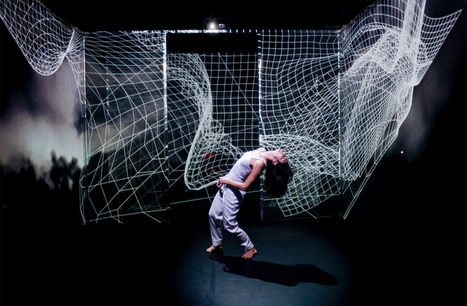
Le Clair Obscur cherche des modes de communication inédits entre l'ordinateur et l'acteur/danseur. Par l'interaction/ synchronisation de ce dernier avec des outils multimédias, le Clair Obscur interroge la place de l'être, humain, dans son environnement, et particulièrement un environnement numérique qui le dépasse.
An international symposium followed by a one-day hacklab dedicated to the issues at stake with the Blockchain technology.
Digital culture constantly generates new paradigms, mediums and technologies. Blockchain is one of those. Blockchain is the revolutionary system that underlies cryptocurrencies such as BitCoin, the first decentralised digital currency for which it was created. But the potential uses of blockchain extend far beyond its initial purpose, turning upside-down numerous fields, from finance to collaborative economics, from medias to creative industries, not to mention education, health or politics. Blockchain – this very technical and still unfamiliar word – covers different realities and a large array of usages, technologies and players.
Participants
Alex Pazaitis (P2P Foundation, P2P Lab), Michel Bauwens by Skype (BE/TH, theorist, founder of the P2P Foundation, Ars Electronica Golden Nica 2016), Yves Moreau (BE, KU Leuven), Jean-Jacques Quisquater (UCL Crypto Group), Chris Speed (UK, University of Edinburgh), Jelle Gerbrandy (IT, Backfeed), Nicolas Loubet (FR, Cellabz), Enric Duran (ES, anarchist, activist, FairCoop), Thomas König (AT, developer, Faircoin), Jaromil, (IT/NL, activist, artist-developer, D-CENT), David Guez (FR, artist), LarbitsSisters (BE, media artists, LARbitsLAB), Max Dovey (UK, artist), Rieul Techer (FR, co-founder Paillasse Saône, project DAISEE), Xavier Lavayssière (FR, entrepreneur, lawyer, developer, Les Bricodeurs), Isabelle Humbert-Radtke (FR, sculptor & engineer, Les Usines Louise)
An event produced by iMAL, in collaboration with LarbitsLab, based on a proposal by LARbitsLAB. With the support of Saison des Cultures Numériques 2016 and Rachid Madrane (Minister for the Promotion of Brussels, Fédération Wallonie-Bruxelles).
Introduction par Monsieur Philippe Busquin, Ministre d’Etat et Commissaire européen chargé de la Recherche scientifique de 1999 à 2004
L'Internet promeut nos libertés et est source de possibilités extraordinaires. En même temps, les technologies de l'information et de la communication créent des risques majeurs vis à vis de nos libertés et de la protection de notre vie privée.
La surveillance sous toutes ses formes est devenue commune et les grands acteurs de l’internet et les États ne s’en privent pas. Les révélations de Snowden ont ouvert bien des yeux. Les technologies qui permettent de nous espionner peuvent pourtant aussi servir à nous protéger. Mais où trouver l’équilibre ?
IPOcle is an installation by Candaş Şişman simulating the way we perceive the reality that exist in our physical world and the various layers, variables, cycles that are present in this process of perceiving. With the senses that we have, we can perceive only a limited portion of the physical reality that surrounds us. This perceived physicality keeps altering as it goes through many layers and processes (biological and psychological) in our brains. These perceptions draw our perceptual schemas and these schemas in turn shape the reality we perceive. Our perceptions and what we perceive, therefore, constantly reshape call each other into being, as in a vicious cycle. At this point, how can we define what reality really is, what constant can we refer to, and aren’t we supposed to look at this issue in a more holistic and intertwined manner? The IPOCle is made of a strong light source, lenses, a convex mirror, a fog machine and a sound system; installed inside a dark container. The light source is located so that the goes through the lenses, hung one after another. The refracted light reaches the mirror. The convex mirror transforms the light and reflects it back. The fog machine keeps running to make the dispersed light visible for us; while a base frequency keeps running in the background. The light and the light source describe physical reality and input The lenses: The process and various factors of perception The mirror: What is perceived, the output and the cycle.
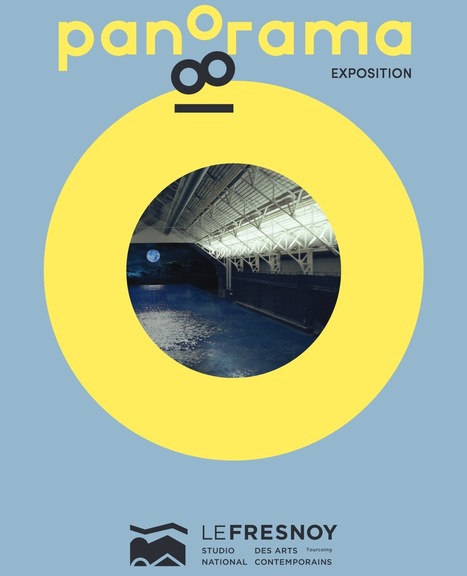
Eviter le piège de l’exposition collective, Graal introuvable ¦¦¦ Découvrir un lieu magique, symbole d’une politique culturelle ambitieuse française avec une direction et une équipe passionnées et stables ¦¦¦ Le montrer en majesté avec la richesse de ses strates historiques et dévoiler ce qui est parfois caché ¦¦¦ Réunir des partenaires que rien ne devrait réunir ¦¦¦ Tenter de dialoguer avec un espace non conçu à l’origine pour y montrer des œuvres ¦¦¦ Mêler des artistes consacrés et des inconnus en oubliant le jeunisme, l’esthétiquement correct et les quotas ¦¦¦ Leur attribuer à chacun un espace après discussion ¦¦¦ Puisque des contraintes nait la liberté, leur indiquer de nombreux thèmes potentiellement fédérateurs (mais qui ne seront probablement pas retenus) ¦¦¦ Privilégier la commande sur l’œuvre préexistante ¦¦¦ Travailler sur un parcours fluide avec des intensités lumineuses diverses en préférant le vide au plein, la surface au volume ¦¦¦ Créer des émotions différentes ¦¦¦ Mettre en valeur le processus créatif et une certaine difficulté d’interprétation ¦¦¦ Faire le compte des occasions manquées et des refus polis pour finalement s’en réjouir ¦¦¦ Traiter les artistes pratiquant le cinéma sur le même plan que ceux qui désirent occuper toute la nef avec une seule installation sans porter attention à leurs amis
InterAccess is an art gallery, educational facility and production studio dedicated to the creative use of technology, electronic art and new media culture.
Our programs support art forms that integrate new technologies from conception and development to exhibition and discussion. We explore the impact of technology on the social, political and cultural aspects of contemporary life, and encourage audiences to see anew their relationships with interactive artworks.
We provide a public forum for the development of practices involving interactivity, networked and remote connection, and the interface of the physical and the virtual. We provide diverse year-round public programming, including:
Exhibitions and events (live music and performance)
Hands-on workshops (intro to advanced)
Professional development and teacher training
Free weekly drop-in Open Studio
Artist talks and panel discussions
Documentation through video and publication
Partnerships and special projects
Annual support for the InterAccess Media Arts Award through OCAD University
How can we appreciate a Sense of Place in the space between the local and the global? Do our GIS technologies enhance or supress the psychology of distance that distinguishes between them and us in times of environmental crisis? Are we making sense of our remote sensors in our telematic umwelt? Virtual simulations create powerful immersive experiences, but are they just distracting us from the complexities of feeling the volatile environment? Do we have the mental dexterity and visual literacy to comprehend these trasnscalar networked ecologies? From the overview to the nanoscape, BunB 2017 will critically explore our (missing) Sense of Place.
A Sense of Place aims to provoke discussion, reflection and action to address the imminent social, economic and cultural impact of climate change. Balance-Unbalance cultivates transdisciplinary relationships and initiatives which seek to provide insights, awareness, innovation, behaviour change and resolutions. To achieve these ambitions Balance-Unbalance explores innovative art and technology practices that provide new models which enhance participation, public engagement, information literacy and ecological action.
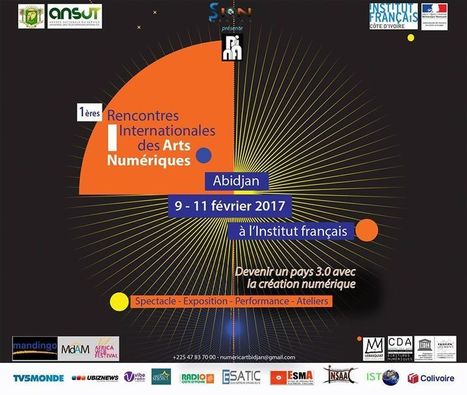
Les 1ères Rencontres Internationales des Arts Numériques d’Abidjan (#RIANA2017) se tiennent du 9 au 11 février 2017 à l'Institut Français d'Abidjan.
Cet événement est un moment de retrouvailles internationales des experts d’Europe et d’Afrique sur les créations numériques, et a pour objectifs de :
- Faire connaître les arts numériques ; - Former aux arts numériques et à la création digitale; - Susciter l’intérêt du public pour les arts numériques et les nouvelles technologies afin de faire d’Abidjan une plateforme de cette discipline novatrice en Afrique.
Au programme: Spectacle - Exposition - Performance - Ateliers - Rencontres professionnelles et d'affaire.
Now entering its fifth year, Vector Festival is a participatory and community-oriented initiative dedicated to showcasing digital games and creative media practices. Presenting works across a dynamic range of exhibitions, screenings, performances, lectures, and workshops, Vector acts as a critical bridge between emergent digital platforms and new media art practice.
Since 2013, Vector Festival has developed an active presence in regional and international communities related to contemporary art and critical game cultures. Curators Skot Deeming and Martin Zeilinger invite you to contribute artworks for consideration toward festival programming, which will include a feature exhibition at InterAccess throughout the month of July, along with off-site screenings, performances, workshops, and panels from July 13-16, 2017.
We currently seek works from artists at all stages of their careers that are working within the spectrum of new media art. This call is open to works on any subject.
The curators seek works for the following programs:
- Artworks for Exhibition - Film/Video/Machinima works for Screening - Performances, including sound, live coding, chipmusic concerts, as well as performances and interventions in virtual and public spaces.
Eduardo Kac is a pioneer of bio art. The School of the Art Institute professor has pushed boundaries—and buttons—throughout his career. He is best known for his series of "transgenic" works, art that blends natural and created elements in highly unexpected ways. These works include a green fluorescent rabbit, a synthetic gene built on a Morse code translation of a sentence from the Book of Genesis, and a genetically engineered petunia that contains Kac's DNA. Join curator Hamza Walker and Kac for a conversation on his radical art practice and the many questions it poses for our genomic time.
The annual Richard Gray Visual Art Series recognizes a significant gift from founding CHF board member and distinguished art dealer Richard Gray. Thanks to the generosity of Lorraine and Jay Jaffe, Eduardo Kac will also visit a Chicago-area classroom and lead an interactive experience with the students.
Video produced by Pentimenti Productions.
This program was recorded on November 9, 2013 as part of the 24th Chicago Humanities Festival, ANIMAL: http://chf.to/2013Animal
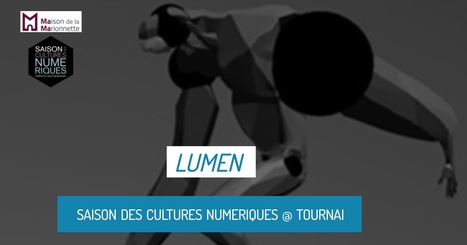
LUMEN vise à mettre en lumière les rapprochements entre les univers marionnettiques et les développements numériques. Au programme : un accueil en résidence, un laboratoire, des présentations de recherches, des spectacles et performances.
Avec la participation de la compagnie Cendres la Rouge, François Zajéga & Loïc Reboursière, le Créa-Théâtre, Numédiart, l’Académie des Beaux Arts de Tournai, Nils Houtteman.
Ce qu’il y a de bien avec Accès)s(, c’est que chaque année, le festival nouveaux médias de Pau parvient à se renouveler tout en poursuivant son exploration des territoires technologiques et ses bordures. Sans doute cela tient-il à son exceptionnelle ouverture : chaque édition est construite par un (ou deux) commissaires invités, le plus souvent artistes.
Après « Vu du ciel » en 2015 (invitée : Agnès de Cayeux), « Disnovation » en 2014 (invités Bertrand Grimault et Nicolas Maigret), l’édition 2016 a pour thématique « Frontières et projections », sur proposition des commissaires artistes Hortense Gautier et Philippe Boisnard, connus sous le nom d’HP Process.
Crise migratoire, perte des repères géographiques et mentaux qui faisaient le ciment de nos sociétés… Sur cette crête d’actualité douloureuse, Accès)s( surfe jusqu’en décembre pour proposer un ensemble chaotique, exigeant et parfois labyrinthique, prenant l’idée de la carte et des frontières comme un « espace de possibles, générant de nouvelles façons d’être au monde, grâce à des artistes et chercheurs qui travaillent à l’intersection de l’art numérique, des arts visuels et sonores, de la poésie, de la géographie, du documentaire et de la prospective »...
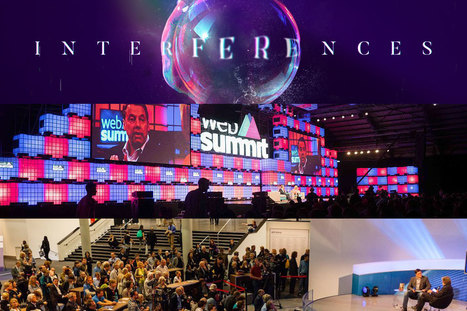
KIKK, WebSummit, NEM : en novembre, faites la tournée des festivals tech européens avec Cap Digital ! Acteur clef du rayonnement de l’innovation francilienne et organisateur du rendez-vous incontournable de l’innovation numérique Futur en Seine, Cap Digital invite ses entreprises adhérentes à s’exporter à l’international le temps d’un mois riche en événements.
Plongée au coeur du design et de la création au KIKK Festival, immersion business à la rencontre des plus grands entrepreneurs au Web Summit ou découverte des dernières mutations de l’industrie des médias au NEM Summit, faites votre choix ! Cap Digital vous accompagne pour profiter au mieux de votre voyage et faire de ce déplacement une étape décisive pour le développement de votre activité.
Voix De Femmes est partenaire du Liège Web Fest depuis 2014. Chaque année le Prix Voix de Femmes y récompense une créatrice du secteur de la webcréation et/ou du transmédia. Ce prix s’intègre dans une politique d’aide à la création menée par Voix De Femmes : une Carte Blanche est proposée à la lauréate.
C’est ainsi, que, depuis quelques mois, Elisabeth Meur-Poniris développe le projet protéiforme « Intimités Numériques », à travers lequel elle interroge les impacts et les apports des nouvelles technologies sur notre rapport au monde et aux autres, à la sexualité et au corps.
Prévu pour se déployer sur l’ensemble de la saison 2016-2017, le projet débutera à l’automne 2016 avec la création du dispositif interactif « The LoveBot »...
In October of 2016 in Sassari and between the months of December and January in Cagliari KyberTeatro organises the third edition of International Theatre, Art and New Technologies Festival The Wonders of the Possible//UPGRADE.
LMDP Festival is the first of this kind in the whole of Italy. Its aim is to promote the interrelation between artistic and technological languages. The Kyber Teatro, spin-off of L’Aquilone di Viviana theatre company creator and manager of the Festival, addresses to Italian and International artists an Open Call to submit their projects on the theme “Interaction between arts and technology”.
The International Digital Art Festival Patchlab takes place between 11 - 16 October 2016 in Krakow, Poland. This event is dedicated to interdisciplinary digital art and created on the boarders of humanities, new technologies and creative programming.
This 5th edition of the festival focuses on the relation between human and machine, especially the relation existing within the new virtual reality, and on the issue of privacy and online safety. More than 30 invited artists will present their works.
Patchlab is an exhibition at the Manggha Museum of Japanese Art and Technology, Contemporary Art Gallery Bunkier Sztuki presenting selected interactive installations and VR works, interdisciplinary dance spectacle, audiovisual performances and live acts, also screenings of selected works awarded during MADATAC Festival in Madrid...
To get content containing either thought or leadership enter:
To get content containing both thought and leadership enter:
To get content containing the expression thought leadership enter:
You can enter several keywords and you can refine them whenever you want. Our suggestion engine uses more signals but entering a few keywords here will rapidly give you great content to curate.


 Your new post is loading...


 Scoop.it!