Media Arts Watch Lab - www.arts-numeriques.info - laboratoire de veille Arts Numériques - twitter @arts_numeriques - @processing_org - @DigitalArt_be - by @jacquesurbanska @_Transcultures
An exhibition about the symbiosis between arts and technologies with 20 artworks from 13 countriesAn international art contest by the Liedts-Meesen FoundationZebrastraat (Ghent), iMAL and La Cambre (Brussels)...
Interactive and participatory installations, sound and kinetic sculptures, net art, urban arts, robots and bots, bio art, generative art: the artistic forms proposed in Update_4 are as diverse and exciting as the issues and themes raised by the artists: explore new ways to perceive and experience physical phenomena through sound, light and images, visualize or materialize the data flow in complex large organisms such as networks and cities, question our future in a globally connected digital world populated with intelligent machines and robots, dig into the historical sediments of media culture created by the endless obsolescence of technologies, propose new forms of aesthetic experiences and of social networked interactions and participatory creations, invent with technologies new participatory or Internet aware forms for traditional media such as photography, cinema and comics, explore the transformation of our complex hybrid environment and its structures of power and control, propose scenarios of cooperation between common place things such as plants and robots, imagine visions linking the biological and artificial life forms, the cyberspace and the outer space,...
Pierre Mariétan suite à un congrès en autour de l'écologie sonore en 1993, se voit faire une proposition d'organiser un congrès sur des thématiques similaires à Paris. Le collectif créé pour cette occasion poursuivra ses activités par la suite. La séance inaugurale aura lieu le 4 mai 1996, et officialisera l'existence du Collectif Environnement Sonore. Ce dernier entamera une série de réflexions sur l'organisation du groupe, en axant ses recherches autour de l'expérimentation, et ce sur une certaine durée. Il ne cherchera à structurer franchement d'emblée un organisme dans une forme figée.
La demande d'un conseiller d'État dans le Valais Suisse, fera naître les RAMES (Rencontres Architecture, Musique et environnement). Là encore s'en suivront de multiples réflexions sur des problématiques et expérimentations autour de l'exercice de l'écoute, de la méthodologie, des pratiques, des raisons d'écouter...
Une association Suisse sera créée pour pouvoir recueillir les soutiens destinés à mettre en place les rencontres (RAMES). ...
ReDiGi, site spécialisé dans la vente de fichiers MP3 d'occasion (si si), sera fixé sur son sort dans quelques semaines. Sommé de fermer ses portes par les majors du disque, le site propose de revendre vos fichiers iTunes déjà écoutés. Une plainte est instruite à New York depuis un an. L'affaire sera jugée en octobre.
CAN is very selective when choosing what goes on the blog and what doesn’t. This can sometimes be a difficult task forcing us to make some hard choices. Until now we have used Twitter or Facebook to share those links to projects and news that just do not fit with the rest of the content on CAN. We are committed to delivering best on the web but this can sometimes be challenging – how to do this best.
We all get precious about our Twitter feeds and Facebook updates. When people post too often, we are in two minds whether to continue following the person or not. If you follow CAN on either of those two sites you have probably noticed that not so many tweets are posted. This is because we believe you follow us because you want the “carefully selected content”. Unfortunately this leaves us with a lot of interesting links we want to share but not spam you when doing it. We think we have finally found a perfect solution.
“On the Web” is the new section of CAN, available from the header menu. Here we will post links to all the exciting things we find, including some of the things we have decided to share on Twitter or Facebook. Now you will have a place to go, to see all the things currently happening on the web, of course related to CAN. We hope this will provide you with more value from CAN without overloading you with thousands of tweets or facebook posts. You decide when to go and when to read it. All links go straight to source sites, nothing more, nothing less.
Ryoji Ikeda, DHC/ART Foundation for Contemporary Art, Montréal
DHC/ART Foundation for Contemporary Art is delighted to present Ryoji Ikeda’s first survey exhibition in North America.
A fascinating and troubling poet of the digital age, Ikeda’s profound investigations in sound, time and space have their basis in mathematical methods which result in works of spare, sublime, if occasionally ear-splitting beauty. Spanning the microscopic to the infinite, his performances, installations and artworks variously produce sine waves, sound pulses, pixels of light and numerical data - sometimes in extraordinary combinations.
The artist has conceived a conceptual counterpoint between DHC/ART’s two buildings: the main space will display framed works, light boxes, sculptural works and works on paper under the rubric systematics. In the Satellite space Ikeda will present audiovisual projects, orchestrated as a symphonic whole, from the datamatics series which tests the limits of perception by visualizing the invisible data streams which permeate our world.
Japan’s leading electronic composer and visual artist, Ryoji Ikeda has gained a reputation as one of the few international artists working convincingly across both visual and sonic media. He elaborately orchestrates sound, visuals, materials, physical phenomena and mathematical notions into immersive live performances and installations. ...
The Japan Media Arts Festival is a comprehensive festival of Media Arts that honors outstanding works in the four divisions of Art, Entertainment, Animation, and Manga, as well as providing a platform for appreciation of the works that have won awards. For the 16th Festival in 2013, entries will be accepted from across the globe. Entries are sought in various forms of expression and disciplines of the Media Arts including interactive art, video, websites, games, animation, and comics, and from professional, amateur, independent and commercial sources.
Award-winning Works, selected for their artistic quality and creativity, will be presented at the Exhibition of Award-winning Works in February 2013. Award winners will also be provided with support for their creative endeavors as well as opportunities to exhibit their work in festivals both within and outside Japan, platforms that may lead to new opportunities in related fields.
I would like to invite you to join us at our Art / Technology / Industry: Future Collaboration conference, which will be held in The Hague on September 21.
The conference is a joint initiative of the STT Foresight Study on Art & Technology and TodaysArt Festival. Art / Technology / Industry: Future Collaboration is part of a two days pre-festival conference.
The purpose of this conference is to explore and discuss new forms of collaboration between art professionals and industry partners.
Admission to the conference is free of charge, after registration.
En 2012, le festival City Sonic fête ses 10 ans d'art sonore en renforçant, dans une belle diversité, ses propositions artistiques (parmi les artistes internationaux notons à Mons cette année la participation de Charlemagne Palestine (UE), Christina Kubisch (Al), Baudouin Oosterlynck (Be), Rodolphe Burger (fr), Max Neuhaus (UE), Laptop Orchestra (UE), Alexander Mc Sween (Qc), Gauthier Keyaerts (Be), Christophe Bailleau (Be)... et beaucoup d'autres. Mais aussi de très nombreuses découvertes et « émergences sonores », travaux d'étudiants d'écoles d'art partenaires accompagnés à l'année et montrés dans le festival) et pédagogiques...
For a few weeks, Antonin Fourneau has been working in residence at Digitalarti Artlab on the Water Light Graffiti project : a wall made of LED which light up when touched by water. After several tries, prototypes and material improvements, Water Light Graffiti was finally ready to take place for a few days in a public space, which happened to be Poitiers. From July 22nd to 24th, Poitiers inhabitants could discover and try Water Light Graffiti with the artist, the Digitalarti Artlab team and Painthouse, a graffiti collective, invited for demonstrations. ...
We recieved a lot of great audio submissions that presented audio as abstract explorations of space, the universe, mutliple dimensions and distant worlds. A lot of this work sat really well when played together. So that is what we have done.
Pour fêter le lancement de l'application belge "Beat Bang, pulsations électroniques 1988-2012", le 1er étage de la Gaîté lyrique accueille des musiciens belges toute la soirée.
Au programme : des lives, la découverte des paysages sonores de Beat Bang, des jeux vidéo, les interventions des labels invités et la présentation de leurs productions à la boutique. Tout le 1er étage de la Gaîté lyrique vibrera sur les pulsations électroniques des artistes belges présents pour l’occasion : Yannick Franck (Idiosyncratics), Gauthier Keyaert aka The Aktivist (Transonic), aMute (Humpty Dumpty) et Herrmutt Lobby (Vlek).
Lors d’une mission archéologique organisée par “la Ville” dans le désert, Blake alias le Waldganger est victime ainsi que toute l’équipe d’une attaque menée par des inconnus. En se mettant à couvert, le Waldganger découvre une salle ancienne dans laquelle se trouvent un autel, un cadavre et une dague. Le Waldganger perd conscience en touchant cette dague. À son réveil, à l’hôpital, Blake, défiguré, est bizarrement pris en charge par l’armée. Il se rend peu à peu compte qu’il est doué d’étranges visions du passé et du présent. Ses intuitions sont décuplées, il sent les choses comme personne. Il ne tarde pas non plus à se rendre compte que sa force et sa rapidité augmentent.Tout cela serait-il lié à la 3eme plaque d’identification qui est apparue à son cou? Dès lors Blake se demande s’il n’est pas en train de devenir fou ou s’il n’est pas victime d’hallucinations.
Il y a souvent dans les discours vantant le transmedia une quête d’absolu intégral. Le transmedia est pour beaucoup la possibilité de dépasser la limitation de la fiction classique. Mais quelle est cette limitation ? Pourquoi la dépasser ? Comment fonctionne-t-elle et que nous fait-elle au juste ?
En passant d’un média à un autre, le transmédia déborderait le cadre et ainsi rendrait plus réel la fiction : le spectateur deviendrait le joueur de sa propre existence. Négativement l’isolement du médium est alors compris comme impliquant une limitation perceptive, alors que le but à atteindre serait l’immersive narrative. L’idéologie transmédiatique est souvent tournée contre la finitude du simulacre et pour la réalisation (au sens de rendre réel) de la fiction. On trouve entre cette idéologie et celle qui fut portée par la réalité virtuelle dans les années 90 beaucoup de points communs.
24-28 October 2012 on several locations in UtrechtFestival exhibition in CBKU: 12 – 28 October
Opening exhibition: Thursday 11 October, 20:00h
In 2012, the Impakt Festival heralds the end of the dominance of the Western media culture. Central to the 23rd edition of the Impakt Festival will be the changes within the media landscape as a result of the drastic economical and geopolitical shifts on the world stage. Two festival curators have been assigned to compile the No More Westerns programme: Cher Potter and Samantha Culp. Alongside them, Indian academic Parmesh Shahani has been appointed festival fellow in collaboration with the Centre for Humanities and the Master’s study programme New Media & Digital Culture at Utrecht University.
You would measure time the measureless and the immeasurable. You would adjust your conduct and even direct the course of your spirit according to hours and seasons. Of time you would make a stream upon whose bank you would sit and watch its flowing. - Kahlil Gibran.
Algorithms only really come alive in the temporal time-frames that they move through. Their existence depends on being able to move freely along time's arrow, unfolding and expanding out in to the universe, or reversing themselves backwards into a finite point. Every form and structure that the universe creates is the result of a single step along that pathway and we're only ever observing it at a single moment. Those geological steps can take millions of years to unfold and we can only ever really look back and see the steps that happened before we chose to observe them. Computational algorithms break down that slow dripping of nature's possibilities and allow us to become time-travellers, stepping into any point that we choose to....
In Microscopic Opera, the tiny nematodes C. elegans perform an abstract opera under a microscope.
"I'm looking at common scientific research tools from an artistic and theatrical perspective to discover new qualities. In this installation the movement of the worms is translated into sound in real time. For this project I used worms that each have a mutation that makes them move in a different way. This is often used by researchers to easily identify these worms under the microscope, but in Microscopic Opera the different movements of the mutants will produce different sounds, enabling them to perform an abstract opera piece together. You can see the worms moving in real time on big screens behind the microscope set up."
The installation won the Designers & Artists 4 Genomics Award 2010.
For us, web developers, the choice of a source code editor shouldn’t come lightly. This is where we spend most of our development time and where productivity is gained or lost on a grand scale. No two developers are alike, so there is a plethora of editors that can accommodate any coding style. But this politically-correct statement doesn’t answer the most fundamental question of all – which is the best? ...
Discuts est un magazine imprimé né d’une collection d’objets sonores insolites, oubliés ou novateurs. Ses pages sont nourries d’enquêtes et d’interviews d’artistes, de chercheurs et même d’amateurs. Discuts développe une étude curieuse de notre environnement sonore physique, favorisant les jeux de la création dans tous ses états.
Le magazine Discuts est gratuit, vous pouvez vous le procurer dans différents lieux culturels, mais vous pouvez également vous y abonner afin de contribuer à la longévité des éditions. Pour tous les envois postaux, nous vous proposons une formule valable pour quatre numéros afin de couvrir les frais de port. Cet abonnement est fixé à 6€ pour la France et 10€ pour l'étranger. Vous recevrez automatiquement et en priorité chaque parutions pendant un an.
Created by Waldek Węgrzyn at the Academy of Fine Arts in Katowice, Poland, “Electrolibrary” is a project that connects a custom made paper book to the computer, so it can be used as an an interface. The book can be browsed as any other regular book but when connected to the computer via USB, by turning pages, you can navigate through the website, getting additional information, quotations, movies and animations appropriate to the currently open page.
The content of the book is Waldek’s diploma thesis discussing phenomenon of a book as an inteface. The text contains number of references to different works, but the major inspiration is the manifesto “The topography of typography” published in 1923 by a graphic designer El Lissitzky which has also influenced the design of the book. ...
Dispositif d’accompagnement de la jeune création, Les Laboréales visent à soutenir l’émergence de nouvelles formes et écritures artistiques transdisciplinaires, issues de l’hybridation entre plusieurs media (arts vivants, arts visuels, …) et pouvant s’ouvrir à d’autres domaines hors du champ artistique (sciences, écologie, urbanisme, …). Ce laboratoire se définit comme un espace de recherche et d’expérimentation artistiques.
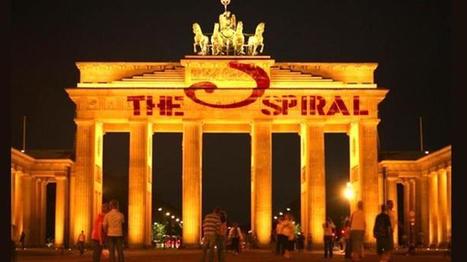
La rentrée du Transmédia démarre fort cette semaine avec le lancement d’une nouvelle expérience transmédia intitulée The Spiral, coproduite par sept chaînes et diffusée en télévision en septembre dans neuf pays. « The Spiral » est à la fois une série TV, un jeu en ligne et un événement créatif.
Tout commence par le cambriolage de six toiles de maîtres. Chaque participant au jeu est invité à rechercher les tableaux dissimulés sur le site thespiral.eu. Au final, cette quête collective débouchera sur la création de « La Spirale ». Cette œuvre d’art, précieuse entre toutes, sera inaugurée le 28 septembre à 21 heures, lors d’un événement majeur qui se déroulera devant le Parlement européen à Bruxelles, et également dans d’autres lieux. ...
Thechangebook.org est le dernier-né des réseaux sociaux sur le Web. Ressemblant fortement à Facebook, il en renie pourtant les pratiques commerciales publicitaires, et aspire à devenir “la référence du réseau social engagé”.
Début août est apparu sur la toile française un nouveau réseau social : Thechangebook.org. Avec une interface très proche de celle de Facebook, il se dit pourtant différent, à savoir : “libre, engagé, clairement réactif“. Lancé par une partie de la rédaction d’Actualutte, « un journal Web donnant la parole à toutes les luttes sociales et politiques », il veut devenir « la référence du réseau social engagé » pour les internautes d’ici et d’ailleurs.
Dans sa ligne de mire : la logique commerciale de Facebook, reposant sur la vente des données personnelles des utilisateurs aux publicitaires. Nous avons rencontré l’un des fondateurs de Thechangebook afin qu’il nous en dise plus sur la genèse, les buts, et l’avenir de celui-ci (le réseau ne souhaitant ni leader, ni porte-parole officiel, nous ne révélerons pas son identité).
De la mise au point des premières lunettes de vue à l’avènement de la chirurgie ophtalmologique laser, la technique et la médecine s’allient pour améliorer le sort des malvoyants. Aujourd’hui un vieux fantasme semble être à portée de main, redonner la vue aux aveugles. Le nerf de la guerre consiste à réactiver ou remplacer les cellules photo-réceptrices de la rétine dont la dégénérescence entraine une cécité irrémédiable a priori.
En 2010, l'équipe d'Eberhart Zrenner (université de Tübingen, Allemagne) conçoit un implant de trois millimètres de côté capable de recréer une image de 38×40 pixels. Véritable rétine artificielle, cette petite puce placée en lieu et place des cellules photo-réceptrices permet à des non-voyants de retrouver une vision suffisante pour se repérer dans un environnement familier et lire des gros caractères.
Plus futuriste, l’optogénétique, une technique initialement développée comme outil de recherche fondamentale pourrait bien trouver ses lettres de noblesse en ophtalmologie. Les tests effectués sur la souris sont concluants. Cette approche qui consiste à activer l’expression de gènes par un signal lumineux permet à des animaux aveugles de retrouver une sensibilité à la lumière.
Demain, tous bien-voyants ? Autant de pistes explorées dans On verra ça demainen compagnie du Professeur José-Alain Sahel, chef de service d’ophtalmologie à l’Hôpital des Quinze-Vingt et directeur de l’Institut de la Vision à Paris et de Serge Picaud, chercheur à l'Institut de la Vision.
To get content containing either thought or leadership enter:
To get content containing both thought and leadership enter:
To get content containing the expression thought leadership enter:
You can enter several keywords and you can refine them whenever you want. Our suggestion engine uses more signals but entering a few keywords here will rapidly give you great content to curate.


 Your new post is loading...