Media Arts Watch Lab - www.arts-numeriques.info - laboratoire de veille Arts Numériques - twitter @arts_numeriques - @processing_org - @DigitalArt_be - by @jacquesurbanska @_Transcultures
Curated by Heitor Alvelos, Karen Gustafson, Nuno Correia and Pedro Branco, FUTUREPLACES 2012 is a meeting of people with one question in mind: if digital media can do so much for global communication, knowledge and creativity, how can it contribute to local cultural development? October 2008 marked the start of this challenge. After the success of prior editions, where we surveyed current successful projects from very diverse backgrounds and fields of knowledge, and rehearsed strategic approaches, we will dedicate FUTUREPLACES 2012 to interpreting our heritage and preparing what's ahead in these times of great changes.
FUTUREPLACES takes place in Porto, Portugal, where the challenges and potential of digital media to transform the social and cultural fabric are very evident. Join us for four days of exhibitions, films, performances, concerts, lectures, parties and workshops – and bring your ideas and your stories!
Technarte invites you to send your paper and be part of a unique Conference, that merges art and technology and that in 25 & 26 April 2013 will celebrate its 8th edition, in Bilbao, Spain.
Every year, Technarte brings together virtual reality, interactive installations, artificial life, inmersive realities, mobile art, augmented reality and many more. You can also be part of Technarte and promote your artistic and technological projects in this great forum formed by artists and experts in technology from all around the world, where you will be able to share your experiences and will discover transgressor and surprising initiatives! Send us your paper before October 14th 2012 and don’t miss out on this opportunity!
Technarte will bring together in Bilbao, Spain, artists, experts of Centres of Technological Research and professionals of the art world and technology in all its forms (researchers and developers of art centres and research labs, professionals of museums, universities, etc.), with which you can share your experiences and who will show you the most innovative artistic disciplines
Send us your paper before October 14th 2012 and don’t miss out on this opportunity! If the combination between art and technology is essential in your life, Technarte is your Conference.
A l’occasion de l’événement Fantastic par lille3000, Pierre Giner (directeur artistique de l’Imaginarium) et l’entreprise Idées-3com (implantée sur la Plaine Images) poursuivent leurs expérimentations communes et imaginent une application de réalité augmentée originale : Fantastic Society.
Gratuite, disponible sur les smart phones et les tablettes (AppStore et Android Market), cette application Fantastic Society permet à l’utilisateur de créer sa propre réalité augmentée ! Au moyen d’une interface simple, il crée son propre avatar 3D et peut le «jouer» (le faire apparaître et danser) sur tous les signes de communication de l’événement Fantastic : affiches, flyers, programmes…
Fritzing is an open-source initiative to support designers, artists, researchers and hobbyists to take the step from physical prototyping to actual product. We are creating this software in the spirit of Processing and Arduino, developing a tool that allows users to document their Arduino and other electronic-based prototypes, and to create a PCB layout for manufacturing. The complementing website helps users to share and discuss drafts and experiences as well as to reduce manufacturing costs.
Fritzing is essentially an Electronic Design Automation software with a low entry barrier, suited for the needs of designers and artists. It uses the metaphor of the breadboard, so that it is easy to transfer your hardware sketch to the software. From there it is possible to create PCB layouts for turning it into a robust PCB yourself or by help of a manufacturer.
g-speak™ is Oblong's core technology platform. g-speak is used today to address high-value, real-time, big-data, and big-workflow challenges in applications such as military simulation, logistics and supply chain management, and energy grid management.
The g-speak platform enables the development of multi-user, multi-screen, multi-device, spatial, networked applications.
g-speak is available for license customers as an SDK with runtime libraries for standard computers and mobile devices.
Oblong also offers full-scale g-speak development environments that include high-end hardware for multi-user gestural input and object tracking.
Oblong provides development support, design expertise, and integration services. Our default goal is to work ourselves out of a job, transferring knowledge, expertise, and technology to our customers. We are, however, committed to working at whatever level, and in whatever roles, ensure long-term success for our partners.
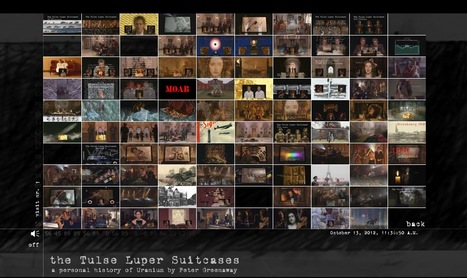
The Tulse Luper Suitcases reconstructs the life of Tulse Luper, a professional writer and project-maker, caught up in a life of prisons. He was born in 1911 in Newport, South Wales and presumably last heard of in 1989. His life is reconstructed from the evidence of 92 suitcases found around the world – 92 being the atomic number of the element Uranium.
The project includes three feature films, a TV series, 92 DVDs, CD-ROMs, books, a website and Vj performances.
CreArtCom est un studio qui conçoit et produit des scénographies proposant des relations esthétiques, corporelles et symboliques aux technologies de l'image, du son, de la lumière et de la matière. Le studio propose un répertoire d'oeuvres originales autour du geste, du mouvement, du jeu. L’équipe développe des projets focalisés sur l'humain et l'expression de soi. Ces projets ont pour objectif de placer le public au centre des questions de son environnement, de son identité et de sa corporalité par les biais des technologies interactives et de leur appropriation. Depuis 2009 ces travaux sont diffusés sur tout le territoire et à l'étranger.
Call for works: International proposition for children acousmatic repertory. The purpose is to raise young audience’s awareness as regards acousmatic music. It is developed through educational workshops for beginners and trainings in acousmatic.
Description
We look for participants for the composition of acousmatic music for children.
We wish to launch an important piece production with the help of the acousmatic / electroacoustic community.
The purpose of this repertory is to raise young audience’s awareness of acousmatic music. Through educational workshops for beginners and trainings in acousmatic, the repertory will be promoted and will be made available to the public and participants.
La chaîne ARTE lance Intime Conviction, une enquête policière transmedia qui se conclue par la mise en examen du principal suspect.
L’histoire : Un soir, Paul Villiers, médecin-légiste, retrouve sa femme morte, une balle dans la tête. Très vite, une enquête se met en place et les soupçons de la capitaine Lebrun se portent sur le mari, qui est pour elle le suspect idéal.
C’est ici que rentre en scène le web, puisque le procès fera intervenir les comédiens du film qui joueront leur rôle face à des magistrats professionnels et des jurés, recrutés par ARTE sur le site dédié à l’enquête.
Art Website Sales Contract is a document that I use to sell my websites.
I think in moving images, and I don't think moving images are objects.
I place these moving images in domain names. Each URL is the title and the location of each art piece. These websites are public, their ownership is exclusive. Domain names are one of the internet’s few scarcities. They are unique, they can't be forged or copied.
This contract explains the rights and duties of the artist and the collector, to make sure the work remains intact as long as possible.You can download the contract here (pdf). It can be used by anyone who wants to buy or sell an art-piece-in-a-domain-name.
by Salvatore F. Pileggi, Carlos Fernandez-Llatas and Vicente Traver
The social trend is progressively becoming the key feature of current Web understanding (Web 2.0). This trend appears irrepressible as millions of users, directly or indirectly connected through social networks, are able to share and exchange any kind of content, information, feeling or experience. Social interactions radically changed the user approach. Furthermore, the socialization of content around social objects provides new unexplored commercial marketplaces and business opportunities. On the other hand, the progressive evolution of the web towards the Semantic Web (or Web 3.0) provides a formal representation of knowledge based on the meaning of data. When the social meets semantics, the social intelligence can be formed in the context of a semantic environment in which user and community profiles as well as any kind of interaction is semantically represented (Semantic Social Web). This paper first provides a conceptual analysis of the second and third version of the Web model. That discussion is aimed at the definition of a middle concept (Web 2.5) resulting in the convergence and integration of key features from the current and next generation Web. The Semantic Social Web (Web 2.5) has a clear theoretical meaning, understood as the bridge between the overused Web 2.0 and the not yet mature Semantic Web (Web 3.0).
An experiment with real-time audio synthesis. Works well in Chrome & Safari but runs slowly in Firefox. Thanks to Tom Ashworth for harmonising the sound!
NASA's Kepler spacecraft is one of the most powerful tools in the hunt for extrasolar planets. The Kepler team's computers are sifting through the data, but we at Planet Hunters are betting that there will be planets which can only be found via the remarkable human ability for pattern recognition.
This is a gamble, a bet if you will, on the ability of humans to beat machines just occasionally. It may be that no new planets are found or that computers have the job down to a fine art. And yet, it's just possible that you might be the first to know that a star somewhere out there in the Milky Way has a companion, just as our Sun does. Fancy giving it a try?
The concept of nature has acquired a new relevance in the hyper-technological age, leading many artists to reflect on artificial environments where one is unable to trust what is real and what is not. A significant number of artists today challenge the gap between traditional perceptions of “nature” and “culture.” In many cases, they introduce new understandings of the sublime that replace its romanticism and the related sense of awe with a diverse range of critical, political and poetic approaches.
UNNATURAL presents scientific, romantic, conceptual, poetic, sensual and ecological conceptions of nature through primarily video and photography reflecting advances in technology in the twenty-first century. The works in the exhibition question conventional means and methods of representing the natural world and metaphorically embody both the paradoxical longing to fuse with nature and the threat embedded in such fusion. ...
Processing is an open source programming language and environment for people who want to create images, animations, and interactions. Initially developed to serve as a software sketchbook and to teach fundamentals of computer programming within a visual context, Processing also has evolved into a tool for generating finished professional work. Today, there are tens of thousands of students, artists, designers, researchers, and hobbyists who use Processing for learning, prototyping, and production.
software to create and perform audiovisual shows. It helps you to integrate video in theaters, shows or mappings.
Record, Replay, rearrange your performance with the timeline
The workspace lets you interact quickly and see what you doUse the
Dashboard to arrange in real-time
Adapt: Set up Everything everywhere
4 Corner mapping for Layers mesh warping for screens
Manage Multi-Display with Edge Blending EasilyUse your iPad to Control while moving around
Perform: Play and improvise Live
Use of Creative tools to enchance your performance (Glitchy, Sequency, Samply) Create Connections with other software (Ableton, MaxMSP, Quartz Composer, Cinder, Open Frameworks) Organise Your media in pages so you can use them as Score
Windows version will be announced shortly
Millumin est un logiciel destiné au monde du spectacle. Il permet d'intégrer facilement de la vidéo et des interactions sur scène (théâtre, danse, videomapping, ...). Son éditeur le présente comme "une sorte d'After Effects, mais en temps réel".
Instant Cinema is a comprehensive platform for experimental film, video and computer art, making the best audio-visual work of artists of all generations available to a worldwide audience.
For many years, experimental films and art films were almost exclusively screened in museums and at film festivals. Instant Cinema aims to compensate for half a century of under-exposure of film/video and computer art by exhibiting some of the great classics of recent history, side by side with the work of today’s most talented media artists.
To maintain the highest possible degree of quality, Instant Cinema membership is by invite only. Every participating filmmaker receives five invites that can be sent to other filmmakers or artists who, in turn, have the opportunity to invite five more new people.
Depuis Octobre 2010, DatAData rassemble des chercheurs et des jeunes artistes dans la volonté de répondre aux enjeux esthétiques contemporains que soulèvent les cultures numériques, mais aussi d’accompagner l’évolution en cours dans les lieux d’enseignement de l’art, français et étrangers. En effet, à l’heure où il devient nécessaire d’inventer une conduite inédite pour la recherche artistique et de préciser des outils possibles au sein des écoles, DatAData constitue un espace expérimental de questionnement, de réflexion, de production et d’édition.
Notre manière de travailler ensemble se base sur l’autonomie et la liberté de chaque membre. Chacun mène sa propre recherche de façon individuelle tout en côtoyant et accompagnant celles des autres et tout en s’impliquant dans les différents projets de DatAData (éditions, archives, expositions, etc.).
C’était un événement très attendu dans le champ culturel : le Centre Pompidou a lancé officiellement la semaine dernière son nouveau site internet, baptisé le Centre Pompidou Virtuel (CPV).
La communication institutionnelle qui a accompagné ce lancement a mis en avant les aspects innovants du site, comme l’usage des technologies du web sémantique, le recours aux logiciels libres ou la volonté de s’engager dans une démarche de co-construction avec les usagers, par l’intermédiaire des réseaux sociaux.
Alain Seban, le président du Centre, insiste sur le fait que ce nouveau site s’inscrit dans une logique “d’ouverture” et dans une stratégie d’intégration du “web collaboratif“. ....
Since the early 1990s, there has been a growing body of live performance that is situated online. These events differ enormously in form and content, are described with multiple terms (such as cyberformance, remote performance, internet theatre, screen stage, computer-mediated performance), are staged in a variety of online environments (such as text-based and graphical chat rooms, sound broadcast, real time choreography for screen, virtual worlds, games and purpose-built or existing platforms as for instance facebook) and engage diverse audiences. The net, however, is forgetful: it loses the memory of those events, and of the people who lived them, of the environments and communities who hosted them.
On 12 October 2012, a cyberformance symposium will be hosted by UpStage, the Waterwheel Tap and independent cyberformers, where cyberformers will discuss their online performances with other artists, researchers and interested participants. Questions we would like to tackle in CyPosium include: What different kind of events happened? What did they make possible? What was special about the event? Why were things done in a certain way and what were the results?
Permettre aux chercheurs et aux artistes de pouvoir échanger sur leurs pratiques respectives. Travailler ensemble à l’intégration de technologies dans les productions artistiques.
Pour sa deuxième édition, EXPERIMENTA est invité au Parvis des Sciences, à MINATEC, dans le cadre de la Fête de la Science en Isère. Ce salon de rencontre entre arts, sciences et Design, accueillera pendant trois jours, public et professionnels, autour de propositions au croisement des nouvelles technologies et de la création artistique. Accompagnés par les porteurs de projets présents pendant toute la durée de l’événement, vous pourrez découvrir et expérimenter des dispositifs originaux ouverts à diverses utilisations allant du Design au spectacle vivant, du graphisme aux arts plastiques, avec parfois une visée pédagogique.
Des scientifiques du CEA Grenoble, des étudiants de Polytech Grenoble et des entrepreneurs présenteront leurs travaux en cours autour de maquettes interactives et originales. Des artistes : danseur, jongleur, graphiste, musicien dont la démarche questionne les technologies et recherches scientifiques et leurs usages mettront en public leurs expérimentations : La compagnie Adrien M / Claire B, Clémence Gandillot, Michele Tadini, Yann Nguema.
D’autres acteurs à l’interface des arts, des sciences, de la technologie et du Design seront invités à présenter leurs projets en cours : Erasme, centre multimédia du Rhône, la Cité du Design et l’Ecole Supérieur d’art et de Design de Saint-Etienne, Grame, Centre national de création musicale de Lyon, et l’Atelier Arts-Sciences, organisateur de l’événement.
Websites are today’s most radical and important art objects. Because the Internet is not just another “media”, as the Old Media insists, but mostly a “space”, similar to the American Continent immediately after it was discovered – anything that can be found on the Web has a physical presence. It occupies real estate. To encounter a logo, a picture or an animation in the Internet is a totally different experience than to find the same stuff in a magazine or on the television. “Things” in the Internet exist in a specific location, while in magazines and on TV contents are mostly bullets of information. Online they constitute a body: they are parts of a new genre. They are Web Entities.These “creatures” are sometimes a mix of humans and software -such as Google- but sometimes are made by information only such as in the case of Googlism.com, a website that is able to make a portrait of anything by collecting descriptions about that subject from Google itself .
Most Web Entities are social entities. They get in touch and advertise their existence to each other. Similar to human beings, they will evaluate, criticize, “link” to each other, and ultimately, they develop a “taste”. Bob Dobbs (a friend of McLuhan) said: “advertising is communication between machines”. He also suggested that machines came alive in 1967 and that “now they are in an angelic state”. According to him, “advertising is communication between Angels”.
Memory is closely linked to forgetting. Before the digital era, forgetting was easy, for better or worse, not only is it biologically in-built to forget, the analog world around us cannot guarantee that recorded memories will last forever. Photographs fade, film footage can be lost and media out-dated, thus remembering was the exception and forgetting the default. Now in an age of endless digital image reproduction there is no longer a need to remember. We externalise our memories by handing them over to the digital realm enabled through digitization; inexpensive storage software, ease of retrieval and global access, blurring lines of ownership and making virtual forgetting close to impossible.In the installation, Low-resolution portraits are projected onto the gallery wall, generated by a hardcoded mechanical structure, which in the nature of its construction limits the selection of available images.
This cutting-edge text offers an introduction to the emerging field of media archaeology and analyses the innovative theoretical and artistic methodology used to excavate current media through its past.
Written with a steampunk attitude, What is Media Archaeology? examines the theoretical challenges of studying digital culture and memory and opens up the sedimented layers of contemporary media culture. The author contextualizes media archaeology in relation to other key media studies debates including software studies, German media theory, imaginary media research, new materialism and digital humanities.
What is Media Archaeology? advances an innovative theoretical position while also presenting an engaging and accessible overview for students of media, film and cultural studies. It will be essential reading for anyone interested in the interdisciplinary ties between art, technology and media.
To get content containing either thought or leadership enter:
To get content containing both thought and leadership enter:
To get content containing the expression thought leadership enter:
You can enter several keywords and you can refine them whenever you want. Our suggestion engine uses more signals but entering a few keywords here will rapidly give you great content to curate.


 Your new post is loading...