Media Arts Watch Lab - www.arts-numeriques.info - laboratoire de veille Arts Numériques - twitter @arts_numeriques - @processing_org - @DigitalArt_be - by @jacquesurbanska @_Transcultures
- Un pirate dans votre salon ? Piratage possible de télévision connectée. - Interview exclusive de l'hacktiviste Sl1nk : un hacker qui fait courir le FBI et la CIA. - L'art de la guerre, en mode 2.0. - Les chinois, des soldats "numériques" depuis 2.500 ans. - Demomaker : et si vous alliez plus loin avec votre machine que le simple "Click and Play"
Works can be nominated for prize consideration in the individual competition categories until March 8, 2013.
Nominations are recommendations; thus, nominated projects are not automatically entered in the competition. The nominated artists will be contacted by the organizer before the jury convenes. Then, projects must be formally submitted by the artists themselves prior to the entry deadline and in accordance with all competition criteria in order to be entered in the competition.
Since 1987, the Prix Ars Electronica has served as an interdisciplinary platform for everyone who uses the computer as a universal medium for implementing and designing their creative projects at the interface of art, technology and society.
The Prix Ars Electronica, the Ars Electronica Festival, the Ars Electronica Center – Museum of the Future and the Ars Electronica Futurelab are the four divisions that comprise the Ars Electronica Linz GmbH, whose specific orientation and long-term continuity make it a unique platform for digital art and media culture.
The competition is organized by the Ars Electronica Linz GmbH and ORF’s Upper Austria Regional Studio in collaboration with the OK Center for Contemporary Art and the Brucknerhaus Linz, and the prizes are awarded during the Ars Electronica Festival each year. The Prix Ars Electronica is one of the most important awards for creativity and pioneering spirit in the field of digital media. ...
Ebranlé par l’affaire Aaron Swartz, le prestigieux Massachusetts Institute of Technology ressortira-t-il indemne de ce tragique épisode ? Retour sur les liens de ce brillant informaticien et activiste, retrouvé pendu à New York, avec l'université la plus avant-gardiste des Etats-Unis.
Il y a quelques mois, j’ai eu la chance de passer plusieurs jours au Massachusetts Institute of Technology (MIT), à Cambridge – aux portes de Boston –, pour un reportage au sein d’un des nombreux laboratoires de recherche. Un plaisir de journaliste, et une grosse claque ! Car déambuler dans les bâtiments dernier cri du campus, parler avec les étudiants, les chercheurs, les enseignants, c’est d’abord se trouver joyeusement confronté à une réalité à peine imaginable en France : sur les bords de la Charles River, dans ce coin de paradis pour cerveaux survoltés, l’esprit de corps est un bien commun non-négociable.
Our workshops offer participants to become familiar with basic hardware and software design while at the same time gaining hands-on experience making an interactive art project. The workshops are open to participants of different backgrounds, and no programming or electronic skills are required. The idea is to start from scratch and create a complete project by the end of the workshop, including concept, design, electronics / interfacing, and functional programming with Arduino, Max/Msp, Pure Data or Processing.
Deconstructing readily-available, cheap electronic devices into interactive tools is more than a lot of fun; the process offers the same visible, hands-on learning and understanding acquired through dissection. By re-purposing second-hand hardware or cheap toys, a commercial, mass-produced product is transformed into a unique device, with potential for new and original means of expression or communication. The boundaries of a device are set by the manufacturer (planned obsolescence); those limits can be redefined by such creative recycling.
"new2" is the first show realized in the OFFLINE ART exhibition format. Web based art works will be accessible via wireless network but disconnected from the internet .A high profile selection of 14 artists of various 'Internet generations' - who are all working digitally and online - will present recent and new works. OFFLINE ART: new2 is a group show all about files, versions and copies that questions the endless 'new' in our era of the daily remix on the Internet. A digital file can be copied endlessly, without any loss of quality, and the web culture of nonstop creation, sharing and remixing of files has influenced a whole generation of artists. ...
The term Crowdscience (that is, the science of people) has recently become a very popular term. It means that people (a nineteenth-century term that perhaps should be replaced with the term “citizens”), by actively taking part in research, can enable discoveries, that would otherwise not be possible with traditional media – for the mental, computational and economic resources they require. It also assumes that first-person participation in scientific projects is one of the few ways to not be relegated on the sidelines of democracy in a society permeated at all levels by scientific and technological knowledge. ...
On n’est pas peu fiers d’être pour quelque chose dans l’installation que présente David Guez, artiste co-fondateur de Poptronics, au centre Pompidou dans le cadre de « Hors Pistes » 2013, à partir de vendredi 18 janvier.
« Hors Pistes », c’est un festival, une expo, des conférences qui creusent un sillon pas si simple, entre nouveau cinéma et « mutations de la création contemporaine » (dixit le président du centre Pompidou pour justifier l’événement). Du cinéma donc (28 « focus » autour d’un artiste), et, pour ce qui nous intéresse, « A la loupe », une exposition dédiée à la miniature (après le sport en 2011 et l’animal en 2012).
Open Circuit is a not for profit company based in Cumbria, UK promoting exploratory music internationally via concerts, workshops and using new technologies.
The OpenLab Network is a new research initiative which targets a complex education issue of national significance regarding the ability of art and science researchers to collaborate on research endeavors. The goal of the OpenLab Network is to help change the current status by providing shared research facilities and create a network for collaborative discourse fueled by academic communities, arts and science communities, and industry.
The OpenLab Network project is pursuing the physical development of new collaborative laboratories on campus as spaces to foster this research and establish an on-line social networking system for faculty and students to create projects. Laboratories and studios in both the arts and the sciences will be accessible to users in the OpenLab Network. Within this immersive environment, we will conduct research to acquire skills and knowledge that crosses disciplinary boundaries between science, education, and the arts while sharing expertise in collaborative research methodologies.
Bionic orchestra est une création musicale, visuelle et interactive mêlant human beatbox et nouvelles technologies.
Imaginé par Ezra (Vincent Chtaïbi), beatboxer avant-gardiste évoluant depuis des années en compagnie de L.O.S (Laurent Duprat) au sein de projets pluridisciplinaires, cet orchestre du troisième type est le fruit de trois ans de développement entouré d’un collectif d’ingénieurs des 4 coins d’Europe.
Entre Human beatbox et nouvelles technologies, Bionic Orchestra met en lumière le devenir de ces arts émergents. Un art vocal qui continue d’écrire les pages de son avenir et des technologies omniprésentes qui trouvent ici une alternative poétique. Il s’agit de tracer une nouvelle voie au cœur de ces cultures populaires par une proposition exigeante, pluridisciplinaire et innovante.
Art and Electronic Media by Edward Shanken is the freshest title in the Themes and Movements series published by Phaidon Press. This highly anticipated book demonstrates the formidable history of artistic uses of electronic media, a history that parallels the growing pervasiveness of technology in all facets of life. Over 200 artists and institutions from more than 30 countries are represented. The centrality of artists as theorists and critics is reflected in the focus on artists’ writings. The goal is to enable the rich genealogy of art and electronic media to be understood and seen – literally and figuratively – as central to the histories of art and visual culture.
s we showed you in a recent slideshow, some NASA scientists envision astronauts making whatever they need out of local materials on Mars or the moon via 3D printing. While technology from organizations like Contour Crafting has made this theoretically possible, now, Washington State University (WSU) engineers have actually used moon rocks to print some simple-shaped objects -- on Earth.
Real moon rocks are too rare, so researchers are using an imitation moon rock called lunar regolith simulant. Regolith is a mixture of loose dust, rock, and soil that covers solid bedrock on earth, as well as other planets, the moon, and some asteroids. The simulant is formulated to approximate the real lunar regolith's chemical and mineral properties. There are several versions. The WSU team used about 10 lb of one version that contains silicon, aluminum, calcium, iron, and magnesium oxides. ...
On 2013, "404 International Festival of Art & Technology" celebrates one decade of existence. "404 Festival" launches its 10th open call destined to artists and researchers from all over the world with the aim of spread and stimulates new media creations.
Authors can submit their works in the following areas:
NET.ART STILL IMAGE ANIMATION / VIDEO MUSIC THEORY PERFORMANCE INSTALLATION
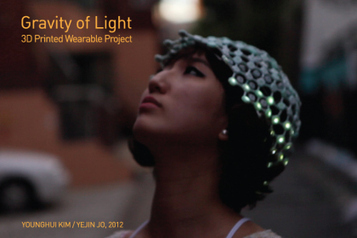
a collection of experimental wearable technology art...
For almost a decade, Younghui Kim has been exploring the field of new media art, defined as wearable technology art, where she has combined physical computing technology and soft textile design. Her wearable technology art projects were presented in numerous exhibitions worldwide such as Emerging Technology Gallery, SIGGRAPH 2004, Gwangju International Design Biennale 2005, and FutureFasion 2006, Social Fabrics 2008, Leonardo Journal, HCI 2010, DALSMA 2011, and ISEA 2011. She tries to express through art of everyday things converging with technology, where her audience can interact and experience by using or wearing them.
Younghui’s wearable technology projects were featured on media such as The Korea Times Magazine, Nippon TV, iChannel TV, Computer Graphics World and artist has been interviewed in Art4D, The Christian Science Monitor (as well as abc.com), Donga Science, News, fashionabletech.com and more.
"5 Million Dollars 1 Terabyte" (2011) is a sculpture consisting of a 1 TB Black External Hard Drive containing $5,000,000 worth of illegally downloaded files. A full list of the files with clickable download links can be found.
At CW&T, we create multidisciplinary work in collaborative environments where we leverage technology and computing. With the latest tools and processes, we imagine near future possibilities and build them into reality.
Our design approach is to create lasting designs while questioning conventional thinking. In our quest to fulfill our goals, we tend to favor minimal aesthetics, intuitive interfaces and over-engineered construction.
Che-Wei Wang [pron. say-way] is an artist, designer and architect. His work involves a wide range of disciplines and skills ranging from architecture, exhibition design, web design, interactive installations, robotics, sculpture and product design. Che-Wei is the winner of the 2003 SOM fellowship and the Young Alumni Achievement Award from Pratt Institute. He holds a Bachelor of Architecture degree from Pratt Institute and a Masters from ITP at NYU. cwwang.com
Taylor Levy is an artist and designer who works with various technologies. In her work, technology is broken apart and reconstructed to expose its otherwise opaque inner workings. She holds a B.A. from Vassar College and a MPS from ITP (TISH NYU). Her thesis work from ITP is in The Leonardo Museum of Science and Technology and she was a resident at Fabrica Interactive in Treviso, Italy. Taylor has experience teaching at Pratt Institute and University of Pennsylvania. taylorlevy.com
Nouveau Tiers-État, grâce à la formidable machine sociétale que constitue les TIC, les internautes de tous horizons dessinent par leurs usages les contours d'une société encore inconnue et exaltante. Depuis 9 ans, la société civile se souhaite mutuellement ses bons vœux et invite des personnalités à nous présenter leur vision numérique. Les E-Toiles d'Or récompensent certains d'entre eux par leurs actes méritants et démocraTIC.
MyCityLab is an online space showcasing art projects, educational resources, technological developments and participatory processes which are grounded in a direct relationship with a particular local context.
MyCityLab operates in the spaces between sectors and among individuals, projects and organizations. We are creating new spaces to foster social innovation by bringing together a mix of people, services, strategies and ideas.
Artists working alongside community leaders, policy makers collaborating with citizens, and citizens helping cities diagnose their problems more accurately.
I wouldn't normally review a zine that's ridiculously hard to get your hands on but the purpose, production and spirit of Critical Making are so meaningful and pertinent to today's culture that i had to make an exception. Critical Making is series of small booklets that look at the political, social, activist and even historical dimensions of the DIY culture:
A handmade book project by Garnet Hertz in the field of critical technical practice and critically-engaged maker culture. Critical making is defined by Ratto as exploring how hands-on productive work - making - can supplement and extend critical reflection on the relations between digital technologies and society. It also can be thought of as an appeal to makers to be critically engaged with culture, history and society. ...
Le Cube et le collectif d'anthropologues "Les écrans de la liberté" s'associent pour proposer le festival international "Anthropologies Numériques" qui aura lieu au Cube les mercredi 20 et jeudi 21 mars 2013 de 9h30 à 18h.
A cette occasion, un appel à projet est lancé pour recueillir des projets en lien avec ces nouvelles formes d'anthropologies. Il est ouvert aux recherches ethnologiques et en sciences sociales, aux travaux expérimentaux de toute nature sur les sociétés et les cultures, aux différentes formes de créations qui privilégient ces rencontres particulières, entre un moment de la vie et une étape de la réflexion. La sélection des projets sera assurée par Les Ecrans de la liberté (Pascal Leclercq, Jacques Lombard, Nadine Wanono) en collaboration avec Le Cube.
Les projets* sont à adresser avant le 28 janvier 2013 à : "Festival Anthropologies Numériques"
Wireless is increasingly pulling in all kinds of applications, platforms, services and things (rfid) into networks. Many people communicate through mobiles, blackberries, digital organizers, palmtops. Cars become information spaces with navigational systems and consoles like Nintendo DS have wireless capacities and get linux kernels installed.We are witnessing a move towards pervasive computing and disappearing technologies in intelligent clothing (wearables), smart environments (knowing where and who we are), pervasive games, and we will see doors opening for some and closing to others. Mimickry and camouflage will become part of application design.
Ipods and Iphones will show colors and produce sounds corresponding with your surroundings. Council will help to develop theories, concepts, scenarios and prototypes for this wireless world, beyond the product, beyond the individual user, to social and culturally empowering experiences for larger groups of people. As we increasingly live in a world where everything is connected, designing stand alone things for stand alone people is no longer an option. Things are connected, and through these things, people are always part of some group, increasingly more online and in the real world as well, as Yocai Benkler shows in his Wealth of Networks.
Ljudmila Art and Science Laboratory was established in 2010. It strives to connect research practices, technologies, science, art and civil society. It engages in the development and popularisation of open culture, free licences and software, and in new ways of distribution. It detects how the communication transformations affect the society and encourages innovative art practices.
Since 2011 it also develops and publishes the Culture.si portal for international cooperation, funded by the Slovene Ministry of Education, Science, Culture and Sport. From 2011 Ljudmila acts also as a public lead of Creative Commons Slovenia.
An American college student named Tyler McNaney is developing a machine that recycles plastic household waste into the raw materials for use in 3D printing.
The Filabot performs the 21st century equivalent of alchemy, melting down unwanted material and turning it into plastic filament - the goop that 3D printers melt down and layer out to form objects.
Normally, plastic filament costs in the region of £50 per kilogram, making 3D printing a pricy hobby - especially if you make a few mistakes. But generating your own - either using your mistakes or anything made from a variety of widely-used plastics - makes it a lot more affordable. ...
To get content containing either thought or leadership enter:
To get content containing both thought and leadership enter:
To get content containing the expression thought leadership enter:
You can enter several keywords and you can refine them whenever you want. Our suggestion engine uses more signals but entering a few keywords here will rapidly give you great content to curate.


 Your new post is loading...