Media Arts Watch Lab - www.arts-numeriques.info - laboratoire de veille Arts Numériques - twitter @arts_numeriques - @processing_org - @DigitalArt_be - by @jacquesurbanska @_Transcultures
Online archives are challenging the dynamics of the database by trying to liberate content from the categories that bind it in order to re-aggregate it into new forms.
This act of sorting, arranging and displaying relationships can be traced throughout history. Aby Warburg, a German art historian, made one of the most interesting examples of alternative displays. In 1924 he presented his Mnemosyne, a display combining photographs, reproductions from books and visual materials from newspapers and magazines. With this Warburg wanted to stress the contextual constellation of history as a visual process presented in three dimensions: type, history and location. To this day people struggle with this concept of mapping and visualisation, now aided by multimedia interfaces, to make sense of large collections of data. Although there are many interesting examples around, most experiments fail to transcend the limitations of their own database structures and only focus on making the available data accessible.
What would happen if we could go beyond simply ‘providing access’ to data, to supporting the circulation of material, including new productions, created from the material flowing in and out of the archive. In other words, instead of holding on to data, distribute and share it by making it publicly available. So-called distributed archives or peer-to-peer practices, also referred to with the technical term ‘seeding’, appear to be very sustainable, and online archives organised in this way thrive on redistribution and reuse. ...
We are a mobile audio webcasting service, which concentrates on recording academic research. We are hired by universities, learned societies and research institutes to record their research as presented at conferences, symposia, workshops, public lectures and seminars and to disseminate it to a ready-made world-wide audience.
Once we have the recording, it is edited to the required specification and the sound is enhanced. Then each recording will be presented on its own individual webpage, with additional information, such as abstract and/or publications. Every page can be linked or embedded to other pages and all carry social network buttons, as well as RSS feeds.
The website here serves as the archive, which can be searched by name, date, event and keywords (tags). All recordings are free to the listener and are covered by a Creative Commons licence, which means you are free to download them and to pass them on.
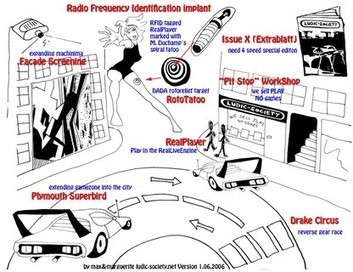
Social Hacking is a series of temporary public art commissions for Plymouth by international artists’ groups against a backdrop of urban regeneration. The project reflects the ways in which these changes to the city can be further influenced by creative human intervention.
Featuring commissioned work from The Institute for Applied Autonomy (USA), Mikro Orchestra Project (Poland), and Ludic Society (Austria/Switzerland). The event also includes the pre-launch of c6’s (UK) new Dot Master project Mobility in the art market, a Mikroparty including performances by Tetine (Brazil) and Mikrokilla & Jura (Poland), project newsroom, artists’ run workshops, workshops by The Pirate University, and a public seminar with presentations by Saul Albert (UK) and McKenzie Wark (AUS/USA).
The project is produced by KURATOR in collaboration with i-DAT, and is funded by Arts Council England, South West and Plymouth City Council, with additional support from citylab_plymouth, Deep Blue Sound, Drake Circus Shopping Centre, The Hub, Plymouth Arts Centre, Plymouth City Museum & Art Gallery, Pyramid Presentations, ride cafe/bar and University of Plymouth.
The project is curated by Birgitte Aga, Geoff Cox, Joasia Krysa, Anya Lewin.
The History of Art is filled with forgeries, but are there fakes in digital art fields made from creative cut-and-pastes, collaborative works and infinite works? We approached four people who, pondering the notion of fake, point to characteristics specific to digital art.
Are your a young artist with an exciting new project? Are you looking for a summer residency in a cultural organisation or medialab part of the worldwide Talent Development Network? Apply now! Artists living in Belgium, iMAL may support you!
A Paris, une galerie propose de visionner des œuvres de 14 Net-artistes via des connexions wi-fi personnalisées.
Vous ne verrez rien à l’exposition « Offline Art : New2 », à moins d’être équipé d’un ordinateur, d’un smartphone ou d’une tablette (prêtée gracieusement le cas échéant), indispensables accessoires pour accéder à ces œuvres immatérielles flottant dans l’éther. Le visiteur pénètre dans un espace vide, celui du white cube de la jeune galerie XPO, à Paris. Au mur, un alignement de boîtiers dotés d’antennes, accrochés comme des tableaux : des routeurs wi-fi (chargés de faire transiter des paquets d’information d’une interface vers une autre) modifiés, dotés d’une clé USB, et déconnectés d’Internet. ...
Un espace expérimental de médiation culturelle, un site internet de dernière génération qui propose aux internautes de flâner dans un espace sensible, un véritable musée virtuel proposant des contenus inédits, textes, vidéos, enregistrements...
SANS-TITRES est un projet participatif développé par l’Association sans but lucratif.
« LETTRES & CARRÉS » dont le siège se trouve à Bruxelles. Créée spécialement pour l’occasion en octobre 2012, l’association est totalement indépendante et autofinancée, elle ne bénéficie à ce jour d’aucunes subventions ni partenariat financier extérieur.
La création de « SANS-TITRES # 0 », prototype d’une aventure à venir, est le fruit d’un travail collectif, volontaire et bénévole de la part de l’ensemble de ses contributeurs.
- Faire de l’internet des objets un enjeu citoyen et pas seulement commercial, au travers la réappropriation des relations entre personnes,objets et réseaux, et la compréhension des mécanismes associés.
- Intégrer le numérique hors des écrans d’ordinateurs dans la politique d’animation du territoire et de co-élaboration de servicespublics.
- Développer de nouvelles méthodes d’innovation agile permettant de résoudre à bas coût de nombreux problèmes concrêts (handicap,énergie, transport, seniors…) en assurant l’amélioration permanente des solutions par le partage des plans et des codes sources.
- Intégrer de nouveaux réseaux internationaux d’innovation qui émergent de façon significative (notamment celui des fablabs) avec un positionnement stratégique (réseau francophone) et y développer des partenariats (notamment nord-sud).
- Utiliser l’éducation par le faire dans le registre numérique, former les acteurs et la population.
- Acculturer les acteurs du monde économique et de l’enseignementsupérieur au nouveaux modèles liés à l’électronique libre. Commele dit Joi Ito, dirigeant le medialab du MIT : «opensource hardware is no brainer» (une évidence).
- Faire du Labfab non seulement un lieu de fabrication, mais un moteur de débats sur des enjeux sociétaux tels que les données personnelles, le transhumanisme, et la société physico-numérique«souhaitable»
Et si l’art, la philosophie et les sciences fondamentales avaient des choses à nous dire sur la période de mutation que nous vivons ? ne nécessite-t-elle pas de nouvelles visions (et de nouveaux discours) pour la penser, et de nouveaux modes opératoires pour la vivre et aussi l’anticiper ?
La réponse est donnée dans ces deux questions : c’est une évidence. Du moins, cela devrait l’être car on ne donne pas assez la parole aux créateurs-chercheurs que sont les artistes, les philosophes et les scientifiques.
C’est un paradoxe parce que, plus que jamais, nous avons besoin de nouveaux énoncés et de nouvelles sensibilités pour comprendre les mutations en cours.
Observer les pratiques émergentes, découvrir de nouveaux discours, se défaire des anciennes grilles de lecture (ou du moins s’y essayer) repérer les germes potentiels de futures tendances, se débarrasser des formules toutes faites…
Ce vaste programme (une « déprogrammation » en réalité) a besoin, pour qu’il se réalise, de puiser dans des ressources très diverses et doit de dispenser de toute frontière préétablie. Analysons la crise financière par le « design exploratoire » ! abordons le processus d’innovation en R&D du point de vue des arts numériques ! Imaginons des relations entre les sciences quantiques et les usages sociaux !
Quand la technologie de pointe rencontre le monde de la mode, ça donne des pièces surprenantes. Ainsi en est-il de la technique d’impression 3D utilisée par la designer Iris Van Herpen lors de son défilé “Voltage” durant la fashion week parisienne.
Onze pièces, conçues et réalisées grâce à un programme de CAO, puis envoyées vers une imprimante 3D dernier cri, qui construit le vêtement couche par couche. La nouveauté, c’est qu’au lieu d’utiliser des matériaux de base rigides tels que le plastique ou le métal, on peut maintenant travailler du caoutchouc ou du polyuréthane. Le champ des possibles est alors infini, et Iris Van Herpen l’a bien compris.
How can you measure someone's pulse, just by pointing a camera at their face? MIT computer scientists have created an algorithm that can do just that, by amplifying the subtle changes in motion and colour in a video.
The algorithm analyses a video and looks for temporal variations -- or elements of the video that change over time -- and then dramatically amplifies those motions.
So, as the heart pumps blood into someone's face, their skin gets redder. The change is way too small to be perceived by the human eye, but by turning up those changes in tone we can see their face change from white (or black) to a deep shade of maroon. ...
As rents - and broadband speeds - keep rising, the internet as a site for the presentation, creation and dissemination of work continues to grow beyond its straightforward use as a promotional tool, or a public way to document work.
aaaan.net stimulates, initiates and (co)produces work and research at the fringes of art, popular culture and technology. aan focuses on innovative and explorative artistic work that is prompted by social and cultural urgency.
aan is not an institute nor does it have its own space, it is a flexible organisation that consists of human hardware. For all its projects aan connects to existing organisations and complements holes in the existing cultural grid.
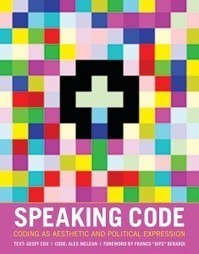
“Speaking Code beautifully folds speech and language, politics, art, and labor into an inspiring analysis. In addition to their clarity in style, Geoff Cox and Alex McLean are not afraid to get their hands dirty with references to the ugly sides of software and unsanitized code, which are too often hidden under the polished covers of contemporary design of digital culture.” – Jussi Parikka, author of Digital Contagions, Insect Media, and What Is Media Archaeology?; Reader in Media & Design at Winchester School of Art, UK
“Speaking Code incisively analyzes the forms, expression and action of computer code. In contrast to much loose and diffuse discussion of software, Speaking Code directly engages with code as utterance. Its careful exploration of code-making and code use opens onto much wider issues of power, agency and value. Theoretically nuanced and technically informed, in the precision with which it treats its materials this book really made me sit up and take notice of code.” – Adrian Mackenzie, Sociology, Lancaster University, UK
Olga Goriunova is Assistant Professor at the Centre for Interdisciplinary Methodologies, University of Warwick. She is the author of Art Platforms and Cultural Production on the Internet (Routledge, 2012) and the curator of Fun and Software exhibition (Arnolfini, MU, 2010-2011).
bitforms gallery is pleased to announce Angles, a fifth solo exhibition in New York with Israeli-American artist Daniel Rozin. Since the late 1990s, Rozin’s constructions in software and sculpture have investigated the psychological and optical cues inherent to image building, such as pattern and the materiality of the picture plane.
In a departure from the traditional rectilinear grid, which was the foundation of his 2010 exhibit X by Y, Rozin’s new series of work proposes another geometric basis of image creation. Focusing on rotational systems of orientation, Angles celebrates the polar, or angular, notations of pictographic information. Using the triangle and sculptural elements that twist their shape, Rozin’s conversation of the grid highlights a new dimensionality of formal representation.
basil.js is a scripting library that has been developed at the Visual Communication Institute at The Basel School of Design during the last nine months and is now made public as open-source. Based on the principles of “Processing”, basil.js allows designers and artists to individually expand the possibilities of Adobe InDesign in order to create complex projects in data visualization and generative design.
Before drawing anything in a browser, ask yourself three questions:
Do you need to support older browsers? If the answer is yes, then your only choice is Raphaël. It handles browsers all the way back to IE 7 and Firefox 3. Raphaël even has some support for IE 6, although some of its underlying technology cannot be implemented there.Do you need to support Android? Android doesn’t support SVG, so you’ll have to use Paper.js or Processing.js. Some rumors say that Android 4 will handle SVG, but the majority of Android devices won’t support it for years.Is your drawing interactive? Raphaël and Paper.js focus on interaction with drawn elements through clicking, dragging and touch. Processing.js doesn’t support any object-level events, so responding to user gestures is very difficult. Processing.js can draw a cool animation on your home page, but the other tools are better for interactive applications.
The Computational Art Practitioner Network is a UK based research organisation mapping the expanding field of artists working with emerging technologies and tools at the core of their practice. We have particular focus on multi-modal interfaces, mobile technology and e-learning pedagogical approaches within computational creative practice.
CAP Network explores this field in relation to contemporary art contexts; individual practitioner methodologies; programming languages and physical prototyping architectures; distributed research and academic frameworks and the commercial sector.
Our most recent projects link us with the Goldsmiths Learning Enhancement Unit at Goldsmiths, University of London.
The interactive light and sound installation aims to materialize a collective mood or consciousness, while alluding to political and psychological borders between humans. Its space represents a border with a physical paradox, that of an infinite but unreachable tunnel. The audience members are invited to “compose” the tunnel from their combined emotional states; their electrodermal response is measured and then translated as light and sound events. The border’s appearance is constantly changing and varies according to the data combinations from the different members of the audience. The installation evokes a place of empathy and equality, where the physical sense of belonging to a group would manifest as a composition in the space.
This is an interactive installation called "senses reconnected". It is a student project that has been realized within one semester at the Media University of Stuttgart. The team consisted of 12 members.
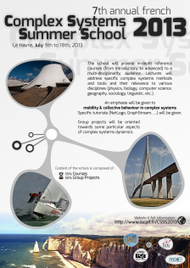
Previous editions of this French Complex System Summer School, organized by ISC-PIF and IXXI, two nodes of the RNSC, took place in Lyon and Paris. In 2013, this summer school is organised by the ISC-N, a coastal city only 2 hours from Paris.
The school will provide in-depth reference courses to a multi-disciplinary audience of researchers and students. The level of lectures will range from introductory to advanced, as attendees are not expected to be familiar with all the fields covered. Lecture topics will address specific complex systems methods and tools and their relevance to various disciplines (physics, biology, computer science, geography, sociology, linguistic, etc.). An emphasis will be given to collective behaviour and mobility in complex systems.
James Patten's surreal Spring 2013 window installation for Barneys New York brings computers into the physical world in order to build a richer experience.
Find out how the NEO MODERN installation came to life and see how his engineered surprises for Christian Louboutin and fashion editor Carine Roitfeld are expanding the vocabulary of design.
To get content containing either thought or leadership enter:
To get content containing both thought and leadership enter:
To get content containing the expression thought leadership enter:
You can enter several keywords and you can refine them whenever you want. Our suggestion engine uses more signals but entering a few keywords here will rapidly give you great content to curate.


 Your new post is loading...