Media Arts Watch Lab - www.arts-numeriques.info - laboratoire de veille Arts Numériques - twitter @arts_numeriques - @processing_org - @DigitalArt_be - by @jacquesurbanska @_Transcultures
A full weekend of music hacking. Software + hardware + art + web. Come build the future of music. April 20th-21st, 2013
Music Hack Day is an international 24-hour event where programmers, designers and artists come together to conceptualize, build and demo the future of music. Software, hardware, mobile, web, instruments, art - anything goes as long as it’s music related.
Have a great crowdfunding idea but need some help with promotion and exposure?
Our services are designed to help crowdfunding projects get more visibility. We accomplish this with social media, press and journalist. We can help your project get more exposure and web traffic. These are critical factors to your crowdfunding success. Our services can send hundreds of people who love crowdfunding right to your project.
We love talking with CrowdFunders. If you have any questions about how our service can help your project please Contact Us. You can also reach us by phone at 888.983.1682. We know we can help you with your CrowdFunding Project.
Dans le cadre de « la semaine jazz » des stages de l’AKDT, nous vous proposons une semaine de création sonore autour de la musique et des arts plastiques. Reportages, portraits, longs formats… travailler sa voix, écrire pour la radio, « raconter » sans paroles, approcher les notions techniques de base du média radio… entre création libre et journalistique, le son sous toutes ses formes nous permettra de capter un microcosme de musiciens et de plasticiens parmi les plus réputés de Belgique. Nous créons sur place une véritable rédaction, le but étant, pour les étudiants en journalisme, de travailler dans des conditions que nous rendons un maximum « réelles » (échéances, travail du ton, billets formats divers,…).
Réalisation d’un journal parlé chaque soir (travail de présentation)
Possibilité de diffusion de certains travaux dans l’émission radio de Pascale Tison « Par Ouï-Dire » sur La Première
Nombre limité d’inscriptions
Un stage ouvert à tous, à partir de 16 ans, et donné par :
L'information doit être libre : bien avant d'être le motto de WikiLeaks, c'était, déjà, le credo des premiers hackers, ceux qui allaient modeler nos vies numériques. Retour sur héritage avec Steven Levy, auteur de L'Éthique des hackers.
Imagined in 2006, this project started from the observation of this fragile yet powerful tool named Internet. As a young mid-twenties team, we were almost born with Internet, or at least we grew up with it. Thus explaining the fact that we all started to be very concerned by the sustainability of the information and the contents published on Internet. Most of the websites we were using when we were young disappeared in less than 10 years… We decided that we had to do something and we founded WebArchivists, without really knowing where it would lead us.
At that time, we had a lot of ideas: P2P-web-archives system using unused FTP-space, self social-networks backup software, browser extensions to archive the site you’re visiting… Because we worked part time on the organization and since we weren’t software engineers, it was quite challenging to develop those projects. Anyway, all the conception work and some user interface design are done…
The installation is composed of four custom applications running at the same time to control every step of the process. The app on the iPads is built in OpenFrameworks. It reads the drawings and sends TCP messages to a central laptop over a local wireless network.
A control panel application built in Processing acts as a middleman between the wireless and the ethernet networks. It runs on a laptop, monitoring the iPads and forwarding their messages to the server that controls the screens. It also enables some extra features, like recording and playing back the performances.
The MPE Server runs on one of the three Mac towers that control the screens. It’s part of the Most Pixels Ever library by Daniel Shiffman and it’s used to synchronize the three parts of the screen. One instance of another OF application –the main one– runs on each of these machines, reading messages from the server and turning them in real time into high resolution graphics for the video wall. In the end, the project has a global resolution of 11520 x 580 pixels, distributed along 568 LED screens.
Cette année, le Mapping Festival met l’accent sur l’expérimentation et vous propose une multitude de workshops sur plusieurs jours. Des thématiques variées, des sélections impitoyables, le Mapping va vous en mettre plein les yeux!
Pour s’inscrire aux workshops, une seule chose à faire!
ATTENTION, vous avez jusqu’au LUNDI 8 AVRIL pour vous inscrire!
Envoyer PAR MAIL à l’adresse: workshops@mappingfestival.com - dans l’OBJET préciser le nom du workshop auquel vous souhaitez participer. - un dossier complet: CV, références, vidéos, photos, tout ce qui vous caractérise et qui peut nous être utile pour mieux vous connaitre.
Vous recevrez une réponse dans les 10 jours qui suivent la fin de l’inscription.
On December 2012, several scholars, artists and scientists with common interests in the intersection of art, science and technology gathered in Prague (Mutamorphosis, an event on mutant futures, Dec 6-8) to discuss a topic that has become increasingly important during our uncertain times: The event was entitled “Tribute to Uncertainty”.
According to Louis Bec, who wrote the introductive paper to which attractors (the organizers of the thematic streams) and participants were encouraged to respond, Uncertainty should be “contextualized in a world undergoing a complete mutation, jolting at all its points of articulation, whether political, economic, diplomatic, geographic, ecological, technological or communicative.” For Bec, Uncertainty functions as a symbol of today’s political changes and mutations, signaling the transformation of a world “whose hierarchies are being shaken, whose disparate social organizations are being disrupted, a multicultural, hybrid, young, active and communicative world representing 7 billion human beings”.
Transformation neither veers towards the best nor can it be programmed or predicted. It presents us with something new, but this “new” is unknown, unpredictable, un-measurable, non-linear. Transformation is marked by uncertainty.
Culture Hack is a digital development programme for arts and culture that enables the creation of innovative digital prototypes and creates new working relationships across the arts, technology and the creative industries.
Founded in January 2011, Culture Hack is a not-for-profit enterprise, run by London digital creative agency Caper.
Le Cracc est un lieu ouvert aux artistes, enseignants, étudiants, formateurs qui souhaitent s'initier ou découvrir différentes techniques interactives.
Son but est de faciliter l'accès aux technologies en mettant à disposition espaces, ressources matérielles et compétences humaines pour l'apprentissage ou la réalisation de projets.
Une soixantaine de capteurs sont accessibles en démonstration et permettent d'appréhender la diversité des possibilités.
Des mallettes interactives sont mises à disposition des enseignants et formateurs qui souhaitent les utiliser au sein de leur enseignement.
Enfin, le Cracc met à disposition matériels et espaces de travail: pour les artistes souhaitant expérimenter, les ressources logicielles et matérielles disponibles et vérifier la viabilité d'un projet. Le Cracc est également ouvert à l'organisation de workshops par les formateurs et enseignants qui en font la demande.
This work attempts to question the audience about the subject of mental manipulation, specifically as it relates to social networking. The audience starts playing with the installation only aware of the unusual way to manipulate it (with their portable devices via a distant website) but as the performance progress, it becomes more and more obvious that the real purpose of the work is far from the simple idea of physical manipulation. Actually, it explores different aspects of mental manipulation, illustrates them by different means till showing the players that while they thought they were manipulating the installation they had in fact been manipulated by it.
The installation works like most "free" online services, highlighting a free useful or entertaining service to hide its real purpose. As these services it is fully designed to manipulate the audience. With almost every artistic or technical detail made on purpose to respectively evoke or to participate to the mental manipulation process. However, this is done in a very "safe" way compared to what is encountered in every-day life since even if their personal data --they allowed access to by themselves-- is revealed, it is (of course) not sold to any third party nor stored.
Our talk in GDC 2013, Next-Generation Character Rendering, is a few hours away. On it, we will present what represents to us the culmination of many years of work in photorealistic characters.
We will show how each detail is the secret for achieving reality. For us, the challenge goes beyond entertaining; it’s more about creating a medium for better expressing emotions, and reaching the feelings of the players.
We believe this technology brings current generation characters, into next generation life. At 180 fps in a Geforce GTX 680.
The team behind this technology consists on Javier Von Der Pahlen (Director of R&D), Etienne Danvoye (Technical Director), Bernardo Antoniazzi (Techical Art Director), Zbyněk Kysela (Modeler and Texture Artist), Mike Eheler (Programming & Support) and me (Real-Time Graphics R&D).
Pour cette 5ème compilation, PLASTIC PEOPLE, nous avons voulu montrer comment les plasticiens utilisent le son en tant que composant d’un d’une œuvre plurielle ou matière à tailler directement en partant d’un outil conceptuel. Suivant la position de celui qui écoute, cet instantané peut devenir cliché. Parfois, les artistes issus du visuel considéreront la musique expérimentale ou électroacoustique comme conservatrice dans ses enjeux tandis qu’une écoute centrée sur la composition trouvera le son des plasticiens banal ou ‘déjà entendu’.
Plaisir hédoniste de l’écoute ou plaisir kantien de la compréhension? Il s’agit peut-être de se poser la question du contexte et de l’intention de chaque sensibilité au regard de son histoire propre et des ruptures proposées par ses avant-gardes. Les disjonctions et les paradigmes de l’art et de la musique confrontés à une hybridation en mouvement.
The Lab, a platform dedicated to cultural innovation in Europe and worldwide, is a five-day forum that takes place during the Nuits sonores festival.
The third edition of the Lab will unfold through its four cardinal points - creation, politics, economy and the media.
The key to this arrangement is innovation and the capacity to simultaneously reinvent our cultural policies and our perception of cultural entrepreneurship.
Many of us have in the cinema industry have never truly grown up. We have found a way to hold onto our youth in flying cameras through scenes borne of our imaginations defying the laws of time and physics as we move through our frame.
But any filmmaker – professional or amateur – will tell you that gravity is all too often a cruel reminder of how hard taking flight can be. Moving a camera in a steady path is one of the biggest challenges for all of us.
That is until you hold the handheld "MoVI" device in your hands and run, or drive, or fly only to see your clumsiness and bumps turned into a near perfect trajectory – thanks to insanely fascinating technology of gyro stabilization and accelerometers. The "MōVI" produced by Freefly Systems based in Seattle WA., is a digital 3-axis gyro-stabilized handheld camera gimbal.
The completely silent device weighs under 3.5 pounds bare and can be operated solo, or with the help of a second "gimbal" operator with a joystick to pull off some incredible moves.
Revolutions Per Minute will feature new and existing works by 30 Chinese sound artists, including Wang Changcun, Xu Cheng (a member of the renowned Shanghai noise group Torturing Nurse), Yan Jun, and Samson Young. Wang Changcun, Xu Cheng, Samson Young, Qu Qianwen, and Xie Zhongqi will be in residence at Colgate throughout the duration of the exhibition. Along with the exhibition’s curators Wenhua Shi and Dajuin Yao, these artists-in-residence will present live sound art performances during the opening week of the exhibition, including improvisations, inter-media performances, and circuit bending. They will also conduct demonstrations on sound art workshops throughout the course of the exhibition.
BBuilt into the title of this first survey exhibition of sound art in China is obviously a pun – "RPM" being a measure with which we describe the different speeds of a record turntable and different types of record formats, but it also refers to the revolutionary nature of the modern Chinese society, and how unbelievably fast a pace it is changing at.
As far as the auditory tradition in China is concerned, the Cultural Revolution achieved its goal with total success, cutting newer generations off from most musical forms, Western as well as Chinese. For the young people growing up in the 1990s and early 2000s, Western-influenced pop, rock, and punk were the only musical nutrients and formed their collective aural memory. In the area of experimental sound, the Chinese artists had a blank slate to start over with.
TThe year 2003 was a landmark for sound in China. "China: the Sonic Avant-Garde," produced by and released on Post-Concrete in the U.S., was the first comprehensive compilation CD introducing Chinese experimental sound works to the world. Later in the same year, Post-Concrete produced "Sounding Beijing," the first international sound and media art festival in China, a historic event that gathered together Western and Chinese artist, and a hardcore audience from all over the country under one roof. The two events were a declaration of a maturing experimental sound art scene in China, the existence of which even the practicing artists themselves did not fully realize at the time. ...
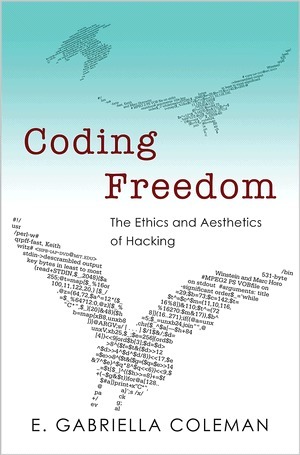
Who are computer hackers? What is free software? And what does the emergence of a community dedicated to the production of free and open source software--and to hacking as a technical, aesthetic, and moral project--reveal about the values of contemporary liberalism? Exploring the rise and political significance of the free and open source software (F/OSS) movement in the United States and Europe, Coding Freedom details the ethics behind hackers' devotion to F/OSS, the social codes that guide its production, and the political struggles through which hackers question the scope and direction of copyright and patent law. In telling the story of the F/OSS movement, the book unfolds a broader narrative involving computing, the politics of access, and intellectual property.
E. Gabriella Coleman tracks the ways in which hackers collaborate and examines passionate manifestos, hacker humor, free software project governance, and festive hacker conferences. Looking at the ways that hackers sustain their productive freedom, Coleman shows that these activists, driven by a commitment to their work, reformulate key ideals including free speech, transparency, and meritocracy, and refuse restrictive intellectual protections. Coleman demonstrates how hacking, so often marginalized or misunderstood, sheds light on the continuing relevance of liberalism in online collaboration.
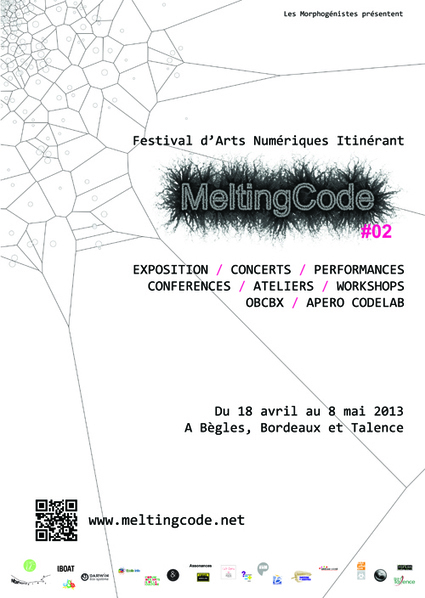
Site du Festival MeltingCode organisé par l'association Les Morphogénistes dans le but de promouvoir la culture des Arts Numériques et les médiums qui en composent son essence.
MeltingCode est un festival dont le but est de faire découvrir la culture électronique et numérique, ou le mélange des Arts, de la Science et des Technologies.
De plus en plus présentes dans les formes actuelles du spectacle vivant, les technologies numériques nous font rêver et parfois nous intriguent. Mais comment sont-elles réellement utilisées ? Par qui, et dans quel but ? MeltingCode se propose de décoder ces pratiques mêlant temps-réel, hacking, électronique et langages de programmation, afin d'offrir au public une vision décryptée de l'univers des Arts Numériques.
Une série de conférences, de workshops, de concerts, de performances live et d'expositions aura lieu tout au long du festival, proposant ainsi différents axes de lecture à travers la médiation culturelle, la vulgarisation technique, la pédagogie, et la création.
Un des buts assumés de l'évènement est de favoriser une dynamique locale en impliquant au maximum les principaux acteurs de la création numérique dans la CUB, tout en l'ouvrant au niveau national, voire international.
François Zajéga : I'm drawing since years. The Spartan aesthetics of the drawing and its thought, a managed momentariness, made me prefer this discipline between all. My images are planar volumes, the graphic organization allowing to feel the space. Whatever is their medium, these compositions use a common vocabulary, made of lines, curves and points.
The construction of an object by the observation of its structure and axes, recesses and reliefs, as well as the layout of this observation in the space, are primary notions of all my production.
During its evolution, my production became more and more abstract, bringing me to the non-represen- tational depicting.
The intention is not anymore to show the surface of things but many of to make it feel the functioning, the energy and the movement on one side, the structure and the volume of the other one.
In my images, the object is not more than rarely recognizable as finished shape. My conception widened, bringing me to conceive it as a articulated volume, made visible by a system of linear forms. Its relation with a space / plan is so important today as its internal structure.
Evolutions like the rapid obsolescence of technologies and formats, the leap from the analogue to the digital realm and the ever-growing production of audio-visual materials create great challenges to all institutions that collect, manage and safeguard audio-visual collections. The SCART website gives access to an ever-expanding pool of knowledge on the preservation of audio-visual heritage that is being created by PACKED vzw and its partner organisations. It aims to help memory institutions and others with the task of preservation.
John Rogers is a materials scientist noted for his contributions to applied physics, particularly his leadership in developing flexible electronic devices. In contrast to traditional solid-state electronics, where components are fabricated on semiconductor wafers, researchers have recently discovered that a host of organic (i.e., carbon-based) molecules can also act as semiconductors. In an early line of research, Rogers used microlithographic stamping technology to design high-density, complex circuits that could be fabricated on a flexible substrate similar to paper.
He has raised the performance of such circuits substantially, to the point that they are finding their way into devices with modest speed requirements, such as commercial display technologies. Nevertheless, the capacity of known organic semiconductors to perform high-speed computations remains limited. To address this, Rogers has also devoted significant effort to developing flexible semiconducting films, based on silicon or carbon nanotubes, literally to stretch the boundaries of signal processing capacity on flexible substrates. Such devices can be placed in locations where standard silicon wafer technologies are impractical or impossible; the myriad of potential applications include photovoltaic cells, adaptive optics, electronic textiles, and implantable biomimetic circuits.
Through his basic research in nanotechnology, chemical engineering, and applied physics, Rogers is building the foundation for a revolution in manufacture of industrial, consumer, and biocompatible electronics.
La soirée du jeudi 11 avril 2013 sera un temps fort du festival EXIT : le même soir auront lieu le lancement du Guide de la Création Artistique Numérique, ainsi que deux conférences avec des intervenants renommés. Durant toute la soirée, l'exposition Natures Artificielles sera en libre accès.
18 h - Lancement du Guide de la Création Artistique Numérique (en papier et en ligne)
La soirée débutera à 18h par le lancement du Guide des ressources et des lieux de la création artistique numérique. Ce guide regroupe tous les lieux, organismes, festivals et institutions impliqués dans l'art numérique en France. Il est disponible en version papier (130 pages couleurs) et en version numérique (site web bilingue FR/EN développé par Digitalarti). Une ressource précieuse pour tous les acteurs de la discipline !
Le guide sera distribué gratuitement tout au long de la soirée. (plus d'infos sur le guide)
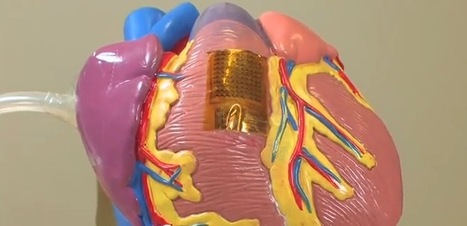
Biostamp flexible, wearable electronic circuits worn on the skin like temporary tattoos by John Rogers of MC10 and University of Illinois.
Materials scientist John Rogers and his firm MC10 have developed flexible electronic circuits that stick directly to the skin like temporary tattoos and monitor the wearer's health.
The Biostamp is a thin electronic mesh that stretches with the skin and monitors temperature, hydration and strain.
Rogers suggests that his "epidermal electronics" could be developed for use in healthcare to monitor patients without tethering them to large machines. Not only would this be more convenient, but the results could be more accurate if patients were examined in their normal environment doing usual activities rather than on the hospital ward.
Other applications could include a patch that lets an athlete know when and how much to hydrate for peak performance, or one that tells you when to apply more suncream. ...
MC10 overcame the rigidity of normal electronic components made from brittle silicon-based wafers by printing them in very small pieces, arranged in wavy patterns.
Earlier versions were applied on an elastomer backing patch, but the latest prototype is applied directly to the skin using a rubber stamp. It can be covered with spray-on bandage available from pharmacies to make it more durable and waterproof enough to withstand sweating or washing with soapy water. It lasts up to two weeks before the skin's natural exfoliation causes it to come away.
The team are now working on the integration of wireless power sources and communication systems to relay the information gathered to a smartphone.
Other wearable monitoring technology we've reported on includes theNike+ FuelBand and Jawbone UP wristbands that monotor health and fitness, plus a wearable camera that uses sensors and GPS technology to decide which moments of your life are worth photographing.
All disruptive technologies upset traditional power balances, and the Internet is no exception. The standard story is that it empowers the powerless, but that's only half the story. The Internet empowers everyone. Powerful institutions might be slow to make use of that new power, but since they are powerful, they can use it more effectively. Governments and corporations have woken up to the fact that not only can they use the Internet, they can control it for their interests. Unless we start deliberately debating the future we want to live in, and information technology in enabling that world, we will end up with an Internet that benefits existing power structures and not society in general.
We've all lived through the Internet's disruptive history. Entire industries, like travel agencies and video rental stores, disappeared. Traditional publishing -- books, newspapers, encyclopedias, music -- lost power, while Amazon and others gained. Advertising-based companies like Google and Facebook gained a lot of power. Microsoft lost power (as hard as that is to believe).
The Internet changed political power as well. Some governments lost power as citizens organized online. Political movements became easier, helping to topple governments. The Obama campaign made revolutionary use of the Internet, both in 2008 and 2012.
And the Internet changed social power, as we collected hundreds of "friends" on Facebook, tweeted our way to fame, and found communities for the most obscure hobbies and interests. And some crimes became easier: impersonation fraud became identity theft, copyright violation became file sharing, and accessing censored materials -- political, sexual, cultural -- became trivially easy. ...
To get content containing either thought or leadership enter:
To get content containing both thought and leadership enter:
To get content containing the expression thought leadership enter:
You can enter several keywords and you can refine them whenever you want. Our suggestion engine uses more signals but entering a few keywords here will rapidly give you great content to curate.


 Your new post is loading...