Media Arts Watch Lab - www.arts-numeriques.info - laboratoire de veille Arts Numériques - twitter @arts_numeriques - @processing_org - @DigitalArt_be - by @jacquesurbanska @_Transcultures
This is the official video documentation of NODE13 - Forum for Digital Arts, February 2013, Frankfurter Kunstverein, Germany node.vvvv.org
Paoloreste Gelfo and his team of ambitious videographers followed every stage of the festival and have taken hours of video footage, to create a documentary about NODE13. NODE is a biannual reunion of vvvv developers, users, artists and activists. It is an international platform, with talks, workshops and an exhibition. A platform to share knowledge and to meet each other- also away from keyboard.
Direction: Paoloreste Gelfo paoloreste.tumblr.com/ and vimeo.com/user5329150 Editor/Colorist/Graphic: Antonio Labbro Francia vimeo.com/user3449801 Music: Edisonnoside soundcloud.com/edisonnoside
Production Coordination: Jeanne Charlotte Vogt Camera: Constantin Urban, Paoloreste Gelfo, Markus Haertel, Yannic Bill
This video was made possible with the help of meso.net wirmachenbunt.de m-box.de vvvv.org
Commisioned by NODE Verein zur Förderung Digitaler Kultur. node.vvvv.org
New media artist Harvey Moon is a creator of tools and machines. Moon’s project Delta is the latest in his line of drawing machines which transform the artist’s conception into a physical drawing using custom fabricated electronics and generative algorithms. Delta takes the drawing machine concept to a new dimension. Moon was commissioned to produce an automatic typewriter which would continuously type on the page. Both Delta and The Automatic Typewriter were unveiled at the School of the Art Institute’s Bachelors of Fine Arts Spring 2013 Showcase.
Sequences is an independent biennial, established in Reykjavík in 2006. The aim of the ten-day festival is to produce and present progressive visual art with special focus on time-based mediums, such as performance, sonic works, video and public interventions. An offspring of the dynamic art scene that thrives in Reykjavik, Sequences is the first art festival in Iceland to focus on visual art alone. New artistic directors are hired to reshape each edition of Sequences according to their vision, making it unique and different every time.
Founding members are the Icelandic Art Center, the Living Art Museum, Dwarf Gallery, Kling & Bang gallery and Gallery Bananananas (the last one closed early 2007). Each institute has a representative on the board, but all the major venues and cultural institutions in the Greater-Reykjavík area have worked with the festival in one way or another. Over three hundred artists from around the world have participated in the festival. The first editions, 2006-8, were annual but in 2009 it was decided to slow the pace and hold the festival every other year. Sequences is funded with generous support of various domestic and foreign funds.
Lab212 is a multimedia collective, founded in 2008 by some friends. The collective is now made of 10 members whose skills in different fields allow them to deal with artistic, pedagogic or even commercial projects.
From UX design to graphic design, programming, electronics and technical design, Lab212 is able to take care of most of the aspects required by innovative interactive projects.
By its sensible, poetic and tangible approach of interactive design, Lab212’s projects try to empower users and cast a different light on the technology surrounding our daily life.
Through its creations, Lab212 invite people to think about our relation with the world we live in and the people we live with. ...
It is a feature documentary telling the story of our interconnection with each other, the planet, and the universe.
We hope that this documentary will change the way we think as a species – to stop seeing ourselves as separate from each other, from the planet and the cosmos – and inspire us to work together to transform our planetary crises.
By weaving together perspectives and ideas from some of the key theorists and thinkers in the fields of cosmology, environmentalism, sustainability, social theory, anthropology and systems dynamics, Continuum tells the story of where we have come from, where we are now, and the possibilities for our future.
Le du-touch est un nouvel instrument de musique que nous avons développé, destiné tant aux professionnels de la musique qu'aux amateurs ou aux non-musiciens. Il est doté d'une nouvelle disposition des notes appelée principe dualo.
Cette disposition, très intuitive, permet de mieux voir et de mieux comprendre la musique. Plus besoin de connaitre le solfège pour jouer de la musique ! Sur un clavier dualo les notes qui sonnent bien entre elles, au sens de l'harmonie, sont placées les unes à côté des autres, ce qui fait qu'elles tombent directement sous les doigts et que l'on peut se faire plaisir très rapidement. En fait, les objets musicaux, comme les accords et les gammes, sont représentés par des formes simples facilement mémorisables.
Le clavier dualo est très visuel et très rapide à prendre en main. Toutes les musiques peuvent être jouées sur ce clavier, avec virtuosité et facilité. ...
La méthode sera présentée en avant-première lors du festival Futur En Seine, à Paris, du 13 au 16 juin 2013.
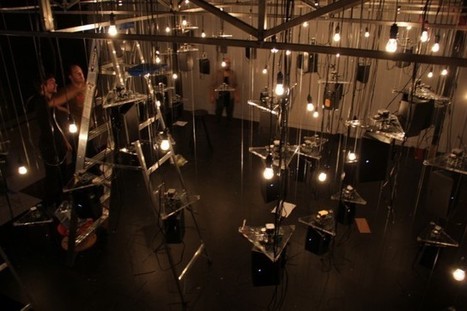
Created along with the english indie band The xx, Matt Mets, Aramique Krauthamer and Kyle McDonald created an exhibit that incorporates the band’s music into a room full of stepper motor controlled speakers that pivot to follow listeners as they move through the space.
Missing is part of Coexist, an exhibition cycle at the Sonos Studio in Los Angeles that attempts to explore the “relationship between man and machine.” The Missing part of that exhibit, on display through Dec. 23, uses 50 speakers, two hacked Kinect 3-D cameras, and a whole lot of code and robotics to create an environment where people are moving through the music and interacting with the speakers, without even trying. – writes Wired.
Development took about 6 weeks from accepted pitch to opening night. Matt Mets developed a system that uses stepper motors with potentiometers (in place of servos) in combination with a custom pcb that is a modified version of an old open source makerbot stepper driver (Matt used to work for makerbot). After a lot of laser cutting and machining used to fabricate the mounts, the pcb on each mount is powered and controlled by a single ethernet cable which is daisy chained along the ceiling of the installation. These are controlled by a single ethernet cable connected to a teensy plugged into the Mac Mini which is also connected to two Kinects that follow the visitor through the space. ...
A group at Tokyo Institute of Technology, led by Dr. Osamu Hasegawa, has succeeded in making further advances with SOINN, their machine learning algorithm, which can now use the internet to learn how to perform new tasks. The system, which is under development as an artificial brain for autonomous mental development robots, is currently being used to learn about objects in photos using image searches on the internet. It can also take aspects of other known objects and combine them to make guesses about objects it doesn't yet recognize.
Christina Agapakis thought that her interest in art would always be separate from her pursuit of science, especially once she had decided to do postgraduate studies in biology.
But she found ways to meld the two. While earning her PhD in biomedical sciences at Harvard University in Cambridge, Massachusetts, Agapakis joined a social experiment called Synthetic Aesthetics. A joint project of the University of Edinburgh, UK, and Stanford University in California, funded by the US National Science Foundation (NSF) and the UK Engineering and Physical Sciences Research Council, Synthetic Aesthetics teamed artists and designers with synthetic biologists and encouraged them to come up with interdisciplinary ideas and projects. Agapakis worked with Sissel Tolaas, a researcher and scent artist resident in Berlin. Together, they made cheese — using starter cultures made of bacteria isolated from the human body. They wanted to make the unseen biological world perceptible to the senses, and to call attention to how synthetic biology might alter microbial communities. “The creativity of designing, rather than studying, biology is really exciting for me,” says Agapakis.
Now a postdoc in synthetic biology at the University of California, Los Angeles (UCLA), Agapakis continues to collaborate with designers, incorporating principles of balance and scale — in this case, being mindful of microbial relationships and interactions — into the design of microbial communities that could, for example, yield new fertilizers or biofuels. She is convinced that artists and designers stoke scientists' creativity. ...
Christina Agapakis thought that her interest in art would always be separate from her pursuit of science, especially once she had decided to do postgraduate studies in biology.
But she found ways to meld the two. While earning her PhD in biomedical sciences at Harvard University in Cambridge, Massachusetts, Agapakis joined a social experiment called Synthetic Aesthetics. A joint project of the University of Edinburgh, UK, and Stanford University in California, funded by the US National Science Foundation (NSF) and the UK Engineering and Physical Sciences Research Council, Synthetic Aesthetics teamed artists and designers with synthetic biologists and encouraged them to come up with interdisciplinary ideas and projects. Agapakis worked with Sissel Tolaas, a researcher and scent artist resident in Berlin.
The UDOO is a ARM based Linux board like the Raspberry Pi, with a second ARM processor onboard to mimic the Arduino Due, that is now raising money on Kickstarter.Read the full article on MAKE
For those who want to put a $35 Raspberry Pi and a #24 Arduino onto the same board, UDOO offers a solution for $109 USD. It runs a version of Ubuntu Linux and Android operation systems and can program its on-board Arduino using Processing.
And do you want to control all the software and hardware you use for your multimedia projects with it?
In addition.... Do you want it to have an attractive, flexible and open source design?
Stop beating around the bush! The thing you want is BHOREAL.
BHOREAL is an Open Source interface based on the Arduino platform that allows to control all types of software and hardware using a surface with RGB LED-backlit pushbuttons.
You can use it as OSC/MIDI device to trigger samples live, as sequencer, synthesizer, rhythmbox, pitch map generator or remote control. It can also work in standalone mode as algorithmic and generative driver, mathematical simulator, game interface, low resolution LED display or any other kind of application you can imagine.
Thanks to its versatility, BHOREAL is a fundamental tool for DJs, VJs, musicians, artists, hackers and all kinds of creative DIY people willing to explore a piece of hardware which is infinitely reconfigurable and reprogrammable.
The BHOREAL controller allows to overcome the constraints imposed by conventional device manufacturers. Its Open Source essence makes it possible to modify and adapt the tool freely.
For the last few years, MID´s team has been working on this interface in order to maximize its flexibility and provide adaptable configurations for each user needs. On the basis of these premises BHOREAL is available in four different models: two DIY self-assembly kits and two “ready-to-use” preassembled units .
Both hardware and firmware are completely Open Source and are released under Creative Commons licenses. BHOREAL is Windows/Mac OS/Linux compatible.
Après les designers, les ingénieurs et les prothésistes, c'est au tour des artistes d'explorer le potentiel de l'impression 3D. A New-York, la galerie Winkleman présente actuellement le travail de Shane Hope, un plasticien qui incorpore à ses tableaux des micro-éléménts conçus par ordinateur. Pour comprendre le principe, ne vous fiez pas à l'atmosphère de joyeux fouillis qui se dégage des toiles. Cette nouvelle façon de faire de l'art, baptisée « nanofacture » par son créateur, est en effet d'une précision bluffante.
Grâce à PyMol, un logiciel de modélisation 3D, Shane Hope dessine la structure moléculaire, puis la forme, de milliers de petits élements. Ces derniers deviennent ensuite réalité grâce à des imprimantes RepRap capables de créer des objets à partir de fichiers numériques et de poudre de résine. L'artiste colle enfin ses micro-créations sur des toiles, qui deviennent le support d'une étonnante rencontre entre peinture acrylique et sculpture 2.0. ...
Music brought to you in brilliant Technitone! Create, collaborate, and share your musical creations.
Technitone draws inspiration from André Michelle's well-loved (and sadly, non-functional at the moment) Tone Matrix. Technitone provides a grid on which you and your cohorts can place instrument sounds on various notes. Like Plink, it automatically hooks you up with buddies to jam with, and it doesn't take much musical know-how to get up and running. Technitone packs a few neat extras, too, such as a solo mode for those who like more control, and a gallery where you can publish your masterpieces, whether made on your own or with a group.
L’Observatoire des Mondes Numériques en Sciences Humaines (OMNSH) est une association française de loi 1901.
L’observatoire a pour objet d’étude la technologie numérique, c’est-à-dire des environnements et outils technologiques reposant sur l’informatique et offrant une interactivité avec leurs utilisateurs et ce, tous supports techniques confondus, présents et à venir.
Cette association a pour but de constituer une plate-forme d’information, de réflexion et d’échange entre la recherche universitaire, les professionnels, la presse et le public, tous quatre liés par cette technologie.
L’OMNSH s’inscrit dans la perspective de partage et d’accès libre à la littérature scientifique sur Internet telle qu’elle est encouragée par la déclaration de Berlin (octobre 2003).
voir la rubrique voir Sciences de l’Art : a pour vocation d’accueillir des analyses relevant des sciences de l’art (18ème section Arts) appliquées au mondes numériques : recherche création, analyse de dispositifs artistiques ou d’appropriation créative, études portant sur les musées et les produits culturels interactifs, recherches en création, articles de critique...
Le D.É.S.S. en arts, création et technologies est un tout nouveau programme offert par la Faculté des arts et des sciences, en collaboration avec la Faculté de musique. Innovateur, ce programme de 30 crédits propose une formation appliquée et pluridisciplinaire dans un domaine émergent.
Ce D.É.S.S. répond aux intérêts professionnels des étudiants qui sont situés à la croisée des pratiques artistiques et des domaines scientifiques et techniques (musique/art audio, cinéma, art vidéo, création littéraire). Il dépasse la simple formation d'utilisateurs de technologies en insistant sur une compréhension et une maîtrise de celles-ci dans un contexte artistique et créatif.
Les étudiants désireux d'acquérir une spécialisation courte leur permettant d'élargir leurs possibilités de carrière pourront réaliser des projets d'études avec une approche pluridisciplinaire les préparant de manière adéquate pour le marché du travail.
La Faculté des arts et des sciences de l'UdeM compte plus de 150 programmes de 1er cycle et 90 programmes de cycles supérieurs en lettres, sciences humaines, sciences sociales et sciences, dont certains sont uniques au Québec et même au Canada.
In the framework of the European Park in progress and the next edition of the international festival of sound art City Sonic, proposed in September 2013 Mons, Transcultures, Centre of digital and sound arts, launches a call for projects/residences for the realizationof small forms/formats (performances, installations, concerts...) inter or multidisciplinary with a sound dimension.
Start of the residency period : August 28, 2013End of the residency period : September 5, 2013Place of the residence : Mons - BelgiumPublic presentation to the Nuit Européenne de la Jeune Création (European night of the young création) : September 6, 2013 in Jardin du Beffroy (garden of the belfry - in the evening).
Park in progress is a European mobility programme (supported by the European Commission -culture programme) which brings together young artists and young creative professionals involved in the various stages of production of an artistic work around a commonproject that seeks transdisciplinarity, A Rich creative experience with artistic creation as means of exchanges and encounters. It is supported by 6 cosignatories on a 3-year period (1st May 2010 – 31st December 2013) : the Arts Council England East-Midland(Nottingham, United-Kingdom), Transcultures (Mons, Belgium), Luxembourgeoise d’Action Culturelle (Luxembourg), ARTos Foundation (Cyprus) and the Pépinières européennes pour jeunes artistes (Saint-Cloud, France). Park In Progress moves around 6 differentplaces in 6 different countries. At every very stop of this itinerary, the artists and young professionals from the creative world take hold of a park or a Green urban zone to create a site specific artistic itinerary , « PARKINPROGRESS », nourished by differentartistic propositions to share with the public. This creation nourishes itself from new proposals established on the encounter with artists and professionals from the hosting country, at every stage of the project.
Transcultures, Interdisciplinary Center for Sound and Electronic Cultures, created in 1996 (Mons - Belgium), organizes festivals, events, workshops, meetings... in Federation Wallonia-Brussels and internationally. The project we are looking for City Sonic mustbe related (openly) with sound. Mons is a beautiful city with the cultural heritage center. It will be the European Capital of Culture in 2015, located near the French border, 45 minutes by train or car from Brussels, 2 hours 30 minutes from Paris and 1 hourfrom Lille.
Festival d'Arts Numériques en Terre d'Aude : mappings, projections, installations, performances, vidéos, mix... organisé par le G.R.A.Ph-Centre Méditerranéen de l'Image...
A la découverte d'une nouvelle forme artistique qui met en scène des créations dynamiques et variées avec pour support le numérique: mappings, projections, installations, performances, vidéos... Cette manifestation propose une programmation sur divers lieux du territoire audois: Carcassonne, Château de Malves-en-Minervois, Saint-Papoul ou encore Limoux. Cette année, le thème du festival est le nomadisme culturel et la mobilité.
Trigger Michael Jackson dance moves using only your face with Face Dance. This project, created by filmmaking duo Supermarché (Catfish, Paranormal Activity 3&4) and a team of creative coders, combines depth sensors, facial recognition software and motion capture of a Michael Jackson impersonator.
born as a place of research and creation of contemporary arts such as performing arts, theater, site specific, music, videos and installations. It is a place that strives to build a network with groups and individuals of young artists of all nationalities who need a space for creation.
IL PAGLIAIO propose to accommodate projects and activities, with the propensity to reduce the distances between the boundaries between diverse disciplines.
The space also has the features needed to create exhibitions, workshops, seminars, photo shooting, and performances.
1995 Video of Virtual IO's I-Glasses. Virtual reality Head Mounted Display with headtracking.
This was the first i-glasses version released and had much lower resolution than the i-glasses they sell today. Back in 1995 this was one of the first affordable home VR headsets along with the Victormaxx cybermaxx and the ForteVR VFX-1. The small and lightweight design made it comfortable to wear, but the enormous cable from the VGA-box to the Computer, the box itself, the cable to the galsses and the power supply rendered it a too large package to really "take everywhere". They still work fine today, but the maximum input resolution of 640x480 makes a modern Windows Vista Desktop appear a bit crowded. For today's standards the resolution and color depth are a bit too low to really enjoy watching 3D movies, but astonishingly the recent "Avatar" game by james Cameron works amazingly well and the nice graphics don't look as bad as you might think on the low res. If you have these then i recommend you try out the demo of the avatar game, just set screen res to 640x480 in the game, enable 3D and set 3D effect to "interlaced". Really an excellent experience even with such an old device.
We're an innovative, digitally oriented global media company whose reach is rapidly expanding.
MIT Technology Review identifies important new technologies - deciphering their practical impact and revealing how they will change our lives.
Our mission is to identify important new technologies—deciphering their practical impact and revealing how they will change our lives.
Founded at MIT in 1899, MIT Technology Review derives its authority from the world's foremost technology institution and from our editors' deep technical knowledge, economic realism, and unequaled access to the world's preeminent innovators.
Le studio britannique Universal Everything a capturé le mouvement d’un danseur pour en faire une animation, qui est projetée sur un écran haute résolution. La chorégraphie du danseur contemporain, se déroule dans un studio de capture de mouvements. C’est alors que la technologie déploie vraiment ses ailes et transforme les données de mouvement en une sculpture numérique, formée par les traînées du corps humain. ...
"Whether you believe that art imitates life or that life imitates art (or both), there's one thing we can all agree on—the advent of the Internet has changed the process of art-making and art's reception forever. In many cases, artists use their work to critique the aesthetic and impact of the digital age, using screenshots, collage, and an extreme combination of mediums to comment on the way we relate to the Internet. While many are skeptical about the place of this art beyond the world wide web, it's undoubtedly an important new lane in art history. Make sure you remember these 25 Internet Artists You Need to Know and their work next time you're thinking about your own Internet consumption."
An Xiao, Penelope Umbrico, Peter Stemmler, Rafaël Rozendaal, Tabor Robak, Ryder Ripps, Lorna Mills, Michael Manning, Jonas Lund, Guthrie Lonergan, Rollin Leonard, Oliver Laric, Parker Ito, Joel Holmberg, Martijn Hendriks, Joe Hamilton, Alexandra Gorczynski, Constant Dullaart, Aleksandra Domanovic, Petra Cortright, Jennifer Chan, Mark Callahan, John Michael Boling, Michael Bell-Smith, Anthony Antonellis.
To get content containing either thought or leadership enter:
To get content containing both thought and leadership enter:
To get content containing the expression thought leadership enter:
You can enter several keywords and you can refine them whenever you want. Our suggestion engine uses more signals but entering a few keywords here will rapidly give you great content to curate.


 Your new post is loading...