Your new post is loading...

|
Scooped by
Jacques Urbanska
May 17, 2013 11:22 AM
|
The first Summer Camp was held in 2011 in Borås Sweden, with 20 experts. This year, the second edition of the eTextiles Summer Camp is planned from 17th to 21st of July in Poncé sur le Loir, France, hosted by Paillard Centre d’Art Contemporain & Résidence d’Artistes. The E-textile Summer Camp’s 2013 theme will be Soft + Slow Electronics. Many of us as engineers, designers and artists are working with soft materials such as textiles and paper, exploring the potential of soft, malleable and flexible electronics. Our practices often involve techniques that require intensive hand work, often resulting in long production processes. Some of the techniques we employ are almost archaic, but because we see value in making our own materials in our own ways, old-fashioned and slow techniques often come into play. We propose to see these practices as "slow", rather than "time consuming". In today’s society "slowness" has gained positive connotation and acknowledgement through movements like Slow Food, Slow Cities and Slow Design Principles. These movements not only embrace the amounts of physical time consumed in a process, but also the social and cultural impacts resulting from slow processes.
|
|
Scooped by
Jacques Urbanska
May 17, 2013 10:58 AM
|
As one of the leading institutions for contemporary art in Belgium, and one without a permanent collection, WIELS Contemporary Art Centre focuses on presenting temporary exhibitions by national and international artists, both emerging and more established. In addition to regular exhibitions, WIELS houses nine residencies for young artists and an active education program, all of which is housed in a former beer brewery (from thence the name WIELS, short for the Wielman Ceuppen’s beer) originally designed in the 1931 by Belgian architect Adrien Blomme, now a restored and historically classified building. Its vast former brewing hall entrance area (housing a café, bookshop, and ticketing booth alongside the brewery’s restored copper vats), gives way to WIELS’ main exhibition spaces – spread over four floors, their post-industrial scale and details gives a particular character to these display spaces.
|
|
Scooped by
Jacques Urbanska
May 17, 2013 10:44 AM
|
Inspiré du concept de « Dromologie » (science de la vitesse selon Paul Virilio), vous assisterez pendant 40 minutes au ralentissement et à l’accélération médiatique de l’œuvre. L’expérience se dévoile comme une exploration sur le chemin de l’inertie intégrale, offrant un prétexte pour une performance en direct qui interroge notre relation au progrès.
Présenté par la SAT dans le cadre du festival MUTEK, Dromos est réalisé avec le soutien du Service de Coopération et d’Action Culturelle du Consulat Général de France à Québec.
|
|
Scooped by
Jacques Urbanska
May 17, 2013 10:11 AM
|
“Crystal Set” in self-test modus. Probing resistance, current flows and response times in a silicon carbide specimen. A closed feedback is analysing its logic structure. Silicon carbide is a semiconductor and emmites light on applied currents (LED) and acts as a piezo electric sound source.
|
|
Scooped by
Jacques Urbanska
May 17, 2013 10:01 AM
|
http://www.fairphone.com The current supply chain (from mineral extraction to manufacturing) is complicated involving many actors and geographies. Consumer pricing, profit before people and the planet and furious competition has led to pressure in the upstream supply chain, accelerating a race to the bottom. You have to dive deep into and take responsibility for the end supply chain that traditional companies have largely avoided until advocacy groups pressured them to do so. This includes issues like conflicts around mineral mining in Congo, poor working conditions in factories from Mexico to China, and the current business models that create “designed for the dump” models to sell more of these products when our planet is already reaching its limits. Designing and creating fair electronics can be a force of change and an attempt to curb current consumption models that fail to measure the environmental and social costs of production. ...
|
|
Scooped by
Jacques Urbanska
May 17, 2013 9:51 AM
|
C’est la lecture de « Programmer ou être programmé » de Douglas Rushkoff qui m’a donné envie d’écrire cette chronique. Le titre est fort, il fait même peur. Comment initier le public à la programmation alors qu’elle semble complexe et presque hors de portée pour la plupart des gens ? Encore plus quand la majorité des utilisateurs du Net n’en voit pas l’utilité ! Faites le test en demandant autour de vous comment faire un lien hypertexte…
Les nostalgiques se souviennent d’HyperCard, le logiciel de programmation proposé dès 1987 par Apple. A l’heure du Web des services en ligne où taper une ligne de code n’est plus nécessaire pour accéder à des données (et les modifier), et que le mot geek est devenu synonyme d’un mec ou d’une fille qui s’habillent « trop cool », Poptronics se devait de réagir !!!
|
|
Scooped by
Jacques Urbanska
May 16, 2013 12:07 PM
|
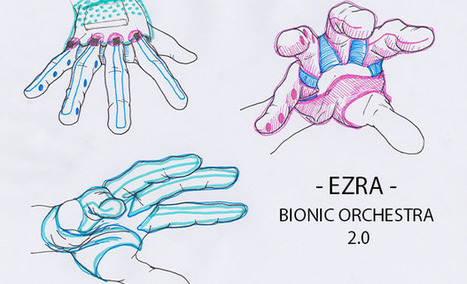
« L’humain a toujours fait des bruits, de la musique et imité son environnement avec la bouche. L’enregistrement et la synthèse ont enrichi le paysage sonore durant le 20ème siècle. L’humain s’en est naturellement inspiré en poussant l’organe vocal dans une diversité technique sans doute encore jamais égalée. Depuis la fin des années 1970 à New York, on nomme cet art le « Human Beatbox ». Au commencement donc était le souffle...nous plongeant à l’endroit même de l’expression non verbale et du rapport passionnel qu’entretient l’humain et la machine. Ne voulant qu’aucun artifice vienne altérer cette musique organique, j’ai continué à transformer, jouer, créer. Puis finalement, je me suis pris au jeu de ce que m’ offrent les technologies de notre temps. Décomplexé de transformer ce souffle, c’est de manière passionnée, presque effrénée, que je me suis mis en quête de créer l’outil qui nous permette d’un geste, de nous démultiplier, de modeler la matière sonore mais aussi lumineuse et de la déplacer dans l’espace où baigne la foule. » Ezra
|
|
Scooped by
Jacques Urbanska
May 15, 2013 6:17 PM
|
The New Media Art and Video Festival TRANSITIO_MX is one of the most important stages for expression and analysis of contemporary artistic practices by technology and digital culture. The event's main objective is to support, recognize and disseminate current research and production around artistic media technology, through an exposition, a contest, a symposium and workshops, the first edition was held in 2005, since then every festival has had a specific theme, in 2013 the festival will address the issue of Biomediaciones.
|
|
Scooped by
Jacques Urbanska
May 15, 2013 5:24 PM
|
“Sympathetic Resonance” (2009) dimensions vary african padauk, birch veneer plywood, aluminum, yarn mallets, rotary solenoids, brass, wires, magnets, boot lace, electronic components. Sympathetic Resonance is an interactive musical instrument sculpture that utilizes the keys of a marimba (a mallet-percussion instrument of african origin) to create four and a half playable octaves. The sculpture consists of 56 "units," each containing a different note, as well as a yarn-wound mallet affixed to a rotary solenoid which allows the note to be triggered by a touch-sensitive aluminum keyboard played by the viewer. The sculpture's modular design allows it to completely change configuration from installation to installation. Each unit can be either mounted or placed on the floor or mounted to a wall, and can be connected to the keyboard with a wire of any length.
joshuakirsch.com/symres.html
|
|
Rescooped by
Jacques Urbanska
from Flux VJing
May 15, 2013 5:15 PM
|
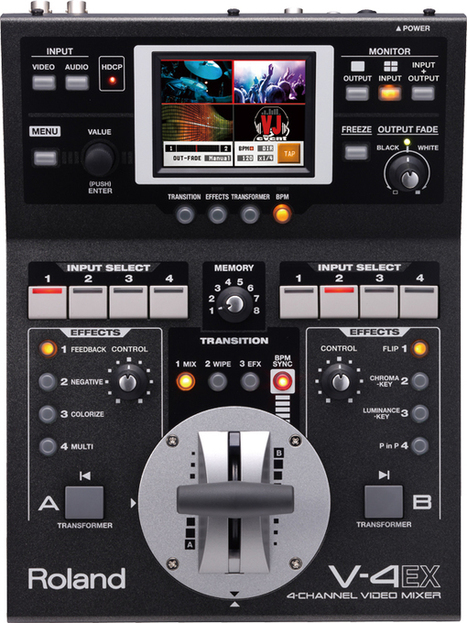
Nous le demandions depuis 2006, il arrivera au deuxième trimestre 2013, le nouveau mélangeur vidéo de Roland V-4EX. 4 canaux intégrant des entrées et sorties HDMI, ENFIN. Cette nouvelle bestiole possède un écran tactile multiviewer pour le retour vidéo, un port USB pour le streaming, prend en charge le HDCP idéal pour récupérer des sources venues de Blu-rays ou de console de jeux, les classiques effects et transitions, sans oublier la célèbre T-Bar. L'Output pourra sortir jusqu'en 1920x1200 pixels ou encore du 1080/50p. Sortie prévue de la V-4EX deuxièmes trimestres 2013. 1995 $ la bestiole.
Via LeCollagiste
|
|
Rescooped by
Jacques Urbanska
from The Digicult Daily
May 15, 2013 3:59 PM
|
The Digital Now is an exhibition series exploring international current art practices in relation to the contemporary media and digital framework. "Drones/Birds: princes of ubiquity", the first chapter of the series, took place in Brussels one month ago, from April 10 to April 21, 2013. This is the report of the exhibition, one the most interesting and challenging in Europe in this first part of 2013. Thanks to Nicolas Wierinck. With Honor Harger, Zimoun Studio Zimoun Paolo Cirio Erica Scourti....
Via Marco Mancuso
|
|
Rescooped by
Jacques Urbanska
from Robots
May 15, 2013 3:12 PM
|
La cybernétique est une industrie en pleine expansion. Pour cause, les robots font de plus en plus partie de notre quotidien et devraient sous peu, par mimétisme, se comporter comme les humains.
Via Gauthier Bouly
|
|
Scooped by
Jacques Urbanska
May 14, 2013 11:12 AM
|
This book is has been commissionned by PACKT PUBLISHING to Julien Bayle, author and digital artist. You can read one of the official first post about the book here.You can read an official interview by Arduino Blog here
“C Programming for Arduino will open new fields of knowledge by looking at input and output concept, communication and networking, sound synthesis and reactive systems design. Readers will learn the necessary skills to be able to continue their travel by looking at the modern world differently, not only as a user, but also as a real maker” – Julien Bayle
|
|
|
Scooped by
Jacques Urbanska
May 17, 2013 11:17 AM
|
A short interview with Tamas Navarro about his installation True Hologram. Navarro is presenting his work at V2_'s Test_Lab: The Graduation Edition 2012, July 5th : v2.nl/events/test_lab-the-graduation-edition-2012 and at the Piet Zwart graduation show Exception Handling, also at V2_ from July 6 to July 15: v2.nl/events/exception-handling About the installation: True Hologram is a lens-based and self-invented device that projects a photorealistic volume in a column of cold mist. The device gathers DIY methodologies, smart/affordable approaches to 3d imaginery and re-adapted technology in order to achieve a 3D display using light, lenses and photographic transparencies. True Hologram is an artistic and intuitive advance of futuristic cinematic outcomes. The research has been executed as an artistic, intuitive investigation about futuristic screening devices, working exclusively with self-invented methodologies.
|
|
Scooped by
Jacques Urbanska
May 17, 2013 10:52 AM
|
-The Boston Cyberarts Gallery is pleased to present Poetic Codings, straight from its premiere exhibition at the Fellows of Contemporary Art gallery in Los Angeles. The exhibition includes three projections by John Carpenter, Casey Reas and Jeremy Rotsztain as well as 20 original, interactive iPad artworks by 8 artists including John Baldessari, Jason Lewis, Lia, Erik Loyer, Jeremy Rotsztain, Rafaël Rozendaal, Scott Snibbe and Jody Zellen. This exhibition includes computer projections by three of the finest new media artists on the West Coast. In the wonderfully interactive Dandelion Clock by John Carpenter, the viewer’s proximity blows the seeds of a digitally created dandelion about the wall. Jeremy Rotsztain’s Action Painting is a video projection transferred onto a large canvas in the style of Jackson Pollock. It is composed using data from action movies as material. Casey Reas, one of the inventors of Processing (a computer language for artists), presents Signal to Noise (Software 1), which uses television signals as a raw material distorting contemporary information into new abstract data structures. ...
|
|
Scooped by
Jacques Urbanska
May 17, 2013 10:17 AM
|
The Memory Room is a project by the Cork-based multimedia artist Danny McCarthy, whose pioneering art practice explores a combination of visual and auditory experiences. This new work consists of an ongoing series of installations in conjunction with a new book and CD published by the Irish sound art label, Farpoint Recordings. The project is curated by Anthony Kelly. Exhibition: 23 May – 07 June 2013
SoundFjord, Unit 3b – Studio 28, 28 Lawrence Road, LONDON, N15 4ER
Opening hours: THURS: 2-8pm | FRI - SUN: 2pm-6pm | or by informal appointment (RSVP)
|
|
Scooped by
Jacques Urbanska
May 17, 2013 10:04 AM
|
Un orgue à patates et une “double plaque chauffantes musicale” (de poche). Un Wiibrator, c’est-à-dire un logiciel pour transformer une manette Wii en vibromasseur. Un Bricophone, un projet de téléphones mobiles “libres” à très bas couts pour téléphoner, gratuitement, en réseau maillé… Des ateliers pour fabriquer des écrans tactiles “Multitouch“, un transmetteur FM USB, ou encore des circuit bending, du nom donné aux bidouillages (ou “court-circuitages”) de jouets électroniques afin de les transformer en instruments de musiques expérimentaux. Le premier “Hacker Space Festival (HSF), comme son nom ne l’indique pas, se déroule jusqu’à ce dimanche 22 juin dans un atelier d’artiste, au sous-sol d’un ancien entrepôt de la zone industrielle de Vitry-sur-Seine, en banlieue parisienne (il est aussi plus ou moins retransmis sur justin.tv). ...
|
|
Scooped by
Jacques Urbanska
May 17, 2013 9:57 AM
|
Lieux d'exposition
------------------------------
Trace(s) - festival des arts numériques - Bagnols-sur-Ceze (FR)
Prieuré Saint-Pierre - Pont-Saint-Esprit (FR)
Exposition d’art contemporain Sillages Numériques
15/05/2013 - 08/06/2013
------------------------------
Galerie H+ - Lyon (FR)
12 avril - 29 mai 2013 : www.h-pl.us
------------------------------
Galerie d'exposition de la Bibliothèque Municipale de Lyon La Part-Dieu - Lyon (FR)
Rencontres réelles et imaginaires / Curator : Violaine Kanmacher
06/04/2013 - 29/06/2013
|
|
Scooped by
Jacques Urbanska
May 17, 2013 9:46 AM
|
|
|
Scooped by
Jacques Urbanska
May 16, 2013 12:01 PM
|
Perte de Signal est un centre d’artistes montréalais dont le mandat est de promouvoir le renforcement et le rayonnement des arts numériques et l’innovation artistique liée à la technologie. De la performance audio à la projection vidéo en passant par l’installation mécanique/robotique et l’intervention publique, le travail des membres de l’organisme se décline à travers différents médiums et à travers l’exploration d’une variété d’approches plastiques et formelles. Les activités de Perte de Signal favorisent principalement : 1) le rayonnement du travail de ses membres sur la scène nationale comme internationale;
2) le soutien à la recherche-création et à l’expérimentation artistique;
3) l’élaboration d’une réflexion critique sur les arts numériques; et
4) la médiation auprès des différents publics. Enfin et surtout, Perte de Signal se veut un lieu de rencontre qui favorise les initiatives, les collaborations, les échanges et la transmission des savoir-faire au sein de la communauté artistique dans son ensemble.
|
|
Scooped by
Jacques Urbanska
May 15, 2013 5:53 PM
|
Glowing Pathfinder Bugs, an interactive art project primarily aimed at children, uses projection to visualise virtual bugs on a real sandpit. The bugs are aware of their surroundings and respond to its form in their vicinity. By changing the shapes and forms in the sand, the bugs’ environment is altered in real time, creating a direct form of communication between virtual bugs and real people.
This highly malleable and tactile physical environment allows us define and carve out landscapes in which the creatures exist, in real time. The piece, originally commisioned by Folly Gallery for Portable Pixel Playground, encourages a simple form of animal husbandry; a sense of looking after, controlling, breeding and caring for the bugs. ... http://www.squidsoup.org/bugs/
|
|
Rescooped by
Jacques Urbanska
from FabLabs & Open Design
May 15, 2013 5:19 PM
|
Our reporter builds a handcrafted cellphone using widely available parts and online instructions
SUDDENLY, my phone rings. It chirps out a tinny version of what sounds like the Christmas carol Angels We Have Heard on High. I am giddy with amazement. On the fifth floor of the MIT Media Lab in Cambridge, Massachusetts, David Mellis has just plugged in the mobile phone I spent all afternoon soldering together. That's right: I just built a cellphone. By hand. Mellis is a graduate student in the High-Low Tech lab, a group of engineering evangelists trying to bring technology know-how to people who perhaps thought it was out of reach. In 2005, he helped found Arduino, a company that makes easy-to-program microprocessors and sells them on simple circuit boards. The idea is to help people make electronic products without needing a degree in computer science. They're popular among hobbyists, hackers and the sort of people who end up working at the Media Lab but they're hardly mainstream. Mellis wondered if he could take the idea further.
Via Aurelie Ghalim
|
|
Rescooped by
Jacques Urbanska
from Arduino, Processing
May 15, 2013 4:06 PM
|
Cette fois-ci, en ce premier jour de l'an, c'est la finalisation des tutoriels en Français que nous annonçons (accessibles ici et là) :-). Exemple provenant du tutoriel. Source: AdaFruit Autorisation: AdaFruit Industries.
Via anthony cocherie
|
|
Rescooped by
Jacques Urbanska
from UseNum - ArtsNumériques
May 15, 2013 3:57 PM
|
Cet article est tiré du Digitalarti Mag 13, à lire en ligne gratuitement.
Avec son exposition "Art Cinétique – Art Numérique", la galerie parisienne Denise René propose un exercice de rapprochement entre art cinétique et art numérique qui tombe sous le sens. Celui du mouvement et de l’interaction révélée à travers des oeuvres où le spectateur reste plus que jamais au centre du processus artistique.
Exposition Julio Le Parc au Palais de Tokyo, présentation de pièces de Jesús-Rafael Soto dans les murs du Musée national d’art moderne au Centre Pompidou, sans oublier deux rétrospectives plus discrètes mais tout aussi essentielles de ces deux artistes-phares au sein des deux espaces - Rue Charlot et Boulevard Saint-Germain - de la galerie Denise René, l’art cinétique a démarré l’année 2013 avec une visibilité qui n’échappera pas au grand public. Preuve en est avec la manifestation monumentale Lumineux! Dynamique! Espace et vision dans l’art, de nos jours à 1913 qui vient tout juste d’investir le Grand Palais et qui, surtout, ne s’arrête pas à la seule volonté de dresser une rétrospective des oeuvres de ses grands maîtres. Dans ce contexte, la Galerie Denise René témoigne de sa spécificité avant-gardiste, fer de lance de l’art cinétique, dont elle est le lieu dédié le plus ancien d’Europe — créée par Denise René et sa soeur Lucienne en 1944 pour faire connaître les dessins et des compositions graphiques de Victor Vasarely, avant de produire l'exposition Le Mouvement, réalisée avec Pontus Hulten, et marquant la naissance de l'art cinétique proprement-dit en 1955...
Via Suteau Alexandre
|
|
Scooped by
Jacques Urbanska
May 14, 2013 11:17 AM
|
"Voice Array" is a construction for vocal improvisation that uses blinking LEDs and a customized intercom system of audio playback and recording. Capturing hundreds of voices and translating each one into a series of light flashes, the piece stores a unique pattern as a loop in the first light of the array, until the next participant speaks into the intercom. Each new recording is pushed along its long horizontal band of LEDs, as sounds of the voices gradually accumulate. When the first voice reaches the other side of the piece, the participant’s phrase is once again released as sound, punctuated by the staggering pulsation of all the lights in tandem. The ever-changing voices stored by the piece play back through a directional speaker, during moments of less activity. Commissioned by the Museum of Contemporary Art, Sydney. Video courtesy of the artist and bitforms gallery nyc. To learn more about Lozano-Hemmer's work, please visit:
bit.ly/pSbJgx
bit.ly/HeemCA
|