Media Arts Watch Lab - www.arts-numeriques.info - laboratoire de veille Arts Numériques - twitter @arts_numeriques - @processing_org - @DigitalArt_be - by @jacquesurbanska @_Transcultures
ECAL Media & Interaction Design + ECAL Industrial Design Workshop led by the dutch designer Roel Wouters – Moniker. Projects realised by the students in Media & Interaction Design in collaboration with the Industrial Design students.
Brief: Build an apparatus that produces videos the world has never seen before.
MID is an interaction design and technology studio, specialising in engineering, interactive design and new media. We work with museums, marketing and communication agencies, architects, public institutions, companies, entrepreneurs, musicians and artists.
Cet article est tiré du Digitalarti Mag 13, à lire en ligne gratuitement.
Avec son exposition "Art Cinétique – Art Numérique", la galerie parisienne Denise René propose un exercice de rapprochement entre art cinétique et art numérique qui tombe sous le sens. Celui du mouvement et de l’interaction révélée à travers des oeuvres où le spectateur reste plus que jamais au centre du processus artistique.
Exposition Julio Le Parc au Palais de Tokyo, présentation de pièces de Jesús-Rafael Soto dans les murs du Musée national d’art moderne au Centre Pompidou, sans oublier deux rétrospectives plus discrètes mais tout aussi essentielles de ces deux artistes-phares au sein des deux espaces - Rue Charlot et Boulevard Saint-Germain - de la galerie Denise René, l’art cinétique a démarré l’année 2013 avec une visibilité qui n’échappera pas au grand public. Preuve en est avec la manifestation monumentale Lumineux! Dynamique! Espace et vision dans l’art, de nos jours à 1913 qui vient tout juste d’investir le Grand Palais et qui, surtout, ne s’arrête pas à la seule volonté de dresser une rétrospective des oeuvres de ses grands maîtres.
Dans ce contexte, la Galerie Denise René témoigne de sa spécificité avant-gardiste, fer de lance de l’art cinétique, dont elle est le lieu dédié le plus ancien d’Europe — créée par Denise René et sa soeur Lucienne en 1944 pour faire connaître les dessins et des compositions graphiques de Victor Vasarely, avant de produire l'exposition Le Mouvement, réalisée avec Pontus Hulten, et marquant la naissance de l'art cinétique proprement-dit en 1955. Pour l'exposition Art Cinétique – Art Numérique, la Galerie Denise René procède, à travers le choix des pièces présentées, à un rapprochement plutôt circonstancié entre cet art cinétique et une création numérique actuelle qui participe désormais, par ses grands principes, mais aussi par ses outils, ses pratiques et certains représentants parmi les plus talentueux de sa nouvelle génération d’artistes, au renouvellement de ses formes expressives. C’est un véritable enjeu qui se dessine là. Autant pour la capacité d’évolution de l’art cinétique, qu’en termes d’opportunité pour l’art numérique de s’inscrire dans le sillage d’un des courants artistiques majeurs du XXème siècle.
the conceptual architectural project uses existing and prototype technologies, transforming solar cells into leaves, batteries into fruits, and lights into 'blossoms' in a 'miniature ecosystem'.
working at the nexus of architecture, technology, and sculptural design, japanese architect akihisa hirata collaborated with panasonic technologies to develop the solar-powered installation 'photosynthesis', on exhibition during milan design week 2012 at the interni pavilions at the università degli studi di milano.
the concept for the project is creating an 'artificial miniature energy system'-- a kind of conceptual prototype for future architecture-- that is powered by the flow of solar energy. the theme of the interni exhibition this year is 'legacy', which hirata chose to interpret from the perspective of leaving a legacy for the future.
A la base du THSF il y a les hackerspaces qui sont des laboratoires plus ou moins formels où tous ceux qui le désirent se regroupent sur des projets touchants à la science, aux technologies, aux arts numériques et à l'informatique. Le THSF permet donc de créer une rencontre qui brasse des gens venant d’horizons culturels et techniques très divers, autour de l’utilisation créative des technologies, leur appropriation et la compréhension des enjeux qu’elles suscitent.
Cette année le thème sera le « RE » l’évènement s’articulera autour de la REconstruction, REprogrammation, REinitialisation et de la bidouille en général.
Que vous soyez connaisseurs ou non, le THSF vous fera découvrir le monde des hackers, qui vous ferons partager leurs connaissances, leurs savoir faire, et leurs philosophies.
Comme chaque année l’évènement s’articulera autour de conférences, ateliers pratiques et propositions artistiques (concerts, performances, installations…). Ce partage de connaissance se déroulera comme chaque année dans une ambiance festive, conviviale et interactive.
Comme pour les éditions précédentes, les rencontres seront enregistrés et retransmises en streaming sur internet, avec en plus cette année le plateau de (des)information TV
Trampoline is a pioneering agency for Art and Media based across Nottingham (UK) and Berlin (Germany). Supporting and developing artists working at the critical edge of emerging technology and digital culture.Company Overview
Founded in 1997, Trampoline is an Agency for Art and Media based across Nottingham (UK) and Berlin (Germany) internationally renowned as a leading arts agency that supports and represents new media arts practice and artists. Trampoline curates and produces festivals, exhibitions, projects, platform events, international conferences, workshops and artists’ residencies in the UK and across Europe.
As an agency, Trampoline has been at the forefront of commissioning award-winning, innovative and critically acclaimed art projects often involving fostering inter-disciplinary and collaborative projects including work by Active Ingredient, Blast Theory, Simon Heijdens, Michelle Teran, Heath Bunting and plan b.
Trampoline are the producers of Radiator Festival & Symposium, the East Midlands' premiere digital and media art festival that launched in 2000.
Trampoline’s current activities include the international touring project “Tracing Mobility”, an innovative mobile symposium and exhibition project, bringing together artists and researchers from all over Europe who take as their inspiration the transformed conditions of a networked, urban society.
La synesthésie, cette idée de fusion des sens, est une métaphore très présente dans la création artistique. Bien souvent, celle-ci n'est pas recherchée dans le but de recréer fidèlement le phénomène, mais plutôt dans celui d'offrir une nouvelle expérience perceptive et/ou sensitive au spectateur. Ce travail de recherche résume le parcours de la synesthésie « son-couleur » en tant que véritable phénomène neurologique,puis en tant que métaphore artistique,tout au long du XXème siècle.Il pose alors les bases d'une démarche plus personnelle et appliquée, concentrée sur la création actuelle: La création à l'ère du numérique.
Depuis l'apparition de l'art dit "numérique",la métaphore de synesthésie est devenue plus puissante grâce à la fusion des différents médias dans un même langage, mais pas seulement... Les frontières entre ce qui émane du monde virtuel et ce qui appartient au monde réel s'amenuisant de plus en plus,des propositions de retour de la matière numérique à l'état de matière physique font alors surface.À partir de cela,l'auteur imagine le concept d'une « matérialisation » du son,à travers de nombreuses œuvres et démarches artistiques, dont la sienne.
Archive for Change is a project initiated by the artists and filmmakers Julie Ballands, Taryn Edmonds and Laura Maragoudaki in 2010, which had the aim to explore urban and social changes in Newcastle upon Tyne (UK). The project is actively supported by the local community and its organizations, because it investigates directly the constant process of transformation of the city, taking Newcastle’s West End as a case study.
As they declare: “Although the history of Newcastle’s West End is unique, it echoes the path of other post industrial towns, and one thing is certain: people have continued to live their lives, build communities and hold onto their roots and memories. Archive for Change is an attempt to celebrate and preserve those stories for years to come”.
The artists took into consideration the process of ‘regeneration’ of a specific city – Newcastle upon Tyne – but similarities can be seen all across the UK. They started to analyze how the urban landscape has changed due to industry developments from post-war to the present, coming into the conclusion that most of the time people were forced to leave their houses. ...
Lumigrids is an LED projector for bicycles, which aims to improve safety during night riding. It projects square grids onto the ground. By observing changes in the grids, the rider can easily comprehend the landforms ahead.
Lumigrids can project a grid onto the ground. On a flat road surface, the grid will consist of standard squares. On a rough road surface, the grids will deform accordingly. By observing the motion and deformation of the grids, the rider can intuitively understand the landforms ahead. In addition, the luminous grids can make it easier for nearby pedestrians and vehicles to notice the bicycle, reducing the likelihood of collision.
Connected Heartbeats is a light-based art installation that translates the sounds of two hearts into a moving visual pattern. A microphone embedded in a stethoscope picks up the sound of your heart and translates it into a moving visual pattern. A second stethoscope allows an additional person to join in, creating a mesmerizing sequence of moving patterns based on each individual's heart rate. Studies have shown that people's heartbeats when in a group of friends or relatives often sync up or harmonize during emotional events. Connected Heartbeats is an experience that binds people together through the visuals created by and for them.
Special Thanks to Max Ma for helping with Video Documentation.
Tutorial how to output algorithmically created graphical ornaments or representations of data in Processing to multiple page documents, ready for offset print with process (CMYK) and spot colors.
Last month at Resonate festival in Belgrade Andreas Gysin ran a workshop titled “Printshop With Processing” aimed at graphic designers who want to integrate Processing in their print-production workflow. The participants discussed and experimented with different ways on how to output algorithmically created graphical ornaments or representations of data to multiple page documents, ready for offset print with process (CMYK) and spot colors. Using this tutorial and examples, previously edited vector graphics, typography blocks or entire layouts in PDF documents can be imported, manipulated and used as templates instead of adding them later-on ‘by hand’. ...
We are pleased to present On the Upgrade – WYSIWYG, a new or-bits.com publishing project.
On the Upgrade – WYSIWYG is a POD book, also distributed as a PDF, which includes artworks by Jamie Allen, Renee Carmichael, David Horvitz, IOCOSE,Michael Kargl, Sara Nunes Fernandes, Julia Tcharfas, Maria Theodoraki and Richard Sides along with interviews contextualising the artistic processes of the featured artists.
On the Upgrade – WYSIWYG is a book exhibition, or an exhibition in a book. It is a new configuration of selected material that was firstly presented online or for web broadcast and operates as an artistic, curatorial and design re-alignment of material originally compiled for online consumption for the book interface. The starting point of this project was that of conceiving the book format as an interface and reflecting upon the tensions that might exist between this holdable interface and the web interface along with that of the computer. Thereby reading patterns, the specificity of engagement with the material presented in a book and what site-specificity might mean in relation to moving between online and offline modes of presentation are some of the aspects that have been considered at the time of the making of the book. ...
The way we perceive our environment is a complex procedure. By the help of our vision we are able to recognize friends within a huge crowd, approximate the speed of an oncoming car or simply admire a painting. One of human’s most characteristic features is our desire to detect patterns. We use this ability to penetrate into the detailed secrets of nature. However we also tend to use this ability to enrich our imagination. Hence we recognize meaningful shapes in clouds or detect a great bear upon astrological observations.
Objective investigations and subjective imagination collide to one inseparable process. The tendency to detect meaning in vague visual stimuli is a psychological phenomenon called Pareidolia, and captures the core interest of this project. ...
Le mois de «Mai numérique» s'achèvera ce week-end avec la 7ème édition de «Nightshot», à Malves-en-Minervois. Hier matin, dans les locaux carcassonnais du «GRAPh», Éric Sinatora, son directeur, a présenté le programme de ce dénouement en compagnie d'Arnaud Eeckhout et Vivian Barigand, deux jeunes étudiants aux Beaux-Arts de Mons (Belgique). Ils proposeront «Twist», l'une des animations des deux soirées de clôture prévues vendredi (18 h 30 à minuit) et samedi (17 heures à 1 heure du matin). De quoi s'agit-il ? De faire vivre un mur en aluminium de 5 mètres sur 4, «qui générerait un objet à la fois organique et hypnotique, quelque chose d'étrange où s'entretient un rapport mystérieux entre la machine et la nature», expliquent Arnaud et Vivian. ...
The examined topics are the immaterial working materials ofl ight and sound in soundart, based on installations by Christina Kubisch. The text begins with the sound installation as a combination of music and fine arts, it moves on from acoustic and visual materials of sound and light to the auditory and visual senses. The last, abstracting step is the examination of perception and idea and lastly the return to sound installation and its effect on the audience...
L’écologie du son pourrait être définie comme rapport de la musique ou du son à l’oikos, la demeure commune, le monde. Félix Guattari nomme trois écologies : environnementale, sociale et mentale. On pourrait donc demander : quels sont les liens de la musique ou du son avec l’environnement et la nature, avec la société, avec la subjectivité au sens large du terme et, plus généralement, quels sont les liens entre musique-son et monde ?
L’écologie du son pourrait être définie comme rapport de la musique ou du son à l’oikos, la demeure commune, le monde. Félix Guattari nomme trois écologies : environnementale, sociale et mentale. On pourrait donc demander : quels sont les liens de la musique ou du son avec l’environnement et la nature, avec la société, avec la subjectivité au sens large du terme et, plus généralement, quels sont les liens entre musique-son et monde ? L’étude de ces liens sera l’occasion de délimiter un champ artistique florissant et de plus en plus étendu, allant de pratiques fondées sur la notion de paysage sonore jusqu’aux « écosystèmes audibles » d’Agostino Di Scipio. ...
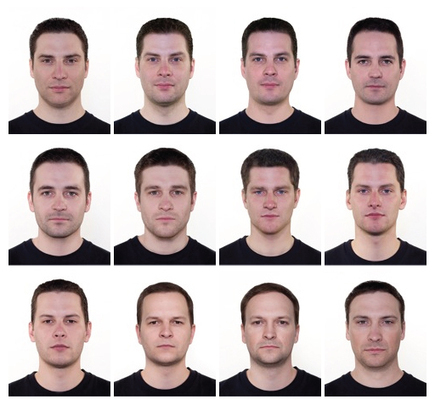
Pendant six mois, douze artistes du collectif tchèque Ztohoven ont vécu avec la même identité. Ils ont voyagé, voté, acheté des armes et se sont même mariés sans que personne ne s'en aperçoive.
Cette histoire incroyable est racontée actuellement par le collectif dans l'exposition londonienne "Cultural Hijack" (détournement culturel). Elle a commencé en 2010, quand ces douze artistes ont adopté la même coupe de cheveux et fusionné leurs photos d'identité à l'aide d'un logiciel de morphing. Ils ont ensuite demandé de nouvelles cartes d'identité sous de faux noms.
monochrom is an art-technology-philosophy group of basket weaving enthusiasts and theory do-it-yourselfers having its seat in Vienna and Zeta Draconis.
monochrom is the super-affirmation of the globalization trap. monochrom has existed in this (and every other) form since 1993.
monochrom is an unpeculiar mixture of proto-aesthetic fringe work, pop attitude, subcultural science and political activism. monochrom publishes the book of the same name in addition to its activity in other areas. What are we doing?
monochrom is an open field of experimentation: international art scene, panel discussion event technology, souls bought and sold, game and shame shows, readings of the dreariest sort, theory cocooning, film short processing, website squatters' consultancy, alternative space travel projects, do-it-yourself surveillance courses, riddle rallyes, ecumenical field services, overhead projector comics, circumstantiation, Power Point fairytales, layouting and decomposition, propagandistic summer camps, monumental puppet theater, aesthetic pregnancy counseling, producing, promoting and destroying music, party service, expressional dance, Biennial brawls, GDR rock, DJ events and lots more...
Among their projects, monochrom has released a leftist retro-gaming project, established a one baud semaphore line through the streets of San Francisco, started an illegal space race through Los Angeles, buried people alive in Vancouver, and cracked the hierarchies of the art system with the Thomann Project. In Austria they ate blood sausages made from their own blood in order to criticize the grotesque neoliberal formation of the world economy. Sometimes they compose melancholic pop songs about dying media and they have hosted the first annual festival concerned with cocktail robotics.
monochrom's mission, its passion and quasi-ontological vocation, is primarily the collection, grouping, registration and querying (liberation?) of the scar tissue represented by everyday cultural artifacts. This mission is conducted everywhere, but first and foremost in culture-archeological digs into the seats (and pockets) of ideology and entertainment.
What does that all mean. Everything and nothing. Anyway, you feel well but are afraid of skin cancer.
The appearance of FS/Partial is deeply related to spectograms. The graphical propositions embodied by these representations are the core for the shape and mechanics of this device.
FS/Partial has a rather strict purpose, preform additive synthesis in live contexts. Therefore, every technical feature and design option works towards a clear and inteligible solution to visually display the Fourier series. The device provides physical control over 8 harmonic partials. The height of each tube is resposible for the amplitude of the sine it controls. From left to right, partials' frequencies get higher, the leftmost being the fundamental frequency of the produced signal.
Additional control is given through two horizontal faders located on the side of the device. One is responsible for setting the fundamental frequency , thus moving all the partials along the spectrum in equal intervals; the other, works like a low-pass filter, cutting off partials that are currently outside the interval defined by the two faders.
There was a long tradition of dismissing and repressing experimental music in Central and Eastern Europe during socialist times. And even after 1989 the West didn't fully explore what was missed in those decisive few decades. This book begins the process of making up for lost time, bypassing the classic academic approach in an elegant and constructive way. It's a trans-regional effort, funded by Goethe Institute, coordinated by the musicologist Föllmer and the two artistic directors Stabenow and Seiffarth, who have spent time and organized meetings, events and workshops in the culture capitals of the respective countries: Budapest, Bratislava, Prague, Krakow, Riga, Vilnius and Tallinn. ...
L’art des bruits a cent ans, la techno en a vingt. Pop, rock, punk ou ethno, petit tour en mode après-coup du vent d’électro qui souffle de Chine, de la Mer noire ou d’Australie. Où l’on évoque Russolo, Derrick May, les Qwartz Awards, Sonic Protest, et autres « Renée se voit en botaniste dans les plans hyperboles »...
Le 4 avril, le printemps des avant-gardes était invité à la Machine du Moulin Rouge, pour les Qwartz et leur célébration des Musiques nouvelles (improvisées, montées, éditées, concrètes ou électro-acoustiquement composées). Parmi les labels Lentonia Records (dédié aux compositrices électro), Staalplaat et M-Tronic, Avoka présentait son Dyskograf : Jesse Lucas, Erwan Raguenes et Yro ont d’ailleurs reçu le prix Qwartz-Max Mathews pour ce lecteur de disques graphiques (qui concourt actuellement dans la catégorie design aux Fubiz Awards).
Espace de travail partagé, situé au niveau de la rue dans le centre historique de León, coworking à la recherche de liaison d'idées, de projets, d'interaction, d'échange de points de vues et d'une relation positive entre les personnes et les entreprises, dans un cadre agréable et inspirante.
Nous entendons la collaboration comme un ensemble d'individus, des professionnels, d'emplois et de solutions qui impliquent la créativité, l'innovation et des pratiques entrepreneuriales englobentes pour développer et intégrer des technologies afin de répondre à nos besoins. ...
kanonmedia is specialized on innovative film and media productions with a focus on processing, conceptual and experimental arts, interventions in public space and sociocultural engagement. kanonmedia productions are strongly characterized by comprehensive thematic research, strong political position raising its voice for and empowering socially disadvantaged groups of population as well as the conscious employment of cutting-edge technologies. Founded in 1996 by Alexandra Reill who – after ten years of film business - focused on the development of interactive dramaturgies and applications, kanonmedia today serves as a NGO with highly innovative inhouse productions and as an internationally active networking / content providing / exhibition platform for activities in the context of sociocultural communication, film and the arts. kanonmedia is based in Vienna / Austria.
resonate is a project of Master´s programm "Komunikation im Raum" FH Mainz and the Master´s programm "Klangkunst-Komposition" HFM Mainz for Luminale 2012.
There’s a reason for Processing’s popularity. By making code simple, elegant, and direct, and catering directly to the kinds of visual ideas creative people have, the environment has made programming accessible to artists and designers in a way nothing else could.
Coding no longer has to be a source of fear, or a bad word.
But Processing, years into its life, has also badly needed a refresh. 2.0 is more than just a house cleaning. It’s a new direction, with “modes” that mean it’s no longer tied to old desktop Java architectures. (See a tantalizing screenshot below – with the click of a menu, you can make CoffeeScript JavaScript for the Web, or run on Android.)
I still love Processing as a way of sketching out ideas, and with strategic use of the GPU in its now-native OpenGL rendering, it can also be surprisingly high-performance.
Of course, that 2.0 reboot has been a long time coming, enough so that you might have even forgotten it was enroute. That’s why the recent 2.0 beta 9 is big news. It includes some major new features that finally reveal what 2.0 is all about – and bug fixes that have been a long time coming. In fact, it’s that moment when the betas stop looking so much like betas. Here’s what to expect. ...
To get content containing either thought or leadership enter:
To get content containing both thought and leadership enter:
To get content containing the expression thought leadership enter:
You can enter several keywords and you can refine them whenever you want. Our suggestion engine uses more signals but entering a few keywords here will rapidly give you great content to curate.


 Your new post is loading...