Your new post is loading...

|
Scooped by
Jacques Urbanska
June 15, 2013 6:24 AM
|
Unless you’ve been living in a remote island for the last few years, you’ve heard about crowdfunding or stories of people raising thousands or millions of dollars online. In fact, there’s been so much chatter out there about crowdfunding that people love to throw out the line “yeah, I’ve heard there are something like 500 crowdfunding sites.” While hundreds of sites may be popping up, not all of them have real communities and funding successes under their belt. Which begs the question… what crowdfunding site is best for you? As a crowdfunding industry insider, I thought I’d give you an easy guide for which site to go to for your crowdfunding needs. I’ll start with a tiny overview of the industry, a short primer on the different types of crowdfunding so you know what you’re looking for, and then I’ll get to specific recommendations for you. The Crowdfunding Industry Collaboration on the web is an area of exponential growth. Crowdfunding, or collaborative funding via the web, is one of the standouts for growth in this evolving collaborative economy. The Crowdfunding Industry Report by Massolution put out data showing the overall crowdfunding industry has raised $2.7 billion in 2012, across more than 1 million individual campaigns globally. In 2013 the industry is projected to grow to $5.1 billion. ....
|
|
Scooped by
Jacques Urbanska
June 15, 2013 6:00 AM
|
The research platform LarbitsLab from Brussels has been invited by the organizers of the conference HyberUrbain.4 on Hybrid Mobility in Valenciennes, to present its project the Flanograph. The Flanograph is a mobile application for smartphones, based on augmented reality, which captures, stores and reproduces patterns of movement – digital tracks – by registering a number of sensory data. Hereby, the urban environment is not perceived solely through the eye of the camera, but by using a complex of sensors a wide range of physical and social processes – including sound and windspeed on one hand and breathing and heartbeat on the other – is registered. These processes are analysed and converted into visual narratives.
The Flanograph is being developed as a choreographic measuring mechanism that is part of the theories of the scientists and Nigel Thrift and Nanna Verhoeff. Nigel Thrift argues in his Non-Representational Theory: Space, Politics, Affect that space is quantifiable and qualified. The study of the British scientist deals with a new understanding of time and space, derived from the rise of digital data. Thrift notes that new media technologies have a significant impact on the perception. Moreover, movement is created by a continuous influx of calculated data. According to Thrift, the digital rationalization of real circumstances enriches rather than simplify reality. In fact, there are new ways created to gain insight in the world. In her study Mobile Screens, The Visual Regime of Navigation Nanna Verhoeff stresses the importance of mobile screens, which allows a new experience of the environment, including the whole body in the process of making space. Indeed, mobile screens offer a fundamentally different observation, as one has no longer a fixed point of registration, but instead a mobile element, carried by the user. In this way, the smartphone becomes a display that registers movement, in which every sensor notices and stores specific data. Through this, the spatial environment is been defined in a new way.
voir aussi http://hu4.hyperurbain.net
|
|
Scooped by
Jacques Urbanska
June 10, 2013 6:01 PM
|
AudioMulch is an interactive musician's environment for PC and Mac. It is used for live electronic music performance, composition and sound design. AudioMulch allows you to make music by patching together a range of sound producing and processing modules. Unlike some patcher-based programming environments, AudioMulch's modules perform high-level musical functions, so you don't have to create things from the ground up using individual oscillators and filters. AudioMulch is designed for live performance and improvisation - you can process live audio sources and control every knob and slider on the user interface using a MIDI controller.
|
|
Scooped by
Jacques Urbanska
June 10, 2013 8:41 AM
|
Sound recordings from three glaciers in Iceland, pressed into three records, cast, and frozen with the meltwater from each of these glaciers, and played on three turntables until they completely melt. The records were played once and now exist as three digital films. The turntables begin playing together, and for the first ten minutes as the needles trace their way around, the sounds from each glacier merge in and out with the sounds the ice itself creates. The needle catches on the last loop, and the records play for nearly two hours, until completely melted...
|
|
Scooped by
Jacques Urbanska
June 10, 2013 8:36 AM
|
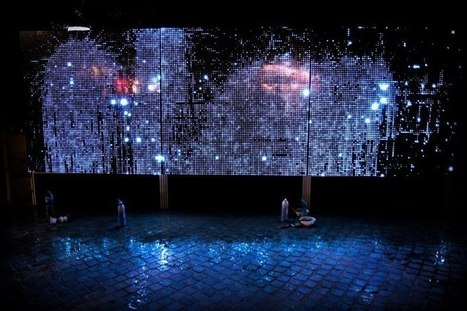
This past summer, while France was liquefying under the scorching heat wave that swept the country, artist Antonin Fourneau unveiled his interactive instalaltion Water Light Graffiti, developed in close collaboration with Digitalarti Artlab. This luminous artwork consists of a surface embedded with thousands of LEDs that light up upon contact with water, thus allowing visitors to create beautiful light frescos with a little help from simple tools like water guns, spray cans, and wet paintbrushes. More recently, as part of Nuit Blanche, crowds in Paris got a chance to marvel at this work with Fourneau, Painthouse collective, and Graffiti Research Lab using it to create luminescent burners. “This structure is a new way for them to emancipate and to experiment. We also wish that we can help the public to stop being so self-conscious, because they’re aware that their artwork is going to disappear anyway,” says Fourneau about the project. ...
|
|
Scooped by
Jacques Urbanska
June 10, 2013 8:25 AM
|
David Fried's "Self Organizing Still-Life" (SOS) is a series of interactive, sound-stimulated kinetic sculptures, which reveal his exploration into the inherent qualities of networked and emergent systems operating far-from-equilibrium intrinsic to nature, individual psyche, communication and social relationships.
Whatever the scale or materials used for the SOS, they all consist of solid hand-made spheres, which are stirred into motion by ambient sound on a predetermined level object. Audible sound is transformed live into waves that silently stimulate each of the spheres into motion. The resulting action of the individual spheres and their interactions with one another are undetermined. They rearrange themselves in continually new patterns of elegantly fluid choreography. Some kiss, some spin off alone, while others race head-on only to meet with a soft embrace, or swerve around one another, often changing the path and destiny of each other without physical contact, as each sphere is able to sense one another.
more on : http://davidfried.com
|
|
Scooped by
Jacques Urbanska
June 10, 2013 8:10 AM
|
Exhibitors | SCOPE - Over 50 critically acclaimed art shows that extend beyond the ordinary in contemporary art.
|
|
Scooped by
Jacques Urbanska
June 10, 2013 7:43 AM
|
Quelque chose est en train de changer avec les images : multipliées, transformées, partagées, leurs vies multiples se jouent des frontières et des lois. Au risque de la banalisation et de la perte du sens, mais aussi de l’invention et de la liberté de créer, pour tous. Bienvenue au festival de la vidéo web créative, participative et collaborative !
entrée libre
> présentation de la 3e édition
|
|
Scooped by
Jacques Urbanska
June 10, 2013 7:34 AM
|
Adobe Creative Days est une série d'évènements dédiés à la créativité sous toutes ses formes pour les professionnels de la création. Vous êtes créatif, directeur artistique, graphiste, designer interactif, illustrateur, développeur web, professionnel de la vidéo,spécialiste des effets spéciaux, photographe, étudiant ou enseignant, ne manquez pas cet évènement où vous pourrez échanger des idées et trouver l'inspiration.
Notez bien la date et inscrivez-vous pour recevoir une invitation au prochain événement qui aura lieu près de chez vous.
|
|
Scooped by
Jacques Urbanska
June 9, 2013 5:17 PM
|
A long piece of rope represents three dimensionally a series of waves floating in space, as well as producing sounds from the physical action of their movement: the rope which creates the volume also simultaneously creates the sound by cutting through the air, making up a single element. Depending on how we may act in front of it, according to the number of observers and their movements, it will pass from a steady line without sound to chaotic shapes of irregular sounds (the more movement there is around the installation) through the different phases of sinusoidal waves and harmonic sounds. But even though this could seem like a mere representation of what we can’t see for ourselves, beyond the persistence of vision, it connects with our most visceral side, combining the intangible beauty of the represented graphic with the brutality of the sound it produces, creating a hypnotic environment of audible results and unique visual stimulations. More info at: danielpalacios.info
|
|
Scooped by
Jacques Urbanska
June 9, 2013 12:41 PM
|
Floe is a kinetic glass sculpture created by four artists and designers from different backgrounds and professions from the Royal College of Art, London; Lida Marinkova (mixed media and textiles), Ozgun Kilic (animation), Oluwaseyi Sosanya (innovation design engineering), Pierre Paslier (innovation design engineering). "The piece is inspired by formations and movement found in nature, it embodies the shape and movement of ice drifting on the surface of the North Atlantic. The glass structure is combined with a simple wave movement and light bringing life to the piece. An interactive element was essential to the project; the audience influences the movement and light intensity with their presence."
|
|
Scooped by
Jacques Urbanska
June 9, 2013 12:34 PM
|
In the "Practice of Everyday Life" Michel de Certeau investigates the ways in which users-commonly assumed to be passive and guided by established rules-operate. He asserts: "This goal will be achieved if everyday practices, "ways of operating" or doing things, no longer appear as merely obscure background of social activity, and if a body of theoretical questions, methods, categories, and perspectives, by penetrating this obscurity, make it possible to articulate them."
"ReFunct Media" is a series of multimedia installations that (re)uses numerous "obsolete" electronic devices (digital and analogue media players and receivers). Those devices are hacked, misused and combined into a large and complex chain of elements. To use an ecological analogy they "interact" in different symbiotic relationships such as mutualism, parasitism and commensalism. Voluntarily complex and unstable, "ReFunct Media" isn't proposing answers to the questions raised by e-waste, planned obsolescence and sustainable design strategies. Rather, as an installation it experiments and explores unchallenged possibilities of 'obsolete' electronic and digital media technologies and our relationship with technologies and consumption.
|
|
Scooped by
Jacques Urbanska
June 9, 2013 12:26 PM
|
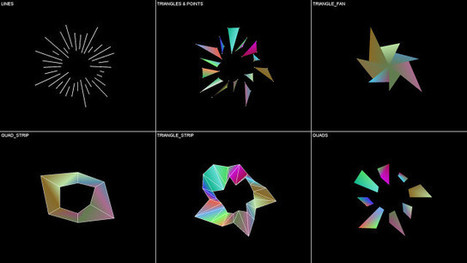
As the title suggests, I’ll be covering a lot of ground in this blog post. My intention is to describe and show practical examples of a number of crucial building blocks for 2D/3D projects. In that sense the tutorial is more a general reference, rather than a step-by-step towards a singular end-result. All of the shared code examples are fully commented, so reading them will tell you what each line of code does. This makes it easier to understand and adapt sketches yourself. In this tutorial I’ll start with the basics, creating custom geometry in two dimensions. Then we’ll look at adding textures to these 2D shapes. Not only is this useful in itself (for 2D visuals), but the concept of texturing is also easier to grasp in 2D. Texturing can be used for a variety of things, not just placing static images onto geometry. One of the examples shows you how to use dynamic texturing and spritesheets to create 2D animations! Once we’ve covered 2D, we’re ready to make the move to 3D. Starting with flying multi-colored pyramids, then creating an earth with vertices, normals, textures and correct texture coordinates. Especially the latter – getting the texture coordinates right – can be quite a challenge. ...
|
|
|
Scooped by
Jacques Urbanska
June 15, 2013 6:11 AM
|
jon.satrom : performs realtime audio/video, spends time data-bending, makes kludgey work-flows, and creates colorful glitch-ware. enjoys working within collaborative projects and open systems.
|
|
Scooped by
Jacques Urbanska
June 13, 2013 9:58 AM
|
The ARTos Cultural and Research Foundation was founded by the artists Achilleas Kentonis and Maria Papacharalambous. It is a contemporary arts and science center dedicated to research and creativity: two magical worlds of adventure and discovery, encompassing sojourns into the fields of learning, chaos and imagination. Its premises, both transcendental and material, inspire the contemporary artist/creator and the scientist/creator alike, offering to both a platform, promoting them at a local as well as at an international level, with quality being the main criterion.
It functions as a multidimensional space, organizing and undertaking the production of multifaceted events from the world of theatre, music, dance, cinema, visual arts, letters and sciences. At the same time, its multipurpose spaces are available to individuals, organizations and other agencies for the hosting of events, presentations, seminars, symposia, conferences and scientific or other workshops.
ARTos is unique in its kind, harmoniously uniting, through a pre-Socratic approach, Art and Science, with the addressor, as well as the ultimate addressee, Man. Because, if civilization is essentially all those scientific and artistic achievements of Man belonging to a specific era, then it is high time for that platform to exist which will bring about the interaction of these two fundamental fields, with the aim of incorporating them into contemporary civilization. It is precisely this role which the ARTos Foundation aspires to play: to attract and challenge the contemporary artist/creator as well as the scientist/researcher, both of whom, through their eternally-inquisitive and unsatisfiable nature, question and doubt, always striving to go one step further. ARTos, in the final analysis, is that space where creative ideas will be born and take shape free of exploitation, and with the intellectual rights of the inspirers and creators being firmly and with respect established and safeguarded.
|
|
Scooped by
Jacques Urbanska
June 10, 2013 8:47 AM
|
Base 8 explores the negative spaces and movements between fingers, hands and arms. A reflection through glass creates the illusion of a world floating in air. As visitors reach into the space, moving structures and abstract geometric forms begin to appear in between their fingers or grow out from their hands and arms. The title of the work was inspired by several rare languages that developed an octal counting base because their culture counted using the spaces in between fingers rather than the fingers themselves (as in the much more common decimal system). ...
|
|
Scooped by
Jacques Urbanska
June 10, 2013 8:38 AM
|
Evan Grant demonstrates the science and art of cymatics, a process for making soundwaves visible. Useful for analyzing complex sounds (like dolphin calls), it also makes complex and beautiful designs. Evan Grant works with cymatics, the art of visualizing sound, and is the founder of the arts and technology collective seeper. Full bio »
|
|
Scooped by
Jacques Urbanska
June 10, 2013 8:28 AM
|
Sound in Context is a short documentary exploring the unique practice of sound within the visual arts world. Through conversations with a number of key art institutions/galleries, artists and curators working with sound in the UK, Sound in Context allows practitioners to discuss some of the issues of presenting and exhibiting sound in the gallery and contemporary art domain. Sound as a medium is time-based and is sensitive to space, perception/experience and environment, and has become intertwined with disciplines of sculpture, architecture, installation, film and media art. The ephemeral, invisible nature of sound poses a number of challenges within cultural practice and presentation. Situated between practices of music and art, sound overflows boundaries of the gallery, disrupts line between stage and audience, moves beyond categorizations, and merges models of economy and culture industry. Sound in Context explores the place and future of sound within an expanded arts milieu, while opening up reflections for sound artists engaging in the art world, and visual artists engaging with sound in their work.
|
|
Scooped by
Jacques Urbanska
June 10, 2013 8:15 AM
|
A short highlight reel from Manchester's FutureEverything - a Summit of Ideas & Digital Invention 2013 FutureEverything (formerly known as Futuresonic) is an art and digital innovation organization based in Manchester, England, founded in 1995 around an annual festival of art, music and digital culture. The organization runs year-round digital innovation labs on themes such as open data, remote collaboration, urban interface and environmental mass observation. FutureEverything presents an international art and innovation award, The FutureEverything Award, introduced in 2010. The FutureEverything festival each year presents the work of 300 artists across its art, music and conference strands, and is conceived as a 'living lab' for participatory experiments on art, society and technology. FutureEverything was Winner of the Lever Prize 2010. The founder and Artistic Director of FutureEverything is the English artist, curator and researcher Drew Hemment.
|
|
Scooped by
Jacques Urbanska
June 10, 2013 8:02 AM
|
UN FESTIVAL OFFSHORE
La quatrième saison de Désert Numérique poursuit ce rendez-vous artistique rural qui rassemble quarante artistes internationaux dans le contexte unique du village de Saint- Nazaire-le-Désert en Drôme provençale, autour des pratiques artistiques contemporaines et numériques.
UN VILLAGE GLOBAL
Le festival Désert Numérique réalise l'utopie du Village Global: nœud d'un réseau planétaire, multiple, dense et informel, Désert Numérique transforme un magnifique village de montagne en un haut lieu (à 560m d'altitude) de diffusion de la scène artistique expérimentale et numérique.
UN DÉTOUR PROFESSIONNEL
Désert Numérique, largement identifié comme initiative modèle, fédère les acteurs régionaux et nationaux du réseau numérique. Le festival propose une grille de programme ouverte à contributions, et accueille des rencontres professionnelles: le réseau Internum (croissant Sud- Est) depuis sa création; le réseau des EPI et EPN de Drôme et d'Ardèche (via ADN, Inforoutes et Coraia); et, en 2013, les Open Ateliers de Nantes, Orléans, Lyon, Marseille, Poitiers...
Désert Numérique prend consience de la fragilité des choses de ce monde, et a la volonté de répertorier les festivals offshore, ruraux, ephémères, oubliés, qui fédèrent ou ont fédéré un courant, une scène artistique, à un moment donné
|
|
Scooped by
Jacques Urbanska
June 10, 2013 7:40 AM
|
MashUp Film Festival - L'intense circulation des images sur le web a révélé des œuvres nouvelles fondées sur le découpage, la manipulation, le réassemblage. Dans une conférence donnée lors du premier MashUp Film Festival en juin 2011, nous avancions l’idée que tout comme Monsieur Jourdain parlait en prose sans le savoir, dans nos interactions digitales, nous nous exprimions par la voix du remix. En effet, sur les sites de réseaux sociaux, l’on s’exprime et on interagit par un partage de contenus, les siens ou venus d’autrui – amis famille ou sites de confiance – que l’on s’approprie symboliquement.Les interactions en ligne s’accomplissent sous le mode du partage expressif de contenus pré-existants, que l’on remixe à sa façon par un retitrage, un légendage, un taggage ou encore un retouchage. Par conséquent, si les conversations digitales ordinaires sont constituées de contenus pré-existants appropriés suivant différents procédés plus ou moins standardisés selon les sites de réseaux sociaux, le web est tramé dans une remixabilité profonde allant d’images partageables au code informatique. ...
|
|
Scooped by
Jacques Urbanska
June 9, 2013 5:24 PM
|
Using simple and functional components, Zimoun builds architecturally-minded platforms of sound. Exploring mechanical rhythm and flow in prepared systems, his installations incorporate commonplace industrial objects. In an obsessive display of simple and functional materials, these works articulate a tension between the orderly patterns of Modernism and the chaotic forces of life. Carrying an emotional depth, the acoustic hum of natural phenomena in Zimoun's minimalist constructions effortlessly reverberates. Recent displays of his work include exhibitions at the Nam June Paik Art Center in Korea; the Kuandu Museum of Fine Arts, Taipei; Art Basel; Galerie Denise René Paris; the Ringling Museum of Art, Florida; bitforms gallery New York; Kunsthalle Bern; Kunstmuseum Liechtenstein; the Contemporary Art Museum MNAC Bucharest; Museum of Contemporary Art MSUM, Ljubljana; Seoul Museum of Art; among others.
|
|
Scooped by
Jacques Urbanska
June 9, 2013 3:06 PM
|
Guitars, discs, effect pedals, amplifiers / Guitares, disques, pédales d’effet, amplis
Variable size / Dimensions variables
|
|
Scooped by
Jacques Urbanska
June 9, 2013 12:37 PM
|
Frustré par des années de violon, Ian Charnas décide en 2009 de jouer avec le feu alors qu'il fait des études d'ingénieur en électricité dans l'Ohio.
Avec une dizaine d'assistants et environ 2000 heures de travail, Ian construit les plus grands transformateurs de tesla au monde. De quoi rendre Zeus jaloux comme un pou.
A la fin du dix-neuvième siècle, l'inventeur d'origine serbe Nikola Tesla donne son nom à ces bobines électriques capables d'atteindre des très hautes tensions. Survolté, ce touche-à-tout de génie invente le radar et imagine les premiers robots télécommandés, de quoi le faire passer à l'époque pour un illuminé.
Un siècle plus tard, Ian Charnas reprend le flambeau.
|
|
Scooped by
Jacques Urbanska
June 9, 2013 12:31 PM
|
Documentation of a non-visual game that uses a vibrating motor as the only feedback. Created as the badge for the 2012 Games++ jam. Built on the Arduino (C++) platform for the ATtiny85. More details and build info:
gamesplusplus.org/badge Circuit and programming: Jeff Thompson
Level design: Alex Myers
|