Your new post is loading...

|
Scooped by
Jacques Urbanska
June 20, 2013 4:00 PM
|
PSL est l’acronyme de Paris Sciences et Lettres, une université de recherche issue de l’association de plusieurs écoles, laboratoires et universités parisiennes. « Paris Sciences et Lettres a l’ambition de devenir rapidement l’une des plus remarquables universités au monde avec une présence internationale forte et une signature commune pour ses publications (PSLResearch University) » selon Monique Canto-Sperber, philosophe et présidente de PSL. « Héritières de la méritocratie française, les institutions de PSL ont voulu en se rassemblant écrire une nouvelle page de leur histoire, dans l’engagement commun d’un constant renouvellement et d’une véritable ouverture. »
Cette initiative vise vraisemblablement l’excellence, un aspect que l’on ressent aussi dans la description de leurs formations d’enseignement. Celles-ci ont débuté récemment, probablement propulsées par les moyens financés promis à PSL dans le cadre de l’IDEX PSL*.
|
|
Scooped by
Jacques Urbanska
June 20, 2013 3:04 PM
|
Digital Publications are slowly ascending since a couple of years. Due to the rise of tablets and smartphones this development has accelerated and by now these publications – e-books, newspaper apps and digital magazines – are forever part of our media landscape. More and more people use mobile devices to read books and magazines and the coming years this way of information processing will dominate the market. Publishers can’t stay behind in relation to digital publishing. However, many publishers in the art- and cultural sector are unfamiliar with these developments. They do not have the knowledge, resources and capacities to develop new methods of digital publishing and participate in the digital market. Moreover, the art- and culture books have an extra challenge, because the form and content are deeply intertwined. This RAAK-MKB project will provide the research and realization of such a platform. The following research questions is formulated: “In what way can a platform be created with new tools for open source-publishing, by which publishers in the art- and cultural sector can produce interactive e-publications by themselves?” To answer this research question, the Institute of Network Cultures (lectortaat Netwerkcultuur) of the Amsterdam University of Applied Sciences and Knowledge center Creating 010 of the Hogeschool van Rotterdam are executing state-of-the-art research. In collaboration with an already existing consortium of eleven MKB-companies consisting of publishers, designers and developers, a fivesome subprojects will be formulated. Within these subgroups publishers, designers and developers, (research)lecturers and students of the participating applied universities will collaborate. The result is a new developed toolkit that exists of tools for digital publishing, based on open source-software of which the source code will be published and freely accessible. As a result everyone can freely copy, adjust and distribute the tools. Five e-publications of titles of the art- and culture books fund of the participating publishers will be produced and presented on a platform that is developed for that purpose. Moreover the following manual will be created: “How to publish an e-book?” on digital publishing processes.
|
|
Scooped by
Jacques Urbanska
June 20, 2013 2:53 PM
|
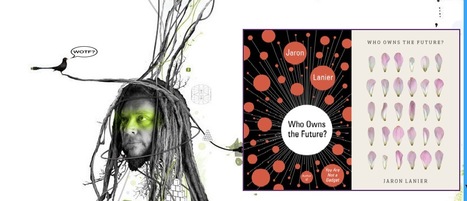
A cyberspace Renaissance man reveals his current thoughts on the World
Wide Web, virtual reality, and other silicon dreams Jaron Lanier is probably best known as a pioneer of Virtual Reality technology but is probably best described as a modern Renaissance man--an eclectic mix of computer programmer, inventor, musician, artist and futurist. He divides his time between California and New York (where he has positions as a visiting scholar at Columbia University and as a visiting artist at New York University), but he can always be found in cyberspace. Scientific American editor Corey S. Powell caught up with Jaron Lanier in the summer of 1996, to hear some of his current thoughts on the World Wide Web, synthetic worlds and other silicon dreams. ....
|
|
Scooped by
Jacques Urbanska
June 18, 2013 4:49 PM
|
Murmur Study is an installation that examines the rise of micro-messaging technologies such as Twitter and Facebook’s status update. One might describe these messages as a kind of digital small talk. But unlike water-cooler conversations, these fleeting thoughts are accumulated, archived and digitally-indexed by corporations. While the future of these archives remains to be seen, the sheer volume of publicly accessible personal — often emotional — expression should give us pause. This installation consists of 30 thermal printers that continuously monitor Twitter for new messages containing variations on common emotional utterances. Messages containing hundreds of variations on words such as argh, meh, grrrr, oooo, ewww, and hmph, are printed as an endless waterfall of text accumulating in tangled piles below. ...
|
|
Scooped by
Jacques Urbanska
June 18, 2013 4:42 PM
|
L’atelier Design Metadata 2013 a permis aux étudiants de travailler sur la notion de mashup et de remix comme des vecteurs d’appropriation et d’écritures nouvelles. Appliqué au texte, au son, à l’image ou à la vidéo, le mashup ouvre des horizons d’explorations, que ce soit dans le design de ses interfaces comme dans ses usages, à la croisée de nouvelles dynamiques sociales et de scénarios.
Le mashup peut être considéré comme une nouvelle forme d’éditorialisation, s’inscrivant dans la continuité des recherches de l’Iri sur l’indexation, la navigation et les dispositifs de contribution. Le mashup est donc un axe de recherche important que l’Iri explore à travers la vidéo, l’image, mais aussi des outils d’agrégations. ...
|
|
Scooped by
Jacques Urbanska
June 18, 2013 4:28 PM
|
Installation view at opening of Software exhibition at the Jewish Museum in New York, 1970. Image from exhibition catalog. Scholar Kathryn Farley, in a 2007 essay published by the Langlois Foundation, described Sonia Sheridan's contribution to Jack Burnham's Software exhibition in detail: In 1969, art historian and media theorist Dr. Jack Burnham approached Professor Sheridan about participating in an exhibition he was organizing at the Jewish Museum in New York for the following year. The exhibition, titled “Software,” exposed the public to a wide variety of perspectives concerning the functional applications of information processing systems....
|
|
Scooped by
Jacques Urbanska
June 18, 2013 4:12 PM
|
When the Whitney Museum of American Art decided to resurrect an early interactive Internet piece, the programming code no longer worked. But would updated software change the artwork? Paintings fade; sculptures chip. Art restorers have long known how to repair those material flaws, so the experience of looking at a Vermeer or a Rodin remains basically unchanged over time. But when creativity is computerized, the art isn’t so easy to fix. For instance, when a Web-based work becomes technologically obsolete, does updated software simply restore it? Or is the piece fundamentally changed? That was the conundrum facing the Whitney Museum of American Art, which in 1995 became one of the first institutions to acquire an Internet-made artwork. ...
|
|
Scooped by
Jacques Urbanska
June 18, 2013 3:54 PM
|
|
|
Scooped by
Jacques Urbanska
June 17, 2013 5:46 PM
|
Soucieuse de démocratiser les nouvelles formes d’art numérique, la Région accompagne les projets des lieux de diffusion (programmation, production, édition, médiation) ainsi que les manifestations et les projets des associations et des réseaux.
|
|
Scooped by
Jacques Urbanska
June 17, 2013 3:15 PM
|
Le Centre d’art de la Maison populaire, lieu d’expérimentation et de recherche, lance un appel à candidature dans le cadre d’une résidence artistique pour la production d’une œuvre numérique rentrant en résonance avec l’hypothèse de travail développée par Marie Frampier, commissaire en résidence au centre d’art en 2014 et ayant pour titre « Véritables préludes flasques (pour un chien) ». Le projet « Véritables préludes flasques (pour un chien) » est établi selon un schéma évolutif et narratif divisé en quatre temps. Il questionne l’absurde et son impossible définition mais aussi la théorie du catastrophisme éclairé et les changements de perception qu’elle peut engendrer. Le quatrième volet est une exposition collective concentrée sur le catastrophisme éclairé et sur les voyages à travers le temps que celui-ci est susceptible de permettre, influençant le futur en revisitant le passé et repensant le présent au regard du futur. Le temps est non pas chronologique mais circulaire, la réalité est possibilisée rétroactivement. La catastrophe est inenvisageable, une fois passée elle semblait inévitable. L’œuvre multimédia sera intégrée dans la programmation du dernier volet de l’exposition à l’automne 2014. ...
|
|
Scooped by
Jacques Urbanska
June 17, 2013 2:58 PM
|
We are pleased to announce the launch of VIDA 15.0, an edition featuring several novelties. For example, this year we have introduced the Telefónica I+D Incentive award. The winner of this new prize will receive assistance from a Telefónica team of experts in research, development and innovation and will be invited to the Telefónica I+D Research Centre in Barcelona. Moreover, in this year’s edition the general public will also be able to participate via our website with the People’s Choice Award. One of the honorary mentions will go to the project that receives the most votes after the jury makes its preliminary selection. The voting process will be open to all online users. First Prize: 18,000 euros (*), Second Prize: 14.000 euros (*), Third Prize: 8,000 euros deadline 31th July 2013 VIDA, the International Art and Artificial Life Awards, launched in 1999 by Fundación Telefónica, was founded to promote creation in this unique field through a recognition of the pioneering work of the artists. Over these fourteen years, VIDA has become one of the most prestigious awards in the art world, and the only one in the world dedicated to the study of life. With each new event, the awards have seen great progress made in the work to promote and stimulate an environment in which art, science and technology converge.
|
|
Scooped by
Jacques Urbanska
June 17, 2013 2:41 PM
|
Pictanovo accompagne les créateurs qui veulent expérimenter des concepts et des genres qui bousculent les idées reçues dans le monde de la production d'œuvres audiovisuelles et artistiques, le jeu vidéo et la médiation culturelle. Avec le soutien de ses financeurs, le Fonds « Expériences Interactives » investit presque 1,5 millions d'Euros pour l'année 2013, dans des projets artistiques innovants sur trois thématiques « Serious Game », « Audiovisuel et Transmedia » et « Installations Artistiques et Médiation Culturelle ». Il met en place deux sessions de sélection (en mai et octobre) sur chaque thématique. Par ailleurs nos équipes vous aideront à monter votre dossier en vous apportant des expertises et en vous mettant en relation avec les partenaires académiques, techniques, économiques ou d'expérimentation pertinents. Dès que vous avez écrit une première trame de votre projet, Venez nous rencontrer !
|
|
Scooped by
Jacques Urbanska
June 17, 2013 1:44 PM
|
Un fascinant voyage dans le futur avec le designer Philippe Starck, à la rencontre de visionnaires qui inventent le monde de demain. Une expérience de télévision augmentée en simultané sur le Web, les tablettes et les smartphones. "Il y a 4 millions d'années, nous ressemblions à une amibe". Si l'homme a, depuis, physiquement évolué, qu'en est-il de ses avancées techniques et en quoi celles-ci modèlent déjà le monde de demain ? C'est la question à laquelle Philippe Starck s'est proposé de répondre, s'entourant de chercheurs et experts afin de nourrir sa réflexion. Décryptage du génome, transhumanisme, sortie de l'économie du carbone : le designer et visionnaire nous invite à un captivant voyage dans notre propre futur.
|
|
|
Scooped by
Jacques Urbanska
June 20, 2013 3:53 PM
|
Unmanned mobile devices, better known as drones, are one of the most significant ‘dark technologies’ of the 2010’s, and proceeds to reconfigure sociopolitical relations through the gesture of the remote gaze. Note that I say ‘mobile’, as opposed to ‘aerial’, as drones encompass unmanned land and water-based craft as well, but for our purposes, the flying eye has been the most visible technology in Baudrillard’s mediascape in terms of its use by the CIA in the Afghanistan/Pakistan and African theatres of operation. To compound matters, the 2012 FAA Reauthorization Act has created a milieu in which estimates are that there could be 10,000 domestic drones in use by 2020 (Bennett & Rubin). Drones are going to be one of the US’s major technology growth markets, with the devices being used in geographic, aerospace, and environmental research as well as military and law enforcement uses. ...
|
|
Scooped by
Jacques Urbanska
June 20, 2013 2:57 PM
|
Why is software so hard? Hard to make well. Hard to deliver on time. Hard to use. Our civilization runs on software. Yet the art of creating it continues to be a dark mystery, even to the experts, and the greater our ambitions, the more spectacularly we seem to fail. Dreaming in Code: Two Dozen Programmers, Three Years, 4,732 Bugs, and One Quest for Transcendent Software sets out to understand why, through the story of one software project -- Mitch Kapor's Chandler, an ambitious, open-source effort to rethink the world of e-mail and scheduling.
|
|
Scooped by
Jacques Urbanska
June 20, 2013 2:47 PM
|
Programmé au théâtre de La Criée le 22 juin, à Marseille, “Superposition”, le nouveau spectacle de Ryoji Ikeda est une expérience métaphysique, une déflagration d’images et de son calculée au hertz et au pixel près, une partition quantique pour 22 écrans et deux performers sur scène...
|
|
Scooped by
Jacques Urbanska
June 18, 2013 4:44 PM
|
as two-thirds of the world’s population does not yet have internet access, google's 'project loon' - a network of balloons traveling on the edge of space - is designed to connect people in rural and remote areas, helping fill coverage gaps, and bringing people back online after natural disasters. floating high in the stratosphere - twice as high as airplanes and the weather - the 'project loon balloons' are carried around the earth by winds and they can be steered by rising or descending to an altitude with winds moving in the desired direction. people connect to the network using a special internet antenna attached to their building. the signal bounces from balloon to balloon, which then provides a connection back down on earth.
|
|
Scooped by
Jacques Urbanska
June 18, 2013 4:35 PM
|
A serie of posts on the queer history of computing, as traced through the lives of five foundational figures. It is both an attempt to make visible those parts of a history that are often neglected, erased, or forgotten, and an effort to question the assumption that the technical and the sexual are so easily divided. There are many ways of telling the history of universal computation, and many origins of the technologies we now consider computational machines. A longer history might begin with Gottfried Leibnitz and Isaac Newton's simultaneous development of modern calculus and the dream of a universal artificial mathematical language. Alternately, we might look to the history of calculating machines, beginning with Charles Babbage's Difference Engine or Herman Hollerith's Electric Sorting and Tabulating Machine. Most every history would certainly include the contributions of Alan Turing, an English mathematician who is considered by many to be the father of computer science. In his relatively short career Turing formalized such concepts as "algorithm" and "computation," he helped crack the Nazi Enigma Machine during the Second World War, was a pioneer in the field of artificial intelligence, and developed early research on such concepts as neural nets, morphogenesis, and mathematical biology.
...
|
|
Scooped by
Jacques Urbanska
June 18, 2013 4:21 PM
|
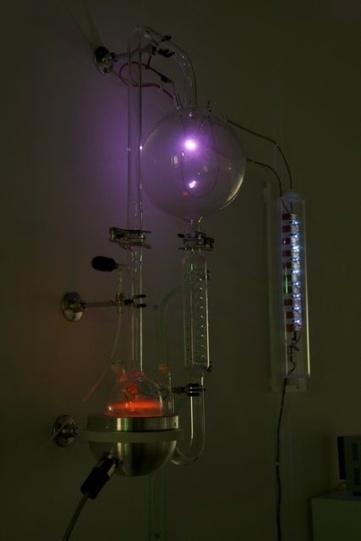
Adam Brown is a conceptual artist working with scientists to create art pieces that use robotics, molecular chemistry, living systems and emerging technologies. Years ago, i saw one of his works at Emoção Art.ficial [Art.ficial Emotion], a Biennial of Art and Technology in Sao Paulo. The robotic sculpture, called Bion, explored the relationship between humans and artificial life. Fast forward to May 2013 when i am aimlessly clicking around and stumble upon one of his most recent pieces. This time, the project doesn't use swarms of responsive synthetic "life-form" but bacteria that, over a period of one week, process the toxins of gold chloride and produce nuggets of 24-karat gold.
|
|
Scooped by
Jacques Urbanska
June 18, 2013 3:58 PM
|
We wanted to design a 3D printing device that could be used within minutes, without needing any technical knowledge, software or computers. We also wanted it to be affordable as well as fun, so that anyone could 3Doodle!
|
|
Scooped by
Jacques Urbanska
June 18, 2013 3:43 PM
|
Project 1: Improving Stereo LocalisationProject 2: The Head-mounted TurntableProject 3: A Belt from the HTProject 4: The Ultimate TweeterProject 5: The 1812 AdaptorProject 6: The Audio PoliceProject 7: The "Jericho" 12-way Sub-WooferProject 8: The Oxygen-Free Listening RoomProject 9: Minimal Surface-Area ClothingProject 10: The Wall of SoundProject 11: The Laocoon LoudspeakerProject 12: Amplifier Debugging NEW!
|
|
Scooped by
Jacques Urbanska
June 17, 2013 4:49 PM
|
On y a tous été exposés sans exception dans notre vie de geek. En effet, le « .Gif » (Graphic Interchange Format, prononcer « djif ») est un format qui permet de publier des images animées sur Internet. Ainsi, rien qu’en vous promenant sur votre site de shopping préféré, les pubs qui vous harcèlent en sont un exemple. Je vous propose ici 6 points qui vont tenter de résumer les 25 ans de vie de ce format en regain de hype, et qui inspire encore beaucoup d’artistes aujourd’hui. Preuve en est, le verbe « to Gif » était le mot de l’année 2012 élu par l’Oxford University Press, rien que ça...
|
|
Scooped by
Jacques Urbanska
June 17, 2013 3:06 PM
|
The New Media Art and Video Festival TRANSITIO_MX is one of the most important stages for expression and analysis of contemporary artistic practices by technology and digital culture in Mexico. The event's main objective is to support, recognize and disseminate current research and production around artistic media technology, through an exposition, a contest, a symposium and workshops, the first edition was held in 2005, since then every festival has had a specific theme, in 2013 the festival will address the issue of Biomediaciones.
The National Council of Culture and Arts (CONACULTA), through the Media Center of National Center for Culture and Arts (CENART), opens call... The online registration system will be available from the publication of this announcement and until July 5, 2013 at 17:00 hrs. (Mexico's Time)
|
|
Scooped by
Jacques Urbanska
June 17, 2013 2:48 PM
|
Deadline For Submissions: Monday 12 August 2013 Exhibition: 25 October 2013 – 19 January 2014
aspex seeks emerging artists working in all media for its open submission exhibition EMERGENCY6. A maximum of 12 artists will be selected for a group show, which will open in October this year. During this exhibition a winner will be chosen to receive the prize of a solo exhibition at aspex in 2015, including a £1000 fee and up to £1000 production budget. The biennial open submission exhibition EMERGENCY is an essential part of the organisation’s programme, providing emerging artists with an opportunity to bring their work to wider attention. Previous winners have been Charlie Tweed 2012, Kihlberg & Henry 2010, Cathy Ward & Eric Wright 2008, Tim Machin 2006 and Susan Collis 2004. This year’s selectors are: S. Mark Gubb, artist; Simon Morrissey, Director, WORKS | PROJECTS; Donna Lynas, Director, Wysing Arts Centre and Joanne Bushnell, Director, aspex.
|
|
Scooped by
Jacques Urbanska
June 17, 2013 1:50 PM
|
Le samedi 20 avril 2013, nous avons reçu une cinquantaine de personnes à l'occasion du Premier HFDAY . De quoi faire une étincelle de plus en France au sujet de l'Open-Source Hardware (Matériel Libre). Un grand Merci à tous ceux qui sont venu ou ont soutenu la journée en relayant l'information. tTh, Philippe, Léon (le cyborg), EricDuino (merci pour les photos ci-dessous d'ailleurs), Seb pour la RepRap blanche, Mix'Art-Myrys pour l'espace et le soutien moral.
|