Media Arts Watch Lab - www.arts-numeriques.info - laboratoire de veille Arts Numériques - twitter @arts_numeriques - @processing_org - @DigitalArt_be - by @jacquesurbanska @_Transcultures
C’est une Toulousaine, un Rennais, un Caennais et une Grenobloise qui sont dans un bar…
Cela aurait pu être le début d’une bonne blague, mais il s’agit en fait de la journée de travail du groupe Communautés d’Inmédiats qui s’est déroulée le 13 juin dernier à Paris. L’occasion de faire le point, d’avancer sur nos projets communs, de partager nos expériences… et de discuter tous ensemble autour d’un café autrement que par écrans interposés !
Une date loin d’être choisie au hasard car il s’agit de la journée de lancement de Futur en Seine, le festival du numérique. Puisque nous avons bien travaillé, eu le temps d’échanger quelques potins et de refaire le monde, nous avons bien mérité une petite visite du Centquatre et son « village des innovations », lieu incontournable de Futur en Seine paraît-il…
Dans une société où la technologie prend toujours plus de place, où nous nous déplaçons hyper-connectés, le nez sur nos écrans, Pablo Sánchez Chillón met en garde contre la fuite de la ville physique et les comportements de "zombies numériques". Il faut selon lui créer une nouvelle sociabilité numérique, portée par des "digizens".
Through this popular annual loan program, administered by the List Visual Arts Center, individual students and student groups may borrow original works of art from the collection for their private rooms and communal spaces.The collection is comprised of the Catherine N. Stratton Collection of Graphic Arts, established in 1966, the List Student Loan Collection, established in 1977, and the Ronald A. Kurtz Student Loan Collection, established in 1985.
Protopitch is the ultimate competition for innovative projects in the creative industry in Flanders, Wallonia and Nord-Pas-de-Calais. Submit a project before 27 June on one of the following subjects: video games, serious gaming, audiovisual media, transmedia, artistic installations, cultural mediation or interactive design and be in with a chance of the first prize, an international press campaign. You will also come into contact with an extensive network of players in the national and international ICT market, potential investors and knowledge establishments.
Since 1998, C. J. Yeh has been exploring the area of new media art which he has integrated into his more traditional areas of study and expression. The juxtaposition and integration of digital and analog, virtual and actual, natural and cultural, articulates his point of view on the changing perception of identity and reality in the digital era. Yeh's exhibition schedule includes showings at the Queens Museum, the Herbert F. Johnson Museum of Art, the Kennedy Museum of Art, and the National Taiwan Museum of Fine Arts. His work has been introduced and reviewed by publications such as The New York Times, NY Arts, World Journal, and Art China.
C. J. Yeh's research interests include practices, theories, and the history of digital art. Since 1999, Yeh's essays on art and technology have been featured in Art and Collection Magazine, ArtNow Magazine, Art Today Magazine, and Artists Magazine, amongst others. He has also written research articles for The Taipei Museum of Contemporary Art, Taipei Fine Arts Museum, and the National Taiwan Museum of Fine Arts. His first book, Art in The Digital Age, was published in 2003 by Art and Collection, the publishing house of Taiwan. His new book, Digital Aesthetic, was released in May, 2008.
Harmonic Plants est un projet explorant le fonctionnement d'un rhizome constitué d'unités basiques, le tout fonctionnant comme un organisme primaire, de type plante.
La première phase du projet prend la forme d'une installation interactive.
A propos de l'installation
Au lancement, il y a une “graine”, c'est-à-dire une entité riche en nourriture capable de produire un petit nombre de noeuds et de les nourrir le temps qu'ils soient arrivés à maturité.
Chaque noeud tente ensuite de synchroniser son cycle de consommation et de production pour maximiser la quantité de nourriture émise et produite. Il le fait en diminuant ou en accélérant son cycle, sachant qu'un rythme rapide demande un gros débit pour pouvoir absorber une grande quantité de nourriture.
Quand un noeud est particulièrement bien rempli, il génére un nouveau noeud.
Cet univers clos peut être perturbé par le spectateur.
En bougeant la main droite, il va créer des remous (apparentés à du vent), favorisant ou défavorisant l'évolution de l'organisme qui lui est présenté.
Avec la main gauche, il choisit l'angle de vue qui lui permet la meilleure compréhension.
Dans le cadre de La quinzaine numérique de la Fédération Wallonie-Bruxelles (21 septembre > 06 octobre 2013), Transcultures organise, en partenariat avec la Commune de Saint-Gilles (Bruxelles), Les Transnomades 2013 (arts en réseaux), un événement spécialement dédié au Net Art, dans sa diversité innovante. A cette occasion, Transcultures avec ses partenaires est heureux de créer une série de nouveau prix, « Mobile » -une première en Belgique- destinés à soutenir des oeuvres en réseau(x) (performances, installations interactives, génératives, projections…) et des créateurs qui se servent d'Internet pour créer de nouvelles formes artistiques connectées.
Ces Transnomades 2013 seront également l'occasion de lancer la version belge du Super Art Modern Museum (spamm.fr) et que vous pourrez retrouver à l'adresse spamm.be.
Lancement des appels à projet : 24 juin 2013Fin de l'appel : 01 septembre 2013les Transnomades 2013 se tiendront pendant la Quinzaine Numérique du 04 au 06 octobre. Des infos sur l'événement vous seront communiquées très bientôt
Plus d'infos sur cet appel le site de Transcultures
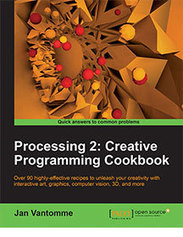
When I started writing my book in December 2011, Processing 2 was still in its alpha stage. I had the plan to write about a lot of new features, but eventually left them out of the book because they weren’t implemented, or ready for prime time. But now that Processing 2.0 is out of beta, it’s time to write about the things that didn’t make the book.
Here’s what you can expect: I’ll move through the book from beginning to end, and post the missing parts on a regular basis right here. We’ll start with some basic 2D drawing, and move on to 3D, working with data, using shaders…
The source code for this series of tutorials will be available on GitHub.
They perform in the world's largest wind tunnel – and their music is going into space. Oliver Wainwright meets the 'experience designer' behind Nasa's new orchestra
As a student, she built a volcano in her living room, made dark matter in her kitchen sink, and built a chair that simulates the three stages of the Soyuz rocket launch. So for designer Nelly Ben-Hayoun, the next logical step was to get inside Nasa. "It was completely impossible," she beams. "So I had to do it. When I want to do a project, I imagine myself sitting in someone's office, badgering them until they say yes. And then it happens...
Junk Jet is a zine-jet, a collaborative format set up to discuss speculative works on topics of art, architecture and media.
n°6 °.° with local contributions by 0100101110101101.ORG, Adam Cruces, Agathe Andre, Aids-3d, Alberto Bustamante, Alejandro Crawford, Aline Otte, Andreas Angelidakis, Angela Genusa, Angelo Plessas, Aude Debout, Aureliano Segundo, Asli Serbest, Blinking Girls, Caspar Stracke, Clement Valla, Cornelia und Holger Lund, Dragan Espenschied, Emilio Gomariz, ET AL., ETC., Francesca Gavin, Golgotha, Hugo Scibetta, Jennifer Chan, JODI, Jon Rafman, Julien Lacroix, Kim Asendorf, Laimonas Zakas, Louis Doulas, m-a-u-s-e-r, Metahaven, Neil McGuire, Mona Mahall, Nicholas O'Brien, Nilgün Serbest, Olia Lialina, Patrick Cruz, Superpool, Tomas Klassnik
Porter plainte contre Obama, la NSA le FBI ou bien encore Google et Facebook, ça vous tente?
Le service de renseignement américain est accusé d'avoir écouté le monde entier, via les sites que nous consultons tous les jours! Mais autant vous prévenir, défendre nos droits en portant l'affaire devant les tribunaux ne va pas être simple.
Porter plainte contre Obama, la NSA le FBI ou bien encore Google et Facebook, ça vous tente? A la suite des révélations portant sur Prism, cet outil de surveillance massive du Réseau qui permettrait aux services de renseignements américains de consulter les données que le monde entier dépose dans les serveurs des géants du Net, certains n'ont pas hésité à se lancer dans le combat. Des plaignants réunis en majorité au sein d'associations américaines de défense des droits, qui cherchent avant tout à défendre les intérêts de leurs compatriotes. ...
How do we benefit from machines that appeal to our emotional perception? Where are the limits of this perception? How discrete can we design machine-made feedback so it is still being noticed? And how can we create such expressions through deformation and re-shaping?
Those are some leading questions that we dealt with at the two-week project called »TalkToMe« initiated by Professor Andreas Muxel at the Köln International School of Design, Cologne, Germany.
Vera Hausmann, Till Maria Jürgens and Vitus Schuhwerk decided to concentrate on the problem of »excessive demands« and set their focus to a flat surface.
This square surface, consisting of a thin metal coated foil, is transformed with invisible string connected to servo-motors and an arduino board, which senses, if somebody comes close. Through squeezing and releasing, the flat motion turns into a spatial transformation and comes closer to the user. This resulting surface dynamically generates new surprising patterns. The intensity of expression is determined by the user’s interaction.
The digitally reconfigurable surface is a pin bed mechanism for directly forming physical three dimensional contoured surfaces from a computer aided design (CAD) file. Using a novel clutching mechanism (detailed below), a dense 2D array of pins is actuated in parallel to the desired geometry. As is typical with these kinds of tools, a smoothing, interpolation layer (usually a piece of rubber) can then be vacuumed onto the tops of the pins to smooth the surface and make it non-porous.
Terminal Projekt was a three day event of electronic music and visual arts, taking place at Sydney's Overseas Passenger Terminal.
As part of the Vivid Sydney Festival 2013 the Sydney Overseas Passenger Terminal, a venue which looks out over the Sydney Opera House, was given a makeover. A large geodesic dome structure was installed and a big party was had as part of Terminal Projekt from Intel, ASUS, and Finely Tuned, which brought together the perfect bedfellows of electronic music and visual arts. ...
1-Je viens d'apprendre l'existence de The Eternal Internet Brotherhood, via un petit billet fort intéressant du net artiste (ou neen artiste) pour les intimes Angelo Plessas! Il s'agit d'une sorte de camp de vacances pour les commissaires, artistes et auteures s'intéressant à la cyberculture. Cet événement que j'ai envie de qualifier d'ésotérique (j'aurais aimé y être, évidemment!) a eu lieu sur une île grecque cette semaine.
2-Un billet paru sur le blog du site Rhizome.org présente une série d'images sur le thème du graffiti numérique. J'aime beaucoup la manière dont les artistes présentés s'approprient l'espace public en y injectant une esthétique numérique. Lorsque j'ai enseigné un cours sur le net art et la cyberculture, il y a quelques années, j'avais justement introduit le sujet avec le graffiti. Il y a définitivement un lien profond entre la pratique du graffiti, la culture remix et la manière dont certains net artistes s'approprient le Web.
José Carlos Casado is a multimedia artist from Spain. A MFA graduate of the School of Visual Arts, he has been based in New York for 15 years.
He uses technologies to create art involving video, 3D animation, photography and sculpture. His work has been shown in multiple solo and group shows internationally and has won numerous prizes and recognitions, including a grant from Picasso Foundation, a scholarship from LaCaixa Foundation, MIT's Leonardo Excellence Award, and two New York Foundation for the Arts Fellowships.
He has participated in more than 20 international New Media Festivals, including Sundance and ArsElectronica. He has been an art resident at the Vermont Studio Center, School of Visual Arts, Anderson Ranch Residency, and Swatch Art Peace Hotel Residency in Shanghai. He performed Aliens With Extraordinary Abilities, a 16-minute performance with video and dancers at the 1st Spanish Art Fest in NYC's Times Square.
Arnaud Eeckhout, artiste sonore et plasticien également musicien, il développe une pratique mêlant installations, performances et vidéos interrogeant les rapports entre le son, l’image et l’espace. Ses travaux croisent adroitement une immédiateté don’t l’humour n’est jamais absent, à une poésie subtile. Des oeuvres qui offrent un temps de dégustation malgré une simplicité apparente.
The numediart board has just published the Quarterly Progress Scientific Report (QPSR) for the fifteenth session of projects, from June to September 2012 (PDF). This report covers the following projects:
#19.1 CityGate (2/2): a multimodal cooperative intercity window#19.2 Laugh Machine#19.3 Human motion recognition based on videos#19.4 Is this guitar talking or what!?
Motion Capture Lab makes a return to Lighthouse this July, presenting an exciting opportunity for filmmakers and film professionals to learn about motion capture, and explore the creative possibilities this technology offers.
Working with Centroid, a leading motion capture and character animation studio, the Lab will provide high-quality craft and technical training, as well as valuable contacts and networking opportunities.
The experimental summer exhibition at the DAM Gallery in Berlin goes into its second round: Summer Splash 2 gives another overview of the different artistic applications for digital media. The works on display explore the possibilities and limits of digital imaging procedures.
Along with the visual motion studies provided by the GIF animations of Evan Roth, there are several interactive works, for example by Sommerer & Mignonneau, in which a “magic lantern” from the 1920s is used. UBERMORGEN.COM create a book made up of comments on YouTube that is on offer at Amazon. Finally, Constant Dullaart presents “The Death of the URL” in his deconstructive Web work. ...
pulse.. is a live-visualization of recent emotional expressions, written on private weblogs hosted at wordpress.com. Weblog entries are compared to a list of emotions, which refers to Robert Plutchik’s seminal book Psychoevolutionary Theory of Emotion published in 1980. Plutchik describes eight basic human emotions in his book: joy, trust, fear, surprise, sadness, disgust, anger, and anticipation. He developed a diagram in which these eight emotions, together with their weakened and amplified counterparts, form a three dimensional cone, consisting of 24 areas. The cone is the basic form of pulse, which can enlarge in the 24 directions of the different emotions. Each time an emotion tag, or a synonym of it, is found in a recent blog entry, the shape-shifting object transforms itself in such a way that the new volume represents a piece of the overall current emotional condition of surfers on the Internet.
The Department of Art and Technology Studies at the School of the Art Institute of Chicago (SAIC) seeks exceptional applications for a full-time, tenure-track faculty member with a commitment to excellence in teaching and to innovative professional practice, beginning in August 2014.
The department seeks artists who work directly with code-based and generative art practices. The ideal candidate will provide leadership in one or more of the department's areas of focus: DIY, open source and community-based art, kinetics, electronics and mechatronics, interactive and responsive art, emerging materials, digital fabrication and bio-art, performance and experimental audio, experimental visualization and object-making, and gaming, augmented reality, social and locative media, networks, and other technology-centered practices. It is important that candidates demonstrate their integration of a skills base with a strong conceptual and historical grasp of contemporary issues in the intersecting worlds of art, science, technology, and new media.
Given its position in an art school with a interdisciplinary focus, the Department of Art and Technology Studies is committed to alternative forms and practices that emphasize innovation with code, software, hardware, and various forms of technology. We recognize that current artistic practices combine media within several modes of exhibition; including but not limited to theaters, galleries, museums, festivals, podcasts, websites, and workshops.
To get content containing either thought or leadership enter:
To get content containing both thought and leadership enter:
To get content containing the expression thought leadership enter:
You can enter several keywords and you can refine them whenever you want. Our suggestion engine uses more signals but entering a few keywords here will rapidly give you great content to curate.


 Your new post is loading...